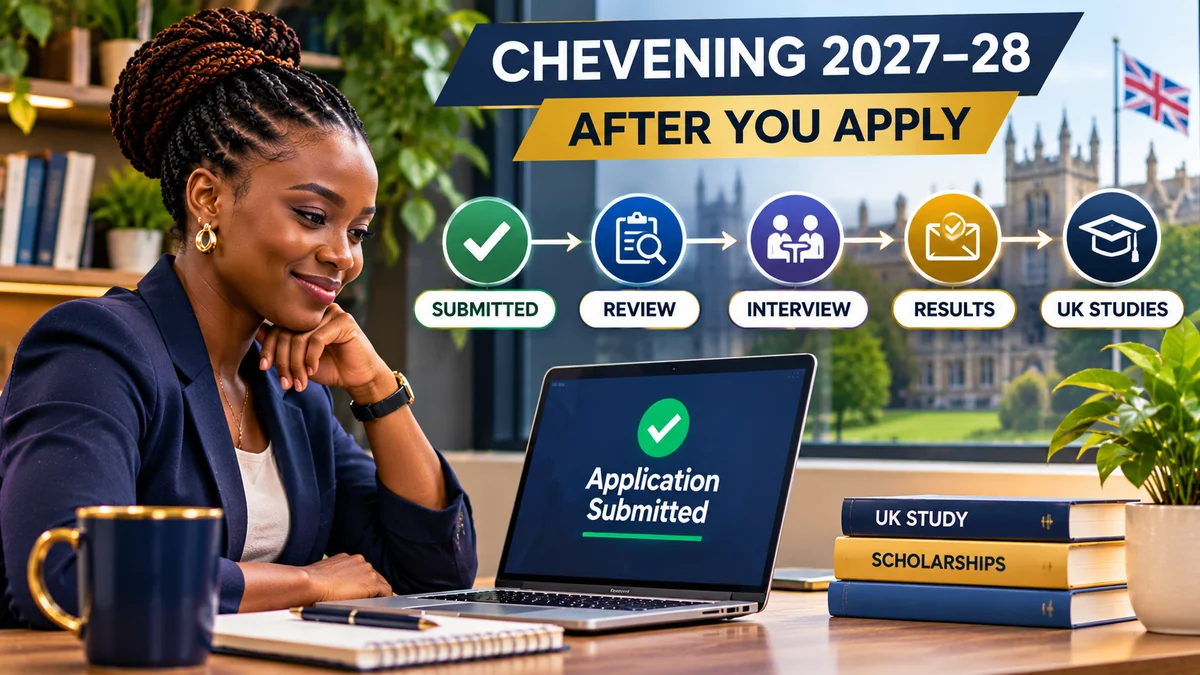
Submitting a Chevening Scholarship 2027–28 application is the beginning of a lengthy selection process, not the final decision. Applications are screened for eligibility and originality, assessed by independent reading committees, shortlisted by British embassies or high commissions, and—if the candidate is invited—followed by a competency-based interview. The official 2027–28 timeline schedules interview invitations for mid-February 2027, interviews for March–April, and outcomes from mid-June 2027.
For Nigerian candidates, the official Chevening Nigeria page confirms that the 2027–28 application period has closed. That does not mean results are ready. As of 2 November 2026, the selection cycle is at the early screening and reading stage. Applicants should use the months ahead to check their submission status, apply separately to UK universities, prepare referees and gather the correct documents without assuming they have been shortlisted.
This practical guide follows every major stage after submission, explains why university admission and scholarship selection are different decisions, and highlights the deadlines that can cost an otherwise successful applicant an award. Information verified on 2 November 2026 using official Chevening guidance. This article concerns Chevening Scholarships, not fellowships, which can follow different schedules.
Chevening 2027–28: the official selection calendar
| Stage | Published timeline | What applicants should do |
|---|---|---|
| Applications close | October 2026 | Keep the confirmation email and unique access code |
| Eligibility screening | From October 2026 | Monitor email; do not assume a silent portal means rejection |
| Reading-committee assessment | Mid-October 2026–January 2027 | Progress UK university applications and contact referees |
| Interview shortlisting | Mid-February 2027 | Watch for an official invitation and book a slot promptly |
| Interview period | March–April 2027 | Upload required documents at least seven working days beforehand |
| Interview decisions | From mid-June 2027 | Read the outcome and any conditional-award tasks |
| University-offer deadline | 8 July 2027, 17:00 BST | Submit at least one qualifying unconditional offer |
| Scholarship year begins | September/October 2027 | Follow final-award, immigration and arrival instructions if selected |
In Nigeria, 17:00 BST on 8 July is 5:00 pm West Africa Time, because the UK is on British Summer Time in July. Mid-month milestones are windows, not an assurance that every applicant receives an email on the same calendar date. Follow Chevening's live timeline and messages from your authorised programme team if information changes.
Stage 1: Confirm that your application was actually submitted
Chevening's online application guidance says a correctly submitted application receives an on-screen confirmation and a confirmation email. Applicants can also log into the application system—ASAMS—to inspect the status displayed at the top. A partially completed form saved as a draft is not equivalent to a submitted application.
Save the submission email in a dedicated folder, check spam or junk folders and keep a secure copy of your eight-character unique access code. You may need that code for later tasks and verification. Do not share it with unofficial agents or social-media groups offering to “check Chevening results” for a fee.
In general, applications cannot be edited after submission. Chevening's guidance on course changes says the three chosen courses cannot simply be replaced in the portal; limited exceptions may be discussed and authorised at interview where circumstances outside the applicant's control affect availability. Do not assume an email asking for an ordinary post-submission essay rewrite is genuine.
Stage 2: Eligibility and originality screening
After the application closes, Chevening screens submissions for plagiarism and eligibility before detailed assessment. According to its official selection explanation , applications are reviewed for compliance with the published rules and then scored by independent reading committees.
For the 2027–28 cycle, Chevening's work-experience guidance requires at least 2,800 hours of qualifying experience acquired over at least two years after completing the undergraduate degree. Other eligibility conditions include citizenship of an eligible country or territory, an appropriate undergraduate qualification and a commitment to return home for at least two years after the scholarship. Applicants are assessed against the cycle's official eligibility requirements .
Chevening also expressly prohibits applicants from using generative AI tools to write their application essay answers. Its application-system guidance warns that plagiarism, fraud or presenting AI-generated essay responses as one's own may lead to disqualification. Preparing independently for an interview is different from submitting invented leadership experience or a machine-written essay as original work.
Passing the basic screening is necessary but not an interview invitation. A candidate who is eligible can still be unsuccessful when independently scored against a competitive pool. Chevening does not publish an applicant-specific probability of shortlisting for individual submissions, so any outsider promising a guaranteed score or selection chance should be treated sceptically.
Stage 3: Reading committees assess leadership, relationships and career impact
From mid-October 2026 to January 2027, eligible applications go through reading-committee review. Chevening's application criteria describe four main areas: evidence of leadership and influence, building professional relationships, a well-researched course choice aligned with real challenges, and a credible career plan with measurable impact.
These are not just tests of polished English. Assessors want examples showing what you personally did, who you influenced, what changed and why a UK master's degree is useful for your intended contribution. A Nigerian applicant who helped improve school attendance, managed a community health initiative or redesigned a small-business process may have relevant material, but it must have been represented truthfully in the original submission.
At this stage, applicants generally cannot add new achievements to the submitted form. Instead, prepare to explain existing examples clearly if shortlisted. Keep relevant dates, roles and outcomes in your own notes for accurate interview discussion. Do not try to influence or directly contact unnamed reading-committee members.
Stage 4: Interview shortlisting in mid-February 2027
After assessments, local British embassies and high commissions review the longlists and invite selected candidates for interview. The official scholarship timeline identifies mid-February 2027 as the expected shortlisting period and March–April 2027 for interviews.
A shortlist invitation means that the candidate has advanced, not that funding has been awarded. If invited, follow the official email link to ASAMS and reserve an available interview slot promptly. The interview guidance says the appointment's location and format are confirmed through the booking process; do not assume every Nigerian applicant will be interviewed at the same venue.
If you have not received an invitation at the beginning of the published window, check your email folders and ASAMS status calmly. Chevening processes applicants across multiple countries; messages do not necessarily arrive simultaneously. Use official contact details when a genuine technical problem or instruction requires it, rather than repeatedly asking the embassy for an early selection decision.
Stage 5: Documents required before the interview
This is one of the most consequential deadlines. Chevening requires candidates invited to interview to upload documentation at least seven working days before their scheduled interview. The published items are:
- Photo identification: a valid passport or permitted national ID, as instructed; bring the original accepted ID to the interview.
- Undergraduate degree certificate or diploma: an official certificate showing the degree and grade; an undergraduate transcript alone is not accepted as the required certificate.
- Two reference letters: the letters must meet Chevening's content and language requirements and be uploaded within the required timeframe.
The references guidance specifies that referees can be professional or academic contacts (or a suitable combination), but should not be relatives or friends. They should explain how they know the applicant, comment on leadership and relationship-building, and include appropriate contact information. Chevening does not collect letters from referees on the applicant's behalf.
If a referee becomes unavailable, Chevening allows alternative referees in certain circumstances, but you must be prepared to explain a change at interview. References should be in English, or accompanied by the required notarised English translation. Missing the required reference deadline can mean the application is no longer considered.
For candidates who need reasonable interview adjustments, the interview guidance asks for contact with the local Chevening team using the invitation contact and relevant advance notice. The safest preparation is to assemble documents early rather than wait for an invitation before contacting busy referees or requesting a replacement degree certificate.
Stage 6: What happens during a Chevening interview?
Chevening describes the interview as a competency-based panel assessment conducted in English, involving representatives of the British embassy or high commission. Questions revisit the written application and explore leadership, influence, relationships, intended impact, selected UK courses and future professional goals.
For example, applicants should be able to explain why a particular course equips them to tackle a clearly identified challenge, what they learned from difficult collaborations, and what they hope to accomplish after returning to their country of award. Prepare real examples with context, your role, actions and outcomes; this is a recommended way to organise genuine experience, not a set of official questions or a guaranteed formula for success.
Research your three selected courses and current admission status. Be ready to explain why your first choice aligns particularly closely with your career plan. If an institution discontinues a course, Chevening says alternative choices may need to be discussed and formally authorised during the interview. Inventing a new university preference without permission can create problems later.
Do not wait for a Chevening interview to apply to UK universities
Chevening selection and admission to a UK university are separate processes. The three course choices on the Chevening form do not automatically generate university applications. You must apply directly to the relevant institutions and meet their individual admissions requirements, which might include academic documents, references, language evidence or subject-specific conditions.
Chevening's course guidance says university applications can take place before or after scholarship submission, but there is a firm requirement to secure at least one qualifying offer from the approved course choices. For the 2027–28 cycle, the official deadline is 8 July 2027, 17:00 BST.
Begin checking each department's admissions calendar now. If the university provides a conditional offer, review exactly which conditions remain and how soon they can be met. Chevening generally requires an unconditional offer, but its current guidance permits one where the only outstanding condition is financial—for example a tuition deposit. Other conditions, such as outstanding academic or language requirements, must be cleared. Chevening does not routinely waive a university's academic rules.
Keep an admissions tracker showing the three approved courses, portal links, deadlines, status, outstanding documents and the university's official contact. Do not pay a non-refundable deposit because someone online claims Chevening has already approved your scholarship. Confirm the financial implications with the university and Chevening before committing money.
Stage 7: Interview results from mid-June 2027
Chevening's post-interview guidance says interview results are communicated by email from mid-June, and candidates may receive notices on different dates. The three broad outcomes after an interview are conditionally selected, reserve or unsuccessful.
| Outcome | What it means | Practical next step |
|---|---|---|
| Conditionally selected | A provisional award subject to completing further requirements | Complete ASAMS tasks and secure the eligible university offer |
| Reserve candidate | On a waiting list; future award is possible but not guaranteed | Continue admissions and monitor messages without assuming funding |
| Unsuccessful | No award from that selection round | Consider feedback from your own preparation and alternative opportunities |
Chevening explains that it cannot provide individual application or interview feedback because of application volume. A reserve candidate may later be upgraded if funding becomes available or another selected candidate withdraws; however, this is not a promise. For scholarships, a reserve candidate must also have a qualifying unconditional university offer to be eligible for an upgrade.
Stage 8: Conditional selection is not the final award
If conditionally selected, candidates receive tasks in the ASAMS portal. The official next-steps guidance includes accepting the conditional award and terms, uploading eligible university offers, providing passport details and completing health or disability disclosures where applicable. Individual deadlines in the outcome email must be followed.
Chevening validates the documentation and course choice before issuing a Final Award Letter (FAL). That final letter confirms the award and provides the basis for the next steps. It is different from a preliminary email saying the candidate is conditionally selected.
The official post-interview instructions state that a scholar should not apply for a UK visa until the Final Award Letter has been received. Follow the Chevening Secretariat's immigration instructions; do not rely on a social-media adviser offering early visa processing or a “guaranteed CAS” service.
The expected UK study start window is September or October 2027, but travel and arrival arrangements depend on the final award, university programme, visa and applicable programme instructions. Avoid making irreversible travel commitments merely because you passed an interview.
What should Nigerian applicants do between November and February?
The months after submission provide time to complete important tasks without attempting to change the scored application:
- Keep evidence of submission. Save the confirmation email, check the ASAMS status and protect the unique access code.
- Progress university admissions. Review deadlines for all three chosen courses and apply directly to the institutions.
- Speak with referees. Confirm that two suitable people are willing and able to supply compliant letters if you are shortlisted.
- Locate the degree certificate. Check that the official award document is available, rather than assuming a transcript alone is enough.
- Review the application. Read the experiences and impact claims you already submitted so you can discuss them accurately.
- Check identity documents. Resolve passport or identification problems early and ensure details are consistent.
- Monitor official communication. Check the registered email and junk folder periodically; beware of impostors and paid “shortlist checks”.
- Prepare without overcommitting funds. Research courses and requirements but avoid non-refundable payments predicated on an award that has not been confirmed.
You do not need a paid intermediary to have your application assessed. Chevening's official guidance says applications are free and warns against third parties charging for application support or promising shortcuts.
Five mistakes after submission that can jeopardise the next stage
1. Treating silence as rejection
The official screening and assessment process lasts months. In early November 2026, a lack of interview communication is entirely consistent with the published calendar. Check official notices rather than assuming a rejected outcome based on rumours.
2. Waiting until February to contact referees
Reference letters are due ahead of a scheduled interview. Asking potential referees to prepare now reduces the risk that a colleague or academic supervisor is unavailable at short notice.
3. Forgetting university admission
A strong scholarship interview cannot replace an eligible UK university offer. Make direct university applications independently and keep the 8 July deadline visible.
4. Trusting invented scores or guaranteed selection claims
No unofficial agency can promise Chevening shortlisting or award approval. Pay no one for purported access to committee results or to alter submitted essays.
5. Mistaking conditional selection for completed funding
Conditional selection means there are outstanding validation tasks. Follow the ASAMS instructions and wait for the Final Award Letter before acting on the visa process.
Frequently asked questions
When will Chevening 2027–28 applicants know whether they have been shortlisted?
The official timetable points to mid-February 2027 for interview invitations. Candidates should rely on their registered email and ASAMS messages; no individual invitation is guaranteed.
Can I update my Chevening essays after submitting?
Generally, no. The submitted application cannot be edited. Limited exceptional course changes may be considered at the interview stage, but this is not permission to rewrite the essays.
Must I have a UK university offer before Chevening shortlists me?
No. You may apply to your chosen universities before or after the Chevening application, but you must obtain a qualifying unconditional offer from an approved course by the stated July 2027 deadline if you advance successfully.
When do I submit my two references?
You nominate two referees in the application. If shortlisted, you must upload the compliant reference letters at least seven working days before your interview, along with the required identification and degree documents.
What happens if I am put on the reserve list?
You remain under possible consideration if a place or funding becomes available, but there is no guarantee of an upgrade. Continue to monitor official notices and the university-offer requirement; do not spend money on the assumption of an award.
Can I use ChatGPT to rewrite my submitted Chevening essays?
Chevening prohibits using generative AI to create application essay answers presented as your original work. After submission you generally cannot edit those answers anyway. Prepare to explain your real achievements in your own words.
When can a successful candidate begin the UK visa process?
Follow Chevening's immigration instructions and wait for the Final Award Letter; conditional selection alone is not the final award confirmation.
Conclusion
The Chevening Scholarship 2027–28 selection journey has clear stages: submission, eligibility screening, independent review, interview shortlisting, interviews, outcome notification, university-offer validation and final award confirmation. The next major public milestone is mid-February 2027, not an immediate decision after the application closes. Nigerian applicants can use the waiting period productively by securing academic documents, coordinating referees and applying to their selected UK courses. Most importantly, distinguish a shortlist invitation, a conditional award and an issued Final Award Letter—each means something different, and the official deadlines still apply.