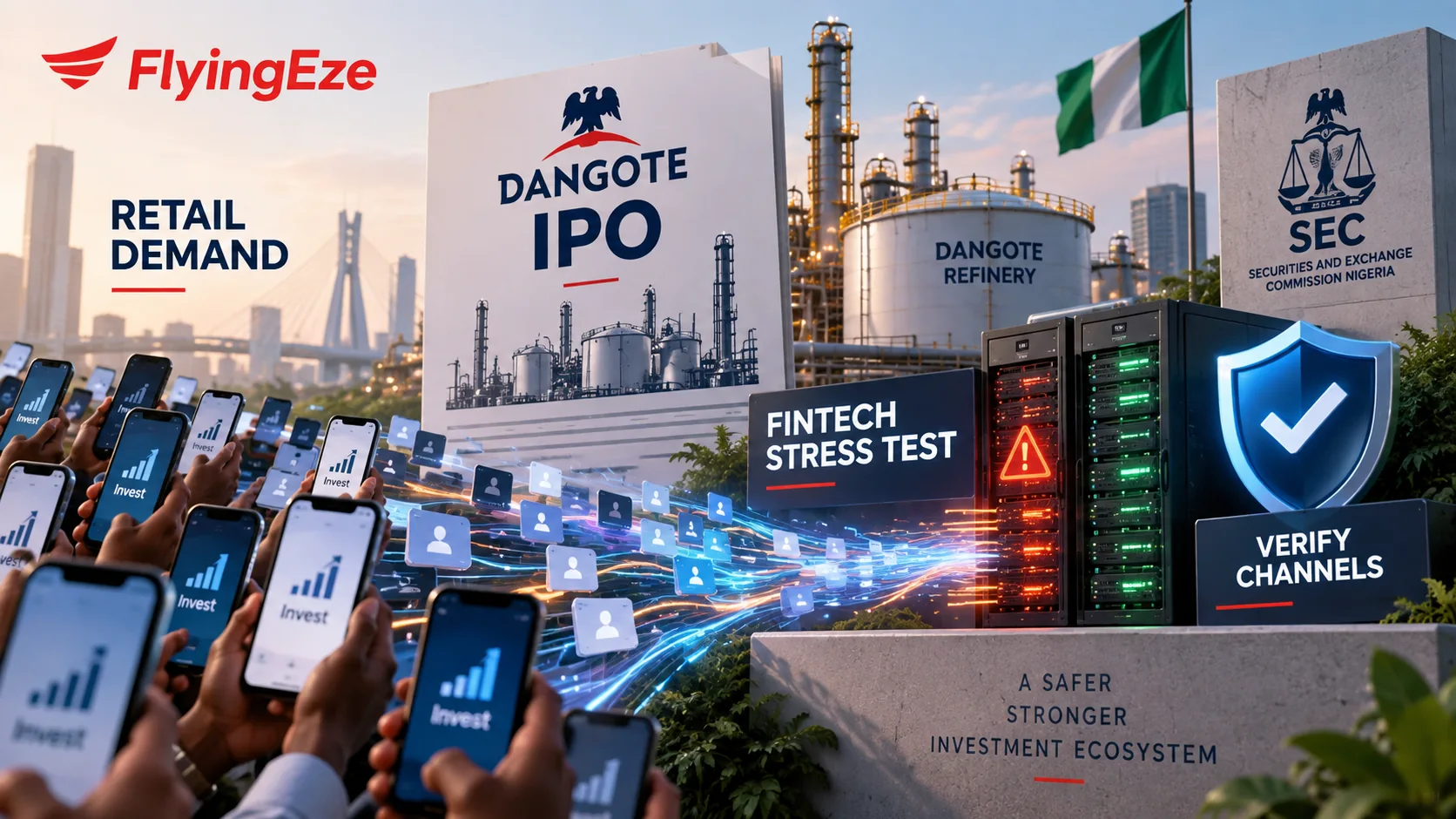
Retail demand for Dangote Petroleum Refinery’s initial public offering has done more than attract first-time investors: it has also exposed capacity pressure across parts of Nigeria’s digital investment infrastructure.
Several investment platforms experienced outages or access problems as users rushed to subscribe to the offer. Reuters reported that Bamboo, Cowrywise and InvestNaija were among platforms affected, while Bamboo said traffic rose to about ten times normal levels within 30 minutes of the IPO opening. The episode offers a practical stress test for the fintech systems increasingly used to connect retail investors with Nigeria’s capital market.
Why the Dangote IPO put investment apps under pressure
The Dangote Petroleum Refinery offer opened on 14 September 2026 after approval by Nigeria’s Securities and Exchange Commission (SEC). The offer has been structured to encourage broad retail participation, including a relatively low minimum subscription of 10 shares.
That accessibility matters. A large public offer can bring a wave of people into digital investing at the same time, including users who may be opening accounts, completing identity checks, funding wallets or bank transfers and submitting orders during a narrow period. Each of those steps can involve several systems rather than a single app.
Reuters reported that the surge affected not only front-end investment applications but also third-party providers. That distinction is important: a fintech can scale its own servers and still encounter bottlenecks if identity services, payment rails, brokerage infrastructure, market connections or other dependencies cannot absorb the same traffic.
A fintech stress test, not simply an app outage
The outages highlight a broader engineering problem for financial technology companies. Normal daily traffic is a poor guide to the load created by a rare, nationally prominent financial event. Capacity planning therefore has to consider extreme but plausible demand rather than averages alone.
For investment platforms, resilience can involve queue management, rate limiting, redundant infrastructure, clear transaction states, idempotent order handling and monitoring of third-party dependencies. The goal is not merely keeping a home screen online. A financial transaction also needs to remain accurate when a user refreshes repeatedly, a payment confirmation arrives late or a downstream provider is temporarily unavailable.
The Dangote episode also shows why graceful degradation matters. When systems are under exceptional pressure, a platform should ideally be able to preserve critical account and transaction functions while reducing less important workloads. Clear status messages can also discourage users from repeatedly submitting the same action because they are unsure whether the first request succeeded.
What retail investors should verify
The rush has created a second issue: fraud risk. Nigeria’s SEC issued a specific notice on the IPO telling prospective investors to obtain information from official sources, verify websites and platforms before providing financial information, and use only designated and approved subscription channels.
The regulator also warned people against sending money to individuals or entities claiming to receive applications outside approved channels. It advised investors to be cautious about unsolicited calls, WhatsApp messages, social-media advertisements and emails promising guaranteed allotments or preferential allocation.
Those precautions are especially relevant when a legitimate platform is temporarily unavailable. An outage can create an opening for impersonators to offer a supposed alternative link or payment route. Urgency should not replace verification.
Prospective investors should read the approved prospectus and understand the terms and risks of the offer before subscribing. This article explains the technology and access issues surrounding the IPO; it is not a recommendation to buy or sell the shares.
What the episode means for Nigeria’s digital capital market
The disruptions should not obscure the underlying signal: large numbers of people are attempting to access a major capital-market transaction digitally. That demonstrates how fintech distribution can widen access beyond traditional brokerage channels.
But wider access changes the reliability standard. An investing application serving occasional trades can become critical financial infrastructure when millions of potential users converge around a major offer. Providers need systems that can withstand sudden spikes while preserving transaction integrity, security and customer communication.
The same lesson applies to banks, payment providers, identity-verification services and other companies connected to the transaction chain. Resilience is an ecosystem property: the user experience is only as reliable as the weakest critical dependency.
What fintech operators can learn
For operators, the practical lesson is to model event-driven demand separately from ordinary growth. Load tests should include account sign-ups, authentication, deposits, identity verification and order submission happening together rather than testing each service in isolation.
Platforms should also map external dependencies and define what happens when each one slows down. Transaction workflows need safeguards against accidental duplicate submissions, while observability systems should show where latency is building before a full outage develops.
Communication is part of resilience too. When users know that an order is pending rather than lost, they are less likely to retry it repeatedly and add more load to an already stressed system.
The bigger opportunity
The Dangote IPO is therefore both a capital-market event and a technology test. If digital investment services can scale reliably during exceptional demand, they can lower practical barriers to participation in future public offers. If they cannot, periods of peak interest may become the moments when new investors have the least confidence in the systems meant to serve them.
The immediate outages reported around the offer were largely stabilised, according to Reuters. The longer-term question is whether platforms and their infrastructure partners use the episode to redesign capacity, dependency management and customer safeguards before the next mass-market investment event arrives.