Historical retrospective: This report reconstructs a dispute that occurred on 13–14 September 2021. It is newly researched for FlyingEze and does not reproduce the missing original article. The original FlyingEze publication timestamp remains unverified.
On Monday, 13 September 2021, Nigeria's Department of Petroleum Resources (DPR) reopened eight petroleum storage depots in the Ijegun-Egba area of Lagos after the Lagos State Physical Planning Permit Authority (LASPPPA) had sealed them over alleged planning-permit deficiencies. The action triggered a dispute between the federal oil regulator and state planning officials about which authorities could license, inspect and shut petroleum facilities.
Ayorinde Cardoso, then DPR's Lagos zonal operations controller, said the shutdown risked interrupting fuel distribution. Lagos State authorities disputed the implication that federal petroleum licences displaced the state's physical-planning requirements. Both accounts are documented in contemporary reporting and in a 14 September 2021 Lagos State government statement .
What happened at the Ijegun-Egba depots?
The confrontation involved petroleum tank farms in Ijegun-Egba, within the Satellite Town area of Lagos. LASPPPA had sealed eight facilities, with lack of required planning permits identified as the reason for enforcement. DPR then directed their reopening on Monday, 13 September 2021.
According to contemporaneous News Agency of Nigeria reporting , Cardoso argued that the petroleum industry was regulated federally and that unilateral closure by a state agency threatened the wider distribution network. Coverage published by The Nation and Punch reported the same reopening and the official's position.
Reopening was an enforcement step by DPR, not a judicial ruling declaring all the facilities compliant with planning laws. The available reports do not independently establish that each of the eight depots possessed every permit required under state law.
Which eight petroleum depots were reopened?
Contemporary accounts identified these companies or facilities among those affected:
- Wosbab Energy Solutions
- Emadeb Energy Services Limited
- Mao Petroleum Limited
- Menj Oil Limited
- Oceanpride Energy Services Limited
- A.A. Rano Nigeria Limited
- AIPEC Oil and Gas Limited
- First Royal Oil Limited
The names were supplied in the DPR account reported at the time. Their appearance in that list should not be interpreted as a finding that any company committed wrongdoing, or as confirmation of the legal status of every facility today.
Why did DPR intervene?
Cardoso said the depots were important to petroleum movements into and out of Lagos. He estimated that the 13 tank farm operators in Ijegun-Egba handled approximately 35–40 per cent of petroleum products arriving in Lagos before redistribution to other parts of Nigeria. This figure was a claim made by the regulator, rather than an independently audited throughput statistic supplied with the reports.
DPR maintained that shutting facilities without coordination could generate product-delivery delays and, potentially, shortages. The official urged LASPPPA to approach the federal petroleum regulator with concerns about its licensees so that the agencies could work towards a resolution.
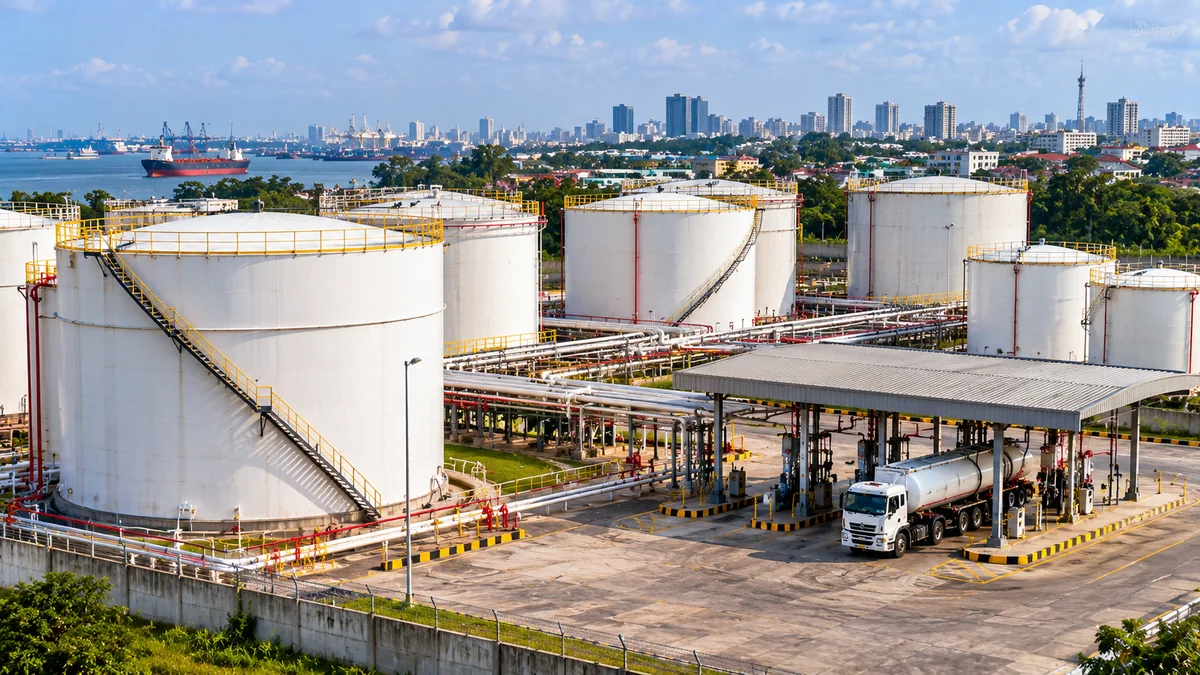
This supply argument matters because tank farms are not petrol stations. They are storage and distribution nodes used to hold bulk volumes of products and feed subsequent transport. A restriction at multiple facilities can affect deliveries elsewhere, although the extent depends on available stock, alternative terminals and logistics capacity. Contemporary reporting documented DPR's concern, not evidence that a nationwide shortage actually occurred because of the September closures.
Why did Lagos State seal the facilities?
From Lagos State's perspective, petroleum licensing and the permission to construct and occupy physical structures were separate regulatory questions. Its officials said planning approvals remained necessary even for oil-and-gas installations licensed by federal regulators.
In the state's official statement dated 14 September 2021 , Commissioner for Physical Planning and Urban Development Idris Salako criticised DPR for unsealing facilities that Lagos authorities regarded as lacking planning approval or completion certification. He insisted that physical development in Lagos required planning permits and urged facility operators to comply with the applicable state processes.
The commissioner also said the state was no longer granting new tank-farm approvals in Ijegun-Egba and preferred new proposals to consider designated locations around Ibeju-Lekki. The state's stated concerns included orderly land use and the relationship between tank farms and nearby residential communities.
Separate reports attributed to a LASPPPA source said the agency had already undertaken a similar enforcement exercise in 2020 and had engaged operators before the September action. As that account was anonymous, it should be presented as the source's statement rather than independently verified proof of the scope of every consultation.
The disagreement over federal and state authority
The centre of the dispute was an important distinction. DPR relied on federal powers relating to petroleum operations and licensing under Nigeria's constitutional and statutory framework. Lagos State asserted its separate responsibility for land-use planning, building permissions and physical development inside the state.
Cardoso invoked the Exclusive Legislative List of the 1999 Constitution and the former Petroleum Act, arguing that petroleum operations fell within federal legislative competence. Lagos State responded that federal petroleum licences did not eliminate planning obligations for facilities erected in Lagos.
Those are the positions taken by the agencies. This reconstruction does not resolve the constitutional dispute, declare either side conclusively correct, or suggest that exclusive federal competence over petroleum automatically decides every question about state building controls. That would require examination of the precise statutory provisions, court authorities and legal facts applicable to the facilities.
The distinction also explains why the controversy was not simply a dispute about fuel supplies. It raised broader questions over how regulators should coordinate when a single operation requires several layers of approval.
Safety and the concerns of host communities
For nearby residents, the debate was not purely legal. Petroleum storage facilities concentrate large quantities of combustible materials, and their siting, separation distances, access roads, emergency preparedness and fire-safety planning can matter greatly to neighbouring communities.
Lagos State's September 2021 statement referred to the interests of host communities and said existing Ijegun-Egba operators were being encouraged to coexist responsibly with residents. It also recorded community concerns about environmental health and requested cooperation between the petroleum regulator, the state and local stakeholders.
These concerns deserve recognition without suggesting that a particular named depot had caused a confirmed incident. No such conclusion follows from the evidence collected for this reconstruction. Environmental or safety noncompliance must be documented separately from the fact that a government body sealed a site.
How the September dispute followed an earlier confrontation
The September episode did not occur in isolation. In late August 2021, DPR had also reopened five filling stations shut by the Lagos State Building Control Agency (LASBCA) in the Ajah and Ibeju-Lekki areas. Those were retail filling stations, not the same eight Ijegun-Egba petroleum depots involved in the September enforcement.
Business Post's August 2021 coverage recorded the earlier controversy and comments from state building-control officials about approvals and construction requirements. Keeping the two incidents distinct avoids confusing LASBCA—the building-control agency involved in August—with LASPPPA, the planning-permit authority involved in the September depot action.
The related incidents illustrate the practical difficulty of coordinating different regulators responsible for different parts of a large and potentially hazardous industry's operations.
What changed after 2021?
One important piece of subsequent context is that the regulatory names and institutional arrangements discussed in the original story changed. Nigeria's Petroleum Industry Act 2021 reorganised national oil-and-gas governance, providing for the Nigerian Upstream Petroleum Regulatory Commission (NUPRC) and the Nigerian Midstream and Downstream Petroleum Regulatory Authority (NMDPRA).
The reform split the former DPR's regulatory responsibilities across new institutions. The NMDPRA became the relevant federal regulator for midstream and downstream petroleum matters, including important parts of the storage and distribution sector. Therefore, an article about DPR's role in September 2021 must be read historically; it should not imply that DPR remains the operating agency under the same institutional structure today.
For related reporting on the later regulator, FlyingEze has covered NMDPRA enforcement involving petroleum retailers and NMDPRA meetings with refiners and marketers . Those later articles concern different events and are linked only to help readers follow the sector's changing regulatory landscape.
What the incident reveals about Nigeria's fuel-supply system
The Ijegun-Egba dispute showed how a regulatory intervention at major depots could immediately raise national fuel-distribution concerns. It also showed why the ability to store and distribute products cannot be considered separately from land-use rules and host-community protection.
An effective compliance framework needs clarity about which licence permits an operator to handle petroleum, which approvals govern its buildings and location, and how agencies should act when a facility is alleged to be operating outside the rules. If several agencies issue inconsistent directions, operators and the public can be left uncertain about their rights and obligations.
That does not mean regulators should refrain from enforcing safety or planning laws. It means enforcement should be lawful, transparent and coordinated wherever overlapping responsibilities exist, without ignoring immediate risks or the continuity of essential supplies.
Did reopening the depots settle the dispute?
No. The reopening on 13 September 2021 is documented; the associated constitutional and permitting arguments remained contested. Lagos State's official statement on 14 September directly challenged DPR's decision and urged compliance with its planning-approval requirements. Later commentary continued to describe friction between the agencies.
Available sources used for this reconstruction do not establish a definitive subsequent court ruling covering all eight facilities, nor do they verify the present planning-permit status of each named operator. It would therefore be misleading to call the episode a final federal victory or a judicial finding that the state lacked all authority over the structures.
Frequently asked questions
When did DPR reopen the depots?
Contemporary News Agency of Nigeria reporting places the reopening on Monday, 13 September 2021.
Where were the depots located?
They were in Ijegun-Egba, in the Satellite Town area of Lagos State, Nigeria.
Why were they sealed?
LASPPPA cited missing physical-planning permits. DPR disputed the state agency's approach and argued for federal regulatory coordination.
Was there a proven national fuel shortage?
The available reports document concern about a possible disruption, not a demonstrated nationwide shortage caused by this particular closure.
Is DPR still the regulator for these depots?
Not in its former institutional form. The 2021 Petroleum Industry Act established the NMDPRA as the national midstream and downstream petroleum regulator.
Conclusion
DPR's reopening of eight petroleum depots in Lagos in September 2021 was more than a short-lived disagreement between regulators. It exposed competing interpretations of federal petroleum licensing and state physical-planning oversight, while drawing attention to supply continuity and the interests of communities located near large tank farms.
The verified historical record supports the reopening, the named facilities, the date and the opposing positions. It does not justify treating the agencies' disputed legal claims as settled law or presenting every facility as fully compliant. Reconstructing the event accurately requires both perspectives—and a clear distinction between what was reported in 2021 and the regulatory system that followed.