Historical retrospective — researched 7 November 2026. This article reconstructs Edo State's September 2021 COVID-19 vaccine shipment using contemporaneous government announcements and independent reporting. The dates, dose figures and official statements belong to 2021; this is not a current vaccine-stock update. The original FlyingEze publication timestamp has not been recovered.
Edo State received an additional 40,012 doses of Moderna COVID-19 vaccine on Thursday, 2 September 2021, as the Nigerian state expanded its second-phase vaccination campaign during the pandemic's third wave. The consignment arrived at Benin Airport from the Federal Government, where it was received by Dr Julie Erhabor, then Executive Secretary of the Edo State Primary Healthcare Development Agency (EDSPHCDA).
The Edo State Government announced the delivery on 3 September 2021 . The report was also published by The Nigerian Observer on 2 September and Voice of Nigeria on 3 September . The state's original announcement exactly matches the topic and slug of the missing FlyingEze article.
The new delivery came shortly after Edo received 65,016 Moderna doses on 20 August. Together, the two documented Moderna consignments amounted to 105,028 doses received. That figure describes delivered vaccine inventory, not the number of injections administered, fully vaccinated residents or people protected from infection.
What happened at Benin Airport in September 2021?
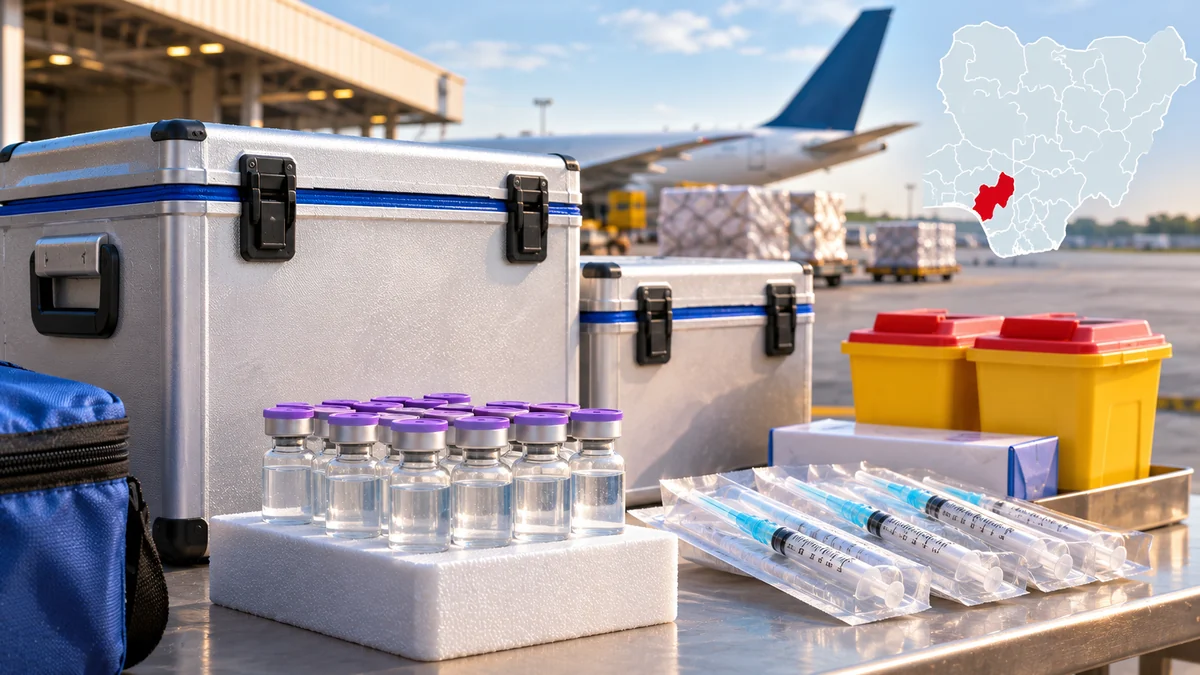
According to the state government's announcement, Dr Erhabor accepted the new Moderna stock on Thursday, 2 September. The shipment included not only vaccine doses but also syringes and safety boxes to support administration and safe disposal of used injection equipment.
These accompanying supplies mattered because vaccine deliveries could not turn into an effective immunisation programme merely by arriving at an airport. Local health teams needed functioning vaccine storage, transport to distribution points, trained vaccinators, registration and records systems, and supplies for safe injection and clinical waste handling.
Erhabor said the state had requested additional vaccine doses because demand was rising and the August consignment was nearly exhausted. She attributed that demand partly to the Edo administration's campaign to encourage broader uptake. Those are the agency's reported explanations; the available reports do not independently audit every dose administered from the first allocation or every reason individual residents sought vaccination.
The image of a government official receiving doses at an airport captured the first stage of a longer delivery chain. Actual patient protection depended on doses reaching eligible recipients, completing the recommended vaccination course and maintaining proper storage and clinical procedures.
How much Moderna vaccine had Edo received?
Two official shipments can be distinguished clearly in the historical records:
| Consignment | Date | Moderna doses received |
|---|---|---|
| First documented August shipment | 20 August 2021 | 65,016 |
| Additional September shipment | 2 September 2021 | 40,012 |
| Combined Moderna receipts | By 2 September | 105,028 |
The earlier delivery also contained 11,696 AstraZeneca doses. In a 23 August 2021 breakdown , Edo State described the August consignment as 76,712 doses in total: 65,016 Moderna plus 11,696 AstraZeneca. The September addition of 40,012 was Moderna only.
It is easy to misunderstand such figures. An allocation, delivery, dose administered and fully vaccinated person are separate quantities. Moderna was being used as a two-dose primary-series vaccine during this period. So 105,028 doses cannot be interpreted as 105,028 completed two-dose courses, even if every delivered vial was eventually used.
Earlier state reporting had referred to an anticipated 65,020 Moderna doses. The later receipt record specified 65,016. The receipt figure is the appropriate one for calculating delivered inventory; the source record does not establish the reason for the four-dose difference, and it would be speculative to invent one.
Why did Edo request additional vaccine stock so quickly?
The government linked its request to growing uptake after the second-phase campaign began. At the time, Edo was facing a third wave of COVID-19 cases, and state officials were urging residents to accept vaccination as a means of reducing the risk of serious illness and pressure on health services.
Governor Godwin Obaseki formally launched Edo's second phase of vaccination on 23 August 2021. In its 24 August statement , the state described efforts to expand uptake and announced planned restrictions on access to large gatherings for people without evidence of at least one vaccination dose.
The policy was controversial. In a 2 September response , Edo officials addressed a court order from Port Harcourt relating to the proposed vaccination restrictions and defended the administration's position. That dispute is separate from the factual delivery of 40,012 doses: a shipment record does not establish the legality of a gathering-access policy, and a government statement is not a final judicial ruling.
The administration also used the language of achieving herd immunity. That was its stated public-health ambition in 2021, not proof that any particular consignment achieved herd immunity. As later variants and evidence developed, the limits of preventing all SARS-CoV-2 transmission became increasingly clear. Vaccines remained important for reducing severe disease, but delivery totals alone could not establish population immunity.
How did the delivery fit Nigeria's national vaccination rollout?
Edo's additional stock was part of a wider federal distribution effort. In early August 2021, Nigeria received approximately four million Moderna vaccine doses donated by the United States through the COVAX mechanism. The World Health Organization's Nigeria office documented this donation as the country prepared to intensify its third-wave response.
The Federal Government launched the second phase of national COVID-19 vaccination in mid-August . The National Primary Health Care Development Agency (NPHCDA), working with states, supported distribution and delivery through public vaccination facilities.
Moderna was one of several vaccines used during that phase. The same period also included deliveries of AstraZeneca doses and a smaller initial consignment of Johnson & Johnson vaccines. These products had different schedules and handling requirements. A state's stock therefore needed to be recorded by vaccine type, not combined indiscriminately into a single count of fully vaccinated residents.
The national campaign involved more than acquiring doses. Officials and international partners discussed storage capacity, transportation, staff training, supply forecasting and public communication. A 19 August WHO report described how the federal agency planned to move further AstraZeneca supplies to states for recipients awaiting second doses.
What did receiving additional doses mean for residents?
For people seeking vaccination in Edo in September 2021, another shipment potentially reduced the risk that local clinics would run short of Moderna stock. The state said it had requested extra vaccine because the first delivery was close to being used up.
However, new stock arriving at Benin Airport did not necessarily mean all clinics had doses available that same day. Officials still had to allocate and transport stock, monitor usable quantities, and organise personnel and appointment or walk-in services. The official reports do not provide a facility-by-facility inventory for 2 September.
The state had earlier said healthcare workers had undergone training for the second-phase campaign. In its August announcement, it referred to distribution planning across Edo's 18 local government areas. The practical aim was to reach communities beyond central Benin City, but the available sources do not demonstrate identical access or coverage rates in each area.
Officials emphasised that vaccination was provided free of charge through the programme. Any reader encountering a historical post promising a September 2021 appointment should recognise it as expired information. Current vaccine eligibility, products, doses and access points must be checked using up-to-date official health advice rather than reused from old reports.
Why were syringes, safety boxes and storage part of the story?
It is common for news headlines to focus on the number of vaccine doses, but administration also depends on basic clinical supplies. Syringes are needed to prepare and deliver injections; safety boxes provide a way to collect and dispose of used needles and other sharps securely. Their inclusion in Edo's reported delivery showed that the shipment was intended to support administration, not merely warehouse stock.
Vaccines also require appropriate temperature control. The necessary storage and transport arrangements depend on the vaccine product and its approved instructions. WHO officials discussing Nigeria's second-phase rollout stressed that Moderna introduced particular cold-chain logistical demands.
Not every dose received is automatically injected. Stock records must account for transfers, opened vials, use, expiration or wastage where relevant. That is why reporting should distinguish government allocations, shipments physically received, doses administered and completed vaccination courses.
For wider context about why dose-accounting systems matter, FlyingEze previously reported the NPHCDA's response to separate allegations of vaccine mismanagement in Lagos . That article concerns a different state and does not suggest any wrongdoing in Edo's September 2021 shipment.
Did the Moderna delivery mean Edo's third wave had ended?
No. In fact, Edo continued to report COVID-19 infections and deaths during September 2021. The delivery was part of an ongoing response to an active outbreak, not a declaration that transmission had stopped.
A state report published on 22 September 2021 said officials had begun administering second Moderna doses across the 18 local government areas the previous day. The report also quoted health officials as saying more than 116,000 people had received vaccinations by then. It separately described new COVID-19 cases and deaths during the third wave.
That later figure concerns the state's wider vaccination campaign at a later reporting point; it is not a direct measurement of how many of the 40,012 additional September Moderna doses were used. It also cannot be assumed to represent fully vaccinated residents without examining the underlying definitions.
Vaccination helps reduce the risk of severe outcomes, but its benefits are measured through careful clinical and population evidence—not by attributing every change in infections to a single shipment. Public-health behaviour, the circulating virus, existing immunity, testing practices and other factors also affected reported trends.
What can the September 2021 episode teach about vaccine reporting?
The Edo delivery illustrates several distinctions that matter whenever governments announce medical-supply milestones. A shipment is an operational achievement, not a clinical outcome. It may enable further vaccination, but additional evidence is needed to establish how widely the stock was distributed and used.
The distinction between Moderna and AstraZeneca also matters. The 76,712-dose August consignment contained both products, whereas the 40,012-dose September addition was Moderna. Mixing these counts without labels could imply more Moderna doses than the state actually reported or incorrectly suggest that vaccines were interchangeable for every patient.
Likewise, a government goal of vaccinating a large proportion of the population was not equivalent to reaching it. Erhabor's remarks were evidence of the administration's intentions and reported demand at the time; they were not an independently audited final evaluation of the campaign.
Finally, a reliable historical report needs chronology. Reporting the September 2021 news as though it happened today would mislead readers about vaccine availability, government leadership and applicable clinical guidance. A retrospective should retain the old dates while clarifying what was known then and what was reported later.
Timeline: Edo's Moderna vaccine supplies in 2021
- Early August 2021: Nigeria receives roughly four million Moderna doses donated by the United States through COVAX, according to WHO reporting.
- Mid-August 2021: The Federal Government begins the second phase of the national vaccination campaign.
- 20 August 2021: Edo receives 65,016 Moderna doses along with 11,696 AstraZeneca doses.
- 23 August 2021: Governor Godwin Obaseki launches the state's second-phase vaccination exercise.
- 2 September 2021: Another 40,012 Moderna doses arrive at Benin Airport, accompanied by syringes and safety boxes.
- 3 September 2021: Edo State publishes its official announcement of the additional shipment.
- 21–22 September 2021: Edo officials report the start of second-dose Moderna administration and continuing third-wave infections.
Frequently asked questions
How many Moderna doses did Edo receive in September 2021?
The state reported receiving 40,012 additional doses on 2 September 2021.
Who received the new shipment?
Dr Julie Erhabor, then Executive Secretary of the Edo State Primary Healthcare Development Agency, received the vaccines at Benin Airport.
How many Moderna doses had Edo received across the two reported shipments?
The August delivery of 65,016 and September delivery of 40,012 added up to 105,028 Moderna doses received.
Were 105,028 people fully vaccinated?
No such conclusion follows from the shipment figures. They are doses delivered, not verified counts of doses administered or individuals who completed a vaccination schedule.
Did the earlier 76,712-dose shipment contain only Moderna?
No. It comprised 65,016 Moderna doses and 11,696 AstraZeneca doses, according to the Edo State Government.
Why was another shipment requested?
The state health agency said demand had increased and that much of the first Moderna allocation had already been used, prompting its request for more stock.
Is the September 2021 vaccine availability notice still current?
No. The article documents a shipment from 2021. Readers should follow present-day health authority guidance for vaccination services and eligibility.
Conclusion
Edo State's receipt of 40,012 additional Moderna vaccine doses on 2 September 2021 was a verifiable milestone in its second-phase COVID-19 vaccination campaign. The arrival brought its two documented August–September Moderna consignments to 105,028 doses, as the government sought to sustain vaccine availability during the third wave.
The significance lay in strengthening supply at a time of reported demand, not in proving that 105,028 residents had been protected or that herd immunity had been achieved. The episode remains a useful example of how national vaccine donations, state-level allocation and the practical requirements of local immunisation worked together during the pandemic.