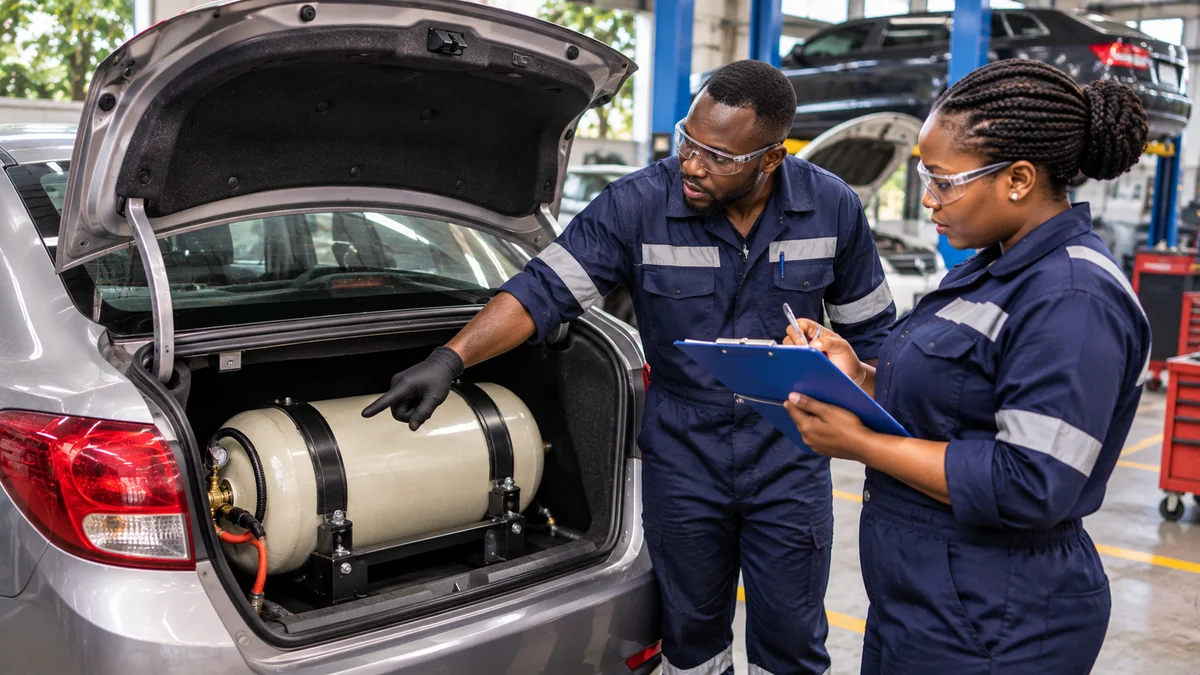
Converting a petrol vehicle to compressed natural gas (CNG) in Nigeria in 2026 can reduce fuel expenditure, but the safe route is to choose an accredited workshop, confirm that its kit and cylinder are certified for automotive CNG, and compare the total installation cost with the fuel savings you can realistically achieve. The Presidential Initiative on Compressed Natural Gas and Electric Vehicles (Pi-CNG & EV) publishes indicative conversion prices of ₦350,000–₦600,000 for passenger cars, ₦450,000–₦800,000 for buses and vans, and ₦180,000–₦280,000 for tricycles. These are guidance ranges, not binding quotations; vehicle condition, equipment and any subsidy can change the final price.
For an approved centre, begin with the National Automotive Design and Development Council (NADDC) verified-workshop directory or Pi-CNG's conversion-centre finder . Check the specific workshop's current accreditation before booking. Do not accept a cooking-gas cylinder, modified industrial cylinder, expired vessel or unverified high-pressure component as a substitute for an automotive CNG cylinder. This guide covers costs, accreditation, pre-conversion checks, refuelling access, maintenance and safe ownership. Information checked 6 November 2026.
What is a CNG vehicle conversion?
CNG is natural gas compressed and stored in a pressure-rated cylinder for use as vehicle fuel. In many petrol vehicles, a qualified workshop installs a compatible gas supply and control system alongside the existing petrol system, creating a bi-fuel vehicle that can use either fuel as designed. A conversion is more than placing a tank in the boot: it involves vehicle compatibility, certified components, secure mounting, appropriate plumbing and electronics, calibration, testing and an owner handover.
Diesel engines are a different engineering case. They may require an appropriately designed diesel–gas dual-fuel configuration rather than a normal petrol bi-fuel kit. A workshop should assess the engine and vehicle first; a generic “works on every car” promise is a warning sign. Pi-CNG's official FAQ also distinguishes diesel retrofits from standard petrol conversions.
The Presidential Initiative expanded its mandate to cover electric vehicles in March 2026, under the name Pi-CNG & EV . That does not mean the safety and maintenance rules for CNG engines and electric vehicles are identical.
How much does CNG conversion cost in Nigeria in 2026?
Published figures vary, and quotations may differ sharply by cylinder capacity, number of cylinders, vehicle design, kit make, installation requirements and whether a government-backed subsidy is genuinely available.
| Vehicle class | Indicative conversion cost | Source and limitation |
|---|---|---|
| Passenger car | ₦350,000–₦600,000 | Pi-CNG & EV FAQ guidance; not a live individual quote |
| Commercial bus or van | ₦450,000–₦800,000 | Pi-CNG & EV FAQ guidance; vehicle size and kit vary |
| Tricycle (keke) | ₦180,000–₦280,000 | Pi-CNG & EV FAQ guidance; availability varies |
| Large truck, complex retrofit or premium specification | Obtain a written assessment | No universal price established for every design |
Those values appear in the official programme FAQ . They are not a government-mandated retail price list, and actual 2026 workshop offers may fall outside them. Ask for a written itemised quote showing the cylinder type and capacity, conversion kit, brackets, valves, installation, calibration, testing, taxes and warranty. A cheaper verbal quote may exclude vital components or post-installation safety work.
Commercial operators may encounter subsidised or financing programmes. Pi-CNG's May 2026 programme update described the Credit Access for Light and Mobility (CALM) Fund, involving CrediCorp and finance partners, with financing from 9% for eligible arrangements and repayment over six months in that announcement. “From” does not mean every applicant qualifies for 9%, and a loan is not a free conversion. Verify the current rate, fees, total repayment, lender and eligibility directly through programme channels.
Where can you find approved CNG conversion centres?
The primary verification resource is the NADDC CNG & EV portal's verified-workshop registry . On 6 November 2026, it displayed 377 verified workshops across 30 states and included workshop names, accreditation codes, states and local-government areas. Users can search and filter records. The Pi-CNG national conversion-centre map separately describes a broader network of 400+ active centres.
The counts come from different live pages and should not be treated as the same audited snapshot. Accreditation entries, programme partnerships and map listings may be updated at different times. Check the exact workshop, code, address and current status before travelling or paying a deposit. A shop being advertised as a CNG converter on a social platform is not equivalent to appearing in the official register.
A five-step verification method
- Open the NADDC registry and search by state, town, workshop name or accreditation code.
- Cross-check the proposed location using the Pi-CNG conversion-centre finder or the initiative's verified contact channels.
- Ask the workshop for its current accreditation details and whether your vehicle type is within its certified capability.
- Request documentation for the SON-certified automotive CNG kit and cylinder, including cylinder markings and identification.
- Ask who will perform the final inspection, what records you will receive and where future servicing will be carried out.
Do not confuse a training provider with an approved conversion workshop. The National Board for Technical Education's CNG training-provider register lists organisations approved for a training trade, but it is not a substitute for confirming the conversion workshop's NADDC accreditation.
Check refuelling access before converting
Conversion is most attractive when a driver can reliably refuel CNG along regular routes. The official Pi-CNG refuelling-station directory lists 105 stations across 24 states and the FCT in its register updated 15 October 2026, consistent with the initiative's October 2026 programme update . These are published network figures; a directory entry alone does not confirm that a specific dispenser is operating or has fuel available today.
Look at your home-to-work route, operating hours, detours, queues, refuelling compatibility and whether multiple stations are practical. A taxi driver who travels every day near a functioning station may save more than a private driver who makes occasional long trips into areas without gas supply. FlyingEze previously covered Osun minibus operators calling for more CNG stations , illustrating why infrastructure access affects the real value of a conversion.
Can CNG save enough money to recover the conversion cost?
Use your actual monthly fuel expense, measured gas use and verified local pump prices rather than a national advertisement promising a fixed percentage saving. Petrol is typically measured in litres, while CNG may be sold per standard cubic metre; they are not numerically interchangeable units. Compare the cost of driving the same distance on each fuel, accounting for the vehicle's real consumption.
A simple payback calculation is:
Estimated payback months = total conversion expense ÷ net monthly fuel saving.
For example, suppose a driver pays ₦500,000 for a complete, certified conversion. If a recorded month of petrol driving costs ₦120,000 and an equivalent distance on CNG costs ₦70,000, the illustrative gross monthly saving is ₦50,000. Ignoring additional maintenance, financing and refuelling travel costs, the simple payback period is 10 months. Those fuel amounts are hypothetical, not verified November 2026 pump prices or typical savings for all cars.
Long queues, station detours, financing interest, changes in CNG price and reduced luggage space can affect the decision. FlyingEze has also reported on changes in Nigerian CNG prices . A sensible buyer should calculate a conservative case with a smaller monthly saving and consider whether the vehicle will remain in service long enough to recover the upfront cost.
What should a workshop inspect before conversion?
An accredited technician should establish that the vehicle is suitable before fitting any gas equipment. Ask for a documented assessment of the engine's general condition, ignition, cooling, relevant electrical systems and available cylinder mounting space. A poorly maintained engine will not become healthy merely because its fuel system has been modified.
For a petrol bi-fuel conversion, ask whether the proposed system is appropriate for the engine and electronic controls, how petrol operation will remain available and how the fuel selector operates. Seek clarification about boot-space loss, added weight, ground clearance, vehicle warranty and any insurance disclosure needed. Do not accept a promise that all models perform identically after conversion.
Conversion time depends on the vehicle. Pi-CNG's official FAQ estimates four to eight hours for many standard conversions, and longer for complex work. That is a general estimate, not an instruction to rush pressure testing or skip an inspection to meet a promised same-day handover.
Critical CNG safety checks: components, cylinders and installation
Never trade safety for a lower price. Automotive CNG involves high-pressure storage. The key safeguards are genuine and correctly rated components, competent installation, formal testing and maintenance according to the approved equipment and vehicle instructions.
| Checkpoint | What the owner should request or verify |
|---|---|
| Workshop accreditation | Current NADDC listing, accreditation code and relevant installation capability |
| Cylinder suitability | Certified automotive CNG cylinder; readable manufacturer and identification markings, service-life information and traceable documentation |
| Kit components | Compatible SON-certified equipment; approved regulator, valve and fuel-system components |
| Mounting and routing | Workshop-confirmed secure mounting, protected gas lines and components suitable for the specific vehicle |
| Leak and functional testing | Documented checks by qualified personnel using approved procedures and instruments |
| Vehicle operation | Clear demonstration of petrol/CNG switching, starting and safe operation |
| Handover records | Written invoice, kit/cylinder information, safety test record, warranty and servicing schedule |
The most important warning is not theoretical. In a 14 September 2026 official statement , Pi-CNG & EV described a 13 September incident at a NIPCO filling station on Airport Road, Abuja. According to information it attributed to the station operator, a vehicle had been fitted with a cylinder not designed or certified for automotive CNG, and the cylinder exploded during refuelling. The initiative called for NADDC-accredited conversion centres and SON-certified automotive CNG kits and cylinders.
Never substitute an LPG/cooking-gas bottle, welding-gas vessel, modified industrial cylinder or fabricated pressure container for an approved automotive CNG cylinder. A gas vessel is not fit for automotive CNG merely because it looks strong or can hold some pressure. Do not attempt home conversion, cylinder repairs, valve adjustments or pressure testing yourself.
What about CNG, LNG and LPG safety reports?
These are different fuels and storage systems. Compressed natural gas (CNG), liquefied natural gas (LNG) and liquefied petroleum gas (LPG) should not be used interchangeably in safety reporting or equipment descriptions.
For example, an April 2026 Pi-CNG update on a separate Kaduna vehicle incident reported an investigation involving an LNG-powered vehicle and failure of a critical safety valve. It highlighted inspection and maintenance, but should not be misreported as proof that the Abuja uncertified-cylinder case involved the same fuel or cause. Safety questions should be tied to the specific equipment and official incident findings.
What to check before accepting the converted vehicle
Ask the installer to demonstrate the new system, explain warning indicators and provide written evidence of inspection and testing. Confirm that the petrol system operates as intended in a bi-fuel vehicle and that the gas system has been calibrated for smooth operation. Check that cylinders and fittings are protected from routine cargo contact and that service access and emergency guidance are understood.
Do not accept the vehicle if the installer refuses to disclose cylinder identification, cannot produce the promised test evidence or has used components inconsistent with the approved specification. The conversion should not be treated as complete until the qualified workshop has addressed any faults and supplied the appropriate documentation.
Safe refuelling and what to do if you suspect a leak
Use authorised CNG stations and follow attendants' instructions, including engine shutoff and any station-specific safety rules. Do not smoke, use naked flames or tamper with high-pressure equipment at the forecourt. Station staff should perform the checks required by their operating procedures and may refuse a vehicle with suspect components.
If you suspect a gas leak, stop using the vehicle, avoid ignition sources, move people away to a safe area and contact trained emergency or CNG service personnel. If the vehicle can be stopped safely, switch off the engine and follow your system's official emergency instructions; do not investigate a suspected leak with a flame, operate questionable electrical equipment near escaping gas or attempt to tighten fittings yourself. A qualified workshop must inspect the system before use resumes.
After a collision, fire exposure, impact to the cylinder area or suspected system damage, arrange professional assessment even if the car appears to drive normally. Follow the cylinder and kit manufacturer's maintenance and inspection intervals, service-life limits and replacement rules; do not invent an across-the-board expiry period for every cylinder.
Government subsidies, loans and claims of “free conversion”
Pi-CNG has run subsidised mass-conversion initiatives for some commercial operators and described consumer financing under the CALM Fund. Availability may depend on occupation, vehicle eligibility, participating workshop, location, application window and available funding. A subsidy announced in one city or for one driver group is not automatically available to every private car owner nationwide.
Before making a commitment, ask the approved centre whether the scheme is active for your vehicle, what exact items the subsidy covers and what you will pay out of pocket. Where financing is offered, request the lender's full repayment schedule and annual interest/fees. Avoid middlemen demanding personal transfers for guaranteed “federal allocation” or bypassing workshop accreditation.
Common CNG conversion mistakes to avoid
- Choosing price before certification: a low-cost quote that omits testing or uses a suspect cylinder is not a saving.
- Ignoring nearby CNG stations: plan refuelling before paying for a conversion.
- Assuming all cars use the same kit: insist on model-specific assessment and compatible components.
- Believing fuel savings are guaranteed: calculate using your actual driving and local prices.
- Accepting no paperwork: keep cylinder, workshop, test, warranty and maintenance records.
- Mixing up LPG, LNG and CNG: ensure the kit is explicitly for the fuel and vehicle configuration intended.
- Skipping service after conversion: inspect and maintain the system according to the approved schedule.
Frequently asked questions
How much is CNG conversion for a car in Nigeria in 2026?
Pi-CNG & EV's published FAQ suggests ₦350,000–₦600,000 for many passenger cars, but actual quotations may differ by engine, kit, cylinder and subsidy. Obtain a written, itemised quote from a currently accredited centre.
Where can I find approved conversion centres?
Use the NADDC verified-workshop registry and Pi-CNG centre finder . Verify the individual workshop's listing and accreditation code before proceeding.
Can a diesel bus be converted?
Possibly, but diesel conversion requires a specialised assessment and an appropriate dual-fuel or other engineered system. It is not the same installation as a petrol bi-fuel car.
Is CNG conversion safe?
Properly engineered systems can be operated safely when fitted with certified automotive components by qualified technicians and maintained correctly. Unapproved cylinders and unprofessional conversions can be dangerous; the September 2026 Abuja incident prompted an explicit official warning.
Can I keep using petrol after conversion?
Many petrol vehicles use a bi-fuel configuration retaining petrol operation, but the specific arrangement must be confirmed for your vehicle and kit.
How long does installation take?
Pi-CNG gives an approximate four-to-eight-hour range for many standard vehicles. Complex work and verification can take longer. Never rush the safety checks.
Does every driver qualify for a free or subsidised kit?
No. Subsidies and CALM financing are subject to programme terms, eligibility and availability. Verify the current offer through the recognised channels.
Conclusion: verify the centre, cylinder and total cost before converting
CNG conversion in Nigeria can be an attractive option for drivers who spend heavily on petrol and have reliable access to refuelling stations. But the decision should begin with vehicle suitability and safety, not a claimed percentage saving or an unusually cheap quote.
Use the NADDC and Pi-CNG directories to find an accredited conversion centre, insist on SON-certified automotive CNG components, require documented installation tests and keep a realistic budget for fuel, maintenance and potential financing. Verify your refuelling route and never accept an improvised or uncertified cylinder. A safe, traceable installation is the foundation of any lasting savings.