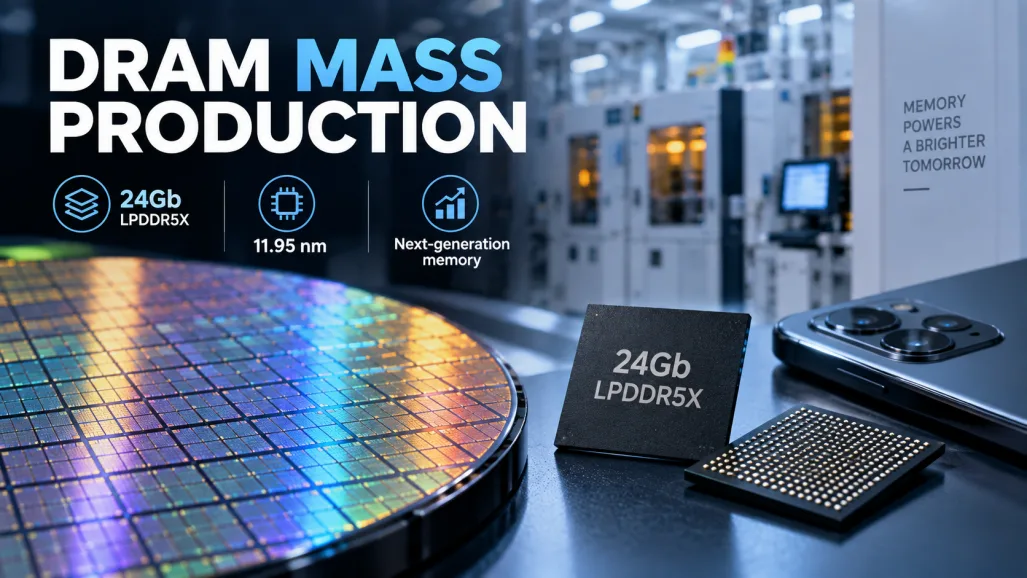
Chinese memory-chip maker ChangXin Memory Technologies, better known as CXMT, says its fifth-generation DRAM manufacturing platform has entered mass production, marking a new step in China's effort to expand domestic production of advanced memory chips.
The company announced the development on 20 September at the World Manufacturing Convention in Hefei. According to Reuters, the platform uses quadruple patterning to reach feature spacing of 11.95 nanometres and is being used to produce two new 24-gigabit LPDDR5X memory products aimed at smartphones and other portable electronics.
What CXMT actually announced
CXMT's announcement has two distinct parts. First, the company says its fifth-generation manufacturing platform is now in mass production. Second, it has introduced two 24Gb LPDDR5X products built for mobile and portable-device use.
Reuters reports that CXMT says the new platform can increase gross die output per wafer by at least 50% compared with its previous generation when measured on an 8Gb baseline. That is a company claim rather than an independently verified manufacturing benchmark, but it helps explain why the process change matters commercially.
More usable dies from the same silicon wafer can improve manufacturing efficiency because each wafer produces more saleable chips before packaging and testing. Actual economics still depend on factors such as yield, defect rates, packaging, product mix and final selling prices.
Why 11.95nm feature spacing matters
DRAM stores the short-term working data used by phones, computers, servers and other digital devices. Increasing memory density requires manufacturers to fit more memory cells into a limited area while maintaining acceptable power use, reliability and production yield.
CXMT says its fifth-generation process uses quadruple patterning to reduce feature spacing in the memory array to 11.95nm. Quadruple patterning is a lithography technique used to create finer structures than would be practical with a single patterning step.
The important point for consumers is not the process label itself, but what denser manufacturing can enable: more memory capacity in a similar physical footprint and potentially better manufacturing efficiency if yields remain strong.
The new 24Gb LPDDR5X products target mobile devices
Alongside the process announcement, CXMT unveiled two 24Gb LPDDR5X products for smartphones and portable electronics. LPDDR memory is designed for devices where power consumption and compact packaging matter.
A 24-gigabit die contains 50% more data than a 16-gigabit die. Device makers can use higher-density memory to build larger-capacity configurations with fewer dies, depending on packaging and system design.
CXMT has been expanding its mobile-memory portfolio for some time. Its official newsroom previously documented LPDDR5X mass production and newer mobile-memory products, showing that the latest announcement builds on an existing product line rather than representing the company's first move into advanced mobile DRAM.
Why this matters for China's semiconductor strategy
The global DRAM market is dominated by Samsung Electronics, SK Hynix and Micron Technology. CXMT remains smaller than those companies, but its progress matters because memory is one of the most important categories in China's broader effort to reduce dependence on foreign semiconductor technology.
US export restrictions have limited Chinese access to some advanced semiconductor manufacturing equipment and technologies. That has increased the incentive for Chinese chipmakers to develop domestic process capabilities and work more closely with local equipment and materials suppliers.
Reuters reports that CXMT developed the new platform through simulation work and collaboration with Chinese equipment manufacturers. If the platform performs as claimed at scale, it could strengthen China's ability to supply domestic smartphone, computer and electronics manufacturers with locally produced DRAM.
Mass production does not automatically mean market leadership
The announcement is significant, but it should not be read as proof that CXMT has matched or surpassed the world's largest memory suppliers across every metric.
Process competitiveness depends on far more than feature spacing. Yield, wafer throughput, power efficiency, performance, reliability, packaging, customer qualification and cost all matter. CXMT has not publicly disclosed all of those figures for the new platform.
There is also a difference between announcing mass production and achieving very large commercial volumes. The next useful indicators will be customer adoption, shipment scale, pricing and whether the products appear in major smartphones or other devices.
CXMT is expanding beyond traditional DRAM
The new DRAM platform arrives as CXMT is also broadening its ambitions. Reuters reported on 18 September that the company is exploring a move into NAND flash memory, a separate market used for persistent storage in products such as solid-state drives.
That expansion would put CXMT into another major memory segment and could increase competition with both international suppliers and domestic Chinese companies. For now, however, CXMT's strongest established position remains DRAM.
What smartphone buyers should expect
Consumers should not expect an immediate change simply because a new memory process has entered production. Smartphone makers must still qualify components, design them into devices and decide whether the capacity, performance, power and price fit their products.
The more immediate significance is on the supply side. Another producer capable of shipping higher-density mobile DRAM can give device manufacturers more sourcing options, particularly in China.
Bottom line
CXMT's fifth-generation DRAM platform is an important manufacturing milestone if the company's mass-production and efficiency claims hold up at commercial scale. The 11.95nm feature spacing, quadruple-patterning process and new 24Gb LPDDR5X products show that China's leading DRAM producer is continuing to push into denser mobile memory.
The next question is not whether CXMT can announce the technology, but how successfully it can manufacture it at scale, win customers and compete on yield, cost, power and performance against the established global memory leaders.