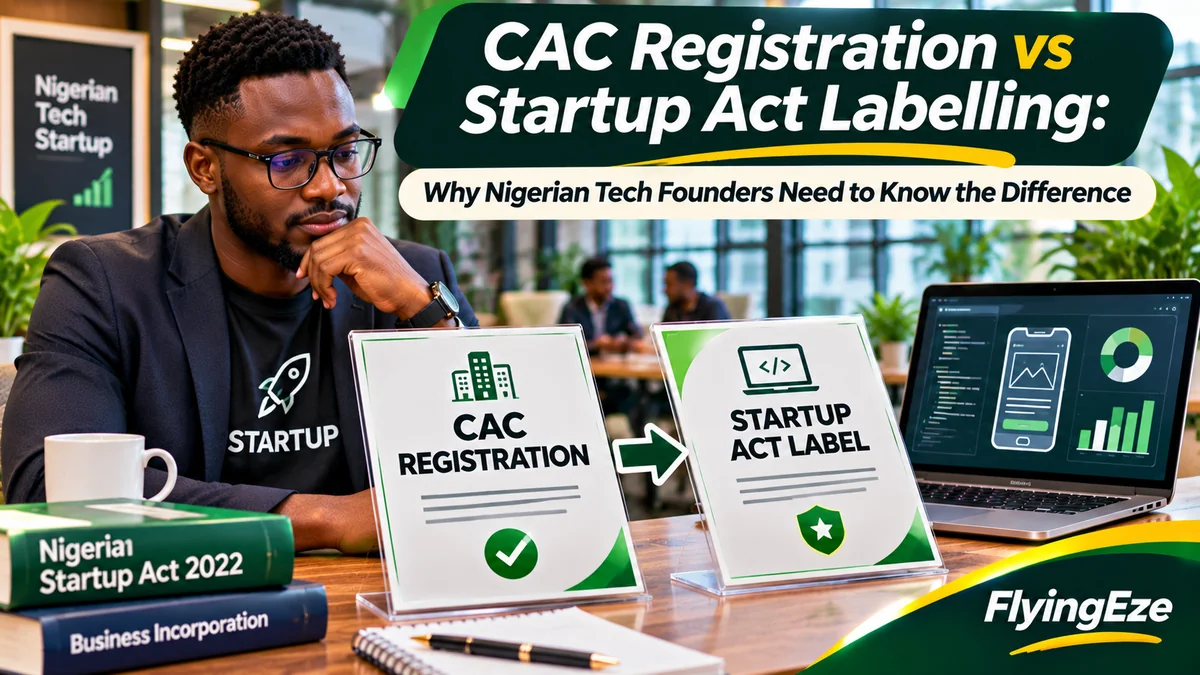
CAC registration and Nigeria Startup Act labelling are not the same thing. Incorporation with the Corporate Affairs Commission (CAC) creates and records a company under Nigeria's Companies and Allied Matters Act, while a startup label is a separate certificate for eligible technology-driven businesses under the Nigeria Startup Act, 2022. A founder generally needs the appropriate incorporated company first, then must satisfy the Startup Act's additional eligibility and application requirements. Having “Tech” in a company name—or owning an app—does not automatically confer a startup label.
This distinction matters when opening accounts, raising investment, considering government innovation programmes or discussing possible tax incentives. A founder may be fully CAC-registered yet have no Startup Act label. Conversely, a startup label does not replace the company's incorporation, tax compliance, relevant sector licences or annual reporting duties.
Sections 13–16 of the Nigeria Startup Act, 2022 establish the label's eligibility, application, certification and ongoing requirements. The CAC's registration guidance explains the separate process for incorporating a company. This article examines the difference, including a significant 2026 update affecting tax-incentive claims. Research verified on 3 November 2026. This is general information, not individual legal or tax advice.
What does CAC registration actually do?
The CAC is Nigeria's corporate registry. It processes company incorporation, business names and other legal-entity registrations under the applicable company legislation. When a founder incorporates a private company limited by shares, the resulting company becomes a separate legal entity from its shareholders, subject to corporate law and its own obligations.
According to the official company-registration process , applicants check and reserve a name, submit the prescribed pre-registration details and supporting documentation, pay applicable filing and stamp-duty charges, and obtain official electronic registration documents once approved. The CAC also registers business names, but registering a business name is not identical to incorporating a limited liability company.
For example, a freelance developer might first trade under a registered business name. That may suit a small personal venture, but it is not a substitute for a limited company's structure when preparing to admit shareholders or pursue the ordinary Startup Act label route. The choice of legal form affects liability, governance and fundraising, not only the registration fee.
FlyingEze's business name versus limited liability company comparison explains the practical distinctions. Founders who have not incorporated can also consult its 2026 CAC registration guide for the standard process.
What is a Nigeria Startup Act label?
A startup label is a certificate issued to an applicant that meets the conditions established under the Nigeria Startup Act. The Act was enacted on 19 October 2022 to establish a legal and institutional environment for technology-enabled startups. It created the National Council for Digital Innovation and Entrepreneurship and assigned administrative functions to a Secretariat supported by NITDA.
Unlike a general company-registration certificate, the startup label addresses a specific policy category: a qualifying startup engaged in digital technology innovation. The official Startup Support and Engagement Portal facilitates labelling and participation by startups and ecosystem organisations. A business's portal account or submitted application is not itself evidence that the Secretariat has issued a label.
The law states that a startup label is valid for 10 years from its issuance, subject to the Act's conditions and possible withdrawal. That should not be confused with another ten-year rule: a company must have been in existence for not more than 10 years from incorporation when seeking eligibility under section 13.
CAC registration versus Startup Act labelling: side-by-side
| Question | CAC company incorporation | Startup Act label |
|---|---|---|
| Primary purpose | Establish legal corporate existence | Recognise an eligible digital-technology startup |
| Law/framework | Companies and Allied Matters Act (CAMA) | Nigeria Startup Act, 2022 |
| Authority | Corporate Affairs Commission | Startup Secretariat/Coordinator under the Act |
| Applicant scope | Businesses of many sectors and legal forms | Companies meeting age, technology, ownership and other criteria |
| Digital product requirement | Not a general incorporation condition | Central to qualification |
| Document issued | Certificate of incorporation and relevant extracts | Startup label certificate |
| Ongoing duties | Applicable CAMA and corporate-law filings | Additional startup reporting and notification duties |
| Tax incentives | Not automatically granted by incorporation | Potential access under applicable, current incentive rules—not automatic relief |
Think of CAC incorporation as the company's legal foundation and labelling as a later qualification assessment. They can complement one another, but they cannot be substituted for each other.
Who qualifies for a startup label under section 13?
The Act imposes more than a requirement to work in technology. Its statutory conditions should be read together:
- Company and age: the ordinary label applicant is a limited liability company incorporated under CAMA, in existence for no more than ten years from incorporation.
- Technology objects: the company's objectives concern innovation, development, production, improvement or commercialisation of a digital-technology innovative product or process.
- Technology ownership or repository: the company holds or is a repository of a digital-technology product or process, or owns or authors registered software, as stated in the Act.
- Nigerian founder equity: at least one-third of shareholding must be held by one or more Nigerians who are founders or co-founders.
- Structural restrictions: the Act excludes certain holding-company or subsidiary arrangements involving an existing company not registered as a startup.
Note the equity number carefully. The statutory threshold is one-third, not 51%. That does not mean every company with 34% Nigerian-owned shares necessarily qualifies: the shares must satisfy the founder/co-founder condition, and the other criteria must be met.
For instance, a two-year-old software business with a Nigerian co-founder holding 40% of its equity might satisfy the nationality/shareholding component. The Secretariat would still need to assess the company's incorporation records, innovation objects and product evidence. A traditional trading company with a basic website is not automatically a digital-technology innovator merely because it advertises online.
What happens if you only registered a business name?
Section 13(4) makes a notable provision for qualifying sole proprietorships and partnerships: they may be granted a six-month pre-label status to comply with the company-incorporation and related requirements. Failure to regularise within that period results in loss of the pre-label status under section 13(5).
This is not the same as a full ten-year startup label. The Startup Portal's current published terms primarily describe the limited-liability-company route and require a CAC incorporation certificate. Therefore, a business-name owner should not assume that a pre-label is issued automatically or that the portal currently offers an unrestricted shortcut.
Before changing legal form or making commitments, confirm the practical pre-label procedure directly with the Startup Secretariat. An appropriate conversion or new incorporation may involve corporate, tax and contractual consequences, including how existing intellectual property and customer contracts are transferred.
How to register with CAC first
For an entrepreneur who has not incorporated, the sequence usually begins with corporate registration:
- Choose the suitable legal structure, including whether a limited company is appropriate for intended investors or shareholders.
- Check name availability and reserve an acceptable name through the official CAC process .
- Prepare the company's business objects, shareholder and director details, share structure, registered address and other required documents.
- Complete the official CAC registration portal steps and pay the prescribed charges shown at the time.
- Obtain and securely retain the certificate of incorporation, certified extract and constitutional documents.
- Complete relevant post-incorporation requirements for accounting, tax, sector licensing and company records.
Do not invent an incorporation date or retroactively change ownership records to meet a label criterion. A founder should use genuine documentary evidence. Following registration, FlyingEze's guide on what to do after CAC registration helps organise the next operational steps.
How to apply for Startup Act labelling after incorporation
The official Startup Portal terms and conditions set out a separate procedure. An eligible company should:
- Visit the Startup Support and Engagement Portal and follow the available registration or sign-in route.
- Complete the startup-label application form requested by the portal.
- Provide the CAC incorporation certificate, memorandum and articles of association, shareholder register and verifiable evidence of its technology product or process.
- Submit the information needed for the innovation and scalability assessment and any additional documents the Secretariat lawfully requests.
- Respond to queries, correct genuine deficiencies and follow the application's official status until a decision is communicated.
- Claim labelled status only when the competent authority actually issues the certificate.
A product demonstration, documentation, code ownership evidence or deployed platform may help explain the innovation; the exact evidence requested should follow the live portal instructions. The statutory application mechanism is in section 14, while section 15 covers certification after a satisfactory review.
Do not treat submitting a form, creating an account or receiving an acknowledgement as approval. The public pages confirm the framework but do not establish a guaranteed processing time, application fee for every scenario or a decision on any individual founder's case. Check current notices before paying a third party or promising an investor that a label is imminent.
What benefits can a label offer—and what changed in 2026?
The Startup Act describes access to initiatives including funding structures, government engagement, innovation support, intellectual-property assistance, certain investor-related measures and potential fiscal incentives. Section 19 establishes a Startup Investment Seed Fund framework, with the Nigeria Sovereign Investment Authority identified as fund manager. These provisions should not be confused with money automatically deposited into a founder's account.
A major legal update matters: sections 24 and 25 of the original 2022 Act referred to the former Pioneer Status Incentive (PSI) framework and historical income-tax relief. But the Nigerian Investment Promotion Commission confirms that PSI was discontinued for new applicants and replaced by the Economic Development Tax Incentive (EDTI) under the Nigeria Tax Act 2025, effective 1 January 2026.
The Federal Ministry of Finance's June 2026 transitional guidance explains that existing incentives under repealed laws may continue for their approved term, while new or pending applications are handled under the new laws. Consequently, a founder should not promote a startup label as an automatic, unconditional three-year or five-year tax holiday in 2026.
Any incentive requires checking the current tax law, qualification conditions, application procedure and administering agency. Obtain advice from an appropriately qualified Nigerian tax professional before calculating investor returns or deciding that an expense is exempt. Labelling and tax-incentive approval are related but different administrative questions.
What obligations continue after receiving a label?
Section 16 of the Act creates ongoing duties beyond holding the certificate. Labelled startups are expected to comply with applicable Nigerian laws, report annually on staffing, assets and turnover, maintain proper books, and report incentives received and progress achieved through them. A startup must also notify the Coordinator within one month of relevant changes to its structure, composition or objects.
According to the Startup Portal terms , a company that fails its obligations can be notified and given an opportunity to remedy default. Sections 16–18 describe a 30-day corrective period after notification, possible withdrawal of a label and the possibility of seeking reissuance after rectification.
In practical terms, keep an organised compliance folder with shareholder changes, financial statements, incentive records, product updates and correspondence from the Secretariat. Also maintain ordinary CAC and sector-specific obligations. A label does not immunise a fintech company from payment or securities regulation, a health-tech company from relevant health rules, or a business from data protection requirements.
Three practical founder scenarios
Scenario A: A newly incorporated Nigerian software company
A fictional founder incorporates a company to build a payroll application. It is two years old, has an identifiable innovative digital product and Nigerian founder shareholding above one-third. It may be a plausible candidate to assess for a startup label, but the product, ownership and statutory requirements still need verification. CAC incorporation alone does not make it labelled.
Scenario B: A sole proprietor building a promising education app
The founder has a CAC business-name registration, not a limited company. Section 13's pre-label provisions may be relevant, subject to the current administrative procedure. For the ordinary full label, incorporation as a suitable limited-liability entity is essential. The founder should plan the legal transition rather than assume a business-name certificate is interchangeable with a company's certificate.
Scenario C: A regular retailer using modern POS software
A trading company operates shops and uses digital payments, accounting software and a website, but its primary business is retailing goods rather than developing an innovative digital-technology product or process. Buying technology does not by itself qualify it for the label. Its CAC registration remains valid and useful regardless of whether it meets Startup Act conditions.
What founders should prepare before speaking with investors
Investors typically need clarity on what a company legally owns, who controls it, and whether its stated approvals are real. Maintain accurate incorporation documents, shareholdings and founder agreements. Document ownership or licensed use of important intellectual property and review whether your proposed activities match the company's stated objects.
For a company seeking labelling, be ready to demonstrate the actual technology, not just presentation slides. Show how it solves a problem, what is innovative, and how the product or process is documented. Ensure your cap table is consistent with the one-third Nigerian founder requirement at the time the application is assessed.
Do not describe your business in pitch decks as “government-certified under the Startup Act” until the certificate exists. An honest description such as “CAC-incorporated; assessing Startup Act eligibility” is more credible than an unsupported claim.
Quick founder checklist: which stage are you at?
| Question | If yes | If no |
|---|---|---|
| Is the venture incorporated as the appropriate limited company? | Check documents and age | Review CAC incorporation or pre-label pathway |
| Is the company no more than ten years old? | Continue assessing | Ordinary section 13 age test is not met |
| Does it have a qualifying digital-technology product or process? | Collect supporting evidence | Do not assume ordinary use of software qualifies |
| Do Nigerian founders or co-founders hold at least one-third? | Document the cap table | Review eligibility and ownership arrangements lawfully |
| Do its constitutional objects align with the innovation activity? | Prepare application evidence | Seek appropriate legal guidance |
| Has the Secretariat actually issued a label? | Track compliance and current incentives | Describe status as unlabelled or application pending |
This checklist is a screening aid. It does not replace the Secretariat's formal assessment or legal advice about unusual shareholding, subsidiaries, licensed software and corporate structures.
Common mistakes Nigerian tech founders should avoid
Confusing a CAC business name with a limited company: the ordinary Startup Act label pathway is tied to company incorporation. Assuming a tech company is automatically eligible: innovation objectives, product evidence, founder equity and age still matter.
Repeating the wrong Nigerian ownership percentage: section 13 sets one-third founder shareholding, not an automatic 51% majority test. Confusing company age with label validity: both mention ten years, but one measures age before the application and the other the certificate's validity after issuance.
Claiming outdated tax incentives: the 2026 transition from PSI to EDTI means earlier tax-holiday explainers need fresh verification. Forgetting ongoing duties: corporate filings, label reports and sector compliance continue after approval. Using an unofficial agent: do not pay for a promised guaranteed label, subsidy or regulatory waiver without checking the official channel.
Frequently asked questions
Is CAC registration the same as a Nigeria Startup Act label?
No. CAC registers and incorporates businesses; the Startup Act label separately recognises eligible technology-driven startups following the Act's assessment and approval process.
Can I apply for the label with only a business-name certificate?
The Act provides a limited six-month pre-label route for qualifying sole proprietorships and partnerships, but the ordinary full-label route requires a limited-liability company. Check current Secretariat instructions before relying on the pre-label mechanism.
What percentage of shares must Nigerian founders own?
Section 13 requires at least one-third local shareholding held by one or more Nigerians who are founders or co-founders, alongside the other eligibility criteria.
Does a CAC certificate automatically make my startup eligible for tax relief?
No. Neither incorporation nor receipt of a startup label automatically establishes entitlement to a particular tax incentive. The 2026 tax reforms changed the earlier Pioneer Status framework, so confirm present requirements with the relevant authority.
How long is a startup label valid?
The Nigeria Startup Act states that a startup label is valid for ten years from issuance, subject to compliance and possible withdrawal.
Can an ordinary non-tech retail business obtain a Startup Act label?
Not solely because it has a website, POS or other digital tools. It must meet the Act's substantive digital-technology innovation conditions and other eligibility requirements.
Conclusion
CAC incorporation gives a company its legal footing; Startup Act labelling is a separate recognition for qualifying digital-technology startups. Founders should first choose the right corporate form and complete ordinary registration, then examine the Act's age, innovation, ownership and documentation rules before applying through the official portal.
Most importantly, do not confuse the label with a substitute for regulatory compliance or an automatic promise of grants and tax holidays. In 2026, the updated tax-incentive framework makes independent verification especially important. Accurate records, truthful representations and the right approval sequence will serve Nigerian tech founders better than shortcuts.