GOVERNMENTS take money from the private sector and give it to the public sector. When its private sector is healthy and growing, a country is rich.
When its private sector must carry the weight of a burgeoning state machine, a country is poor.
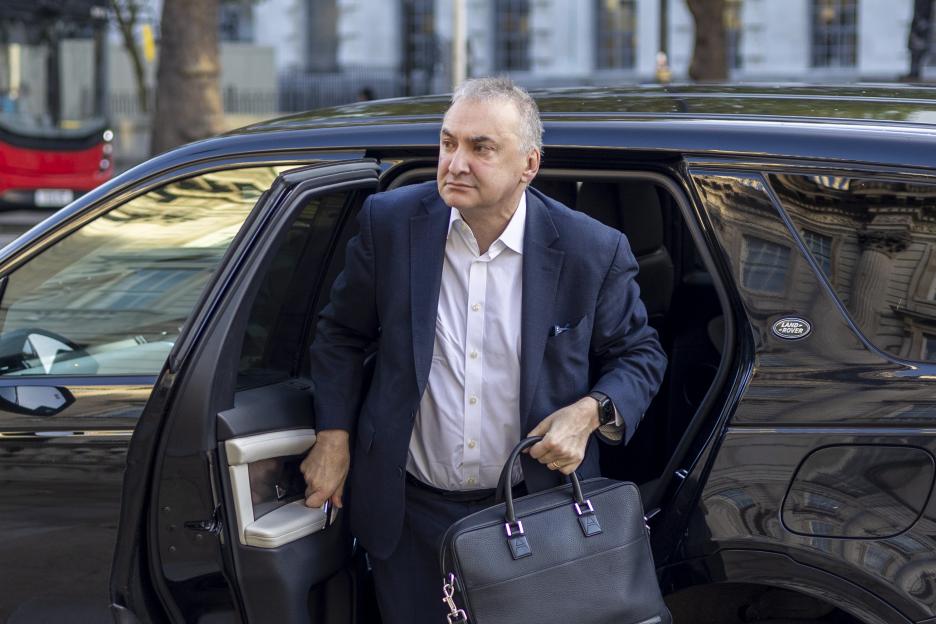 Former Cabinet Secretary, Chris Wormald, had been given a pay-off of around £500,000 after just 14 months Credit: LNP
 Labour is struggling to figure out that growing the private sector is crucial Credit: Getty
Look no further for an explanation of . The people who generate tax surpluses (butchers, bakers, candlestick makers) are struggling to carry those who consume them (NHS managers, racism awareness counsellors, local government officials).
Our problem is that we keep hiring more and more people to work for the Government, and paying them more and more.
Public-sector salaries have risen by 6.1 per cent, according to the Office for National Statistics, private-sector salaries by just 2.8 per cent.
Given that new figures out yesterday revealed is now running at 2.9 per cent — which is in itself, a scandal — private-sector workers have taken a real-terms pay cut to fund the public sector.
I am not arguing that working for a private company is more virtuous than working for the Government (though socialists sometimes seem to believe the opposite).
No, this has nothing to do with merit, and everything to do with affordability.
A government that genuinely wants the growth that politicians keep talking about would lighten the load.
It should be easy to shrink the state payroll to pre-pandemic levels.
A lot of extra officials were recruited on a supposedly emergency basis to deal with vaccination, test-and-trace and other contingencies.
And similarly, a number of extra civil servants were taken on between 2016 and 2020 to deal with the one-off adjustments of , as we put in place different trade and customs arrangements.
Both those bumps are now far in our rear-view mirror. Yet, incredibly, the public sector workforce has grown from 5.4 million in 2016 to 6.2 million now.
How can any country carry such a weight? How can we, at a time of almost no growth, increase both the number of people on the state payroll and their salaries?
 The country has been focused on boosting public sector pay in recent years Credit: Getty
 Teachers deserve a pay rise – but the question is whether the country can actually afford it? Credit: Getty
I don’t believe anyone in the Government asks these questions. Their main calculation is political.
The public-sector unions believed they had an IOU from the incoming Government, and they were not wrong.
Teachers got a 5.5-per-cent pay rise, most workers got 5.5 per cent with a further 3.3 per cent to come, junior doctors got the equivalent of 22 per cent.
Now, you might argue that these are good and deserving people.
As it happens, I agree. Most NHS workers are indeed public-spirited (though, by the of averages, some of them must be lazy and useless).
If I could wave a magic wand, I would give a hefty raise.
That, though, is beside the point. When there is not the , questions of merit become irrelevant. And the plain fact is that there isn’t the money.
Our just passed the £3trillion mark.
The great African-American economist Thomas Sowell liked to observe that socialists are remarkably uninterested in how wealth is created.
They assume, he would say, that its creation is a given, and that the only question is how to redistribute it. But growth does not just happen if the incentives are set wrongly.
Every redistributive tax rise is doubly bad for productivity. If you are taxed more, and keep less of what you earn, you work less hard.
If I am given regardless of what I do, then I also work less hard.
Behind all the talk of “rewarding our hard-working teachers and nurses” is the reality that we are squeezing the revenue-producing part of the economy to engorge the revenue-consuming part. No country can keep doing that.
The expansion of the state payroll has not translated into greater productivity.
Indeed, civil service productivity is below where it was before the lockdown, and it is not hard to see why. Civil servants rarely come into the office.
Are ministers going to do anything about it? On the contrary.
yesterday told the that working from home could lead to greater productivity — which I am sure is the view of civil service , but is emphatically not the view of most private-sector bosses.
When it was put to Ms Rayner that more than 3,800 civil servants never have to go into the office at all, she replied: “Look, I’m not a , that I have to see someone in the office to know that they’re working.”
On the same day, it emerged that the former Cabinet Secretary, Chris Wormald, had been given a pay-off of around £500,000 after 14 months in the job when he was shifted to make room for the current incumbent.
Nice for him, obviously. But how much more of this can the rest of us afford?
- Lord Hannan of Kingsclere is an independent peer and Director of the Institute of Economic Affairs.