How to Avoid Fake NELFUND Portals, Application Agents and Student Loan Scams
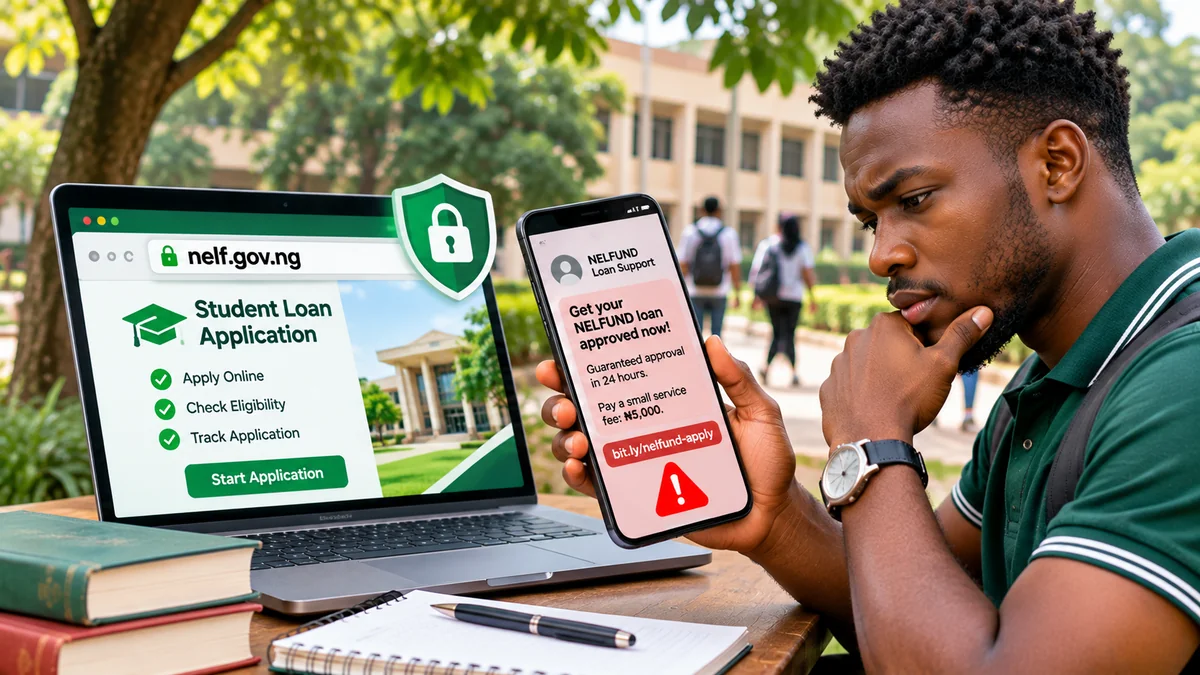
A student applying for the NELFUND student loan in the 2026/2027 academic session may receive a WhatsApp message promising guaranteed approval, an SMS urging immediate registration, or an offer from a supposed agent who claims to have direct access to the Nigerian Education Loan Fund. Some messages borrow government language, logos and announcements to make an unofficial website appear genuine.
The safest way to apply is to start at nelf.gov.ng and follow its official “Apply now” link to portal.nelf.gov.ng . Do not pay a stranger to secure approval, type your credentials into a link sent by an unknown contact, or share one-time passwords with anyone offering to “activate” a loan. NELFUND's real application system handles sensitive identity, admission and bank information, making impersonation scams especially risky.
This guide explains confirmed fake-portal warnings, the warning signs of fraudulent loan agents, how to distinguish legitimate school assistance from paid intermediaries, and what to do if you have already interacted with a suspicious page. Research verified: 6 November 2026.
NELFUND has issued real warnings about fake student loan websites
Fake NELFUND portals are not merely a theoretical risk. In June 2025, NELFUND warned about a fraudulent message claiming that President Bola Tinubu had ordered the reopening of the student loan portal. The News Agency of Nigeria reported NELFUND's statement identifying the linked website as fake and asking students not to submit personal or financial details through suspicious websites.
In November 2025, the Fund also disowned a separate loan-registration link distributed online, according to Punch . In April 2026, a new fraudulent notice claimed to offer a 2026 registration portal and cash transfers. NELFUND again urged applicants to use its verified channels and disregard the false claims.
These incidents share a pattern: the message presents itself as an urgent official update, uses the popularity of the student loan programme, then redirects readers away from established government channels. This article does not reproduce clickable scam URLs, because those addresses are not safe destinations for applicants.
For the 2026/2027 session, application-opening or deadline announcements should be checked on the official platform and with the student's institution. A genuine new academic-session window does not make an unrelated “registration” website authentic.
1. Know the real NELFUND website and application portal
NELFUND's live government website links to its student loan application portal through the “Apply now” control. The portal describes the programme as an interest-free loan with no hidden charges and includes a direct help link to the official support service.
| Purpose | Verified destination |
|---|---|
| Official programme website | https://nelf.gov.ng/ |
| Official student application | https://portal.nelf.gov.ng/ |
| Official support access | Follow “Get in touch” on nelf.gov.ng or “Get Help” inside the official portal |
Type the address yourself or use a bookmark saved from a verified visit. In your browser's address bar, check the actual hostname, not just the text displayed on the page. For example, portal.nelf.gov.ng belongs under the official nelf.gov.ng domain. A name merely containing those words before another site's final domain is not the same address.
An HTTPS padlock is useful because it shows an encrypted connection, but it does not prove that a website is operated by NELFUND: scammers can obtain HTTPS certificates too. Similarly, a result marked “Sponsored,” a professionally designed logo or a familiar-looking login page is not official verification.
2. Recognise the most common NELFUND scam warning signs
Scammers use familiar techniques, often combining more than one in a single message. The Economic and Financial Crimes Commission (EFCC) warns that phishing actors impersonate trusted organisations through emails, messages and fake websites to steal personal or financial information.
| Warning sign | Why it is suspicious | Safer response |
|---|---|---|
| “Pay ₦5,000 to unlock your NELFUND application” | Upfront approval or activation payments are inconsistent with the official no-hidden-charge portal | Do not pay; verify inside the official portal |
| “Guaranteed approval in 24 hours” | No outside agent can bypass eligibility and verification checks | Check your own application status through NELFUND |
| A shortened URL or unusual domain | The link could redirect to a credential-harvesting website | Open nelf.gov.ng independently |
| Request for OTP, password or email login | These details can allow account takeover | Never disclose one-time codes or passwords to an agent |
| Personal account for a “loan processing fee” | Funds may go directly to a scammer | Do not transfer; report the demand |
| “Last chance—share with ten classmates” | Urgency and viral forwarding pressure discourage verification | Check dated notices from official sources |
| Unsolicited requests for NIN, BVN and passport images | Identity information could be misused | Submit data only through the verified application process |
The presence of one unusual detail does not conclusively prove fraud. Nevertheless, when a message demands payment, secret codes or an unfamiliar login destination, stop and verify independently before taking any action.
3. Do not confuse a school help desk with a paid application agent
Some universities, polytechnics and colleges maintain legitimate NELFUND desks to help students correct enrolment data, matriculation numbers and institutional charges. These offices may work through the registrar, bursary or designated ICT team. They help with the institution's administrative responsibilities; they do not have a lawful shortcut that guarantees loan approval.
FlyingEze has reported on NELFUND's instruction to institutions to verify and upload student data . That process helps explain why an application can be delayed even where the student entered information correctly.
Before giving information to someone claiming to represent a school office, independently check the university's official website, student portal or published contact directory. Some schools may publish specialised correction forms or temporary links; these are not automatically fraudulent simply because they are hosted outside the NELFUND domain. However, verify them directly with the institution before entering sensitive data.
Be especially cautious with unauthorised cybercafé operators or private “agents” who ask to hold your login, NIN slip, BVN, bank-card details or email password. Paying for ordinary typing or internet access is different from being promised special NELFUND approval. If someone assists with your form, keep control of your email, password, device and account, and review every submission yourself.
4. Why NIN, BVN, OTP and student records are valuable to scammers
NELFUND legitimately verifies information including identity details, JAMB/admission records and, where applicable, BVN. That need for accurate information gives fake portals an opportunity to request data that appears relevant. The distinction is who receives the information and through which authenticated process, not whether an identifier is ever legitimately needed.
A fake site could use submitted details for identity impersonation, additional phishing attempts or attempts to access other accounts. An OTP or email password is especially sensitive because it can help someone take control of an account. A scammer who controls the email associated with a loan application might attempt account recovery or intercept legitimate messages.
Use a unique password for your application and email accounts, activate multifactor authentication where supported, and avoid reusing passwords elsewhere. Never send your one-time login code to a person claiming to be “customer care.” If a page asks for information unrelated to the application, leave and confirm the request from the official portal.
5. Check social-media announcements before sharing them
Fake notices may include government crests, official-looking signatures, copied screenshots or claims of a presidential directive. NELFUND's April 2026 warning concerned a message that used exactly that type of supposed authority to advertise a fraudulent new portal. A graphic that appears professionally designed is not evidence of an official announcement.
Look for the same notice on the official NELFUND website, its verified social-media account and your school's authorised communication channels. Check the publication date and academic session: an accurate 2025 notice may be inappropriate for a 2026/2027 application. Even a message from a trusted class representative can contain an unverified forwarded link.
Do not assume a search engine's top result is the authoritative site. Search rankings and advertisements are not government endorsements. Open an established bookmark or type the official address directly.
6. Check application status without paying an “expediter”
An application that is pending, rejected for a mismatch or awaiting institutional verification does not prove that an agent can “unlock” it. The official student portal is the proper starting point for checking the state of an application and locating the supported help pathway.
Confirm your name, admission details and institution records. Where the problem is with a JAMB registration number, matriculation number, programme or uploaded fees, ask the appropriate institutional office to review it. Where it is a bank-data or identity mismatch, contact the relevant bank or authority through authenticated channels.
FlyingEze's report on student concerns about delayed NELFUND payments demonstrates the importance of checking actual records and following up with the responsible organisation. A promise to “release your upkeep today” in exchange for a personal transfer should not be treated as a solution.
7. What to do if you clicked a suspicious NELFUND link
Your response depends on what happened. Clicking a link, entering an identity number, sharing a password and transferring money create different risks. Do not panic or pay anyone who offers paid “recovery”; take the protective actions relevant to your exposure.
| What happened? | Immediate response |
|---|---|
| You opened a suspicious page but entered nothing | Close it; avoid downloads; update your browser and check the device if a file was downloaded |
| You entered an account password | Change it on the genuine site, update reused passwords and secure the associated email account |
| You shared an OTP | Change affected credentials immediately and report possible account takeover through the verified service |
| You submitted NIN, BVN or identity documents | Contact the relevant bank and identity-data authority for protective advice; watch for new impersonation attempts |
| You sent money to an “agent” | Contact your bank's fraud desk immediately, preserve transfer evidence and report the fraud |
| You installed a suspicious app or file | Disconnect if necessary, run up-to-date security checks and seek trusted technical assistance |
The Central Bank of Nigeria's consumer guidance emphasises prompt reports of suspected account compromise and fraud. If a transfer has occurred, give your bank the transaction reference, recipient information and time of payment. Ask the bank about urgent restrictions or recovery procedures; reversal is not guaranteed.
Secure your email account, since attackers may use it to reset passwords elsewhere. Retain screenshots of the suspicious message and the URL for a report, but avoid forwarding live scam links to classmates. If financial credentials were exposed, consider monitoring account activity and following the bank's instructions on replacement cards or extra security controls.
8. Where to report fake NELFUND websites and loan fraud in Nigeria
NELFUND's June 2025 warning, carried by the News Agency of Nigeria , provided info@nelf.gov.ng for suspicious-message reports. Because contact channels can change, applicants should confirm the current channel using NELFUND's official contact page or its portal help link.
The Nigeria Police Force National Cybercrime Centre operates a cybercrime reporting portal. The EFCC also urges people to report phishing and fraudulent activity to the agency or another law-enforcement authority. If you have lost money, contact your bank promptly as well—do not wait for a law-enforcement response before notifying the financial institution.
A useful report includes the suspicious page URL as plain text, screenshots, the date and time, the scammer's message or contact identifier, any transfer reference and a short explanation of what information was submitted. Share sensitive material only through a verified reporting channel. Do not publish complete NIN or BVN numbers publicly to demonstrate that you have been defrauded.
9. A safe 2026/2027 application workflow students can follow
- Open the verified website: type nelf.gov.ng directly and use the official application link.
- Check the session: confirm that the current application flow applies to your institution and 2026/2027 academic year; do not rely on an old deadline graphic.
- Verify records: review JAMB, NIN, matriculation details, institutional fees and the bank account intended for any approved upkeep payment.
- Use your own contact details: keep control of the registered email, phone and recovery methods.
- Submit only requested information: read each field and confirm the browser remains on the official portal before entering sensitive details.
- Review the loan terms: understand that the scheme is interest-free but not an automatic grant.
- Keep evidence: save legitimate acknowledgement numbers and records without posting identifiers in public chats.
- Track progress independently: check your dashboard or verified support rather than contacting an unsolicited agent.
- Report suspicious messages: save the evidence and notify the relevant authority without circulating dangerous links.
If you use a shared phone, school computer or cybercafé, log out when finished, avoid saving credentials in a public browser, and check that copies of your NIN or admission documents are not left behind on someone else's device.
Common questions about fake NELFUND portals and application agents
Is the NELFUND student loan application free?
The verified NELFUND portal advertises an interest-free loan with no hidden charges. Do not pay a third party for guaranteed approval or an unofficial “activation” fee. Any separate charge for optional private printing or internet access is not a NELFUND approval fee.
Is portal.nelf.gov.ng a genuine application address?
Yes. The official nelf.gov.ng website links directly to portal.nelf.gov.ng . Verify the exact hostname in your browser rather than trusting similar-looking addresses or link labels.
Can a university NELFUND desk help me?
Yes. Official school desks can help with institutional student records and application-related administrative questions. Verify the office through your institution, and do not confuse legitimate support with a private person promising to override approvals.
Should I share my BVN or NIN with a NELFUND agent on WhatsApp?
No. The legitimate application may request identity information through the authenticated portal, but you should not send identifiers or documents to an unsolicited WhatsApp contact or unofficial form.
Can an agent guarantee that NELFUND will approve my loan?
No outside agent can credibly guarantee approval or eliminate required checks. Be suspicious of claims of special internal access, instant disbursement or a fee to move your application ahead of others.
What if I have already transferred money to a fake loan agent?
Report the transaction to your bank's fraud desk promptly. Save the transaction reference and suspicious messages, secure any exposed accounts, and submit a complaint through verified NELFUND or law-enforcement reporting channels. Recovery is possible in some cases but cannot be promised.
Conclusion
The strongest protection against fake NELFUND portals, application agents and student loan scams is independent verification. Start from NELFUND's official website , confirm the actual application domain, and keep passwords, one-time codes and sensitive identity records away from strangers.
For 2026/2027 applicants, rumours about application openings, instant approvals or “release fees” should never replace information from the authentic portal and your institution. If a suspicious site or intermediary has already received your details, secure your accounts and report the incident promptly. Access to student finance should not come at the cost of exposing your identity or savings to fraud.