ARE you over 40 years old? If so, you would have been invited to a mid-life health MOT by the NHS, and it is vital you attend.
The Check is a 20-minute appointment that could save your life.
 Dr Zoe Williams helps Sun readers with their health concerns
 One reader who is suffering with constant urine infections asks for advice Credit: Getty
A new study suggests that people who attend are 32 per cent less likely to die in ten years. This raises to 43 to 46 per cent in people in their late 60s and early 70s.
At your free assessment, a health professional will measure your weight, height and blood pressure, and take a quick finger-prick or blood sample to check cholesterol and other things. You will also be asked lifestyle questions.
From this, you will be given advice depending on your risk of conditions including , , kidney disease or .
The check-up is offered every five years until you are 74.
If you are eligible but have not been invited, please contact your practice.
Here’s a selection of what readers have asked me this week . . .
No end to infections
Q) I HAVE been struggling with constant urine infections, 15 times in three years.
I have tried so many different antibiotics but while they worked initially, they have little effect now.
I have seen several doctors, had a cystoscopy, which ruled out a tumour, and was prescribed D-Mannose with no results.
I self-catheterise three times a day, as requested. I would be grateful for any advice but please do not tell me to see the hospital’s urologist, as every time the doctors say they will contact them for an appointment, nothing happens.
A) I’m really sorry that you are going through this. It is understandable that you feel stuck in a loop.
Self-catheterisation can be very important but it also makes urinary infections more complicated.
If urine is being retained, bacteria can sit in the bladder so infections may keep returning or never clear.
The key question is whether each episode is a true infection, confirmed on urine culture, and whether the antibiotics match the bacteria.
After repeated antibiotics, resistance becomes more likely so treatment should ideally be guided by lab results rather than guesswork.
I would ask your GP surgery for a proper recurrent UTI review, not just another urgent prescription. This should include reviewing your urine culture , kidney function, discussing catheter technique, how often you catheterise, whether you are fully emptying and whether constipation is contributing.
If urology appointments are not happening, ask the GP surgery to confirm which hospital the referral was made to and contact the urology secretaries to see where you are in the queue and when you can be seen.
Your GP may also be able to send an Advice and Guidance request to urology while you are waiting or refer you to a continence or bladder nurse service, who can often help with catheterisation technique and bladder-emptying plans.
There are prevention options, depending on your kidney function and cultures. These may include methenamine hippurate (Hiprex), low-dose antibiotic prevention, or “rescue” antibiotics, but these need clinical oversight.
D-mannose may help some people, but evidence is mixed. You are not being difficult. This needs a coordinated plan, not repeat cycles.
Q) I’VE had these red marks on my legs for nearly three weeks and I’m worried about them. They aren’t lumpy or itchy and look like they are under the skin.
I thought it was an insect bite but when I rolled a glass over the mark it didn’t change appearance, so I don’t think it is.
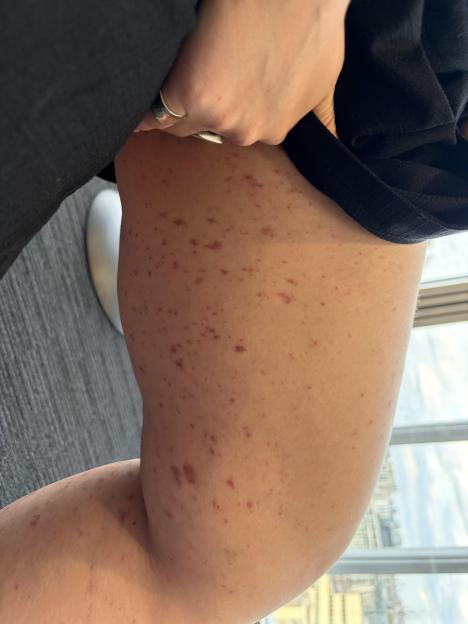 A Sun reader who is worried about marks on their leg writes in to Dr Zoe Credit: Supplied
I don’t have any symptoms but the marks are spreading over my legs, some are on my stomach.
I went to the doctors and was told that they are something called a petechial or purpura rash, which I think is sometimes referred to as Henoch-Schönlein purpura, that the cause is unknown, and nothing can be done to get rid of them, and they should disappear naturally.
I feel in the dark about what this is.
A) I can understand why you’re worried.
Petechiae are tiny red or purple marks caused by a small amount of bleeding under the skin.
Purpura is similar but usually describes larger areas.
Because the blood is under the skin, these marks do not fade when pressed with a glass.
But petechiae or purpura describe the appearance, not the cause. Triggers can include minor trauma, viral illness, inflammation of small blood vessels, medicines, platelet problems or clotting issues.
Previously called Henoch-Schönlein purpura, IgA vasculitis is inflammation of the blood vessels, usually after a virus. It’s one possible cause but not the only one.
Other causes are low blood platelet levels, side effects from medications or liver or clotting disorders.
While your GP is correct that many post-viral rashes resolve on their own, the fact that the spots are actively spreading warrants a routine follow-up for peace of mind and monitoring.
You could ask whether blood count platelets, clotting, kidney function, blood pressure and urine checks are needed.
Seek urgent help if you feel unwell, develop a fever, severe headache, neck stiffness, unusual bleeding, tummy pain, joint swelling or blood in urine.
Pals judge me for taking Wegovy
 Another reader needs advice on taking Wegovy pills – feeling she is being judged by pals Credit: Getty
Q) I’M 31 and I’ve started to take the . My BMI is overweight, not obese, and I have struggled to lose weight for a long time.
Eating well has not been the top of my agenda, due to grief from my mum dying.
Some of my friends have judged me for starting it, thinking it’s dangerous for someone my age. What is your view?
A) I’m sorry about your mum. Grief can affect eating, , motivation and self-care, and that is not a personal failure.
I also understand how painful it can feel when friends judge a decision that is really about your own body and wellbeing.
Wegovy is a type of GLP-1 that has long been used in type 2 diabetes because it helps regulate blood sugar, and it also affects appetite, fullness and weight.
It is prescribed specifically for weight management, but it is a prescription medicine that has potential risks associated.
At 31, your age alone is not the issue. The bigger question is whether this is clinically appropriate for you.
The risk-benefit balance is very different for someone living with complex or obesity-related illness, where weight loss may reduce risks such as heart disease, diabetes, sleep apnoea or joint damage, compared with someone who is otherwise healthy but in the overweight BMI range.
That does not mean your distress about your weight is not real, but that the potential benefits of treatment need to clearly outweigh the risks.
These medicines can cause nausea, vomiting, constipation, diarrhoea and reflux and less commonly, gallbladder problems or pancreatitis.
I would want to be sure this has been prescribed by a regulated clinician, with proper monitoring of side-effects, contraception, nutrition and .
So my view is not you are wrong or lazy, but that you deserve care that supports your long-term physical and emotional health, not just the number on the scales.
TIP OF THE WEEK
IF you develop a bullseye rash – a central red spot, surrounded by clear ring and an outer red ring – please see your GP.
It may be a symptom of Lyme disease, spread by a tick bite, which is more common in summer. You may also have flu-like symptoms. Your GP will prescribe antibiotics.