
Anthropic Confirms Biology Lab as Claude Expands Into Life Sciences
Anthropic has confirmed it operates a Bay Area wet biology lab as Claude expands into life sciences, linking AI research with physical experiments.
 Written byEze Chidiebere Paul
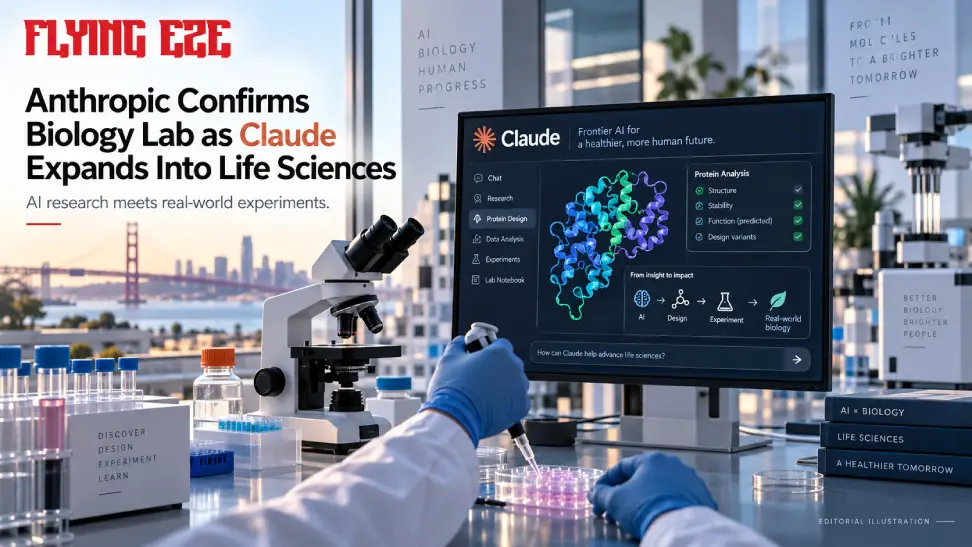
Anthropic has confirmed that it operates a physical biology laboratory in the San Francisco Bay Area, extending the Claude maker’s life-sciences push beyond computer-based research and into real-world experiments.
The development, reported by Reuters on 18 September 2026 and confirmed by Anthropic’s head of life sciences Eric Kauderer-Abrams, adds an important physical layer to the company’s growing effort to use artificial intelligence in biology. Anthropic has separately demonstrated Claude designing protein binders that were then tested by independent laboratories, and this week opened a verification programme giving approved life-sciences professionals access to models and capabilities that are more permissive for specialised biological work.
Key takeaways
- Anthropic has confirmed it is conducting physical biology experiments in its own Bay Area wet lab as well as with external partners.
- The company says the facility is not specifically a drug-discovery lab, despite its broader ambitions to accelerate life-sciences research.
- Anthropic is exploring how Claude can help automate laboratory work while maintaining human oversight.
- Recent Anthropic research found Claude-designed protein binders worked against 14 of 15 tested targets, with external laboratories physically validating the designs.
- The company’s new Life Sciences Verification Program expands controlled access to advanced biology-related capabilities for verified professionals.
What Anthropic has confirmed
Reuters reported that Anthropic has established a wet lab in the San Francisco Bay Area where physical biological experiments are being conducted. Kauderer-Abrams told Reuters that real laboratory work remains the final test for biological research and said Anthropic is doing some of that work in its own facilities while also working with external partners.
An Anthropic spokesperson clarified to Reuters that the facility is not specifically a drug-discovery laboratory. That distinction is important. The company’s broader life-sciences strategy includes tools and research relevant to early drug development, but operating a biology lab does not mean Anthropic is itself running a conventional pharmaceutical development programme or clinical trials.
Claude has already moved from computation to wet-lab validation
The lab disclosure follows a series of increasingly ambitious scientific projects from Anthropic. In research published on 18 August, the company said Claude models autonomously ran protein-binder design campaigns against 15 targets. External evaluators Adaptyv Bio and Twist Bioscience then produced and tested the designs in physical laboratories.
According to Anthropic, Claude successfully designed binders against 14 of the 15 targets. Across the experiment, 354 binders were produced from 1,320 designs. The company reported hit rates between 22% and 35% depending on the setup, compared with the 10–15% it described as typical for current protein-design campaigns.
Those results are potentially significant, but they should not be confused with creating finished medicines. Anthropic itself stresses that designing a high-affinity protein binder is only an early step. Drug candidates still face extensive testing for safety, efficacy, manufacturing, pharmacology and, eventually, clinical performance.
Why a physical lab matters for AI science
AI can generate hypotheses, analyse data and design candidate molecules at extraordinary speed, but biology ultimately has to work in the physical world. A molecule that looks promising in a computational model can fail when scientists synthesise and test it.
That makes laboratory validation a major bottleneck as AI-generated scientific output increases. If an AI system can propose hundreds or thousands of experiments faster than researchers can physically perform them, the limiting factor shifts from idea generation to laboratory execution, measurement and verification.
Anthropic’s interest in physical automation appears aimed at that gap. Reuters reported that the company wants to explore how Claude can direct robotic laboratory equipment, although Anthropic says human oversight remains essential and describes AI-driven laboratory automation as being at an early stage.
Anthropic is widening controlled access to biology capabilities
The timing also coincides with Anthropic’s new Life Sciences Verification Program , announced on 17 September. The programme gives verified life-sciences professionals access to Mythos, Opus and Sonnet models with safeguards designed to permit a wider range of legitimate biology-related work.
Anthropic says the beta programme initially targets teams and institutions and covers areas including drug discovery, research biology, clinical development and manufacturing. The company says dozens of organisations participated during early access.
The controlled-access approach reflects the dual-use nature of advanced biological AI. The same capabilities that could help researchers analyse proteins or accelerate therapeutic development may also raise safety concerns if powerful biological tools are made available without appropriate safeguards.
Claude’s broader life-sciences strategy
Anthropic has steadily expanded its scientific products during 2026. Claude Science, launched in June, provides researchers with an AI workbench integrating scientific tools, computing resources and auditable outputs. In August, Anthropic also expanded programmes providing subscriptions and computing credits to researchers.
The company’s protein-design experiments show where those efforts could lead: AI systems that do more than answer scientific questions and instead coordinate complex research workflows involving specialist software, large amounts of compute and eventually physical laboratory equipment.
What remains uncertain
The existence of a wet lab is notable, but several important details remain unclear. Anthropic has not publicly described the lab’s size, the full range of experiments conducted there or specific diseases being targeted. Reuters also reported that the company is not currently running clinical trials.
There is therefore a substantial distance between Anthropic’s current experiments and any claim that Claude can independently discover and deliver new medicines. Most potential drugs fail during development, and successful laboratory results are only one part of a long scientific and regulatory process.
What happens next
The more consequential question is whether AI can reliably connect computational reasoning with automated physical experimentation. If systems such as Claude can propose experiments, operate scientific tools, analyse results and iterate while remaining under effective human supervision, parts of research that currently take weeks or months could become substantially faster.
Anthropic’s new lab provides infrastructure to test that proposition in the physical world. The results — including failures and safety limitations — will matter more than the existence of the facility itself.
Sources
Continue reading

Joby Completes 3,199-Mile Autonomous Flight Across US
Joby Aviation says its autonomous J208 flew 3,199 miles across the US with zero control inputs from its onboard safety pilot. Here is what the milestone means.
Nigeria Sets 180-Day Roadmap for Digital Free Zones Initiative
Nigeria has ordered a 180-day roadmap for its Digital Free Zones initiative, with work spanning regulation, tax, banking, immigration and digital government processes.

Researchers Used Claude to Breach OpenAI Accounts in Bug Bounty Test
Hacktron AI researchers used Claude in an authorised security investigation that exposed weaknesses affecting OpenAI accounts. OpenAI says it fixed the issues.

AI could spawn a ‘silicon species’ of robots capable of rivalling humans, Microsoft boss warns
ARTIFICIAL intelligence could spawn a “silicon species” capable of rivalling humans, a cyber boss has warned. Microsoft’s AI chief said the tech must be strict...