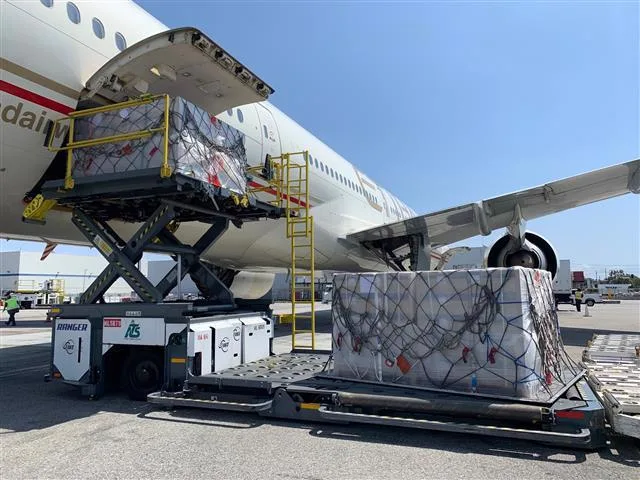
Shipping products from Africa to the United States through Los Angeles International Airport (LAX) takes more than booking cargo space. Exporters must confirm that their goods are admissible, prepare accurate trade documents, choose an air-freight partner, calculate import charges and arrange US customs clearance before the consignment leaves Africa.
This practical checklist is designed for entrepreneurs, manufacturers and small businesses sending commercial goods from countries such as Nigeria, Ghana, Kenya or South Africa to buyers in Southern California. It explains the key decisions, typical documents and responsibilities, including developments in US low-value import rules in 2026.
Essential distinction: LAX is an airport for air cargo. It is not the Port of Los Angeles seaport, and commercial freight is not collected at a passenger baggage carousel. The freight forwarder, airline cargo handler, consignee and US customs broker coordinate shipment and release.
1. Confirm that LAX is the right entry point
Los Angeles World Airports describes LAX as an important air-cargo and distribution centre. Its official cargo information explains the airport’s commercial role and links to cargo-related services.
Air freight often suits urgent, high-value, smaller or time-sensitive shipments, but not every product is economical to send by air. Compare air freight with ocean freight if you are exporting bulky goods, raw materials or inventory without strict delivery deadlines.
Before obtaining quotes, establish whether the shipment will enter US commerce in California, be moved under bond to another US customs port, or transit onward to another country. These are different processes. A freight itinerary naming “LAX” does not, by itself, establish where customs clearance will occur.
2. Check product admissibility before accepting an order
Ask the US buyer or importer to identify the product’s complete description, materials, purpose, manufacturer and country of origin. Then verify the US import rules for that exact item—not merely the category name.
- Food, beverages and dietary products: The US Food and Drug Administration explains applicable facility-registration and prior-notice obligations for many food shipments, alongside relevant product rules. For covered air shipments, FDA generally requires prior notice to be submitted and confirmed at least four hours before arrival; other timing rules and exceptions may apply.
- Plants, seeds and agricultural commodities: Consult the USDA APHIS import guide and its Agricultural Commodity Import Requirements database. Eligibility, permits and phytosanitary documentation depend on the exact item and origin.
- Cosmetics, medicines and medical devices: Review the applicable FDA import requirements . Do not describe a cosmetic as a medical product or make unsubstantiated health claims.
- Textiles and apparel: Check origin, labelling, fibre-content, care-labelling and applicable consumer-product safety requirements.
Some goods may be restricted or prohibited regardless of the shipping method. Ask the importer or broker for a written compliance assessment before dispatching an expensive consignment.
3. Agree who will act as US importer of record
The importer of record is responsible for key customs obligations, including accurate declarations, admissibility and appropriate duties. Often this is the US buyer, but the commercial arrangement can differ.
CBP says a foreign company may, in certain circumstances, import without having a US company as the importer of record, provided the applicable rules are met, including an appropriate resident agent. This is more complex than simply naming a shipping recipient. See CBP guidance on foreign importers .
Before shipping, record the importer’s legal name, address, identifier, customs broker and authority to make entry. A licensed US customs broker can handle filings, but CBP emphasises that importers remain responsible for compliance .
4. Choose a freight forwarder and define delivery terms
Request written quotations from forwarders experienced with your commodity and African origin airport. Confirm the carrier, expected routing, transit time, cargo cut-off, US arrival cargo terminal, screening needs, insurance options and who pays destination handling and storage charges.
Specify the agreed Incoterms® 2020 rule and a named place. For example, FCA can be used when the buyer arranges the main carriage after delivery to a carrier; DAP places different costs and risks on the seller; DDP may require the seller to handle import duties and clearance. DDP should not be promised unless the exporter can legally and operationally meet those obligations. Use the International Chamber of Commerce guidance to understand the distinctions.
Ask for an itemised door-to-door landed-cost estimate, not just an airport-to-airport freight rate.
5. Prepare the core export and import documents
Requirements vary by product, country and transaction. The following is a starting checklist, not a universal list of mandatory documents.
| Document | Why it matters |
|---|---|
| Commercial invoice | Names seller and buyer; accurately states goods, quantities, values and relevant trade details. |
| Packing list | Shows each package’s contents, weights, dimensions and marks. |
| Air waybill (AWB) | Records the air carriage shipment and supports cargo tracking; unlike certain ocean bills of lading, it is not a negotiable title document. |
| Origin evidence or certificate | Supports the declared country of origin when requested or required. |
| Product-specific permits/certificates | May include phytosanitary, health, testing or regulatory records. |
| Customs and broker details | Supports appropriate US entry filings, tax/duty assessment and cargo release. |
Cross-check invoice figures against packing-list quantities, package labels and the AWB. The US International Trade Administration explains the functions of common shipment documents; CBP sets commercial-invoice information requirements .
Avoid vague descriptions such as “African goods” or declaring a sample as having no value when it has a real customs value.
6. Complete your home-country export formalities
Africa does not have one export-clearance system. Use the official customs, trade and product-regulator requirements for the particular country of dispatch.
For Nigerian exporters
The Nigerian Export Promotion Council (NEPC) describes exporter registration, export contracts, commercial invoices, packing lists, quality-assurance documents and the Nigeria Export Proceeds (NXP) form used in formal export procedures. The applicability of inspections and certificates depends on the goods and transaction.
Start with an NEPC exporter certificate where required, coordinate NXP processing with the authorised dealer bank and confirm the correct Nigerian customs procedure with your clearing agent. Agricultural, food or animal products can trigger additional documentation from the competent authorities.
Exporters from Ghana, Kenya, South Africa and elsewhere should use their own authorities rather than copying Nigeria’s document names or procedures.
7. Pack, label and screen the cargo correctly
Agree packaging standards with the forwarder and airline before collection. Use sturdy, accurately marked cartons or suitable pallets; document gross and net weights; protect fragile contents; and verify dimension and weight limits. For temperature-sensitive products, confirm cold-chain capability at every transfer point, not just at the departure airport.
Air freight charges can be based on chargeable weight, using the greater of actual weight and a carrier-specific volumetric calculation. Oversized cartons can make shipping more expensive even when they are light.
Declare batteries, aerosols, chemicals or other potentially dangerous goods truthfully. Some products require specialist classification, packing, marking, labels and shipping declarations under the IATA Dangerous Goods Regulations . Never hide restricted contents inside a general cargo description.
8. Recalculate US duties and landed cost for 2026
Do not assume that a small parcel enters the United States duty-free. CBP confirms that the general US$800 de minimis duty-free treatment was suspended for imports from all countries effective 29 August 2025, subject to relevant statutory exceptions. Low-value goods can therefore incur import duties, taxes or fees. See CBP's de minimis guidance .
Have the broker classify the goods using the applicable 2026 Harmonized Tariff Schedule of the United States (HTSUS) . Rates may depend on classification, origin, trade measures and other current requirements. Country of export and country of manufacture are not necessarily the same.
A realistic landed-cost estimate should include product cost, local export handling, freight, insurance, applicable customs duties and fees, brokerage, destination handling, potential inspection/storage costs and final delivery. Do not treat any assumed preferential tariff or trade programme as automatic eligibility.
9. Arrange LAX cargo arrival, clearance and pickup
Commercial shipments arriving at LAX generally proceed through airline cargo handling facilities rather than passenger terminals. The consignee, forwarder and broker should agree in advance who will receive arrival notices, submit customs entry information and arrange collection after release.
The US Automated Commercial Environment (ACE) is used for import and other trade reporting. A qualified importer or broker files the relevant entry information, and other agencies may review regulated products. Physical arrival does not mean goods have already been cleared or are ready to collect.
Ask your service providers to confirm both customs release and cargo-terminal availability before dispatching a driver. Verify collection address, opening hours, identification, delivery order, payment of handling charges and any free-storage deadline. Keep the AWB number and forwarder contact accessible to both seller and buyer.
10. Track exceptions and keep the evidence
Build a simple shipment log recording: booking confirmation, handover date, AWB number, departure, arrival, customs status, inspection or hold notices, release, final delivery and the buyer's receipt.
If cargo is held, ask which authority issued the hold and for the specific missing information. Do not describe a carrier delay as a customs rejection without evidence. Save signed delivery records, updated invoices and cost receipts to help reconcile the transaction or resolve a dispute.
After each shipment, compare actual cost and transit time with the quotation. This is especially useful for exporters planning repeat shipments or negotiating better future rates.
Quick pre-shipment checklist
- ☐ Product and country-of-origin import eligibility verified with the US buyer or broker.
- ☐ US importer of record, consignee and customs broker confirmed.
- ☐ Written Incoterms® rule and named delivery point agreed.
- ☐ Forwarder has confirmed LAX routing, cargo acceptance and delivery timetable.
- ☐ Commercial invoice, packing list, AWB arrangements and applicable permits checked.
- ☐ Home-country export registration, banking and customs formalities completed.
- ☐ Packaging, screening and dangerous-goods checks completed.
- ☐ Current HTSUS classification, duties and total landed cost reviewed.
- ☐ LAX cargo terminal pickup or onward delivery plan confirmed.
- ☐ Tracking contacts and responsibility for delays agreed.
Frequently asked questions
Can I send commercial goods through the LAX passenger terminal?
Commercial air freight normally moves through airline cargo facilities and freight handlers. Passenger baggage rules are different. Confirm whether your shipment is booked as air cargo, express courier, postal mail or accompanying baggage.
Is LAX the same as the Port of Los Angeles?
No. LAX is an airport handling air cargo. The Port of Los Angeles is a seaport handling maritime trade. A shipment routed through one does not automatically follow the procedures of the other.
Do all African exports need an FDA certificate?
No. FDA requirements depend on the product. Food, cosmetics, drugs, devices and other regulated categories may face different obligations. Agricultural products may also be subject to USDA rules.
Does a shipment under US$800 avoid US import duty?
Not under the former general de minimis rule. CBP says that treatment was suspended for imports from all countries from 29 August 2025, subject to exceptions. A broker must assess the actual duty and fee position for the goods.
Conclusion
Exporting via Los Angeles International Airport can be practical for African businesses when speed and shipment value justify air freight. But reliable delivery depends on decisions made before goods leave Africa: verify admissibility, assign customs responsibility, prepare correct documents, calculate current duties and arrange the cargo-terminal handover.
Entrepreneurs travelling separately to meet suppliers or buyers can also consult FlyingEze's Los Angeles business-trip planning guide ; passenger travel and commercial cargo clearance remain separate processes.
Research verified 27 October 2026. Import rules, tariff measures and cargo-provider procedures can change. Confirm shipment-specific requirements with the relevant authorities and qualified freight or customs professionals before dispatch.