Historical retrospective: This newly researched article examines WWE's 2020 series Fight Like a Girl, first released on Quibi. It is not presented as a report newly published in 2020.
In April 2020, WWE stars Becky Lynch and Sonya Deville appeared in Fight Like a Girl, a short-form reality programme made for the now-defunct mobile streaming service Quibi. Rather than following championship contests or scripted wrestling rivalries, the series paired established performers with women seeking to build confidence and address personal challenges. WWE had confirmed the cast on 15 January 2020, and the programme began streaming on 13 April that year.
The collaboration brought together some of WWE's most recognisable female performers and a very different type of television storytelling. Its central premise was not that every difficulty could be solved by exercise. It was that discipline, encouragement and shared experiences might help participants take meaningful steps towards goals they had chosen for themselves. A contemporary WWE announcement and the company's April launch coverage establish the series' origins and format.
What was WWE's Fight Like a Girl?
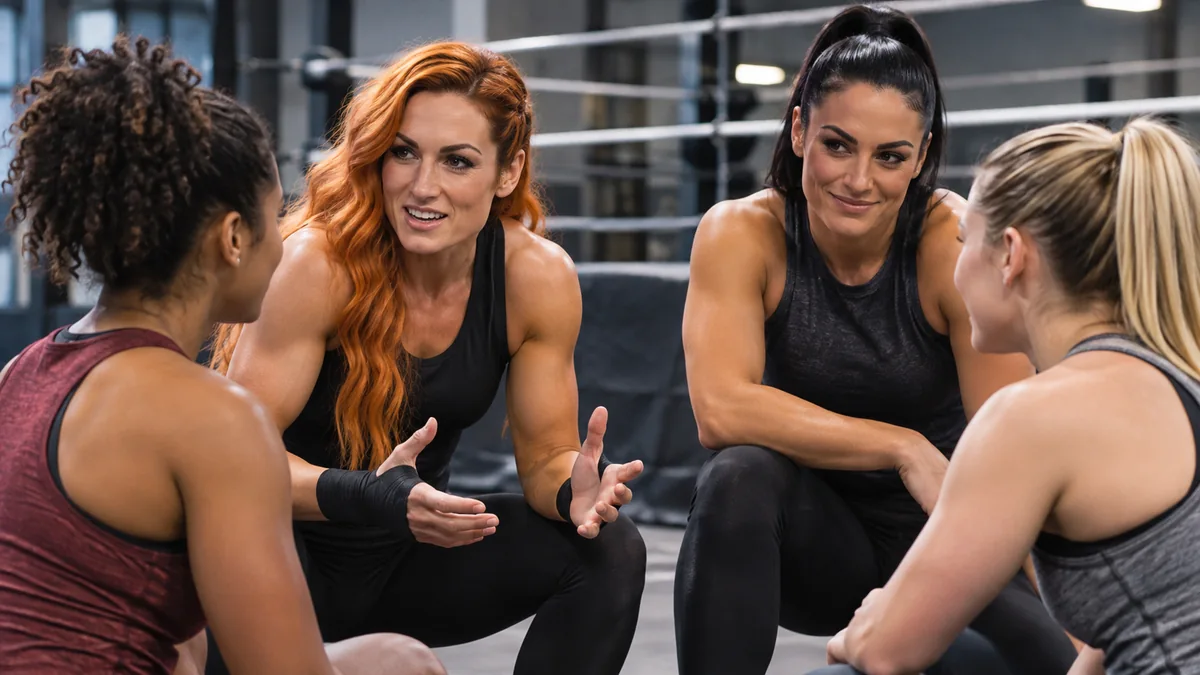
Fight Like a Girl was a reality and mentorship series produced by WWE Studios and Critical Content. Stephanie McMahon, then WWE's chief brand officer, introduced a female WWE performer to a participant facing an obstacle in her life. The two women would discuss the challenge, draw on personal experience and work through training activities associated with the WWE Performance Center in Orlando, Florida.
The format moved away from the usual boundaries between wrestling celebrity and television audience. The athletes were not presented simply as competitors preparing for matches. Instead, they were mentors explaining how they had dealt with setbacks, difficult decisions and pressure. The participants were not wrestling recruits: the programme was about their own circumstances, not earning a WWE contract.
Footage combined conversations with physical workouts and an end-of-episode presentation. Its message was that strength could be understood in more than one way. The concept was straightforward enough for a brief mobile video, although real personal change is generally more complicated than any television segment can fully demonstrate.
WWE had originally publicised the project in July 2019 , before identifying the participating stars in January 2020. The programme eventually launched as part of Quibi's original slate in April.
Why Becky Lynch was a prominent participant
Becky Lynch was one of the headline performers in the 2020 cast announcement. At the time of the series' launch, WWE identified her as its Raw Women's Champion. Her established onscreen identity, built around competitiveness and self-belief, made her a recognisable figure for a programme about confidence and resilience.
But Fight Like a Girl asked something different of a wrestling star. In the ring, confidence is expressed through performance, character and competition. In a mentoring setting, it means listening, communicating and helping somebody articulate a goal. The series offered viewers a chance to see these skills used in a less confrontational environment.
Episode listings identify Lynch's instalment as Becky Lynch and Rachel. The important verified point is the pairing itself. The available promotional material describes personal mentoring and physical training, but it does not justify inventing private conversations or presenting a television resolution as proof of lasting life changes.
Lynch's inclusion also illustrated the appeal WWE believed its women's roster had beyond wrestling broadcasts. A performer known to millions for her in-ring persona could connect with an audience interested in personal development and unscripted human stories. That intersection between sport, entertainment and celebrity was central to the Quibi project.
Sonya Deville's episode: mentorship based on personal experience
Sonya Deville's involvement provided particularly clear evidence of how the format worked. Deville, whose real name is Daria Berenato, had spoken publicly about her experience of coming out as lesbian and finding the confidence to live openly. Her own history was relevant to her work with a participant named Samantha in the programme.
In a 22 May 2020 interview with TV Insider , Deville discussed mentoring Samantha, who was navigating how to speak openly with members of her family. Deville said they had connected through experiences of self-acceptance, and that the programme had involved both training and personal conversations. She also reported that they remained in contact after filming, an observation limited to the time of that interview.
In a separate 2020 interview published by Athleisure Mag , Deville described how the project combined physical exercise with emotional support. Her account makes clear that the mentoring element was not merely a promotional label: the show deliberately matched a participant with a wrestler whose experience could be relevant to her.
This aspect of the series deserves careful framing. A reality programme can give somebody space to tell a story, but neither a televised conversation nor a training montage should be mistaken for professional counselling or a guaranteed outcome. The relevance of Deville's episode lies in representation, empathy and the value of seeing an established public figure discuss a difficulty she had personally experienced.
Which other WWE stars appeared?
The official line-up also featured Sasha Banks, Brie Bella, Nikki Bella, Alexa Bliss, Charlotte Flair, Nia Jax and Natalya. Stephanie McMahon connected the participants with the stars and served as an executive producer. Programme listings record a ten-episode first season, with instalments featuring individual wrestlers or, in the case of the Bella Twins, a joint appearance.
The wider roster matters because the production was not designed as a one-person celebrity documentary. It assembled performers with distinct public images and experiences, creating room for different mentoring conversations. A participant working with Deville, for example, would not necessarily face the same concerns as someone paired with Lynch or the Bella Twins.
WWE's official production credits name Stephanie McMahon, Susan Levison and Ben Zierten for WWE Studios, alongside Tom Forman, Jenny Daly and Jon Beyer for Critical Content. The TVmaze programme record also documents the 2020 run.
How the WWE Performance Center became part of the story
The WWE Performance Center in Orlando supplied a recognisable setting and a practical structure for the programme. Participants trained in the same broader environment associated with developing professional wrestlers, although they were not being presented as WWE trainees.
That setting helped explain the show's visual language. Physical drills offered a way to communicate effort, persistence and progress on screen. Training also provided opportunities for mentors and participants to speak during activities rather than only in formal interviews. WWE's publicity emphasised an eventual reveal, which gave the short episodes a recognisable television narrative.
It is important to distinguish these production choices from independently proven results. Workout sequences can be emotionally compelling, and participants' accounts deserve to be taken seriously, but the available sources do not establish that every participant experienced a permanent transformation. The programme documented a limited period, not a long-term clinical or social study.
Why Fight Like a Girl launched on Quibi
Quibi was designed around premium, short-form programmes intended primarily for viewing on mobile devices. Its name reflected the idea of quick, self-contained viewing experiences, often lasting only a few minutes. A series built around one wrestler, one participant and one principal challenge fitted that approach.
For WWE, the partnership offered a way to reach viewers who might never sit through a full wrestling television broadcast. For Quibi, it provided established personalities and a recognisable global entertainment brand. The programme sat between reality television, sports celebrity content and inspirational storytelling.
Timing, however, shaped the experiment. Quibi launched in April 2020, as the COVID-19 pandemic disrupted working lives, travel and everyday routines. The premise of entertainment for people on the move arrived at a moment when many potential viewers were staying at home. That mismatch became part of later discussion about why the platform struggled, although no single factor fully explains a business's failure.
The first episodes of Fight Like a Girl were available on 13 April 2020, according to contemporary launch reporting . The show ultimately became a relatively brief example of how traditional entertainment companies were experimenting with a new distribution model.
What happened to Quibi after the series?
The series' story did not end with its spring 2020 debut. In October 2020, Quibi announced that it would wind down after approximately six months of operation. Contemporary coverage described a service that had failed to achieve the audience scale needed to sustain its business model. The closure meant that viewers could no longer treat Quibi as a continuing home for programmes such as Fight Like a Girl.
In January 2021, Roku announced an agreement to acquire rights to Quibi's programming library. Roku later explained that it planned to make more than 75 titles available through its advertising-supported Roku Channel. That development was significant because the closure of a streaming platform did not necessarily mean every programme made for it would disappear permanently.
Roku's own retrospective on the acquisition confirms the wider rights deal. Programme databases subsequently associated Fight Like a Girl with The Roku Channel. Actual viewing availability can change by country, licensing arrangements and date, so historical listings should not be treated as a guarantee that an episode is currently accessible in a particular territory.
Why the series remains relevant
Seen retrospectively, Fight Like a Girl offers two distinct stories. The first is about WWE's effort to present its female performers in roles beyond competition. It placed high-profile athletes beside everyday participants, made personal experience central to the episodes and explored how sporting discipline could intersect with emotional confidence.
The second is a media-industry lesson. The show was created for a platform with an ambitious distribution strategy that disappeared within the same year. Its continued presence in programme records illustrates why the history of a television series cannot always be understood by looking only at its original streaming service.
Those themes should not be confused with a promise that a brief exercise programme can solve complex difficulties. What the available evidence supports is a format designed around mentorship and participants' own goals. Whether the show produced long-term outcomes for every participant is a different question, and one the public promotional record cannot adequately answer.
WWE's women's division has remained a subject of wider news coverage; for a separate, more recent example, FlyingEze has also reported on Chelsea Green and the prominence of women's championship stories . That coverage concerns a different period and should not be read as part of the 2020 production.
A verified timeline of the Quibi collaboration
- 10 July 2019: WWE publicly outlined its collaboration with Quibi on Fight Like a Girl.
- 15 January 2020: Quibi and WWE named Becky Lynch, Sonya Deville and the other participating WWE stars.
- 13 April 2020: Fight Like a Girl premiered on Quibi.
- October 2020: Quibi announced plans to shut down the streaming service.
- January 2021: Roku announced its acquisition of distribution rights to Quibi programming.
Conclusion
Becky Lynch and Sonya Deville's appearances in Fight Like a Girl belonged to a particular moment in 2020: WWE was extending its stars' public roles beyond the ring, while Quibi was testing the market for celebrity-led mobile programming. The collaboration offered a platform for women to discuss confidence, challenges and personal experience through the language of sport.
The platform itself was short-lived, but the series remains a useful historical example of cross-media experimentation and athlete-led mentoring. Its most enduring lesson may be modest rather than spectacular: stories of resilience can resonate when public personalities listen as well as perform, even if real change cannot be measured by the length of a television episode.
Editorial disclosure: This article has been independently reconstructed from original corporate announcements, contemporary interviews and programme records. FlyingEze has not verified the original article's publication timestamp, and this reconstruction must not be presented as an untouched historical publication.