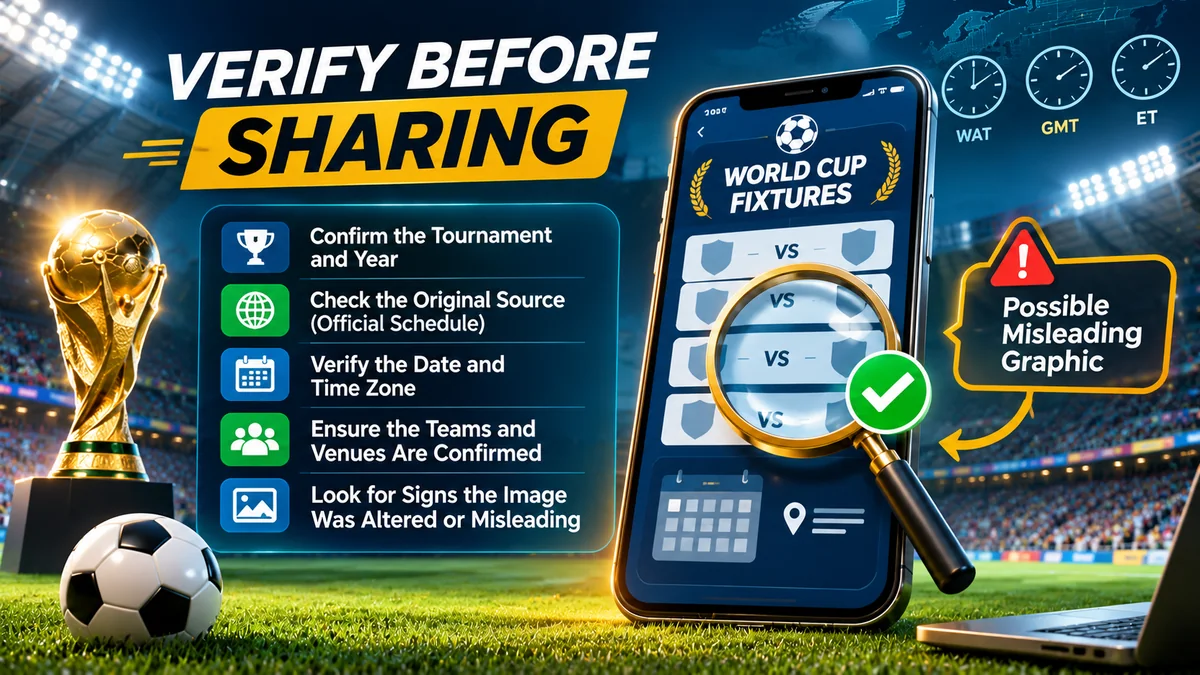
That glossy “World Cup fixtures of today” image in your WhatsApp group may be accurate, outdated, incorrectly converted to your time zone or entirely fabricated. Before forwarding it, confirm the competition and year, locate the original organiser's schedule, compare the teams, dates, times and stadiums, and check whether the image has been edited. A familiar football logo, a polished design or thousands of shares does not establish authenticity.
The same habits help readers check ordinary fixture cards, screenshots of match results and knockout-bracket predictions. This guide provides a practical verification process, with examples from the 2026 men's FIFA World Cup and research from FIFA and independent fact-checkers.
Date note (verified 25 November 2026): The 2026 men's FIFA World Cup took place from 11 June to 19 July 2026. Its fixtures are historical results, not games coming up today. Different FIFA competitions, including women's and youth tournaments and qualifiers, follow separate calendars. Never infer that a graphic labelled simply “World Cup” describes the men's senior finals.
Why viral World Cup fixture graphics are easy to misread
A social graphic compresses numerous facts into a small picture: national flags, team abbreviations, a competition name, kick-off times, venues, a date and sometimes a knockout bracket. Much of the surrounding context can disappear when someone crops the picture, removes the caption or forwards it from one group to another.
Even without deliberate deception, a graphic can become misleading. Someone might share an accurate pre-tournament calendar after a schedule update; crop out a time-zone label; reuse a picture from a previous tournament; or post an unofficial prediction as if it were a confirmed pairing. A football-themed template also makes it simple to create a convincing-looking image that contains entirely invented details.
The UK House of Commons Library's guidance on verifying images and videos recommends establishing who posted an image, seeking the original source, checking contextual claims and using reverse image search where useful. These principles apply directly to football schedule cards.
1. Check exactly which World Cup the image names
Start with the competition title, not the flags. “World Cup” may refer to the men's senior tournament, the FIFA Women's World Cup, a men's or women's youth championship, the Club World Cup or World Cup qualifying matches. Their schedules are not interchangeable.
Inspect the year, age category, gender category and qualification or final-tournament label. If the picture omits them, do not assume the competition from its colours or logo. Search the tournament name plus the two teams and the date. Then open the relevant competition page on FIFA's official website .
For example, a post claiming “2026 men's World Cup matches tonight” on 25 November 2026 cannot be an upcoming fixture list for that finals tournament: FIFA records its final as 19 July 2026. It might be an old picture, a misleading caption or a mix-up with another competition. The mismatch is a reason to investigate—not a licence to invent what the poster intended.
2. Find the original source, not just the account that shared it
A forwarded image may carry “Source: FIFA” even when no link to a FIFA page exists. Trace the claim back to its origin. Look for an organiser's publication, a federation announcement, an official competition page or a reputable outlet that gives a verifiable source.
Ask whether the sharing account posted the original graphic or merely copied it. A large following, a blue check, a news-style account name and an impressive watermark are not substitutes for corroboration. If the first visible copy is a screenshot of a screenshot, there may be several missing steps between the original and your screen.
Do not treat the absence of an obvious creator as proof of fraud. A fan can reproduce a schedule accurately. The correct test is whether the information matches an authoritative source, not whether the artwork has professional branding.
3. Compare every match with FIFA's current or archived schedule
For the 2026 men's finals, FIFA's official match schedule and results archive is the strongest reference point. It identifies the match, date, stadium and, once played, the result. Other FIFA competitions have their own fixtures pages, so do not use the men's finals archive to verify a women's or youth championship.
Check at least one fixture line by line, and check the whole graphic if you plan to share it as a complete daily programme. Match the competitors, date, kick-off, venue and stage. A graphic containing one correct headline fixture can still have errors in its other rows.
Remember that fixture calendars develop over time. FIFA initially announced the 2026 match framework before all group opponents were known. After the final draw, FIFA released updated venue allocations and kick-off details for all 104 matches . Differences between two authentic versions can reflect publication dates. Check the latest organiser record for the question you are trying to answer.
4. Verify the date, time zone and meaning of “today”
A fixture graphic that says “8:00 PM” is incomplete without a time zone or location. Is that the host city's local time, the publisher's time, GMT/UTC or the viewer's converted time? For readers in Nigeria, the standard is West Africa Time (WAT), UTC+1, which may place a late match in North America on the following calendar day.
Look carefully for small print such as “all times local”, “GMT”, “ET” or “WAT”. A US or Canadian host city's local UTC offset may vary with daylight saving time, and different host cities do not all share one time zone. Never apply a single US offset to an entire multi-city tournament.
The safest method is to open the official match listing, note the full date and kick-off with its stated zone, and convert it for your location. If the graphic says “today”, compare its reference date with the day you actually received it. Posts often survive in group chats long after the matches have finished.
For a more detailed explanation, FlyingEze readers can explore the broader 48-team World Cup format , which helps distinguish match stages and historical context.
5. Confirm that the teams and pairing were known at the time
A convincing graphic can identify teams that had not yet qualified or been drawn against each other when the graphic was supposedly published. Check the date on which its claims could first have been known.
In the 2026 tournament, some details were announced before the final draw, while the final draw and subsequent match allocation established additional team pairings and times. A purported fully confirmed group-stage card circulating before those details were final would need strong corroboration from FIFA.
The same principle applies to knockout fixtures. A genuine early bracket may list “winner of Group A” or a third-place qualification slot instead of a national team. That is not a design error. The identities depend on results. A social card that names both future knockout opponents as certain before the relevant matches have been decided is usually a prediction, not an official confirmed fixture.
6. Check the venue and match stage
Match posters sometimes borrow a famous stadium image for visual appeal; that does not automatically mean the game is played there. Treat the venue text as a factual claim and compare it with the organiser's match record.
Likewise, confirm whether the graphic describes a group-stage fixture, a round-of-32 match, a round of 16, a quarter-final, a semi-final, the third-place play-off or a final. The 2026 men's tournament used 48 teams, 12 groups and a round of 32 before the familiar later knockout rounds. A poster applying the older 32-team format to the 2026 finals without explanation deserves scrutiny.
For context on how group allocations were originally presented, FlyingEze published an earlier report on the 2026 World Cup group-stage draw . Historical posts can help reconstruct what was known at the time, but FIFA remains the source for final official fixtures and results.
7. Inspect the picture for edits—but do not rely on appearance alone
Look for mismatched typefaces, different text sharpness, crowded score boxes, misaligned flags, irregular shadows, cropped logos or conflicting dates. These details can justify a closer look, but they cannot conclusively establish that a picture is fake. Genuine graphics can contain design errors; sophisticated edits can look flawless.
Nor does an official-looking logo settle the matter. A copied brand mark or broadcast-style scoreboard can be placed on an altered screenshot. What matters is whether the claimed information agrees with the original publication or broadcast.
Documented example: During the 2026 World Cup, independent fact-checker Lead Stories examined a screenshot that purported to show an earlier set of score predictions. The image had been altered after a match so that a previously incorrect Mexico–South Africa prediction looked correct. The report is about a prediction screenshot, not an official fixture-calendar graphic, but it demonstrates how one modified number can change the meaning of an otherwise familiar sports image. See the original fact-check and comparison .
Another Lead Stories investigation found that a purported Fox Sports screen overlay during the Mexico–South Africa game contained text not present in the actual broadcast replay. Again, this was a broadcast graphic, not a fixtures list; the lesson is that an authentic-looking visual wrapper cannot authenticate the words within it. See the broadcast-overlay fact-check .
8. Reverse-search the image when its origin is unclear
If the graphic seems suspicious, save a copy or use its image address in a reverse image search. Services such as Google Lens, Bing visual search and TinEye can surface earlier or visually similar versions. The Full Fact image-verification guide explains how earlier appearances can reveal a different original context.
Try searching a distinctive title, sentence, fixture pairing or text fragment in quotation marks as well. A clean version may appear on an organiser's archived post, an official media release or a fact-checker's site.
Reverse searching has limitations: a newly created image may have no matches, and a screenshot can be cropped enough to evade simple searches. Metadata is also often absent from images circulated on social platforms and may be modified. An empty search is therefore not proof of authenticity. Treat it as one tool alongside direct fixture verification.
9. Watch for scam links attached to fixture images
A false or misleading schedule card can be used as bait for an unrelated website. Be wary of captions telling readers to click a shortened link to unlock exclusive match times, buy access, join a paid group or enter a password. Separate the factual claim—when a match is played—from whatever action the post asks you to take.
Instead of following an unfamiliar link in a forwarded image, open the organiser's known website independently. Do not share payment-card details or account passwords merely to verify an ordinary fixture. If a post claims to sell tickets, confirm the actual authorised channel and current ticketing rules separately; a football match schedule does not prove that a seller is legitimate.
These precautions are especially important when posts demand immediate action or claim that fans have only minutes to get access. Urgency is not evidence.
10. Check whether the graphic is a prediction, a provisional schedule or a result
The words around a graphic matter. “Potential round of 16”, “projected bracket”, “subject to qualification”, “provisional”, “confirmed”, “live” and “full-time” describe different states of information. Sharing an entertaining prediction as a confirmed fixture can mislead friends even when the original creator labelled it correctly.
For a played match, cross-check the final result. For a scheduled match, look for updates on the organiser's page. For a future knockout pairing, establish whether both teams had actually qualified for their bracket slots when the image was posted.
The goal is not to accuse every designer of fabrication. It is to preserve the distinction between factual tournament information and commentary, speculation, satire or old content.
A 60-second verification routine before forwarding
When the image arrives in a group chat, use this short routine:
- Read the label: competition, edition and year.
- Read the timestamp: day, month, year and stated time zone—not just “today”.
- Open the official organiser's page: search independently for the exact tournament.
- Compare the lines: teams, stage, kick-off and stadium.
- Check the status: confirmed fixture, provisional slot, prediction or historical result.
- Investigate anomalies: reverse-search suspicious artwork or find the earliest upload.
- Share the source: if the details are correct, forward a direct official link with the relevant time-zone note.
If you cannot verify the details promptly, the responsible option is simply to hold the graphic rather than repeat an unsupported claim. You can still ask the sender where the image came from without suggesting they shared it maliciously.
Three examples of what the checks reveal
| Claim on a viral graphic | What to verify | Likely interpretation |
|---|---|---|
| “2026 men's World Cup fixtures tonight” posted on 25 November 2026 | Official 2026 finals dates | Not a current men's finals fixture list; that tournament ended in July |
| “Knockout opponents confirmed” before the deciding group matches | Bracket slots and qualification results | Possible prediction or premature claim, not necessarily official pairings |
| “Kick-off 8 PM today” with no city or zone | Source listing, date and time zone | Time and even calendar day cannot safely be inferred |
The examples illustrate how to reason about a post; they are not descriptions of three specific viral images.
What to do if you already shared an incorrect fixture card
Correct the record in the same conversation or channel where you circulated the image. A short correction can say which detail was wrong and provide the official tournament link. Where possible, delete or label the earlier post so other readers do not keep passing it on. Do not quietly replace the image with a different date while leaving the original claim unacknowledged.
For editors and page administrators, record the source used, when it was checked, the publication time zone and any correction made afterward. A small source note and a clear “last checked” date are more useful than a graphic that appears permanently current.
Frequently asked questions
Where can I confirm the World Cup fixtures of today?
First identify the exact FIFA competition, then use its dedicated FIFA fixtures page. If you are checking the completed 2026 men's finals, consult the official schedule and results archive rather than a page suggesting that historical matches are still upcoming.
Can a fixture graphic be wrong without being fake?
Yes. It may use an older official schedule, the wrong time zone or a provisional bracket. “Outdated” and “incorrect” do not automatically establish intent to deceive.
Does a FIFA logo mean an image is official?
No. Branding can be copied, and a correct-looking logo does not confirm the text. Verify the information against a trusted original source.
Can I tell an AI-generated fixture image by looking at it?
Not reliably. Odd text or inconsistent design can raise suspicions, but high-quality synthetic images may have no obvious flaws. The stronger approach is source verification and comparison with organiser records.
Why do two websites show different dates for the same match?
They may be displaying different time zones, especially around midnight. They may also be using different schedule revisions. Compare the match number and the organiser's current date/time information before drawing conclusions.
Conclusion
A viral World Cup fixture graphic should be treated as a convenient summary, not as its own proof. The fastest reliable check is to identify the competition, inspect the date and time zone, open the original FIFA schedule and compare every claimed match. If the pairing is provisional, say so. If the image is old, label it historical. If the origin is uncertain, investigate before forwarding.
Football graphics are made to be shared. A verified link and a few seconds of checking help ensure that what spreads is the correct match information—not an attractive mistake.