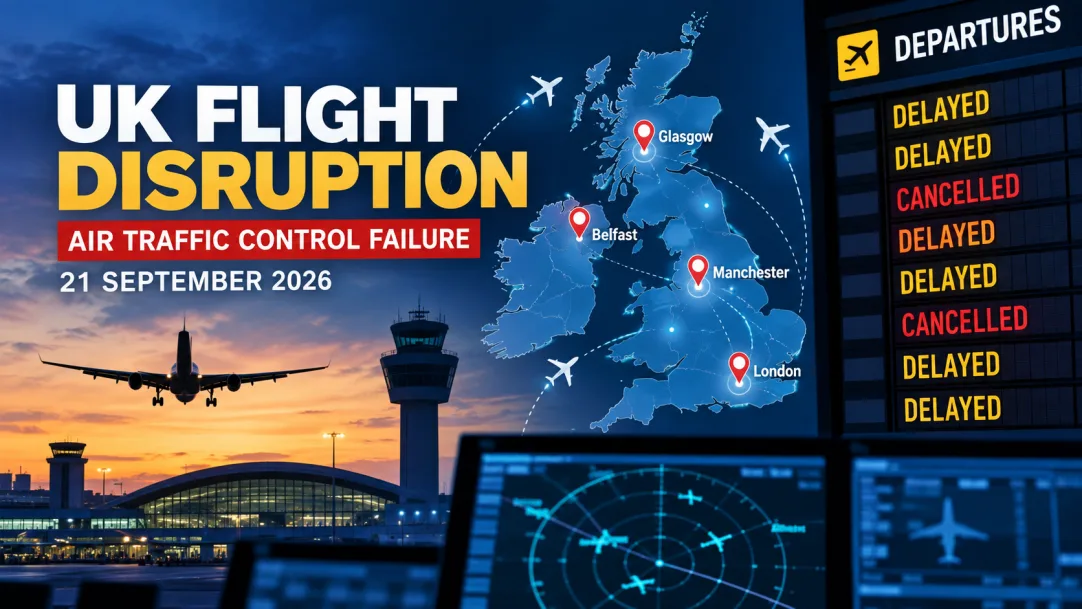
Flights at several UK airports were delayed and some services cancelled on Monday after a technical failure at the National Air Traffic Services (NATS) control centre in Prestwick, Scotland, caused fresh disruption across the country's aviation network.
The problem affected airports including Manchester, Glasgow and Belfast, while Gatwick and London City warned passengers of some disruption. NATS later said the technical issue had been resolved, although airlines and airports cautioned that delays could continue while schedules recovered.
What happened at the Prestwick control centre?
NATS said it experienced a technical issue at its Prestwick air traffic control centre. The centre handles significant volumes of air traffic across northern parts of the UK and surrounding airspace, meaning restrictions introduced while the fault was investigated could quickly affect airline schedules.
Reuters reported that the incident caused delays at several British airports. The disruption came less than two weeks after a separate technical problem affected UK air traffic, increasing scrutiny of the resilience of the country's air traffic management infrastructure.
NATS said Monday's fault was unrelated to the earlier incident.
Which airports and airlines were affected?
Manchester, Glasgow and Belfast were among airports reporting delays linked to the air traffic control problem. Gatwick and London City also warned passengers that some flights could be affected.
Airlines adjusted schedules as restrictions worked through the network. easyJet cancelled some flights, while British Airways warned customers that disruption could affect services. Travellers were advised to check directly with their airline before travelling to the airport because individual flights could recover at different times.
Even after an air traffic control fault is fixed, disruption can persist. Aircraft and crews may be displaced, departure slots have to be reassigned and delayed inbound services can affect later rotations.
Why a short technical failure can cause wider disruption
Air traffic control systems coordinate aircraft safely through busy sections of airspace. When a technical problem reduces available capacity, controllers can impose traffic-flow restrictions while engineers investigate and restore systems.
Those restrictions can reduce the number of aircraft permitted through affected airspace during a given period. The resulting queues can spread beyond the location of the original fault, particularly when major airports and tightly scheduled short-haul networks are involved.
Second major NATS problem in less than two weeks
The timing of Monday's disruption is significant because it follows another recent UK air traffic control failure. NATS has said the two incidents were not related, but airlines have renewed calls for robust and resilient systems as passengers face the consequences of repeated disruption.
The latest incident does not mean every UK flight was affected. The scale varied by airport, airline and route, and operations began recovering after NATS reported that the technical issue had been resolved.
What passengers should do
Passengers due to travel should check their airline's latest flight status before leaving for the airport and monitor airport departure information for changes. Travellers with disrupted journeys should also retain booking information and receipts for reasonable expenses where relevant to any claim under applicable passenger-rights rules.
Customers should rely on direct airline and airport updates for the status of individual flights rather than assuming that the resolution of the underlying technical fault means every delayed service will immediately operate as scheduled.
Operations recovering after the fault
NATS said the Prestwick technical issue was resolved later in the morning. Airlines and airports then worked through the accumulated delays and schedule changes.
The episode adds to pressure on the UK's aviation infrastructure to demonstrate resilience as technical failures can rapidly produce knock-on effects across interconnected airport and airline networks.