A DRAMATIC solar eclipse will sweep across Europe on Wednesday, August 12, marking the biggest celestial spectacle visible from Britain in nearly three decades.
But will skywatchers in the UK get to experience complete darkness?
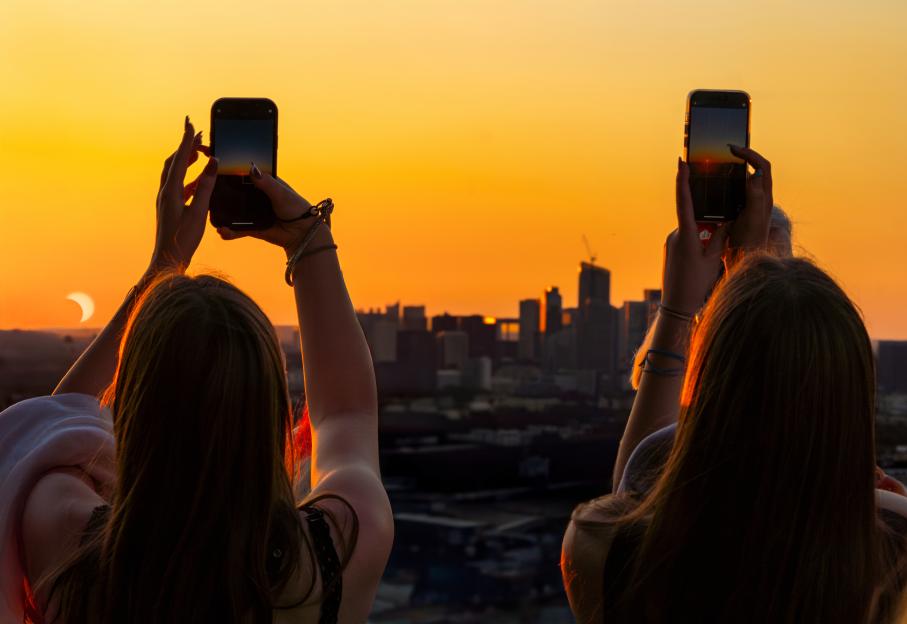 British viewers will be treated to a spectacular deep partial eclipse – weather permitting Credit: Getty
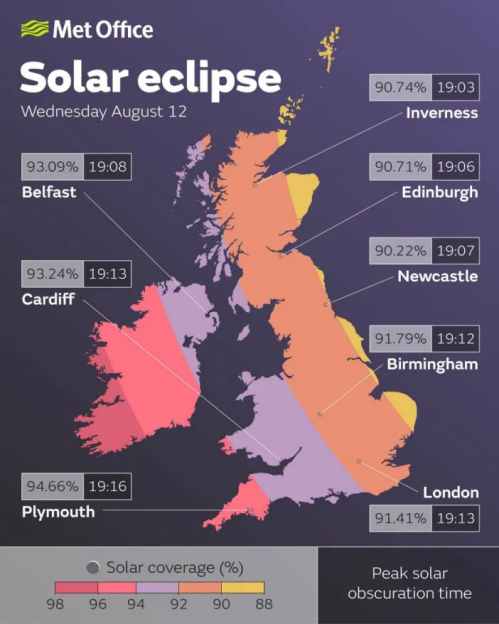 The Met Office has shared when the sun will be obscured the most across the UK
Here is everything you need to know about where totality occurs, how much coverage the UK will see, and where to find the best views.
Is the August 2026 eclipse a total eclipse in the UK?
No, but British viewers will still be treated to a spectacular deep partial eclipse – .
On August 12, Britain will instead see a deep partial , with the Moon covering between 90% and 96.5% of the Sun, .
The highest coverage in the UK will occur in the far South West:
- Isles of Scilly & Cornwall: Up to 96.5% obscuration
- South West & South Coast: Around 93% to 95% obscuration
- London & Central England: Around 92% obscuration
- Northern England & Scotland: Around 90% to 91% obscuration
This will cause a noticeable dimming of daylight, cooler evening temperatures, and a thin crescent Sun.
But it falls just short of the 100% totality required to plunge the landscape into twilight and reveal the Sun’s outer atmosphere (the corona).
Britain’s next total solar eclipse .
Where will the eclipse reach maximum totality?
To witness 100% total solar darkness, you must be standing inside a narrow geographic strip roughly 180 to 300 kilometres wide known as the “path of totality”.
The path begins in northern Russia and Greenland before crossing western Iceland, the North Atlantic Ocean, and sweeping straight across mainland Spain.
Key locations to see the total eclipse include:
- Spain: The prime holiday destination for eclipse chasers. Totality will cover vast stretches of northern and central Spain – including A Coruna, Bilbao, Zaragoza, and Valencia – before ending over the Balearic Islands (Majorca, Ibiza, and Menorca) at sunset.
- Iceland: Western regions, including the capital Reykjavik, will experience up to two minutes of total darkness in the mid-afternoon.
- Portugal: A tiny border area in northeastern Portugal near the village of Rio de Onor will just clip the edge of the totality track.
- Greenland: The eastern and southern coastlines will sit directly under the path of totality.
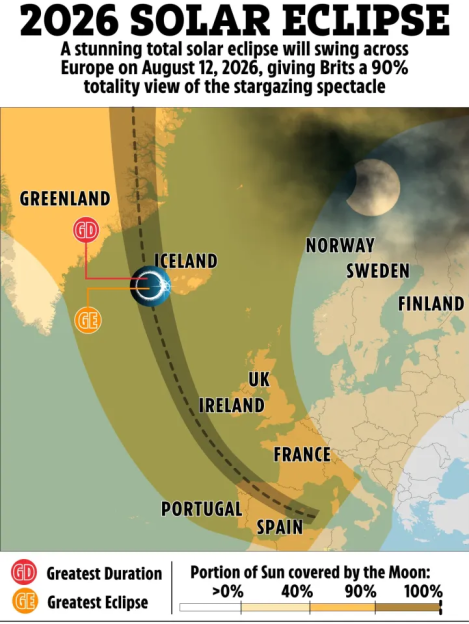 The eclipse is set to begin from around 6pm in most areas of the UK on Wednesday
What time does the solar eclipse happen in the UK?
For those watching from Britain, the eclipse takes place during the late afternoon and early evening on Wednesday, August 12.
The key timings for UK viewers are:
- 6.15pm: The partial eclipse begins as the Moon starts moving across the Sun’s disc.
- 7.05pm – 7.15pm: Peak coverage occurs, with the Sun reduced to a sliver low on the west-northwest horizon.
- 8.05pm: The eclipse finishes as the Sun sets.
How can you safely watch the eclipse?
Even with 96% of the Sun covered, looking directly at it with the naked eye can , so .
Only look at the Sun or . Standard sunglasses will .
You can also try indirect projection by standing with your back to the Sun and holding a kitchen colander or pinhole card to project crescent-shaped solar shadows onto the ground.