
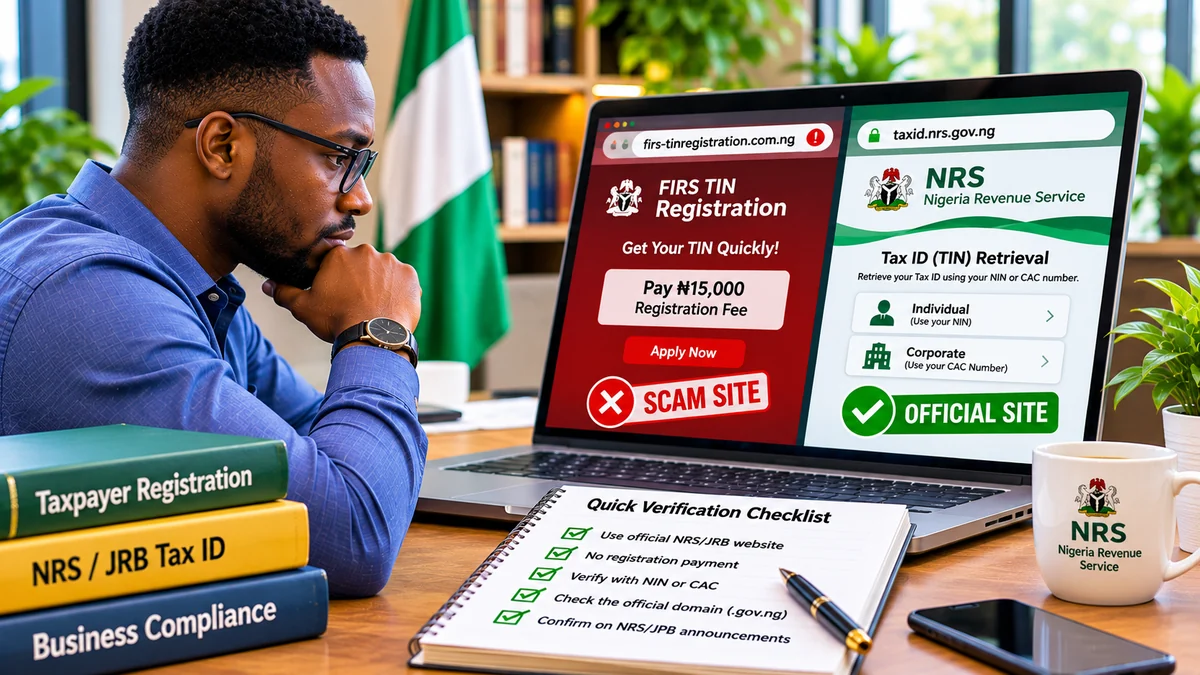
To avoid taxpayer registration scams in Nigeria, use the official Nigeria Revenue Service (NRS) or Joint Revenue Board (JRB) Tax ID portal, check the real website address yourself and refuse any demand to pay for ordinary Tax ID retrieval. The harmonised Tax ID service introduced in January 2026 is free: individuals use their National Identification Number (NIN), while registered businesses use Corporate Affairs Commission (CAC) information. An urgent WhatsApp message, a fake payment receipt or an agent's promise to “activate” your TIN is not evidence that the demand comes from a tax authority.
Nigerians who search for firs tin registration form may encounter older references to the Federal Inland Revenue Service (FIRS), advertisements for private assistance and websites whose names resemble government services. The federal agency now operates as the Nigeria Revenue Service, and the official national Tax ID portal is a joint NRS/JRB service. The correct public retrieval addresses are taxid.nrs.gov.ng and taxid.jrb.gov.ng .
This guide shows how to recognise impersonation, confirm a legitimate web address, distinguish genuine tax payments from invented registration fees, protect NIN and CAC details, and respond if you have already paid or submitted documents to a suspicious site. It includes clearly fictional examples of scam tactics, not accusations against named taxpayers or companies. Research checked: 18 November 2026.
What the official 2026 Tax ID process actually requires
The FCT Internal Revenue Service's official launch announcement and the JRB Tax ID Retrieval Standard Operating Procedure explain how to retrieve the harmonised 13-digit Tax ID. The system checks the taxpayer's underlying government identity electronically; it is not meant to force everyone to purchase a new paper certificate.
| Detail | Official position | What a scam may claim |
|---|---|---|
| Where to retrieve the ID | NRS/JRB official Tax ID portal | “Only my private application website works” |
| Individual requirement | Valid NIN and matching NIMC first name, surname and date of birth | “Send me your NIN slip, BVN and bank OTP” |
| Registered business requirement | Valid CAC registration number, with the proper company category | “Pay to link your CAC record first” |
| Standard retrieval fee | ₦0 | “TIN generation, activation or express-release fee” |
| Routine document upload | No physical documents uploaded for ordinary NIN/CAC-based retrieval | “Upload directors' ID cards and bank statements to activate” |
| Processing | Designed for near-real-time retrieval, subject to available source records and systems | “Only our insider can bypass portal errors” |
These are rules for standard Tax ID retrieval. Separate government services—CAC registration, NIMC identity modification, taxpayer account administration, filing an actual tax return or paying a genuine assessed liability—may have different documents and authorised charges. A trustworthy guide must not claim that every tax-related transaction in Nigeria is free.
How fake FIRS TIN registration forms and websites work
A common impersonation pattern begins with a sponsored search result, short link, Facebook page, SMS or WhatsApp message promising instant registration. The page may copy a government logo, use the words “FIRS”, “NRS”, “CAC” or “TIN”, display a green-and-white design and ask for an amount described as processing or verification.
Some schemes focus on stealing money. Others seek identity records, bank card details or one-time passwords. The Central Bank of Nigeria's fraud guidance identifies phishing and social engineering as attempts to make people disclose confidential information by impersonating trusted organisations. Reporting by BusinessDay in September 2026 also documented how fraudsters repurpose government branding, fake websites and urgent payment prompts across multiple agencies.
Do not assume an attacker must invent a completely nonexistent government service. Often, the real Tax ID portal and real national tax reform provide just enough background to make a fraudulent message appear plausible. A deadline or warning could contain some true general information while its payment link and account details are fraudulent.
Seven warning signs of a taxpayer registration scam
- A charge to generate or activate your basic Tax ID. JRB's official SOP says ordinary Tax ID retrieval is free. A supposed “mandatory FIRS TIN activation fee” contradicts that rule.
- A personal-account payment demand. An unsolicited person requesting a transfer to secure a taxpayer number or to lift a sudden block is a high-risk contact. Verify the underlying government service independently.
- An unfamiliar website with government-like words. A page containing “firs”, “nrs”, “taxid” or “gov” in its title or domain is not automatically controlled by an agency.
- Pressure to act within minutes. Warnings about immediate account closure, prison, loss of a business registration or same-hour penalties should be checked against the actual legal notice and authority.
- Requests for banking credentials or an OTP. A Tax ID retrieval form requires specified identity information, not your card PIN, internet-banking password or bank transaction authorisation code.
- Unexpected identity-document uploads. The standard portal's NIN/CAC verification is electronic. A third-party upload request for complete NIN slips, passport photos, bank statements and directors' IDs should prompt independent verification.
- Guaranteed shortcuts around a failed lookup. A name mismatch or CAC verification outage may require correcting source data or waiting for the legitimate service—not paying someone who claims to create an identity outside the rules.
A single warning sign may have an innocent explanation in another service, but several together are a strong reason to stop. The central question is always: Can the payment, form or requested document be traced to the responsible government organisation through an independently verified channel?
How to confirm the genuine government website address
Open a fresh browser tab and type one of the following addresses rather than clicking an unsolicited message:
| Purpose | Verified official website |
|---|---|
| Retrieve an individual or corporate Tax ID | https://taxid.nrs.gov.ng/ |
| Alternative official Tax ID entry point | https://taxid.jrb.gov.ng/ |
| Federal tax authority information | https://www.nrs.gov.ng/ |
| JRB news, taxpayer guidance and support | https://www.jrb.gov.ng/ |
| Separate NRS taxpayer account registration | https://selfservice.nrs.gov.ng/registration |
| Check CAC legal registration records | https://icrp.cac.gov.ng/ |
| NIMC identity-modification information | https://nimc.gov.ng/self-service-modifications/ |
Read the actual browser address bar, not merely the large headline on a page. The host taxid.nrs.gov.ng is different from a made-up example such as taxid.nrs.gov.ng.example.test: the latter would be a subdomain of example.test, not a Nigerian government service. Another fictional warning example is nrs-activation.example.test. These .test addresses are reserved illustrative examples and are not live allegations.
The .gov.ng domain is a useful sign for Nigerian government services, but examine the entire hostname, the path and the service's link from an authenticated agency page. A link printed in a message can display one address while opening another. HTTPS and the padlock show an encrypted connection to the displayed hostname; they do not prove that the organisation behind that hostname is genuine.
Some legitimate authorities use additional authorised service domains. Do not automatically call every other domain fraudulent: verify any alternate domain from the agency's original website first. Likewise, a search engine's sponsored result is advertising placement, not independent verification of the website's operator.
FIRS versus NRS: does the old agency name prove a scam?
Not by itself. The term Federal Inland Revenue Service (FIRS) appears in historic tax laws, old payment confirmations, accounting systems and previously published articles. The federal agency now operates as the Nigeria Revenue Service (NRS), and the 2026 harmonised Tax ID system is associated with NRS/JRB. Older official websites or records may still be encountered during transition.
However, a private page claiming to be an official “FIRS TIN registration form” should not be trusted simply because FIRS was once the familiar authority name. Find the current service through the NRS/JRB website and check whether the specific action is still authorised. Do not treat legacy branding as either automatic proof of legitimacy or automatic proof of fraud.
For the normal process, the official Tax ID explanation describes the service as retrieving an existing harmonised tax identity derived from NIN or CAC records. The user should not need a paid intermediary to turn a valid underlying identity into a number.
Fake Tax ID payment demands versus genuine tax bills
There is an important difference between paying to retrieve a Tax ID and paying an actual tax obligation. The first is free under JRB's SOP. The second may involve a genuine liability assessed or paid through the relevant tax authority's authorised process. CAC incorporation, an approved NIMC data correction or professional accounting work may also cost money without becoming a fraudulent Tax ID fee.
| Request | What to do |
|---|---|
| “Pay ₦15,000 for instant Tax ID generation” | Do not pay as a government retrieval charge; verify the free NRS/JRB service |
| “Pay an agent to unlock a blocked TIN” | Check source-record errors or official service availability first |
| Actual CAC registration or post-incorporation filing fee | Check CAC's authorised portal and applicable filing charge |
| Legitimate NIMC data-modification charge | Check the correct NIMC service and current fee schedule |
| Tax assessed or payable under a real account | Verify the notice, taxpayer account and official payment route directly with the relevant authority |
| Private accountant's agreed professional fee | Confirm the provider and agreed service; it is not automatically an official Tax ID retrieval charge |
| Message saying a tax refund requires an upfront “release” payment | Treat as suspicious until independently confirmed by the tax authority |
Do not forward an unexpected invoice to a purported “tax officer” using the contact details printed on that invoice alone. Find the institution's official customer-service information independently, confirm the underlying obligation and use its genuine payment procedure. A real reference number on a document is not proof that the beneficiary account is legitimate.
Bank-account closure threats: what the JRB actually said
Tax-related fraud often relies on fear. A message may insist that your bank account will be closed within hours because a “FIRS TIN” has not been activated, or that funds are being held until you pay a registration charge.
The JRB's public clarification of 12 December 2025 rejected claims that bank accounts or transactions would be restricted automatically from 1 January 2026 solely because of unavailable Tax IDs. It also said the new Tax ID system would not automatically deduct funds based on possession or absence of the identifier.
This is a specific clarification about the transition, not a promise that no financial institution can ever ask for tax-identification information. Nigeria's tax laws and financial-sector rules can require certain taxpayers to supply their identifiers for regulated transactions. If your bank requests an update, verify the message in its official app, branch or published customer-service channel. A threat from an unknown WhatsApp account does not establish a lawful bank instruction.
How to check a suspicious SMS, email, WhatsApp or social-media advert
- Do not use the embedded link first. Close it or leave the message unopened while you verify the source independently.
- Write down the claimed organisation and purpose. Is it Tax ID retrieval, a tax assessment, CAC registration, NIN correction or an alleged refund?
- Visit the agency's real homepage yourself. Look for the relevant service or an announcement supporting the request.
- Check the exact hostname and destination. A real-looking button, QR code or shortened URL can conceal a different destination.
- Check whether a fee actually exists. For routine Tax ID retrieval, the official answer is ₦0.
- Use a trusted contact channel if still uncertain. Call or write to the actual agency or bank using contact details published on its website, not the suspicious message.
- Keep evidence if the request appears fraudulent. Save the message, sender, visible URL and any payment details without exposing other people's identity records publicly.
CBN's consumer fraud advice likewise tells people not to click suspicious links and to verify senders by contacting the organisation directly. This is useful even when a message contains familiar tax terminology, a government crest or an authentic-sounding employee name.
Protect your NIN, CAC documents, BVN and banking credentials
The official standard individual lookup uses the NIN and matching NIMC details, while the corporate lookup checks CAC registration. Those identifiers should be supplied only through the genuine service for an authorised purpose. The JRB SOP says normal retrieval relies on electronic identity verification and does not require uploading physical documents.
Do not send your BVN, full bank-card information, card security code, bank PIN, account password or one-time authorisation code to someone promising to register a TIN. A bank OTP is not proof of a tax officer's identity. A fraudster can prompt a real bank message after initiating an unauthorised transaction, then pressure the victim to read back the code.
For registered companies, avoid forwarding entire incorporation files, directors' passports and sensitive financial statements to unverified agents. Professional accountants can assist with genuine compliance tasks, but their work should be authorised, documented and limited to the information they actually need.
Use strong, unique passwords, enable multi-factor authentication where supported, and save official confirmations securely. If a website demands more personal data than the legitimate process specifies, independently check whether you have entered a separate service rather than the basic Tax ID portal.
What if your Tax ID lookup fails? Avoid a fake “repair” service
An unsuccessful lookup is not necessarily a scam or a disqualified taxpayer. The JRB SOP recognises issues such as an incorrect NIN name match, a defective CAC record and temporary verification outages. It recommends retrying after roughly five minutes for transient problems and escalating persistent technical failures through the JRB help desk.
Use the official Tax ID service-status page to check whether NIN, CAC or Tax ID verification has a technical issue. If the source record is wrong, correct it with NIMC or CAC as appropriate. Do not invent a new name, use someone else's NIN or pay an intermediary who claims to override a failed government API.
Also keep the difference between retrieving an existing valid ID and opening a separate taxpayer service account clear. The NRS taxpayer registration portal has other workflows; its existence does not make a paid private “Tax ID activation” page legitimate.
What to do if you paid a fake tax-registration website
Act quickly; stop interacting with the suspicious contact. CBN's published fraud guidance says consumers should notify their financial institution immediately after suspected compromise. The Nigeria Police Force National Cybercrime Centre (NPF-NCCC) operates an official cybercrime reporting service. Reporting improves the chance that the incident can be investigated, but a refund or reversal is not guaranteed.
- Contact your bank through a verified channel immediately. Provide the transaction time, amount, reference and destination. Ask about protective blocks, payment tracing and any available dispute procedure.
- Secure compromised accounts. If passwords, banking credentials or OTPs were shared, follow your bank's urgent security instructions; change passwords and enable stronger authentication.
- Keep the evidence. Retain screenshots, payment receipts, email headers, phone numbers, links and a description of what information was disclosed.
- Report the suspicious activity. Use NPF-NCCC or its e-reporting channel ; other relevant agencies, including the EFCC , may have suitable reporting routes.
- Notify the impersonated authority. Reach NRS, JRB, CAC or NIMC through independently verified contact information so it can assess the misuse of its identity.
- Monitor for further exploitation. A scammer holding your NIN details or business records may attempt identity misuse, new phishing messages or a fraudulent “refund recovery” approach.
If a stranger now offers to recover the payment for another upfront fee, verify that new claim independently. Do not publish full NIN slips, bank account numbers or other identity records in social-media warnings; share necessary evidence securely with the bank or investigating authority.
Illustrative scam scenarios and safer responses
The following are fictional examples designed to explain common patterns. The sample naira amounts and messages are not official notices or documented allegations involving any particular named domain.
| Example message or situation | Why it is suspicious | Safer response |
|---|---|---|
| “Pay ₦15,000 today for FIRS TIN activation or your account closes” | Ordinary retrieval is free; the JRB rejected automatic closure claims tied solely to missing Tax IDs at the 2026 transition | Check NRS/JRB and your bank independently |
| “We can fix your NIN mismatch instantly if you send your OTP” | Source-record correction belongs to NIMC; a bank OTP has no legitimate role in a basic tax lookup | Use NIMC's official modification service and protect the code |
| “Your company cannot get Tax ID until an agent receives your bank statement” | JRB's ordinary corporate lookup uses a CAC registration number and no physical file upload | Check the CAC record and use the official portal |
| “Click to claim your government tax refund and pay a release charge” | Unsolicited refund and advance-fee claims need verification, even when they quote a real taxpayer number | Ask the actual tax authority about the stated refund process |
| “Here is a .gov.ng address” but the browser opens a different hostname | Displayed link text and destination may differ | Type the official service address directly |
Quick verification worksheet for individuals and businesses
Before uploading information or paying any supposed tax-related charge, record the details below. This is an editorial safety worksheet, not a compulsory government form.
| Check | What to record |
|---|---|
| Claimed agency | NRS, JRB, state revenue service, CAC, NIMC or other actual authority |
| Exact service | Free Tax ID retrieval, genuine filing/payment, identity modification or company filing |
| Official website verified | Complete genuine address reached independently |
| Identity requested | NIN/CAC details genuinely required for that specific task |
| Fee checked | Official basis for any payment; do not invent a Tax ID retrieval charge |
| Correct contact | Support details from the real agency's website |
| Risk indicators | Urgency, private-account transfer, bank OTP request, suspicious domain |
| Outcome | Verified / needs clarification / rejected and reported |
If you cannot verify the route or the fee, pause the transaction. A small delay to check an official source is generally safer than sending identity documents and money to an unverified recipient.
Frequently asked questions
What is the genuine FIRS TIN registration form in Nigeria in 2026?
For ordinary Tax ID retrieval, use the joint NRS/JRB online service at taxid.nrs.gov.ng or taxid.jrb.gov.ng . The 2026 system retrieves a 13-digit Tax ID linked to an individual NIN or a company's CAC record; it does not require buying a legacy paper FIRS form.
Is Nigerian TIN registration free?
Standard NRS/JRB Tax ID retrieval costs ₦0 according to the JRB SOP. Other genuine services—such as CAC registration, tax filing liabilities or certain NIMC corrections—can involve separate fees.
How can I tell whether a tax registration website is fake?
Check the full browser hostname, navigate from the real NRS or JRB page, compare requested data with the official procedure and refuse unexpected registration payments or requests for banking credentials. Government-looking logos and HTTPS alone are insufficient proof.
Does the official Tax ID portal ask for my BVN or bank OTP?
The documented ordinary NIN/CAC retrieval workflow does not require banking OTPs, card PINs or passwords. Do not supply such credentials to a person who claims to register your tax identity.
Can an agent charge me for a TIN?
An independent professional may charge for legitimate advisory or administrative work under an agreement. That is separate from the government's standard Tax ID retrieval fee, which is zero. Do not confuse a private service charge with a compulsory NRS/JRB fee.
Will my bank account close if I do not pay a Tax ID activation fee?
The JRB rejected claims of automatic account restrictions on 1 January 2026 solely from missing Tax IDs. Real financial institutions may have lawful identification requirements; verify any actual request through your bank directly. A private activation fee is not the recognised way to resolve this.
Can I use an old FIRS site or TIN certificate?
Legacy tax records can remain relevant for reconciliation, but check which service the current NRS/JRB or relevant tax authority authorises. Do not assume an old PDF form or a third-party page is the standard 2026 retrieval route.
What if an official Tax ID check fails?
Verify the NIN or CAC source details and check the NRS/JRB service-status page. Retry temporary errors and contact the official help desk. Correct actual source-record mistakes through NIMC or CAC rather than trusting an informal “repair” agent.
What if I have already entered my NIN on a suspicious site?
Stop supplying further records, preserve the URL and correspondence, watch for subsequent impersonation, and report relevant concerns through official channels. If banking credentials were also shared, contact your bank urgently and secure the accounts.
Where can I report a fake tax website or payment demand?
Alert the impersonated tax agency through its real site and file an appropriate complaint with the Nigeria Police Force National Cybercrime Centre . If money moved, contact your bank immediately; other competent authorities may also investigate.
Does a Tax ID prove that someone has paid taxes?
No. A Tax ID identifies the taxpayer. A tax payment receipt, filed return and Tax Clearance Certificate are different records and have separate verification requirements.
Final safety checklist before submitting your details
- Visit the NRS/JRB Tax ID website through a trusted, independently verified address.
- Know whether the task is free retrieval, a genuine tax payment or another government service.
- Use the correct NIN or CAC record for the taxpayer; do not invent a new identity.
- Never disclose banking passwords, card PINs or one-time transaction codes to a registration agent.
- Do not pay for standard Tax ID activation, generation or release.
- Check original agency announcements before believing urgent tax threats or account-closure messages.
- Preserve evidence, contact your bank promptly after suspected fraud and use official cybercrime reporting channels.
Bottom line: Legitimate taxpayer registration in Nigeria is not proved by a government-looking logo or a rushed payment request. Standard 2026 Tax ID retrieval is free and available through verified NRS/JRB channels using recognised NIN or CAC records. Protect your identity, verify the exact service and its fee independently, and treat unfamiliar links and private “activation” payments as warning signs until proven otherwise.
Editorial verification: 18 November 2026. This independent consumer safety article is based on official JRB/NRS Tax ID procedures, the FCT-IRS rollout announcement, JRB banking clarification, CBN fraud advice and NPF-NCCC reporting information, with additional background reporting on government-brand impersonation. Fictional examples and the AI-generated featured image do not represent actual fraudulent operators. Government services, interfaces and rules can change. This is general information, not individual legal or tax advice.