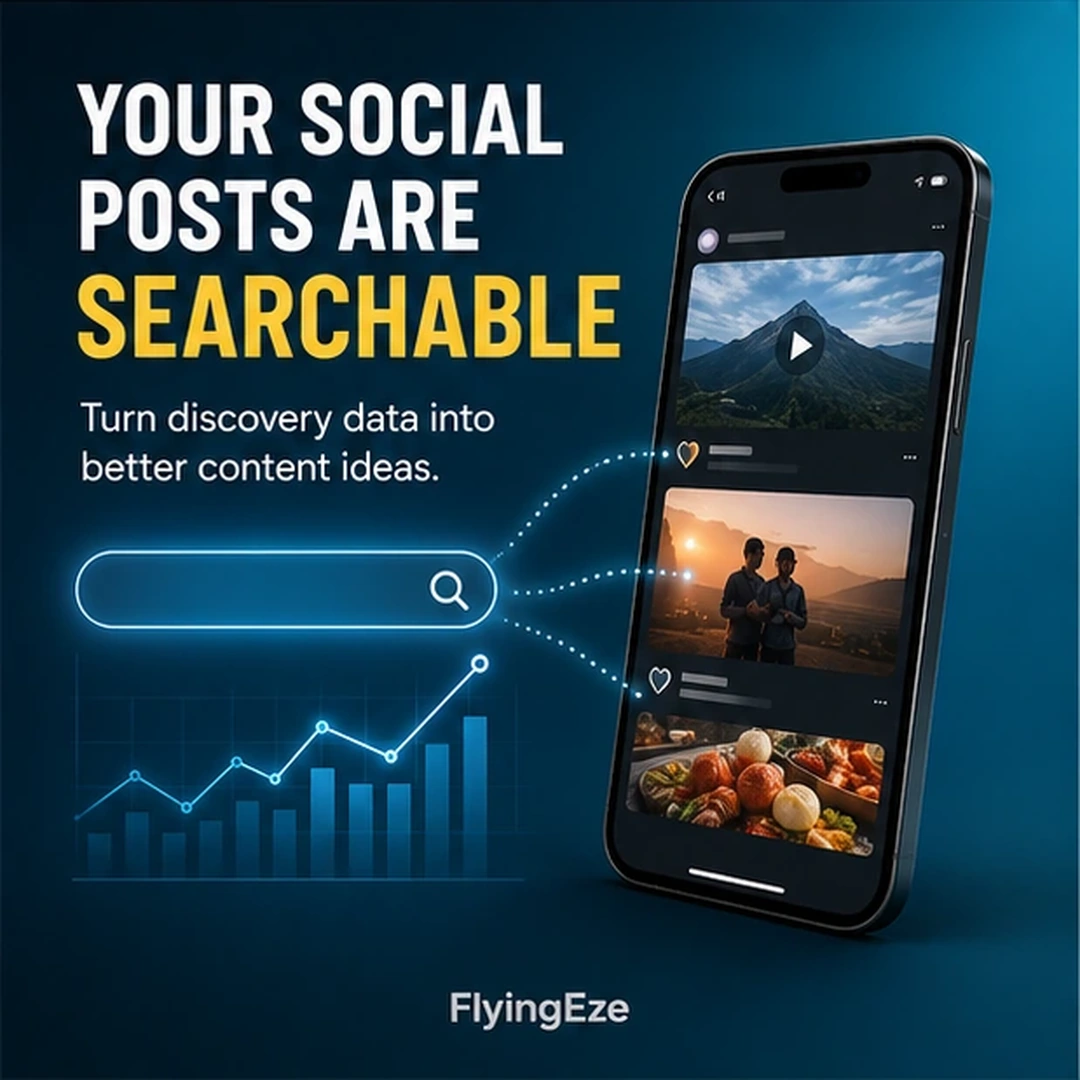
Creators often treat social media and SEO as completely separate parts of their content strategy.
One team makes videos.
Another publishes articles.
Social performance is measured with likes, comments, views, and shares, while search performance is analysed somewhere else.
Google's latest Search Console expansion makes that separation less useful.
On July 29, 2026, Google announced the global availability of platform properties in Search Console, allowing creators and publishers to monitor how content from Instagram, TikTok, X, and YouTube performs when people discover it through Google.
That creates an interesting opportunity:
Your social content can now help tell you what people are searching for.
What Are Search Console Platform Properties?
Traditionally, Search Console has been associated primarily with websites.
A website owner could use it to understand questions such as:
- Which pages appear in Google?
- What search queries lead people to the site?
- How many impressions does a page receive?
- How many people click?
- Which content performs best?
Platform properties extend part of that visibility to supported third-party social and video accounts.
Google currently supports:
- TikTok
- X
- YouTube
Creators can add an eligible account or channel as its own Search Console property after verifying ownership.
The important distinction is that Search Console is not replacing the analytics provided by those platforms.
It is showing how content from those platforms performs when it is encountered through Google.
What Can Creators Measure?
Platform properties can provide performance information such as:
- Clicks
- Impressions
- Click-through rate
- Search position
- Content or post performance
- Search queries and query groups
- Performance trends over time
Google's new guidance specifically recommends using the Insights report to identify top, rising, and declining search-query groups associated with social and video content.
That can reveal something social analytics alone may not tell you:
What was someone actively searching for when they discovered your content?
A TikTok Video Can Become SEO Research
Imagine you publish a TikTok video explaining:
“Three reasons your website is loading slowly.”
The video receives reasonable engagement on TikTok.
Months later, Search Console shows that people are continuing to discover it through Google searches related to:
- why my website is slow
- speed up business website
- website loading slowly
- improve website performance
That information can become useful beyond the original video.
You might create:
- A detailed website article
- A longer YouTube tutorial
- A website-speed checklist
- An FAQ page
- A second TikTok video answering a related question
- A LinkedIn post aimed at business owners
- A downloadable guide
One social post can therefore become a source of content research.
Search Data Can Help You Decide What to Publish Next
One of the hardest questions in content marketing is:
“What should we create next?”
Teams often answer that question through brainstorming, competitor research, keyword tools, trends, or intuition.
Search Console adds another source:
topics your own content is already proving that people discover through search.
Google explicitly recommends examining search-term themes to understand what an audience cares about and using those insights as inspiration for future videos, captions, and other content.
For marketers, the opportunity goes further.
If a short social post receives consistent Google visibility around a particular problem, that may indicate a topic worth developing more deeply.
Instead of guessing whether the audience cares, you have evidence that people are already finding your content while looking for information about it.
Old Social Posts May Still Have Value
Social media encourages a very short-term mindset.
Publish.
Collect engagement.
Move on.
But discovery through Google can give older content a longer life.
Google specifically suggests using platform-property data to identify older videos that have started receiving search traffic again. That might indicate an opportunity to:
- Pin the original content
- Republish or refresh the idea
- Create a follow-up
- Produce a “part two”
- Expand the subject into a longer resource
That changes the way creators can think about their archives.
An old post is not necessarily dead simply because it has disappeared from the social feed.
Search and Social Can Inform Each Other
A stronger content strategy creates feedback between channels.
For example:
Social post → Google search data → deeper article → new video → additional search data
Or:
YouTube video → search-query insight → FAQ page → Instagram carousel → follow-up video
Instead of operating as isolated channels, each format can help identify opportunities for the others.
That is particularly valuable for businesses that already create large amounts of social content but struggle to decide which ideas deserve deeper investment.
Look Beyond Clicks
Clicks matter, but they are not the only useful signal.
An impression tells you that content appeared when someone was searching or browsing a Google experience.
Repeated impressions around a topic may show that your content is being associated with a particular subject even when people do not always click.
Questions worth investigating include:
Which topics receive the most Google visibility?
Look for recurring themes rather than isolated posts.
Which queries are increasing?
Growing query groups may highlight emerging audience interests.
Which old posts are becoming visible again?
There may be renewed interest in that subject.
Which content receives impressions but few clicks?
The topic may be relevant while the title, description, thumbnail, or presentation is not sufficiently compelling.
Which formats travel best between social and search?
Perhaps your tutorials perform better than opinions.
Perhaps short explanatory videos continue attracting discovery long after publication.
Those patterns can inform future editorial decisions.
There Are Important Limitations
Search Console data should not be treated as a complete picture of audience demand.
Platform properties show how supported social content performs through Google.
They do not replace Instagram Insights, TikTok Analytics, YouTube Analytics, X analytics, or other native platform data.
Google's documentation specifically notes that Search Console does not measure how often content was shown inside the social platform itself.
Search-query reporting also has limitations.
Some queries are anonymised for privacy, and Search Console does not necessarily display every individual search term associated with impressions or clicks.
So use the information as one signal among several.
Don't Turn Every Search Query Into Content
There is another potential mistake.
New data often creates an urge to optimise everything.
If one unusual query produces an impression, that does not automatically mean you need an article about it.
Look for patterns.
Ask:
- Is this relevant to our audience?
- Is the topic connected to what we actually do?
- Are multiple related searches appearing?
- Is interest growing?
- Can we add something genuinely useful?
- Does the topic support our wider content strategy?
Good data should improve editorial judgment, not replace it.
Content Strategy Should Connect Channels
Google's platform properties highlight a broader change in digital publishing.
A TikTok video can appear in Google.
A YouTube video can inform your blog strategy.
An Instagram post can reveal a question worth answering in greater depth.
A website article can generate ideas for another social series.
The lines between social media, search, video, and publishing are becoming increasingly blurred.
For creators and businesses, that means content strategy should be organised around audience needs and topics, not only around individual platforms.
Don't think:
“What should we post on Instagram?”
Start with:
“What does our audience want to understand?”
Then decide which channels and formats are best suited to answering it.
Why It Matters
Search Console platform properties give creators and businesses another way to learn from content they have already published.
Instead of judging a social post only by what happens immediately after publication, marketers can examine whether it continues to be discovered through Google and what search themes are associated with that discovery.
That creates a valuable feedback loop:
Publish → measure → discover demand → expand the idea → measure again.
The bigger lesson is simple:
Content strategy works better when channels inform each other instead of operating in isolation.