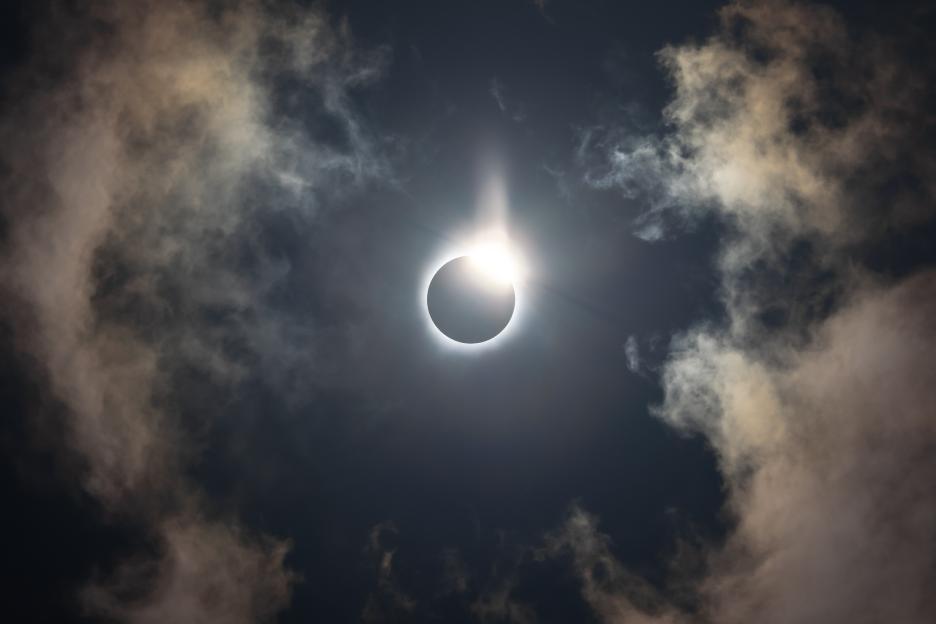
A RARE solar eclipse is set to be visible across the UK tonight.
Brits will be able to witness the moon cover a large portion of the sun this evening.
 A partial solar eclipse will be visible on Wednesday evening Credit: Getty
 The Met Office has shared when the sun will be obscured the most across the UK Credit: Met Office
The partial is set to be one of the most impressive celestial spectacles the nation has seen in over two decades.
While watching the partial solar eclipse requires great by the harmful UV radiation, it’s an unforgettable experience that can’t be missed.
The amount the sun is covered by the moon as well as the optimum time to see the eclipse differs depending on where you are in the country – so it’s important to know exactly .
The eclipse will begin from around 6pm for most UK areas – but the peak coverage will come later.
The most coverage of the sun is set to be experienced by those in the South West of England, around and .
Here the solar coverage will be around 94.66 per cent, with optimum viewing time at 7:16pm, according to the .
Those in London and the surrounding areas can expect up to 91.41 per cent solar coverage, with peak solar obscuration occurring around 7:13pm.
If you’re up in Scotland, the most coverage of the sun will be seen from around 7:03pm – with up to 90.74 per cent of the sun set to be blocked by the moon.
Those in midland areas, such as Birmingham, will experience around 91.78 per cent of solar coverage, with peak obscuration happening around 7:12pm.
 The eclipse is set to begin from around 6pm in most areas of the UK on Wednesday
In an announcement shared by the Met Office, the meteorological service explained that weather conditions can impact the view, too.
“The extent of the Sun’s coverage and the timing of maximum obscuration will differ across the country. Local weather conditions may impact viewing opportunities, so it’s worth checking the forecast in advance,” the statement said.
“Northeast Scotland will have around 88% covered just before 7pm, whilst in the far southwest of England there will be around 96% coverage just after 7:15pm.”
Brits are also being warned to make sure they protect their vision as they watch, with the Met Office adding: “Never look directly at the sun; use a pinhole projector or certified eclipse glasses to view it.”
The last time the UK experienced an eclipse that saw this much solar coverage was 1999, when almost all of the sun was covered in Cornwall and Devon.
Responding to the Met Office announcement, social media users reminisced on the astonishing moment.
“I remember down here in Cornwall, looking at the last solar eclipse in 1999 with my late wife. Amazing I will never forget that as long as I live,” one wrote.
“We were sat up high looking across St Austell Bay. We saw the moon race across the bay. All of a sudden it went dark, the birds started roosting. We could see all the streetlights come on. (It was really eerie) and it went incredibly cold,” the commenter added.
“We were in Newquay in 1999. Still remember the eerie silence and the birds reaction. Guess it going completely dark in the middle of the day freaked them,” another shared.
“I remember the last one. I was 14. Was quite eerie. No wind, no birds flying or singing,” a third person said.
“Yes, it was it was really strange. I will never forget that as long as I live,” agreed another.