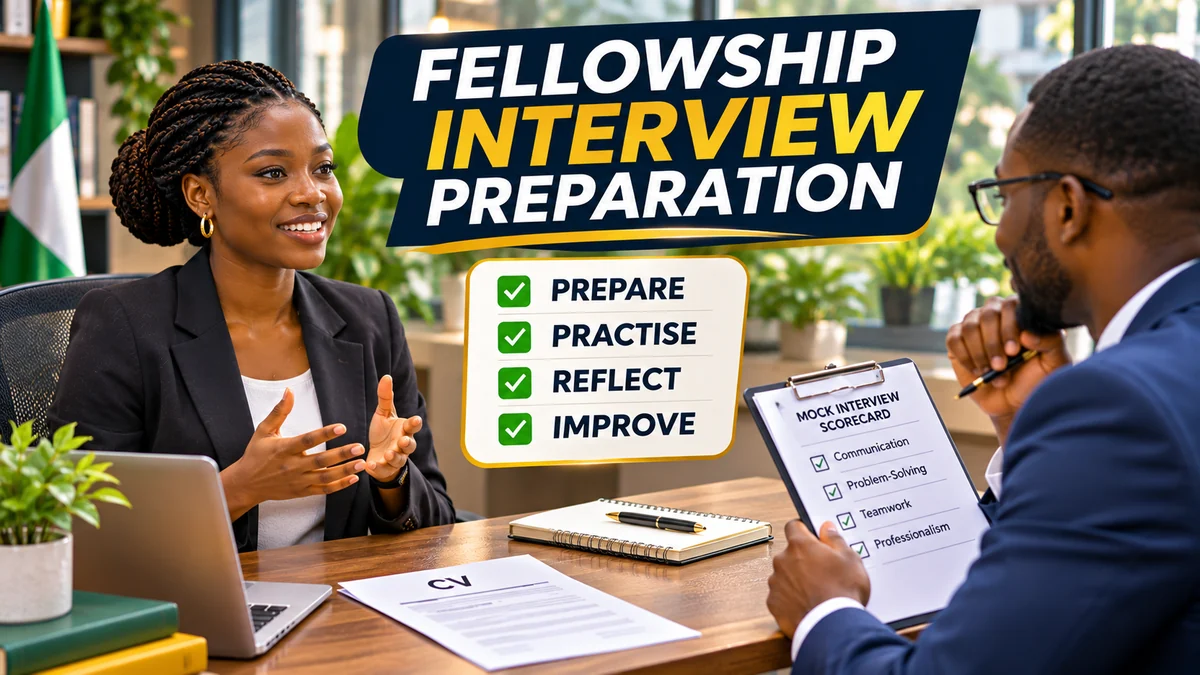
The best way to prepare for a graduate fellowship interview is to practise clear, evidence-based answers about things you have actually done: the situation you faced, your responsibility, the action you took and the result. Review the fellowship's real selection criteria, prepare examples from university, NYSC, volunteering or personal projects, and get specific feedback before an interview or recorded-video assessment.
For applicants interested in the Nigeria Jubilee Fellows Programme (NJFP), one distinction comes first. NJFP 2.0's published selection process describes an online application, a 60-second introduction video, a psychometric assessment and consideration for matching with host organisations. Its public FAQ does not establish a mandatory live interview for every applicant. A host organisation or a different fellowship may use an interview, but candidates should not assume an unofficial invitation is part of NJFP merely because it uses the programme's name.
This guide uses NJFP as a practical reference while offering interview preparation relevant to graduate fellowships and early-career opportunities in Nigeria. It draws on recruitment research, career-service guidance and official programme information, and explains what the research supports—and what it does not. Fact-check date: 14 November 2026.
Does NJFP 2.0 require a fellowship interview?
According to the official NJFP 2.0 FAQ , eligible applicants submit an online application, then a 60-second video, followed by a psychometric assessment for those progressing through the published stages. Successful applicants enter a prequalified talent pool; matching depends on the availability of host organisations and how their requirements align with candidates' skills, experience and geographic preferences.
Entering the talent pool is not the same as receiving a fellowship placement. NJFP says candidates become Fellows only after matching and formal onboarding. The published general procedure does not list a universal compulsory live panel interview. If someone claims every applicant must pay for an “NJFP interview slot”, that conflicts with the official FAQ's clear statement that applications and placement are free.
Still, preparing for an interview makes sense: some host employers may separately assess candidates, and graduates can use these skills for other fellowships, placements or later employment. The correct approach is to distinguish official NJFP requirements from broader interview preparation and check every invitation against njfp.ng and the applicant dashboard.
Note also that the official FAQ still references an application window of 22 October–12 November 2025; this historical window is not evidence that a fresh November 2026 call is open. Follow newly dated official notices for any future application cycle.
What does “evidence-based interview preparation” mean?
It means choosing techniques with a plausible, documented basis rather than copying viral “secret answers”. There are two different forms of evidence to consider: research on how interviews assess candidates and research on how candidates learn to respond more effectively.
A major 2024 meta-analysis in the International Journal of Selection and Assessment examined 37 studies of interviews and job-related performance. It helps explain why structured, job-relevant questions and clearly assessed examples matter to employers. It does not prove that memorising an answer increases an applicant's probability of being selected by any particular fellowship.
A 2021 study of 240 recent graduates found that feedback following simulated interviews was positively associated with interview self-efficacy, or confidence in one's ability to interview. Another 2023 study of asynchronous video interviews found benefits from brief interviewee training, while a practice opportunity alone did not consistently improve measured outcomes. The lesson is to practise deliberately and with feedback, not merely repeat a rehearsed script.
Preparation can improve clarity, self-awareness and readiness; hiring decisions also depend on eligibility, role requirements, competition, interviewer assessment and available places. There is no scientifically supported “guaranteed fellowship answer”.
Step 1: Identify the competencies you need to demonstrate
Start from the actual criteria instead of rehearsing every generic question online. NJFP's published eligibility and selection information explicitly refers to communication, problem-solving, time management, professional attitude, leadership, civic values, accountability and commitment to a career field.
Make a two-column worksheet. In the first column, write each relevant competency; in the second, write one real event showing it. For a different fellowship or a confirmed host-organisation opportunity, add the specific duties and technical competencies in its description. Keep examples connected to the purpose of the role.
| Competency | Evidence a graduate might prepare | What to explain |
|---|---|---|
| Communication | Academic presentation or community briefing | Audience, your message and how you checked understanding |
| Problem-solving | Research error, process challenge or project obstacle | Diagnosis, decision, action and outcome |
| Teamwork | Group assignment or volunteer initiative | What you personally contributed and how conflict was managed |
| Time management | Coursework, NYSC or a deadline-driven project | Priorities, milestones and follow-through |
| Leadership and accountability | Peer support or responsibility for an activity | Who benefited, how you were accountable and what you learned |
| Career motivation | Relevant coursework, project or self-directed learning | Why the field fits and what you hope to develop |
These are example categories, not official NJFP interview questions. Candidates without paid employment can draw from a final-year project, NYSC community development service, an internship completed in the past, volunteering or a carefully documented personal project. Never invent a supervisor, achievement, grade or employer to fill a gap.
Step 2: Build answers using STAR, but avoid sounding robotic
The STAR method stands for Situation, Task, Action and Result. The University of Pennsylvania's Career Services recommends using brief, specific STAR examples from work, volunteering and student leadership while making your own contribution clear. UNDP's general recruitment guidance likewise describes competency-based interviews as seeking evidence of past behaviour. That UNDP careers guidance is useful for preparation but is not itself a statement of NJFP's selection procedure.
For a question such as “Tell us about a time you solved a problem,” try the following structure:
- Situation: Briefly describe where and when the issue occurred.
- Task: Explain the outcome or responsibility you were assigned.
- Action: Describe the precise steps you took, including collaboration or escalation when needed.
- Result: State the outcome and, where relevant, what you learned. Use numbers only when verifiable.
Illustrative answer, not a real applicant's experience: “During a final-year survey project, our team discovered incomplete responses just before analysis. I was responsible for checking the data. I created a spreadsheet validation checklist, reviewed the missing fields with the team and documented the limitations. We submitted a cleaner dataset on time, and I learned to include quality checks earlier in a project.”
That answer works as a preparation model because it is relevant, concrete and modest. The applicant should replace it with an authentic experience rather than claiming the fictional survey project. Aim for understandable answers, not a perfect word-for-word performance.
Step 3: Create an evidence bank before writing full responses
An evidence bank is a short collection of five or six true situations that can answer several questions. Write each story in bullet points rather than a memorised essay. Include the project, your exact role, one important decision, the result and what you would do differently.
A student who developed a basic website might use the same project to discuss research, teamwork, client communication and technical learning—but should emphasise different truthful details in response to different questions. An agriculture graduate might use a field assignment to demonstrate data collection, reliability and practical judgment. An education graduate could discuss adapting lesson materials after learner feedback.
Keep supporting evidence, where appropriate: a public portfolio, anonymised sample, course project, recommendation or non-confidential presentation. Never disclose an organisation's private customer data, medical records, bank details or restricted internal files merely to make an answer more impressive.
For help building the underlying capability, FlyingEze's guide to 3MTT versus self-paced online courses explains options for developing practical digital skills. Training is useful when connected to actual projects, not when certificates become a substitute for experience.
Step 4: Run a structured mock interview with useful feedback
Instead of asking a friend, “Was I good?”, ask them to play the role of an interviewer and use the same questions, time limits and simple scoring rubric for each practice round. This is inspired by research showing the value of structured, job-related assessment and by career-services advice to seek specific feedback.
A practical 25-minute rehearsal: spend five minutes introducing yourself and explaining your motivation; 15 minutes on three behavioural or scenario questions; and five minutes reviewing your delivery and evidence. Record it only with the consent of everyone involved.
Ask the reviewer to score each answer from 1 to 5 on these dimensions, with clear criteria rather than personal preference:
| Dimension | What a strong response demonstrates |
|---|---|
| Relevance | Answers the actual question without long detours |
| Evidence | Includes a specific true example or a clear reasoning process |
| Personal contribution | Distinguishes the applicant's actions from group accomplishments |
| Clarity | Uses understandable language, appropriate pace and logical order |
| Reflection | Explains what was learned or what could improve |
This scorecard is an editorial practice tool, not NJFP's official marking scheme. The numbers help track whether your own answer improves over multiple sessions; they do not predict a fellowship result. The most valuable feedback is concrete: “I could not tell what you personally did” is more actionable than “be more confident”.
Review the recording if you made one, select the single largest problem and rehearse that response again. Avoid trying to change every speaking habit at once. The 2021 simulated-interview study suggests meaningful feedback can support interview confidence, but it does not guarantee improved selection outcomes.
Step 5: Prepare for the 60-second NJFP video as a separate task
NJFP 2.0's official FAQ describes a 60-second introductory video as part of the published process. UNDP's 2025 NJFP 2.0 preparation guide described a prompt asking what makes the applicant an ideal NJFP Fellow and a 10 MB file limit for that intake. Those historical details should be verified against the live portal for any newer round; they must not be treated as an announcement that applications are currently open.
A one-minute introduction is not the same as a 25-minute live competency interview. It should make a few essential points: who you are, the direction you want to develop, one skill with evidence and how the placement fits your next step.
Use this suggested practice allocation, not an official time breakdown:
| Approximate time | Content |
|---|---|
| 0–10 seconds | Your name, graduate background and professional focus |
| 10–35 seconds | One skill supported by a real project or responsibility |
| 35–50 seconds | Your motivation and the contribution you hope to make |
| 50–60 seconds | A short, confident closing sentence |
Rehearse aloud and use a timer. Check sound quality, camera angle, lighting, file format and the actual platform instructions. If the portal provides recording or upload rules, those take priority. A clear smartphone video recorded in a quiet place can be more suitable than an expensive production with distracting transitions or music.
Step 6: Practise behavioural, situational and technical questions differently
Not every question calls for an identical answer. Behavioural questions ask what you did before. Situational questions ask what you would do in a hypothetical scenario. Technical questions may check knowledge relevant to a role.
For behavioural questions, use a truthful STAR story. For a situational question, give a reasoned sequence: understand the problem, identify constraints, consult the right person, take proportionate action and check the outcome. For technical questions, describe your method and limits; if you do not know the exact answer, say so and explain how you would investigate safely.
The following are practice prompts created for this article, not leaked or verified NJFP assessment questions:
- Tell us about a difficult task you completed under a deadline.
- Describe a disagreement during a group assignment and how you responded.
- What motivates you to work in your chosen field?
- Give an example of a mistake you corrected and what changed afterward.
- How would you handle an instruction that might expose a customer's private information?
- What would you do if you were assigned a task outside your existing skills?
- Describe how you used evidence or data to make a decision.
- How would you balance your learning goals with the needs of a host organisation?
For a host-specific practice round, add relevant technical exercises. A finance graduate might explain a reconciliation approach; an engineering graduate could discuss safety and diagnosis; a communications graduate might outline a short outreach plan. The goal is to demonstrate reasoning, not to pretend you have already mastered unfamiliar work.
Step 7: Handle “Tell me about yourself” and motivation questions with focus
Graduates often start by recounting every stage of their education. A more useful opening answers: What is your background, what can you already contribute and what do you hope to develop?
An illustrative structure is: “I studied [discipline] and developed an interest in [field] through [specific project]. My role involved [action], which helped me build [relevant competency]. I am looking for a structured opportunity to contribute while developing [specific capability].”
Use your own words and examples. Avoid claiming an exact host, city or job title is guaranteed through NJFP. The programme's official matching procedure considers employer needs and availability, so a sensible candidate can explain preferences while remaining realistic about placement.
For evidence-focused motivation, be specific about the kind of contribution you want to make—accurate records, better service delivery, responsible use of technology or stronger community engagement—rather than simply saying you want a prestigious opportunity.
Step 8: Prepare honestly if you have little or no paid experience
A recent graduate may have excellent potential without conventional work experience. Use university assignments, completed NYSC activities, supervised placements, volunteer work or personal projects, making clear which setting each came from.
For example, organising a student study group can demonstrate communication and scheduling; troubleshooting a small software project can demonstrate problem-solving; facilitating a community session can show leadership and listening. Those examples are useful only when they truly happened and you can explain your contribution.
NJFP's current stated eligibility also includes restrictions related to age, graduation year, degree class, NYSC completion and current employment or enterprise. Preparation does not override eligibility. Check the official FAQ and do not conceal current work or invent prior roles to make an application appear stronger.
For guidance on general interview structure in another competitive programme, FlyingEze has a Chevening scholarship interview preparation guide . Its process is different from NJFP; use it only for transferable practice principles, not as evidence of NJFP's official interview rules.
Step 9: Prepare the practical details of an online or in-person interview
For a remote conversation, confirm the invitation independently, the local date and time zone, application or meeting link, expected duration and any permitted materials. Test the device, camera, microphone and internet connection in advance. If possible, arrange a quiet location, sufficient battery charge and a simple backup connectivity plan.
For an in-person meeting, verify the organisation and address through official channels, plan a safe travel route and aim to arrive with enough time to settle. Bring requested documents, but avoid handing identity records to an unverified intermediary. If the location changes suddenly, confirm the change with the known organisation.
Do not over-focus on an accent, fashionable clothing or expensive equipment. Clear speech, appropriate presentation, relevant evidence and reliable participation matter more than an elaborate studio setup. If accessibility support is required, ask the organiser through its official channel what arrangements are available rather than assuming every interview format has the same provisions.
Step 10: Respond to difficult questions with honesty and professional judgment
If you do not know an answer, it is acceptable to say, “I have not worked with that tool yet, but here is how I would learn or verify the process.” For a personal mistake, focus on accountability rather than blaming others. For a team outcome, acknowledge colleagues while explaining your own part.
Questions about confidentiality, safeguarding information or workplace ethics are opportunities to show judgment. If a scenario asks you to share client data with an unverified person, explain that you would follow authorised procedures, confirm access rights and escalate uncertainty. Avoid repeating sensitive real-world data from internships or organisations.
Interview practice should not involve buying “guaranteed questions”, impersonating another candidate or giving a coach access to your NJFP account. Official NJFP materials say no application or placement fee is charged. If someone presents an interview-payment demand as compulsory, verify it directly with NJFP and do not pay based on the message alone. FlyingEze's guide to identifying fake remote job offers explains other recruitment red flags.
A seven-day evidence-based interview practice plan
| Day | Practical exercise | What you should finish with |
|---|---|---|
| 1 | Read the confirmed fellowship or role criteria; verify whether an interview is actually required | Six relevant competencies and the official process link |
| 2 | Collect five real stories from study, NYSC or prior projects | Bullet-point evidence bank with outcomes and learning |
| 3 | Turn three stories into flexible STAR outlines | Clear Situation–Task–Action–Result notes |
| 4 | Answer aloud and record one consented solo practice session | Baseline recording and clarity notes |
| 5 | Run a structured mock interview with a trusted reviewer | Specific feedback and a simple scorecard |
| 6 | Revise weaker answers and rehearse the NJFP-style 60-second introduction separately | Improved examples and a timed video rehearsal |
| 7 | Test equipment, review documents, verify official invitations and practise calm delivery | Ready-to-use preparation checklist |
This is a suggested learning routine, not an NJFP timetable. One week is not a magic duration, and extra repetition without feedback may have diminishing value. The goal is to improve identifiable weaknesses rather than exhaust yourself memorising dozens of answers.
How to measure whether your interview practice is improving
Compare your first and later practice recordings against the same five measures: did you answer the question, provide an actual example, explain your own action, communicate clearly and conclude with a meaningful result or learning? A reviewer should identify one strong feature and one specific change for the next attempt.
Use factual corrections first. An answer with a false achievement is not stronger because it sounds smoother. Next address excessive background, missing personal actions or an unclear result. Only then focus on pacing and presentation. If a recording makes you self-conscious, seek a trusted reviewer rather than assuming camera rehearsal alone is the best method for everyone.
The research on video-interview training is mixed in meaningful ways: a short instructional intervention may improve performance in a studied setting, but practice alone is not universally sufficient. Do not treat changes in a homemade practice score as evidence that an actual interviewer will select you.
What to do after an interview or fellowship assessment
Write down the types of questions you were asked, the examples you used and what you could improve—without sharing confidential assessment content or violating any programme instructions. Send a concise thank-you note where appropriate and if the interviewer provides a legitimate contact route. Follow the organisation's stated timeline instead of sending repeated messages every day.
For NJFP specifically, the FAQ says applicants receive email or dashboard updates across stages. Check the registered email, spam folder and the official NJFP portal . If you face a genuine technical issue, use the dashboard helpdesk or the current official contact instructions. Being prequalified is not a guaranteed match, and a lack of immediate host placement is not proof of a hidden interview you failed.
Use each legitimate assessment experience to update your evidence bank. If you are not selected, the practice still has value for future interviews, professional networking and clearer communication about your skills.
Frequently asked questions
Is an interview compulsory for every NJFP 2.0 applicant?
The official published process identifies an online application, 60-second introduction video and psychometric assessment, followed by talent-pool matching. It does not establish a universal mandatory live interview for every candidate. Follow any independently verified instructions that apply to your actual application or host opportunity.
What NJFP interview questions should I expect?
No verified public NJFP question bank guarantees the exact prompts. Prepare for broadly relevant competencies such as communication, problem-solving, teamwork, accountability, motivation and professional behaviour, but do not describe illustrative practice questions as official exam content.
Does the STAR method guarantee a fellowship placement?
No. STAR can help organise honest examples, and career services recommend it for behavioural questions, but placement depends on eligibility, assessments, role fit and available opportunities. Practise flexible reasoning rather than memorising a script.
Should I use an AI tool to write my interview answers?
An AI tool may help you brainstorm practice questions or identify unclear wording, but you should verify every factual statement and use your own real experience. Do not submit invented achievements, impersonate another applicant or ignore a programme's rules about outside assistance.
Can I prepare for a fellowship interview without work experience?
Yes. Authentic university projects, past NYSC service, volunteer experience and personal projects can illustrate useful skills. Explain the task, your own action and what happened instead of claiming an employment history you do not have.
How can I know whether an NJFP interview invitation is real?
Check your official NJFP dashboard, the programme website and the current support guidance before opening attachments, paying fees or sharing identity details. The programme states that application and placement involve no fee.
Is NJFP currently taking new applications?
The official FAQ referenced during research still describes an October–November 2025 intake and says subsequent calls will be announced through official NJFP channels. This article does not establish a new live November 2026 application window. Check njfp.ng for a newly dated notice.
Conclusion: practise for the real process, not a rumour
Strong fellowship interview preparation begins with verified programme requirements and ends with honest, specific evidence of your skills. Prepare a few genuine examples, use STAR to organise them, practise aloud, get meaningful feedback and adapt to the actual format you are invited to complete.
For NJFP, remember that the officially documented process centres on the application, short video, psychometric stage and host matching, rather than a guaranteed live interview for every applicant. Good preparation improves readiness; it does not promise a fellowship.