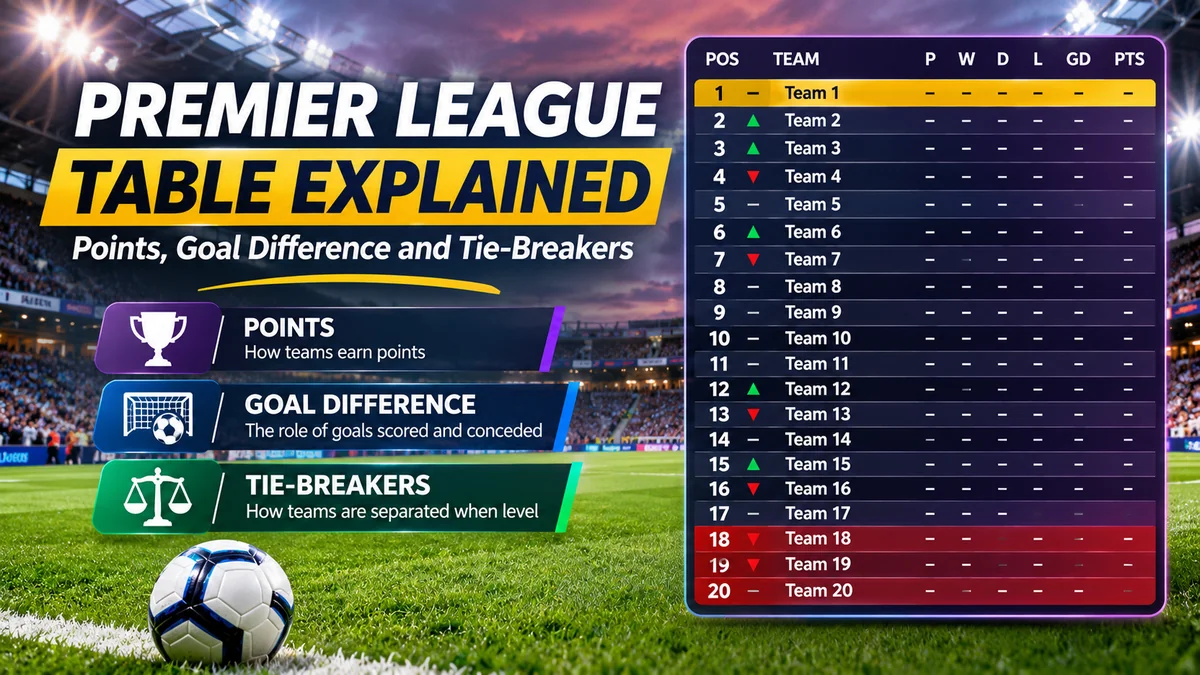
The Premier League table ranks all 20 clubs primarily by points: three for a win, one for a draw and none for a defeat. When teams have the same points, goal difference comes next, followed by goals scored. Additional head-to-head rules can resolve final-season ties that affect the title, European qualification or relegation. The clubs in 18th, 19th and 20th at the end of the season are relegated to the Championship.
That is the short answer for anyone searching for the Premier League table from 1 to 20. But a real standings page contains more than a league position. Played matches, goals for and against, games in hand and recent form help explain why a side is first, mid-table or fighting to stay up.
This guide explains each column and every ranking step, with worked examples and a real title race decided by goal difference. It focuses on the rules rather than copying a live table that would become outdated after the next match. For today's changing positions, use the official Premier League 2026/27 standings .
How does the Premier League table work?
The Premier League has 20 teams. Each club plays the other 19 teams twice—once at home and once away—making 38 league matches per team and 380 fixtures across a complete season. The team with the most points at the end wins the league, subject to the official tie-breaking rules.
The Premier League's own competition explainer confirms the basic format and three-point win system. Match results change the standings, while any disciplinary points deductions or corrections officially recorded by the league also affect a club's total.
A useful distinction: the league table measures results to date, not a prediction of the eventual champions. A side in fourth in November has not automatically qualified for the UEFA Champions League, and a side in 18th has not yet been relegated.
Premier League table columns explained: P, W, D, L, GF, GA, GD and Pts
| Column | Meaning | What to look for |
|---|---|---|
| Pos | League position | Rank from 1st to 20th |
| P / Pl | Matches played | How many of the 38 games have been completed |
| W | Wins | Each victory ordinarily earns three points |
| D | Draws | Each draw earns one point |
| L | Losses | No points for a defeat |
| GF / F | Goals for | Total league goals scored by the team |
| GA / A | Goals against | Total league goals conceded |
| GD | Goal difference | GF minus GA; can be positive, zero or negative |
| Pts | Points | Three times wins plus draws, subject to official adjustments |
| Form | Recent results | Often the last five matches, usually shown as W, D or L |
The two quick consistency checks are P = W + D + L and, in an ordinary season with no deduction or adjustment, Pts = (3 × W) + D. The GD number should always equal GF minus GA. If you see different values, check for a data-update delay, a correction or a formal points adjustment.
How are Premier League points calculated?
A win awards three points, a draw one point to each side, and a loss zero. There are no bonus league points for winning by a large score, scoring multiple goals or keeping a clean sheet.
Example: A fictional team plays 30 matches, winning 18, drawing eight and losing four. It has earned 18 × 3 = 54 points from victories and eight more from draws, giving it 62 points. The record checks out because 18 + 8 + 4 = 30 games.
A club that wins three games earns nine points; another that draws all three earns three points. That is why victories, rather than simply avoiding defeat, can make a significant difference over a season.
The maximum possible points total after winning all 38 games is 114. A team cannot normally exceed that from match results alone.
What is goal difference (GD), and why does it matter?
Goal difference is goals scored minus goals conceded. If a team scores 57 goals and concedes 35, its GD is +22. If it scores 32 and concedes 50, its GD is −18. A positive number means a club has scored more than it has allowed.
GD matters most when clubs are tied on points. The side with the higher goal difference ranks above the other. For example, +22 is better than +21; −5 is better than −12.
It also helps explain why big wins can be relevant to the league title or relegation battle. A 4–0 win and a 1–0 win each deliver three points, but the former improves goal difference by four rather than one.
Worked example: equal points, different goal difference
| Fictional club | W | D | L | GF | GA | GD | Pts |
|---|---|---|---|---|---|---|---|
| Team A | 18 | 8 | 4 | 57 | 35 | +22 | 62 |
| Team B | 18 | 8 | 4 | 52 | 31 | +21 | 62 |
Team A ranks above Team B despite conceding more goals because its overall goal difference is one goal better. The table does not rank teams by fewest goals conceded when points are equal.
The official competition has been decided by this rule. In 2011/12, Manchester City and Manchester United both finished with 89 points, but City won the title with a +64 goal difference compared with United's +56. The Premier League's historical account documents the final standings and Sergio Agüero's decisive last-day winner against Queens Park Rangers.
What happens if two clubs have the same points and goal difference?
Goals scored (GF) is the next criterion. Suppose Team A has 62 points, GD +22 and 57 goals scored, while Team C also has 62 points and GD +22 but has scored 65. Team C ranks above Team A on goals scored, even though both have the same points and overall goal difference.
Here is a consistent fictional example:
| Team | P | W | D | L | GF | GA | GD | Pts |
|---|---|---|---|---|---|---|---|---|
| Team C | 30 | 17 | 11 | 2 | 65 | 43 | +22 | 62 |
| Team A | 30 | 18 | 8 | 4 | 57 | 35 | +22 | 62 |
Team C has eight more goals scored. Its different win–draw record does not matter once the teams have the same total points; its superior GF settles the comparison at this stage.
Premier League tie-breakers: the official order
The league's May 2026 explanation of the title rules sets out the sequence used where final positions matter:
- Points: the club with more points finishes higher.
- Goal difference: if points are equal, compare total GF minus total GA.
- Goals scored: if both measures are equal, the club with more league goals is placed higher.
- Head-to-head points: if a decisive final placing remains unresolved, compare points earned in league matches between the tied clubs.
- Head-to-head away goals: if required, compare away goals scored in those head-to-head games.
- Play-off: if a title, European qualification or relegation outcome still cannot be decided, a one-off neutral-ground play-off may be needed.
Important nuance: the further head-to-head and play-off steps are specifically significant when the final season placings affect the championship, qualification to another competition or relegation. Clubs otherwise identical on points, GD and goals scored are not necessarily forced into an extra match to separate an inconsequential mid-table position. Do not assume an in-season table's display order itself establishes that a hypothetical final head-to-head test has been completed.
The Premier League said in its May 2026 relegation FAQ that a neutral-venue table-deciding play-off had not occurred in the competition's history as of that publication.
How a head-to-head example works
Imagine Teams X and Y finishing level on points, GD and goals scored, with their final ranking needed to decide a European berth. If X beat Y 2–1 at home and drew 0–0 away, X collected four points in their two meetings while Y collected one. X wins the head-to-head points comparison.
If they are also equal on head-to-head points, the next specific comparison is away goals in those meetings—not their total away wins against all other opponents. A neutral play-off only becomes relevant if the required criteria still cannot separate them.
Premier League table positions 1 to 20: what each zone means
The 20 rows tell several different stories. Some positions award a title, some can qualify for European football, and three lead to relegation—but not every row has a fixed reward.
| Final position | What it usually means |
|---|---|
| 1st | Premier League champions |
| 2nd–4th | High league finish; normally Champions League qualifying places |
| 5th | European qualification position; could also be a Champions League place when England earns an additional allocation |
| 6th–7th | European qualification may extend here depending on domestic cup winners and UEFA allocations |
| 8th–16th | Generally the middle-to-lower part of the table; a European berth is possible in some allocation scenarios, not automatic |
| 17th | Last position above the relegation zone; survives in the Premier League |
| 18th | Relegated to the Championship |
| 19th | Relegated to the Championship |
| 20th | Bottom of the table and relegated to the Championship |
The Premier League's European qualification guide shows why a single table snapshot cannot permanently label fifth, sixth or seventh as fixed UEFA competition places. The number of Champions League spots and the redistribution of domestic cup places can affect how far European qualification extends.
For a deeper explanation of how those tournaments themselves work, see FlyingEze's guide to the UEFA Champions League format and qualification .
What does the relegation zone mean?
The relegation zone is 18th, 19th and 20th place. At the end of the season, those three clubs go down to the English Football League Championship. Three Championship clubs take their places in the following Premier League season.
Before the final match, however, a team can be in the bottom three and still have enough remaining games to climb out. Equally, a club in 17th could fall into the bottom three. This is why supporters watch the points gap, goal difference, games played and remaining fixtures together.
The Premier League's official relegation FAQ confirms the three relegation places. An unofficial “40-point safety rule” is only a football rule of thumb, not a mathematical or regulatory requirement. The points needed to survive change from season to season.
Why games in hand can make the table misleading
A club has a game in hand when it has played fewer league matches than another club it is being compared with. This may happen because of rescheduled matches, weather or clashes with other competitions.
For example, if Team M has 52 points after 26 games while Team N has 50 points after 25, M is currently ahead. But N could move to 53 points by winning its additional fixture, provided M's total does not change in the meantime. The possible three points are not awarded in advance: the match must be played and the result recorded.
Points per game, calculated as points divided by matches played, can help readers compare uneven schedules, but it is not the standard Premier League ranking method in an ordinary ongoing season. Official position is based on actual points and the applicable ranking rules, not hypothetical points from outstanding games.
What do the arrows and coloured symbols beside teams mean?
Many sites display green upward arrows, red downward arrows or grey horizontal symbols showing movement relative to a previous table. Others use highlights to indicate Champions League, Europa League, Conference League or relegation positions.
These are interface aids, not additional points or official tie-breakers. Colours and symbols can differ across broadcasters, league websites and football apps. Check the legend before interpreting them.
The Form section usually summarises recent wins, draws and defeats, sometimes across five league games. A team can have better recent form than the side above it but still sit lower because total season points decide the table.
How to read a live Premier League table correctly
- Check the competition and season: make sure you are viewing the men's first-team Premier League rather than an under-21 table or a historical season.
- Check when it was updated: matches can finish at different times, and a live table may briefly reflect an in-progress result.
- Read P and Pts together: two clubs may have played different numbers of matches.
- Check GD and GF for tied points: do not use alphabetic order or head-to-head as the first test.
- Separate current from final consequences: a provisional position is not yet an awarded title, European berth or relegation.
- Use official references: consult the Premier League table and the current competition handbook when a dispute over rules arises.
A time-stamped news report can accurately describe the standings when it was written but become outdated after another fixture. FlyingEze has covered individual table movements, including Brighton's early-season move above Arsenal in August 2026 . Such stories are historical matchweek snapshots, not permanent league standings.
Five common mistakes fans make about league positions
- Thinking one goal equals one league point: only match results award the standard three, one or zero points.
- Believing the team with most wins must be higher: draws can mean a club with fewer wins has more points overall.
- Using head-to-head before GD: the Premier League compares goal difference and then total goals scored first.
- Assuming fifth always means Europa League: additional Champions League allocations and domestic cup outcomes can change the European picture.
- Declaring a November table final: clubs can move significantly before all 38 matches are completed.
The classic 2011/12 title race remains a reminder that goal difference is not merely a decorative statistic; it can decide the champions after an entire season. For another example of football standings being discussed in real time, FlyingEze also reported on Manchester City's temporary lead after a September 2026 match .
Frequently asked questions
How many teams are in the Premier League table?
There are 20 teams. Each plays 38 league matches, producing 380 fixtures in total across the complete season.
How many points is a win or draw worth?
A win earns three points; a draw earns one point for each side; a defeat earns zero.
What is the first Premier League tie-breaker?
Goal difference is the first way to separate teams level on points. Goals scored is next. Further criteria apply when a consequential final placing remains unresolved.
Does the Premier League use head-to-head before goal difference?
No. Unlike some other competitions, goal difference and then goals scored come before the relevant head-to-head tests.
Which teams are relegated from positions 1 to 20?
The clubs finishing 18th, 19th and 20th at the end of the season are relegated to the Championship.
Is the fifth-placed team guaranteed a Champions League place?
No. A fifth Champions League spot depends on the applicable UEFA allocation for that season. Other European places can also move according to cup winners and the relevant rules.
The bottom line
The Premier League table from 1st to 20th is built from results, not reputation. First compare points, then goal difference, then goals scored. If a decisive final placing is still tied, head-to-head results and potentially a neutral-ground play-off can come into play. Remember that 17th is the final survival position, while 18th through 20th are relegated at season's end.
Knowing the difference between a live snapshot and a final table makes it much easier to follow a title race, the battle for Europe or the fight against relegation without misreading the numbers.