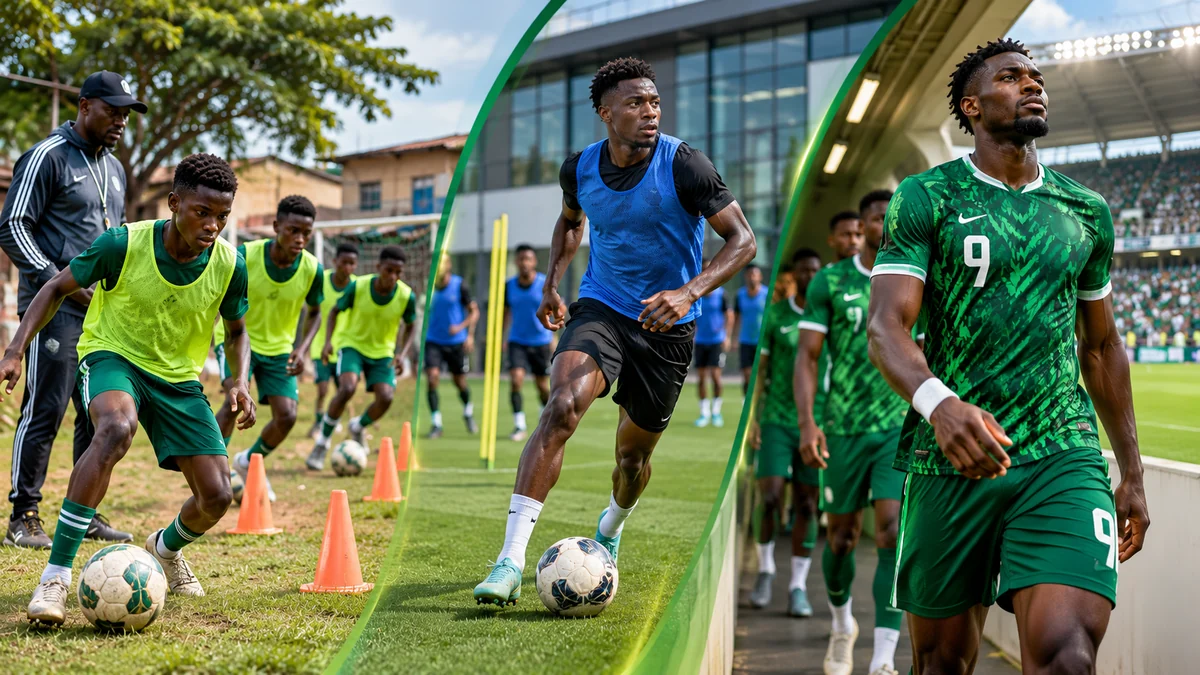
Nigeria's football development pipeline starts long before a player receives a Super Eagles invitation. Community pitches, school tournaments, youth academies, regional scouting, club youth teams and professional leagues all create opportunities to develop and identify talented players. The Golden Eaglets (U-17) and Flying Eagles (U-20) provide international exposure, but they are not compulsory stages or guarantees of a senior national-team place.
That distinction matters. Nigeria have won a record five men's FIFA U-17 World Cups, yet success at youth level does not automatically translate into a long professional career or a competitive senior team. The real question is how promising teenagers receive high-quality coaching, regular meaningful matches, education, medical support and the opportunity to mature into dependable senior professionals.
Official NFF, NPFL and FIFA reporting shows that Nigeria's system contains several pathways rather than one national academy ladder. The FIFA Talent Development Scheme (TDS) has supported scouting and youth camps, while the NPFL U-17 Youth League has provided a bridge between club academies, youth national squads and senior club football. FIFA has also funded a new NFF technical-centre project in Abuja. This guide examines what those initiatives do, where the gaps remain and how a young Nigerian player can navigate the pathway safely. Research checked: 12 November 2026.
What does Nigeria's football development pipeline look like?
| Stage | Typical opportunities | What a player must develop |
|---|---|---|
| Grassroots | Neighbourhood teams, school matches, community and local tournaments | Enjoyment, coordination, basic technique and consistent participation |
| Structured youth development | Academies, local clubs, age-group coaching and regional talent programmes | Ball mastery, decision-making, fitness, teamwork and education |
| Scouting and youth club competition | NFF talent programmes, club youth leagues, trials and recognised tournaments | Performance against comparable opposition and reliable player records |
| National youth teams | U-15 development, Golden Eaglets U-17 and Flying Eagles U-20 | Competitive maturity and adaptation to international football |
| Professional senior football | NPFL and other eligible domestic or overseas first-team leagues | Regular minutes, tactical awareness and sustainable professional standards |
| Super Eagles | Senior selection, camps, friendlies, qualifiers and tournaments | Current form, positional suitability, fitness, eligibility and national-team performance |
The table describes possible routes, not mandatory promotions. Some Super Eagles players gain recognition through overseas clubs or later professional breakthroughs without featuring for Nigeria at U-17 or U-20 level. Others represent national youth teams but never secure regular senior-club football. A strong development system should accommodate both trajectories.
Stage 1: Grassroots football is where the talent pool begins
For many children, football begins at school, in a neighbourhood match or with a local volunteer coach. These settings matter because they offer the widest entry point into the sport, including to families who cannot immediately afford an established academy.
At younger ages, the goal should not be to create a professional player in a few months. It should be to build coordination, first touch, passing, movement, teamwork and enjoyment. Appropriate coaching also teaches communication, resilience, respect for referees and how to cope with mistakes.
Access is uneven. Transport, safe playing areas, footwear, coaching costs and school obligations may all shape whether a child gets enough practice and competitive exposure. A talented youngster in a smaller town should not need to move to Lagos or Abuja simply to become visible to a scout.
The NFF and FIFA have been studying ways to strengthen the grassroots environment, while the NFF's Talent Development Scheme reporting describes scouting activity across ten states following a workshop with representatives from around the federation. The practical challenge is sustaining regular and geographically broad access rather than relying only on isolated trials.
Stage 2: What a good football academy should actually provide
An academy can give young players more structured coaching and opportunities to play against stronger opponents. But the word academy on a social-media profile does not prove quality, safeguarding or a recognised route to a professional club.
Parents and players should look for a written training plan, appropriate coach qualifications, a genuine match schedule, safe facilities and clear fees. Training should progress with age and ability, rather than exposing every youngster to the same physical workload. Good academies assess technique and game understanding alongside physical development.
Education matters. Only a small share of talented junior players can expect a long professional career, and injuries or changes in personal circumstances can interrupt progress. A responsible academy should support school attendance and offer realistic information about the uncertainties of elite sport. Parents should ask what happens to children who do not receive a professional offer.
Selection claims deserve scrutiny. An academy saying it has connections in Europe is not evidence that it can guarantee a contract, a visa or a Super Eagles call-up. Ask for verifiable examples of actual player development, clear safeguarding arrangements and a written explanation of any proposed travel or representation agreement.
Stage 3: The NFF and FIFA Talent Development Scheme
One of the clearest documented routes for early talent identification is the FIFA Talent Development Scheme. FIFA designed TDS to help member associations identify and nurture young players more systematically. Its 2026 development update describes the programme's emphasis on long-term pathways, coaching and giving talented children opportunities to reach their potential.
According to the Nigeria Football Federation , the national scheme began in 2023, followed by a December workshop bringing together state representatives and subsequent scouting across ten states. The NFF said 48 players were selected from that scouting pool for national camping and recorded in its player database. These are figures from a specific reported programme stage, not a tally of all young players registered in Nigeria.
In another NFF report, 120 boys were invited in two batches to a two-week U-15 Future Eagles development programme in Abuja. Coaches described the aim as identifying promising 12- to 15-year-olds and building a longer-term pool from which future age-group and senior teams might benefit.
There is also a wider development story beyond the men's Super Eagles. The NFF inaugurated a girls' TDS programme in Abuja on 10 December 2025 , describing it as an effort to expand identification and opportunity for girls. The women's route ultimately leads toward the Super Falcons, not the men's Super Eagles, but it demonstrates why a national development system must reach both sexes.
These initiatives are promising institutional building blocks. They do not establish that every region has a permanent FIFA academy, that each selected child will become a professional or that all proposed national facilities have been completed.
Stage 4: The NPFL U-17 Youth League and the club pathway
Between junior academies and senior professional football lies a difficult transition: young players need competitive matches, not only training sessions. The Nigeria Premier Football League (NPFL) U-17 Youth League is a documented example of this bridge.
The NPFL's account of its inaugural 2024 Youth League says the competition involved youth teams from its member clubs, with zonal qualifying stages and a final tournament. It reported that some participants later appeared for their senior clubs and four players were selected for Nigeria's U-17 team. That is a tangible example of club football creating national scouting opportunities, although one successful group of players cannot establish the league's long-term impact.
The NPFL also documented a 30-player Youth League All-Stars camp in Abuja in July 2024 , drawing youngsters from clubs including Rangers, Remo Stars, Rivers United, Plateau United and Katsina United. Such camps can provide additional coaching and assessment outside the pressure of tournament selection.
The next challenge is the first team. A junior prospect who trains with senior professionals may still struggle to play meaningful minutes. Coaches have to judge readiness, positions, injury risk and match demands. For the player, steady development in a competitive domestic league can be more valuable than a prestigious club name without appearances.
The domestic-league route is not exclusive. Nigerian footballers also develop through clubs and academies abroad. The crucial test at this stage is whether the player is receiving appropriate training, competing regularly and making measurable progress toward sustainable senior-level football.
Stage 5: Golden Eaglets and Flying Eagles as international development platforms
Nigeria's Golden Eaglets represent the men's U-17 level. The Flying Eagles represent the men's U-20 level. Playing in CAF age-group competitions or FIFA youth tournaments can expose a youngster to different tactical approaches, high-pressure fixtures and scouts from other football markets.
The country has a formidable record. FIFA lists Nigeria's five men's U-17 world titles in 1985, 1993, 2007, 2013 and 2015—more than any other country in that tournament's history at the research date. The 2013 team featured Kelechi Iheanacho, while Victor Osimhen was one of the standout performers of the 2015 champions.
At U-20 level, the Flying Eagles finished third at the 2025 CAF U-20 Africa Cup of Nations , beating hosts Egypt on penalties in the bronze-medal match. They also qualified for the FIFA U-20 World Cup in Chile and reached its knockout stage. Those are useful indicators of international youth competitiveness, not proof that every member of that squad will become a Super Eagles regular.
Youth tournaments can create visibility, but winning a U-17 World Cup is not the same as building a successful 10-year senior career. Players still need transitions into professional clubs, professional habits, opportunities to play and long-term physical and psychological support.
FlyingEze has covered the age-group ecosystem, including the Golden Eaglets' WAFU B U-17 competition and NFF coaching appointments for the Flying Eagles and Golden Eaglets . These reports describe particular competitions and decisions; they should not be mistaken for permanent team rosters.
Case studies: what the paths of Iheanacho and Osimhen teach
Kelechi Iheanacho emerged internationally as an influential member of Nigeria's victorious 2013 U-17 side. He subsequently established himself in professional club football and earned senior international recognition. His path shows how outstanding age-group performance can open opportunities, provided the player continues developing after the youth tournament.
Victor Osimhen was the leading scorer of the 2015 U-17 World Cup, with a tournament-record ten goals, before moving through professional football and becoming a prominent senior Nigeria striker. FIFA's retrospective on the 2013 and 2015 Golden Eaglets traces how selected members of those teams developed after the competition.
The broader lesson is not that every teenager should leave Nigeria immediately after a strong tournament. Both careers involved further coaching, professional competition and adaptation. Young players develop at different rates, and the most famous graduates are not a representative measure of every academy's success.
Stage 6: Why regular senior-club football matters before a Super Eagles call-up
The final transition is from a promising youth player to someone the senior national team can trust. A Super Eagles coach needs players capable of dealing with adult professional football: pressing, defensive organisation, tactical instructions, travel, physical duels and high-stakes matches.
Selection can draw from the NPFL, other domestic competitions and leagues abroad. The important questions are whether the player is performing, fit, eligible and suitable for the position and style required. Reputation from a previous youth tournament may attract attention, but it cannot substitute for current assessment.
A successful pipeline therefore should not end with an U-17 cap. It should connect clubs, youth national-team selectors and senior technical staff through credible scouting reports and match evidence. A coach should be able to track how a player changes from age 15 to 19 to 23, rather than relying only on isolated highlights.
The senior route also includes eligible players raised abroad. FIFA's September 2026 player-eligibility guidance explains how nationality, genuine links, previous international appearances and possible changes of association can affect national-team representation. Nigerian ancestry or a Nigerian passport does not automatically answer every eligibility question, especially where a player has previously represented another country.
For context on the eventual senior team's competitive responsibilities, FlyingEze has reported on Nigeria's 2027 AFCON qualifying win against Madagascar . Youth development's ultimate value is tested when a new generation becomes ready to contribute in fixtures of that kind.
The infrastructure question: pitches, facilities and coaching
Nigeria's football development depends on both people and facilities. Good coaches can teach on modest pitches, but persistent shortages of safe training grounds, medical support and appropriate accommodation make continuity harder.
FIFA reported that the NFF began an Abuja technical-centre project in March 2025 using US$4,879,570 in FIFA Forward funding. The plan included a 68-room players' accommodation block, new natural-grass and synthetic pitches, an upgrade to an existing pitch and spectator and dressing-room facilities.
The announcement projected completion within two years. That is a project plan, not evidence that every facility was fully operational by November 2026. Such infrastructure can reduce the logistics burden for national-team camps, but it cannot by itself replace local coaching or regular junior competitions.
Coaching education is another priority. In July 2026, the NFF publicly discussed decentralising coaching courses to make qualification and refresher training more accessible across Nigerian states. A stronger system needs capable coaches at entry level as well as elite national facilities.
The biggest gaps in moving young talent toward the national team
Several recurring structural risks can interrupt a young player's progression:
- Unequal access: Rural communities and low-income families may have fewer supervised training and scouting opportunities.
- Insufficient meaningful games: An academy can train frequently but provide too little competition against comparable teams.
- Unreliable player records: Incomplete identities, ages or match histories complicate fair age-category selection and long-term tracking.
- Weak transition into senior football: Youth players may be promoted in name but receive few first-team minutes.
- Coaching and medical gaps: Quality varies, especially where clubs cannot fund qualified staff and injury prevention.
- Education and family pressure: Players may be encouraged to abandon schooling before any secure professional opportunity exists.
- Exploitation: Unverified agents, false foreign-trial offers and unsafe contracts can harm children and families.
These are risks a development policy should address; they are not numerical findings from a single nationwide audited study. The effectiveness of a programme should be judged using measured participation, player retention, safeguarding outcomes and the quality of professional progression, not solely a tournament medal count.
Protecting under-18 players: agents and overseas transfer rules
International opportunities can be valuable, but junior players require special protection. FIFA's 2026 guide to minor-player applications reiterates that the international transfer of players under 18 is generally prohibited unless a narrowly defined exception applies and the relevant requirements are satisfied.
FIFA also warns that representation of minors is subject to additional rules. Its parent education material states that an agent must have the necessary authorisation to work with minors and must obtain the parent's or legal guardian's prior written consent before approaching them for representation.
Parents should be wary of anyone promising to take a 14-year-old abroad immediately for a guaranteed contract in return for an urgent fee. Ask for the organisation's verifiable identity, the agent's FIFA licence and minor-representation authorisation, written trial details, school and welfare arrangements, and independent legal advice where appropriate.
No academy, scout or intermediary can guarantee a professional contract or a future Super Eagles selection. Families should prioritise safeguarding, truthful information and compliant processes over an apparent shortcut.
What parents and young footballers should do next
- Choose a credible environment. Visit the club or academy, meet coaches, inspect the training location and ask about safeguarding and school arrangements.
- Build fundamentals. Work on first touch, passing under pressure, decision-making, movement and appropriate physical development.
- Seek regular matches. Match experience against comparable opposition is needed to test progress.
- Document development. Maintain accurate age and identity records, match appearances, position history and medical information with appropriate privacy protections.
- Check realistic pathways. Understand whether the organisation competes in recognised leagues and what genuine opportunities exist for older players.
- Keep education active. Prepare for the possibility that elite professional football does not become a career.
- Verify agents and trials. Confirm permissions, costs, documents and parental rights before signing or travelling.
- Value consistent progress over exposure. A regular first-team opportunity in a suitable club can be more beneficial than a famous trial without meaningful football.
How Nigeria can measure whether the pipeline is improving
Instead of relying exclusively on headlines about another talented youngster, the NFF, leagues, clubs and academies could measure the system through useful, transparent indicators:
| Development measure | Why it matters |
|---|---|
| Players participating by age, region and sex | Shows how broad and inclusive access is |
| Qualified youth coaches and ongoing education | Indicates the quality of instruction available |
| Competitive matches per youth team | Measures meaningful opportunities to develop |
| Verified player identity and age records | Supports integrity and fair competition |
| Transition from youth leagues to senior club minutes | Tracks the difficult professional-development stage |
| Medical, educational and safeguarding standards | Reflects the welfare of players beyond football results |
| Progression to U-17, U-20 and senior selection | Connects talent identification to national-team outcomes |
These are proposed evaluation metrics, not claims that every Nigerian club already publishes them. A transparent, multi-year picture would help distinguish sustainable development from a successful short tournament run.
Frequently asked questions about Nigeria's football development pathway
How can a young footballer in Nigeria become a Super Eagles player?
There is no guaranteed route. A player can develop through school, grassroots clubs, academies, youth leagues, domestic or overseas professional clubs, with senior selection depending on current form, fitness, eligibility, positional needs and the national coach's decisions.
Is an academy compulsory before playing for Nigeria?
No. An academy can help by offering structured training and matches, but the Super Eagles are not restricted to graduates of a particular academy or the national U-17 and U-20 teams.
What is the NFF Talent Development Scheme?
It is Nigeria's implementation of FIFA's talent-development initiative, intended to widen scouting and long-term player development. NFF reports describe regional scouting, player camps and database records, rather than a guaranteed professional placement programme.
What are the Golden Eaglets and Flying Eagles?
They are Nigeria's men's under-17 and under-20 national teams respectively. Their competitions provide international experience, but participation does not guarantee senior national-team selection.
How many U-17 World Cups has Nigeria won?
Five men's FIFA U-17 World Cups: 1985, 1993, 2007, 2013 and 2015, as confirmed by FIFA.
Did Victor Osimhen come through Nigeria's youth national team?
Yes. He was part of the Golden Eaglets' 2015 U-17 World Cup-winning team and finished that tournament with a record ten goals, later establishing himself in professional and senior international football.
Does the NPFL have a youth development league?
The NPFL introduced an U-17 Youth League and documented its inaugural 2024 competition and subsequent All-Stars camp. The 2024 report also described participants progressing to senior club squads and national U-17 selection.
Can a player based abroad represent Nigeria?
Potentially. FIFA eligibility depends on nationality, qualifying links, previous international appearances and other applicable rules. Some cases require a formal eligibility or change-of-association process.
Can a 16-year-old join a European club from Nigeria?
International moves involving minors are subject to restrictive FIFA rules and limited exceptions. A player or parent should obtain proper legal and regulatory guidance rather than assume age 16 automatically permits an overseas transfer.
Does paying an agent guarantee a national-team invitation?
No. Be suspicious of anyone offering a guaranteed Super Eagles place, foreign contract or protected trial for payment. Verify any representation arrangement and applicable safeguards.
What should Nigeria prioritise to produce more senior internationals?
Accessible coaching and pitches, credible age-group records, regular youth matches, player welfare, links to meaningful senior-club playing time and long-term scouting are stronger foundations than relying on one tournament result.
Conclusion: the Super Eagles are the end of the pathway, not its starting point
Nigeria's football development pipeline is a network of opportunities rather than a single conveyor belt. Children begin in communities and schools; some advance through academies and club youth teams; others are identified through regional programmes, the NFF's talent-development work or professional competitions. Youth national teams can accelerate growth, but the leap to senior football still depends on development over several years.
Nigeria's five U-17 world titles demonstrate the country's potential. The continuing work of the NFF, NPFL and FIFA shows that the next challenge is turning that potential into broader access, better coaching, fairer scouting, safe transitions and sustained professional performance. When those stages connect, the Super Eagles have a better foundation for future success.