
THE NHS is pleading with Brits to act now to protect themselves against an early flu season.
The service’s national medical director said hospital admissions for the virus are the “highest” she’s seen for this time of year.

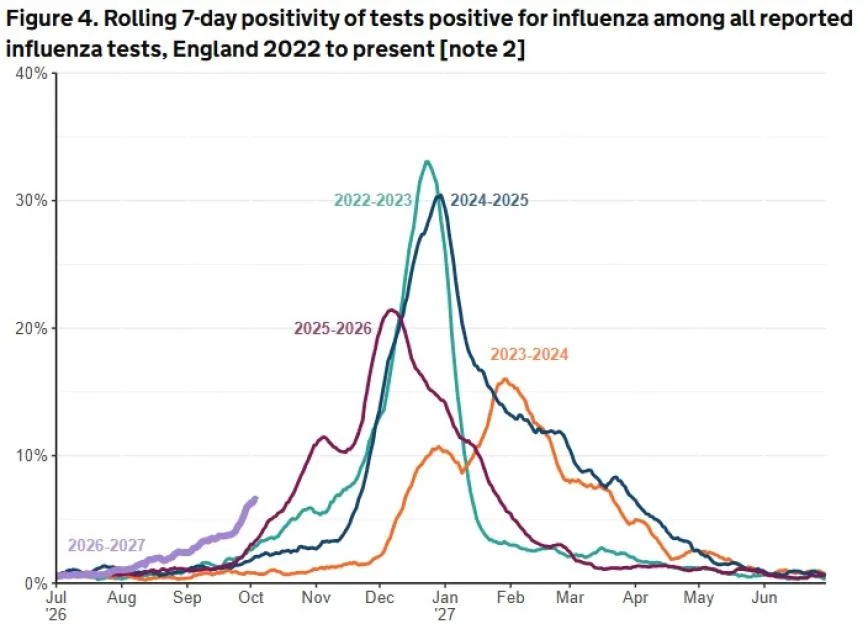
Flu season started five weeks early last year and hospitals were after a “quad-demic” of winter bugs hit over December and January.
Levels of flu are currently low, but the figures from September are still higher than they’ve been in the same period for the last four years, according to the UK Health Security Agency (UKHSA).
Cases have been rising since August, particularly in young adults.
Professor Frankie Swords, national medical director at England, told a briefing: “From an NHS perspective, it is very early in the season, but the number of admissions for flu are the highest that I can remember seeing at this time of year, and it’s coincided with just the start of the expected increase in Covid cases in our hospitals.”
Covid cases and hospitalisations have started ticking up as the virus “circulates at low levels”, according to the UKHSA.
Prof Swords added: “This is coming on the back of the busiest we’ve ever had in our emergency departments, we have got very, very busy hospitals.”
All the above are “slightly ominous early signs of pressure,” she added.
Prof Swords urged Brits to “act early” in protecting themselves from the virus.
“Although the weather’s still nice, and perhaps people aren’t thinking too much about flu at the moment, please, we are acting early, and I’d really encourage people to act early.
“Because winter is coming, and the pressure is going to build and rise as temperatures fall.”
UKHSA figures show hospital admissions for flu were 1.97 per 100,000 for the week to October 4.
There are three types of , and while it is too early to know which one may dominate this winter, the current vaccine protects against all three.
Early data shows there is an equal mix of subtypes A(H3N2) and A(H1N1) in England, the UKHSA said.
Prof Swords revealed 3.9 million people have already had their flu vaccination since the start of last month.
The NHS started vaccinating pregnant women, toddlers and school-age children from September 1, with over 65s and other eligible adults offered it from October 1.
Analysis suggests that the vaccination programme in England last winter prevented around 100,000 hospital admissions and 7,000 deaths.

Who can get a free flu jab?
You’re eligible for a free flu vaccine if you:
- Are aged 65 or over (including those who will be 65 by March 31, 2027)
- Are aged 18 to 64 and have certain long-term health conditions
- Are pregnant – you can have a flu vaccine during any stage of pregnancy
- Live in a care home
- Are the main carer for an older or disabled person, or receive a carer’s allowance
- Live with someone who has a weakened immune system
- Are aged 16 or over and sleeping rough or staying in a homeless hostel or night shelter
Find out where you can get yours .
Elsewhere, the UKHSA report shows that Covid-19 activity is also increasing, but is still at low levels.
Figures released today show that in the week up to September 30, there were 1,857 Covid cases reported in England.
This marks an increase of 477 (34.6 per cent) on the previous week – a rise of 293 (33.5 per cent) on the previous week.
Figures also show that 1,168 patients were admitted to hospital with Covid in the seven days up to September 30.
The so-called is thought to be driving cases.
Despite its nickname, it closely related to strains seen in the UK for more than a year.
Experts have told Sun Health the strain is being mistaken for .
Dr Alex Allen, consultant epidemiologist at UKHSA, said: “There’s been quite a lot of interest in the so-called American strain, which has also been called Stratus or the XFG strain.

“That’s been circulating in some form or another in the UK for over a year now, and it’s only in the last couple of months we’ve actually seen this increased activity.
“There’s nothing particularly in the evidence or data that suggests that this American strain or XFG is more severe or more likely to cause severe illness.
“The current running vaccination programme has vaccines that are specifically targeted against the XFG strain… we’re expecting that to have a significant protective effect.”
Eligible Brits can also get a free Covid jab now.