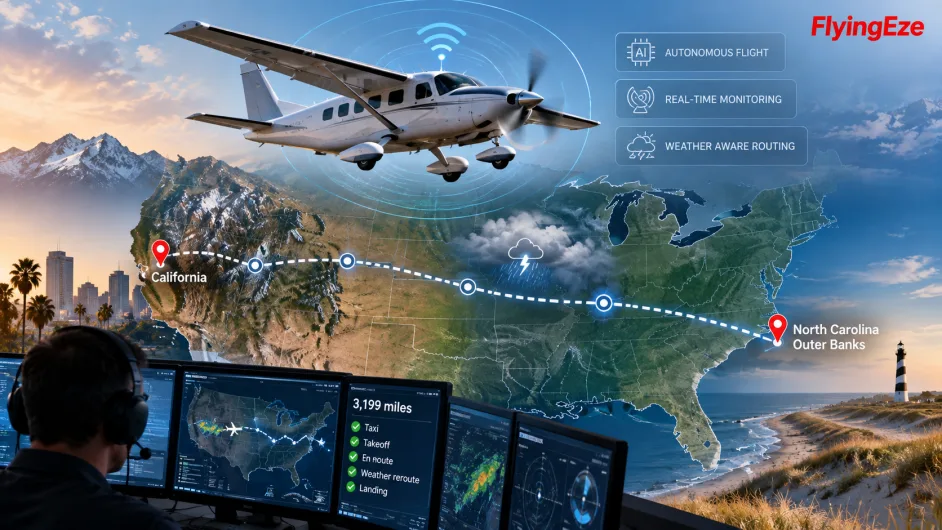
Joby Aviation says an aircraft equipped with its autonomy technology has completed the first autonomous flight across the United States, travelling 3,199 miles from California to North Carolina with no control inputs from the safety pilot on board.
The aircraft was a converted Cessna Caravan rather than Joby’s electric air taxi. During the transcontinental journey, the J208 autonomously handled taxiing, take-offs, route navigation and landings while being supervised remotely, according to Joby’s 18 September announcement.
What Joby’s autonomous J208 achieved
The eastbound journey began at Buchanan Field Airport in Concord, California, and concluded at Dare County Regional Airport on North Carolina’s Outer Banks. Joby said the aircraft operated under remote supervision from its Autonomy Headquarters in California and Shaw Air Force Base in South Carolina, at distances of up to 2,323 miles.
An onboard safety pilot remained available to intervene if required. Joby’s specific claim is that the pilot made zero control inputs during the 3,199-mile crossing. That distinction means the demonstration should not be described as an uncrewed or pilotless transcontinental flight.
Busy airspace and severe weather
The route included stops in Phoenix, Fort Worth and at Shaw Air Force Base before reaching North Carolina. Joby said the aircraft integrated into operations at Phoenix Deer Valley, a busy general-aviation airport, despite having no prior familiarity with the airport.
The autonomous system also rerouted around severe weather and thunderstorms in real time, according to the company. These scenarios are important tests for autonomous aviation because real-world operations require more than maintaining a predetermined cruise path.
Why Joby used a converted Cessna Caravan
The J208 uses a converted Cessna Caravan airframe equipped with Joby’s autonomy hardware and software. Joby acquired the underlying autonomy programme when it bought Xwing’s autonomy division in 2024.
Using an established aircraft type allows the company to test autonomous logistics capabilities on a platform already familiar to freight and regional operators. Joby says its autonomy system has accumulated more than 400 flights and 800 automated flight hours across controlled and uncontrolled airspace.
Remote supervision remained part of the flight
The milestone demonstrates automated aircraft control, but human oversight remained part of the operation. A safety pilot was physically aboard, while remote personnel supervised the aircraft and its mission.
That makes the achievement different from a fully uncrewed commercial service. Regulators will still have to determine how increasingly autonomous aircraft can operate safely and routinely in shared civil airspace, including what levels of onboard and remote human supervision are required.
Potential uses beyond passenger air taxis
Joby is best known for developing electric vertical-take-off-and-landing aircraft for urban passenger transport, but the J208 programme targets a broader autonomy market.
The company says autonomous aircraft could support commercial freight, medical logistics, disaster response and defence operations. During the US tour, the aircraft demonstrated logistics and dual-use applications at several stops.
Joby also said the programme has participated in US military exercises and that the aircraft can be remotely supervised over long distances. Those demonstrations do not establish that autonomous Caravans are ready for routine commercial operations, but they show how the technology is being tested beyond controlled research environments.
What happens next
After reaching the Outer Banks, Joby said the aircraft would begin a westbound return journey with planned stops including Raleigh, the Washington area, Louisville, Wichita, Oklahoma City, Salt Lake City and Portland.
The next major questions concern certification, operational approvals and how much human supervision regulators will require. Joby has demonstrated that its system can control a conventional aircraft over a transcontinental route; turning that capability into routine commercial service will require additional regulatory and operational milestones.
For aviation, the significance of the flight lies less in removing humans entirely and more in demonstrating autonomous control across varied airports, weather and airspace over thousands of miles while retaining human oversight as a safety layer.