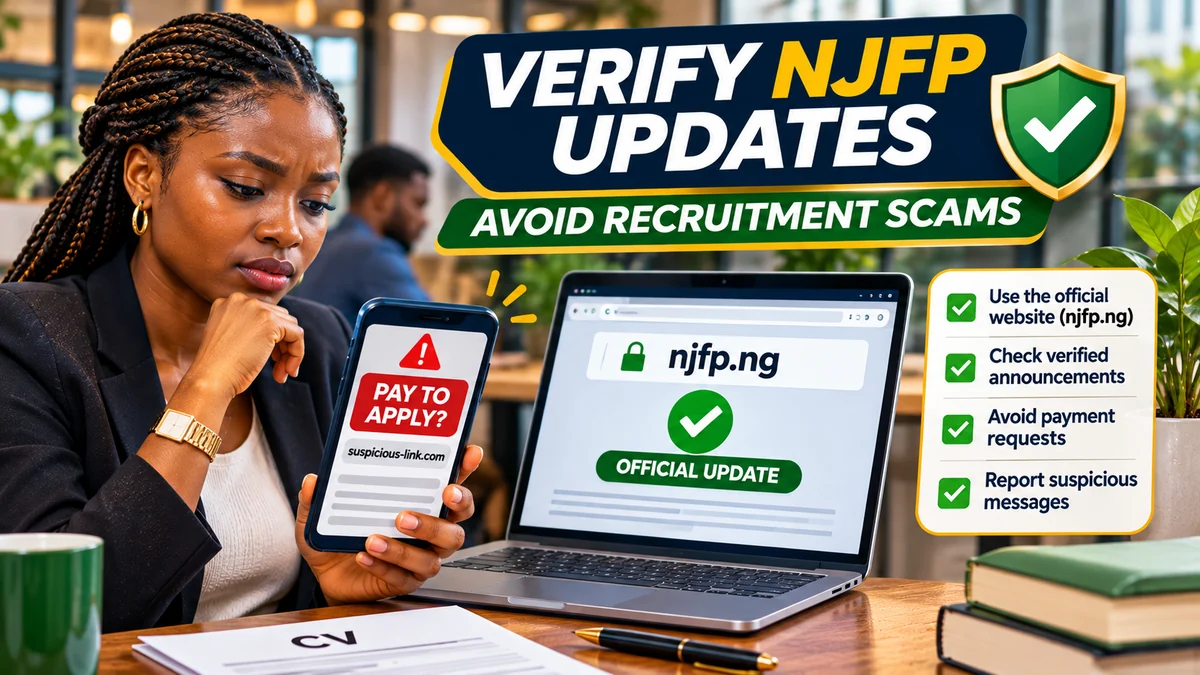
To verify an official Nigeria Jubilee Fellows Programme (NJFP) update, start at njfp.ng , check the programme's FAQ and application instructions, and confirm any new deadline or selection notice independently before clicking a link or uploading documents. NJFP 2.0 says applications and placements are free at every stage. Anyone asking you to pay an application, shortlisting, assessment or placement fee is contradicting the programme's published rules.
That matters because convincing recruitment fraud can arrive as a WhatsApp broadcast, Telegram announcement, social-media advert, email, text message or even a professional-looking PDF bearing a copied logo. This article explains how to recognise reliable NJFP sources, check a real application status and respond if you have already sent money or sensitive information to a suspicious contact.
Research checked 14 November 2026. This is a verification and safety guide, not a new application announcement. The latest publicly stated 2025 intake dates are historical and do not establish that NJFP applications are open today.
What is NJFP, and why do fake recruitment notices attract attention?
The Nigeria Jubilee Fellows Programme is a Federal Government of Nigeria initiative supported by the European Union and implemented in partnership with the United Nations Development Programme (UNDP). The updated NJFP 2.0 model aims to connect eligible graduates with workplace experience, mentorship and skills development, including 12-month paid placements with host organisations.
Programme benefits and the hope of securing experience can make urgent recruitment notices emotionally persuasive. A scammer may exploit that interest by promising guaranteed placement, selling purported exam answers or claiming to be an NJFP official able to “upgrade” an application. These are illustrative fraud patterns, not verified allegations that a particular named NJFP official or current announcement is fraudulent.
For background on what the programme actually offers, consult the official NJFP FAQ . The separate question here is whether a message about it is authentic.
1. Use the official NJFP website as your starting point
Begin with the domain njfp.ng, preferably by typing it yourself or using a previously verified bookmark. Its official FAQ identifies njfp.ng/apply as an application starting point. It also directs existing applicants to portal.njfp.ng for sign-in and dashboard access. The separately hosted self-service.njfp.ng presents account-recovery functions and should be approached from official NJFP navigation when you actually need those functions.
Read the entire address carefully. In a website name such as portal.njfp.ng, the subdomain is portal and the main domain is njfp.ng. A message that merely contains those letters elsewhere in a longer address is not necessarily on the official domain. Similarly, a fake site can copy NJFP branding and still have nothing to do with the programme.
Do not treat the padlock or https:// indicator as independent proof of government endorsement. HTTPS protects the connection to the site you are visiting; a criminal site can also use HTTPS. The correct domain, expected page content, and an announcement confirmed through another official channel matter more.
2. Check the announcement date before sharing an application link
An old NJFP notice can be genuine and still no longer be actionable. The NJFP FAQ records an intake from 22 October to 12 November 2025, and UNDP's 2025 application guide describes that launch. A reposted 2025 graphic is therefore not proof of a newly opened 2026 application window.
The programme says later rounds depend on the existing candidate pool and will be announced through its official website and verified social channels. On 14 November 2026, the retrieved official FAQ still contained the historical window; this research did not establish a live new application call or a new closing date.
Before acting, match four details: publication date, intake year, start and end dates, and the official application destination. If a forwarded message claims applications close “tonight” but its linked announcement does not appear on the official programme website, treat it as unverified rather than rushing.
3. Understand what an authentic NJFP application process looks like
The official programme materials describe an online application, eligibility checks, a short video and a psychometric assessment, followed by entry to a prequalified talent pool for candidates who complete the necessary steps. Some earlier UNDP guidance also refers to a computer-based aptitude test; the exact current instructions and sequence should be taken from the official portal for the relevant intake.
The distinction between a prequalified candidate and a Fellow is crucial. According to NJFP, joining the talent pool does not guarantee placement. A candidate becomes a Fellow after being successfully matched to a host organisation and onboarded.
A message saying “You have been shortlisted—send ₦10,000 to guarantee your host organisation” conflicts with both the no-fee policy and the described matching process. A high-quality-looking admission letter or appointment screenshot is not enough to override the dashboard and independent support verification.
Even a legitimate application confirmation is not evidence of an immediate job offer. Distinguish application received, assessment completed, prequalified and formally matched or onboarded.
4. Know the strongest red flags in fake NJFP recruitment messages
| Warning sign | Why it deserves scrutiny | Safer response |
|---|---|---|
| Payment to apply or secure placement | NJFP says it charges no fee at any application or placement stage | Do not pay; verify via the official portal |
| Guaranteed selection from an “agent” | Matching depends on criteria and suitable host availability | Check your dashboard and independent NJFP support |
| A link using a lookalike domain | Fraudsters can copy an official webpage | Type njfp.ng independently |
| Urgent OTP or account-password request | May be designed to take over your profile | Do not disclose codes or passwords |
| NIN/BVN sent to a personal chat | Could expose sensitive identity information | Use only the authorised application process |
| Old intake flyer presented as new | Real historical information can be misleading when reposted | Compare dates with the current official notice |
| Unsolicited app or “assessment software” download | May install malware or steal data | Follow only current official portal instructions |
The UNDP scam alert warns against paid recruitment approaches and impersonation. Nigeria's ngCERT August 2026 advisory separately describes phishing, impersonation and AI-assisted social-engineering attacks. The general lesson is that a professional tone, government-style graphics or copied logos cannot establish authenticity.
5. Check emails, WhatsApp broadcasts and social-media accounts carefully
A genuine announcement might be forwarded by an ordinary person. Forwarding is not, by itself, evidence of a scam—but it is not independent verification either. Open the official NJFP website and look for the corresponding announcement before taking action.
For emails, inspect the full sender address, any unusual reply-to address, the destination behind buttons and the actual request. The NJFP FAQ lists applications@njfp.ng for certain application-support issues and the dashboard helpdesk for technical problems. Even a message that appears to come from the correct domain should be cross-checked if it unexpectedly asks for money, a password or OTP: sender details can be spoofed, and legitimate accounts can sometimes be compromised.
For social platforms, use links originating from the official programme site to identify current verified channels; do not assume every profile with a blue check or “NJFP Support” in its name is officially authorised. A copied logo, follower count and verified-looking badge are not enough.
Do not share one-time codes in a comment, direct message, Telegram group, Google Form or email. If a forwarded alert provides a phone number for confirmation, find the support number independently on the current official website instead of trusting the number in the alert.
6. Treat NIN, BVN and identity documents as sensitive—but recognise legitimate requirements
The official NJFP eligibility documentation calls for a National Identification Number (NIN), Bank Verification Number (BVN) and supporting identity or education records. This is an important nuance: the mere appearance of NIN or BVN fields does not prove a form is fraudulent. Their requested use and the destination where information is submitted determine the risk.
Only provide the details through the current, authorised NJFP application process when required. Do not send scans of a NIN slip, BVN, birth certificate or degree document to an unknown “agent” who promises placement. Do not share account passwords, bank transaction PINs, card details or verification OTPs with anyone claiming to process your application.
If you use a cybercafé or shared computer, sign in directly through the official portal, avoid saving passwords in the browser, download only necessary documents, and sign out when finished. NJFP's own FAQ specifically reminds users of shared computers to log out. If possible, remove personal files you uploaded to the public machine and clear temporary copies without deleting anyone else's data.
An official application may use multi-factor authentication. That does not make a telephone caller entitled to ask you to read the code aloud: enter verification codes only in the legitimate sign-in flow you personally initiated.
7. Use a two-minute verification checklist before applying
- Start from the source: independently open njfp.ng .
- Check the date: look for a newly published intake notice, not a recycled 2025 flyer.
- Check the destination: compare the application link against the official application page and the portal linked from NJFP.
- Check the payment request: reject any claim that a fee, account transfer or paid shortlisting service is mandatory.
- Check the account status: if already registered, sign in directly to the NJFP fellows portal rather than through a chat link.
- Check the sender: independently confirm any unusual instruction through the official helpdesk or current official contact details.
- Check before sharing: do not forward a “recruitment is open” claim until you can cite a dated official announcement.
This is an editorial safety checklist, not an additional NJFP screening stage. If you cannot establish authenticity, doing nothing temporarily is safer than paying or surrendering personal information to an unverified contact.
8. Examples of suspicious messages and how to respond
Example A: “Congratulations! Your NJFP name has been selected. Pay an onboarding clearance fee to activate your ₦150,000 stipend.” The stipend amount resembles a benefit described in NJFP's FAQ, but the payment request conflicts with its no-fee policy. Real-sounding programme details can be copied into fraudulent messages. Do not transfer money.
Example B: “NJFP registration reopened today, closing in two hours. Enter your BVN and password on this new form.” A deadline that cannot be corroborated and a nonofficial data-collection page are warning signs. Verify the current notice and portal independently. An actual official portal may request BVN as part of eligibility; an unsolicited chat form is not the same thing.
Example C: “An NJFP recruiter can secure your preferred host organisation if you send your video and OTP privately.” NJFP describes host matching based on candidate and organisational needs. A private placement guarantee and OTP request warrant rejection and reporting.
Example D: “Download this compulsory NJFP aptitude app or run this setup file to sit the test.” Do not install unexpected software. Follow technical instructions shown in the current official dashboard. Nigeria's October 2026 ngCERT recruitment-malware advisory shows how fake assessments can deliver harmful files, although that advisory concerns other recruitment impersonation campaigns and does not identify NJFP as its target.
9. What if you already clicked a suspicious NJFP link?
Your next step depends on what you actually did. Opening a webpage alone is not equivalent to sending money or credentials, but the situation deserves attention if the site asked you to download software or submit data.
- Stop interacting with the suspicious site or chat. Do not send further money or answer “verification” questions.
- Keep the evidence: record the URL, the sender address or phone number, timestamps, payment details and messages. Save screenshots, but do not post unredacted NIN/BVN records publicly.
- If you entered a password, visit the genuine NJFP portal directly, reset the password and check for unfamiliar account changes. Protect the email account used for registration, especially if the same password was reused.
- If you shared an OTP or approval code, assume the associated login may be compromised until checked. Use the official account-recovery process and support helpdesk.
- If you sent money, contact your bank or payment provider immediately through its verified support channel and request the appropriate fraud or transaction investigation process. Do not trust someone who asks for another transfer to “release” a refund.
- If you uploaded identity documents, notify the official NJFP support team that the documents may have been exposed. Monitor accounts connected to the compromised information and seek guidance from the relevant issuer or financial institution as needed.
- If you installed a file or app, disconnect or secure the affected device as appropriate, run trusted security checks and obtain qualified help if there are signs of compromise. Use a separate trusted device to change important passwords.
These are risk-reduction steps, not a promise of recovering funds or reversing identity exposure. The earlier the affected providers are informed, the better the opportunity to investigate and restrict further misuse.
10. Where should a suspicious NJFP recruitment message be reported?
Use the NJFP dashboard's helpdesk or grievance-redress mechanism when you have an account, or the current official contact method shown on njfp.ng/faq . The FAQ currently lists applications@njfp.ng for application-related support; check the address on the live page before using it. Supply a concise description and evidence, not an unnecessary collection of identity documents.
If there is suspected criminal fraud, report it to the appropriate Nigerian law-enforcement authorities. UNDP's scam alert likewise directs victims of fraudulent approaches to local authorities. For cybersecurity incidents, Nigeria's National Cybersecurity Coordination Centre describes incident-reporting coordination through ngCERT; the ngCERT website provides official cyber-threat advisories and contact routes.
If money has moved, contact your bank immediately rather than waiting for a recruitment office to respond. If a scam involves a compromised social account or a phishing page, use the platform's impersonation or abuse-reporting tools as an additional step—not a substitute for securing your accounts.
Never report by replying to a suspicious person with your password, OTP or full BVN. An authentic report is a description of the incident supported by carefully handled evidence, not another opportunity for a stranger to collect credentials.
11. How to follow genuine NJFP updates without checking rumours every day
Maintain a simple verification routine. Bookmark the official NJFP homepage and FAQ; keep your registered email account secure and check its messages for the current application cycle; and sign in directly to the portal for dashboard status. Follow social accounts that you have reached through the programme's own website, rather than through an unverified public directory.
When a new notice appears, save the original URL, its publication date, the application-period dates and any official reference number if provided. If a forwarded headline changes the dates or demands payment, compare it with the saved source before sharing.
It is also useful to know the standard eligibility conditions before a future call is announced: Nigerian citizenship; a qualifying bachelor's degree or HND within the stated graduation period and grade threshold; completion of NYSC or exemption; and the age, work-status, NIN and BVN requirements listed in the official FAQ. A claim that someone can waive these rules for money is not an official programme policy.
For related career preparation, FlyingEze's guide to spotting fake remote job offers explains wider recruitment red flags. Its NELFUND fake-portal guide gives another Nigerian example of why the correct official domain matters. Neither article replaces the NJFP portal as a source of NJFP-specific facts.
Frequently asked questions
What is the official NJFP website?
The programme's main website is njfp.ng . It identifies njfp.ng/apply as an application entry point and portal.njfp.ng for applicant dashboard login. Start from the programme website rather than an unsolicited shortened link.
Is there an NJFP application or selection fee?
No. NJFP's official FAQ says no fee is charged at any stage of application or placement. Treat purported registration, screening, interview, shortlisting and placement fees as serious fraud indicators.
Is NJFP recruitment currently open in November 2026?
The official FAQ retrieved for this research still cited the 22 October–12 November 2025 window and said new intakes would be announced through official channels. That is not sufficient evidence of a live November 2026 opening. Check the official site for a newly dated announcement before applying.
Can an NJFP social-media page be fake even if it shows the programme's logo?
Yes. A logo, display name, polished video or apparent verification badge can be misleading. Locate the programme's current official social profiles via its own website and verify any unusual application or payment instruction through another official channel.
Does NJFP legitimately request NIN and BVN?
Yes; the published eligibility and documentation rules list NIN and BVN. That does not authorise strangers to request the information over WhatsApp or through unrelated forms. Provide required details only in the legitimate application workflow.
Does an NJFP shortlist message mean I have been placed?
No. NJFP distinguishes prequalified talent-pool candidates from Fellows who have been matched to a host and formally onboarded. Placement is not guaranteed merely because someone completed an assessment or entered the pool.
What should I do if I paid someone claiming to be an NJFP agent?
Stop further payments, contact your bank or payment provider immediately using official channels, retain transaction evidence, report the contact to NJFP through its official helpdesk, and make an appropriate law-enforcement report. There is no guaranteed recovery, and further “refund processing” fees are another warning sign.
Conclusion: verification is part of applying safely
The most important NJFP safety rule is simple: confirm the source before trusting the announcement. Start from the real njfp.ng website, distinguish historical application windows from new ones, follow only the verified portal process, and reject any demand for application or placement fees. Treat NIN, BVN, passwords and OTPs with the care they deserve.
A genuine opportunity should withstand independent checking. An urgent message demanding payment or secrecy should not determine your next step. Apply through official channels, document what you verify and report suspicious recruitment approaches so that other graduates are less likely to be misled.