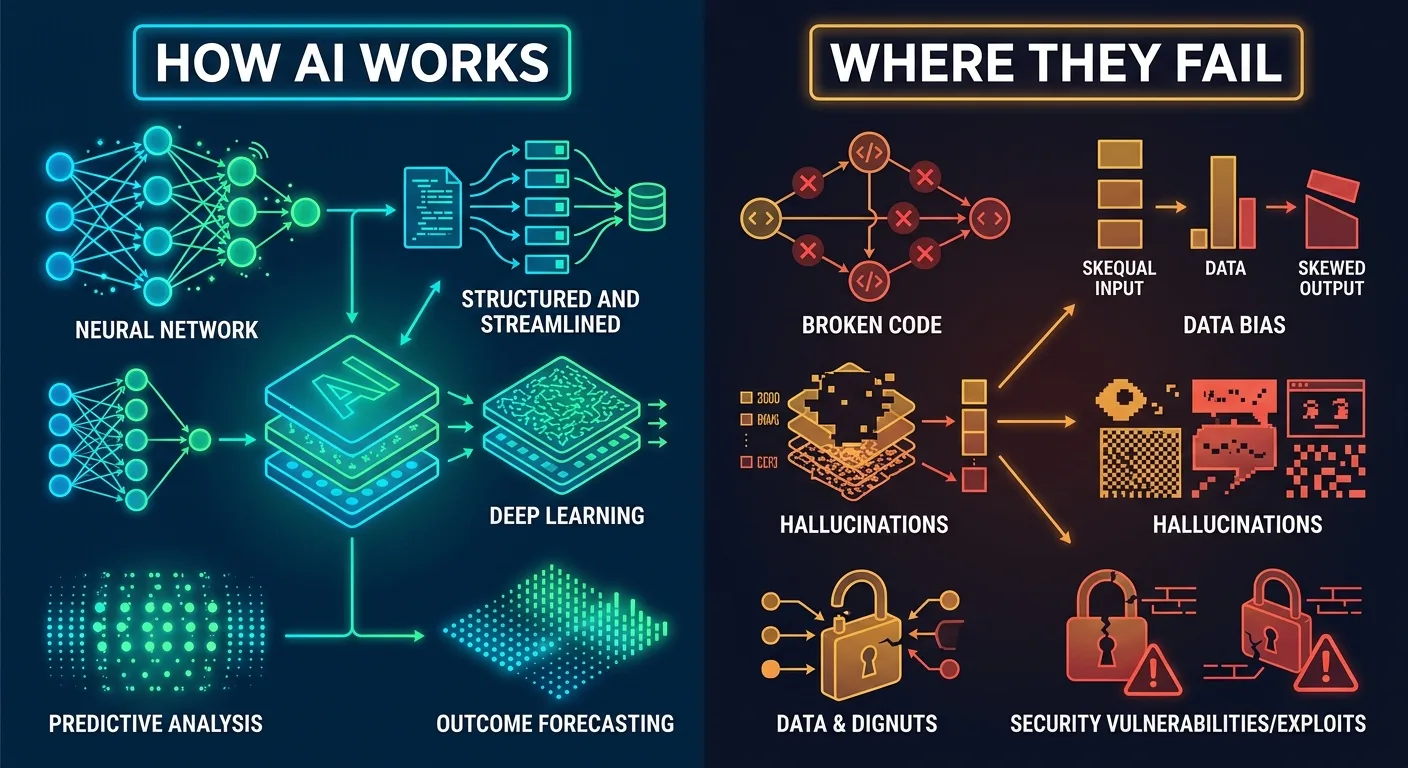
Artificial intelligence (AI) is technology that uses models and other computational methods to produce predictions, recommendations, decisions or generated content from information it receives. A fraud detector may estimate whether a payment is suspicious; a speech recogniser converts audio into text; a generative AI assistant produces a response to a question. They perform different tasks, but each is an example of a computer system using data and learned or designed patterns to generate useful outputs.
AI is powerful without being infallible. A system may write a convincing explanation and invent a citation, identify familiar photographs but struggle with an unusual image, or achieve an impressive benchmark score yet fail in a changing workplace. The important question is not simply “Can AI do this?” It is “How reliably can this particular AI system do this task, using this data, under these conditions?”
This guide explains how AI systems are built and used, how machine learning and generative AI differ, why errors happen, and what people and organisations should check before relying on an answer or automating a decision. It draws on the OECD's AI definition and due-diligence guidance , Google's machine-learning education, the US National Institute of Standards and Technology (NIST) , and Stanford's 2026 AI Index . Research verified: 9 November 2026.
What is artificial intelligence, in plain English?
The OECD defines an AI system as a machine-based system that infers from inputs how to generate outputs—such as predictions, content, recommendations or decisions—that may affect digital or physical environments. Different systems have different degrees of autonomy and may or may not adapt after deployment. This is a broader definition than “a chatbot that talks like a person”.
Consider three familiar activities:
- A streaming service suggests a film based partly on viewing patterns.
- A bank's fraud-detection system flags an unusual transaction for further review.
- A text-generation tool drafts a message or summarises a document.
The underlying algorithms, data and safeguards can be very different. Some systems focus on classification, some on forecasting and others on generating new material. There is no single algorithm called “AI” that powers everything.
AI also differs from ordinary rules-based automation. A rule such as “if an invoice is overdue by 30 days, send a reminder” can be implemented without machine learning. A model predicting which invoices are most likely to be paid late might learn its patterns from historical examples. Both approaches can be combined, and using AI where simple rules already solve the problem is not always worthwhile.
AI, machine learning, deep learning and generative AI: what is the difference?
| Term | Meaning | Simple example |
|---|---|---|
| Artificial intelligence | Broad field of systems producing inferences, decisions or generated outputs | Route planning, forecasting or language assistance |
| Machine learning (ML) | Methods that learn useful statistical relationships from data | A model classifying fraudulent payments |
| Deep learning | Machine learning using multi-layer neural networks | Image recognition or speech transcription |
| Generative AI | Models that produce content such as text, images, audio or code | A system drafting a first version of a report |
| Large language model (LLM) | A language-focused model trained to process and predict sequences of tokens | A conversational writing or coding assistant |
These categories overlap rather than replace one another. A large language model is generally a type of generative AI built with deep-learning techniques. But an AI-based product need not generate text, use a giant neural network or connect to the internet. Google's Machine Learning Crash Course distinguishes regression and classification models from neural networks, embeddings and modern language models.
How an AI system works: from data to an output
Although architectures vary, many machine-learning applications follow a practical lifecycle: define a task, prepare data, train a model, test it, deploy it and monitor its behaviour.
Step 1: Define the problem
Teams must first specify what success means. “Make our business smarter” is not a useful target. “Predict which products are at risk of running out of stock in the next seven days” is more testable. The target also determines whether a simple spreadsheet formula, conventional software or machine learning is appropriate.
Step 2: Collect and prepare relevant data
Data might include text, transactions, images, sensor readings or carefully labelled examples. Developers check for mistakes, duplicates, missing fields, inappropriate personal information and patterns that do not reflect the intended users. Data quality is not a cosmetic step: misleading or incomplete input can train a model to learn the wrong relationship.
Step 3: Train the model
During training, an algorithm adjusts its parameters—numerical values governing how inputs are transformed into outputs—so that its predictions better match a defined training objective. For example, an email-classification model can learn associations between message characteristics and confirmed spam labels. Training is different from simply storing every example in a conventional database, even though some models may memorise parts of their training material.
Machine learning has several major approaches. In supervised learning, examples include a target answer, such as “spam” or “not spam”. In self-supervised learning, a training objective can be created from the data itself, such as predicting masked or subsequent tokens. In reinforcement learning, a system learns from rewards or feedback on actions. Actual production systems can combine these methods.
Step 4: Validate and test on unseen cases
Models need more than a good training score. Developers commonly use a training set to fit the model, a validation set to guide development and a test set to check performance on separate examples. Google's dataset-splitting guidance explains why repeated adjustments based on the same test data can make evaluation less trustworthy.
Step 5: Run inference
Inference is the point at which a trained model processes a new input and produces an output. A person submits a question, an image or a payment record; the application prepares the input, runs the model and returns a response. The output may be a probability, a label, a recommendation, generated text or a command proposed for another system.
Step 6: Monitor and improve
Performance can deteriorate after deployment. Customer behaviour changes, new fraud methods emerge, product catalogues expand and users ask questions unlike those in the tests. Responsible operators monitor errors, investigate incidents, review user feedback and decide whether to modify the data, model, instructions or business process.
A practical example: how AI might detect a suspicious payment
Imagine a small retailer examining transaction patterns. Historical records show amounts, transaction times, payment channels and confirmed fraud outcomes. A classification model can learn how combinations of these features relate to reported fraud. When a new payment arrives, the system produces an estimated risk score.
But a risk score is not proof of fraud. A legitimate customer shopping abroad may look unusual, while a cleverly designed scam may resemble a normal purchase. If the retailer blocks every payment above an arbitrary score, it could inconvenience genuine customers. A safer workflow might flag borderline transactions for an authorised employee and test how often genuine customers are wrongly blocked.
That example shows why an AI product is not just its model. It also includes data pipelines, thresholds, business rules, human review, security controls and monitoring. FlyingEze's guide to AI tools for Nigerian small businesses explores practical uses; the present article focuses on the underlying mechanisms and limitations.
How generative AI and large language models produce answers
Generative AI includes models for text, image, speech, video and code. Large language models work with tokens, which are units of text or other encoded information. During training, many such models learn to predict tokens or sequences based on the context available to them. Their parameters capture useful statistical regularities developed through training.
Modern language models commonly use the Transformer architecture. Its attention mechanisms help the model weigh relationships among tokens in context. Google explains these concepts in its introduction to large language models and Transformers .
When you ask a language model a question, it processes the prompt and generates a response through a sequence of learned predictions. Additional training, fine-tuning and human or machine feedback may influence how it responds. A well-designed application may also search documents, call a calculator or use other tools. The exact capabilities depend on the model and product—not every chatbot is connected to the web or can perform external actions.
Crucially, fluent language is not the same as verified knowledge. Generating a plausible sentence and checking whether the sentence is true are different operations. A system may provide a correct explanation one moment and an invented source the next.
What can AI do well today?
Performance is task-dependent. Useful applications include summarising documents for review, suggesting draft code, recognising patterns in large datasets, transcribing speech, helping people search information, assisting with translation and supporting scientific analysis. A system tuned to one constrained task may be more dependable than a general-purpose assistant given a vague objective.
Stanford's 2026 AI Index technical-performance chapter documents rapid improvement in language, mathematics, coding and some multimodal benchmarks. It also describes uneven capability: models that perform extremely well on selected academic tasks can struggle with seemingly simpler perceptual or real-world tasks.
The report gives a useful cautionary example: AI agents scored about 66.3% on the OSWorld computer-use benchmark in 2025, a substantial improvement but still short of reliable completion on every tested task. That is a specific benchmark result, not a universal statement that all agents fail one-third of the time. Product design, permissions and task difficulty affect actual outcomes.
Where AI systems fail—and why
1. Hallucinations: confident but false content
Generative AI may invent a citation, misquote a policy, fabricate a case, or produce a convincing but incorrect explanation. NIST's Generative AI Profile calls this phenomenon confabulation. It can arise because the system is optimised to generate likely content, not automatically verify every external claim.
For journalists, students and businesses, this means checking quotations, statistics, citations, legal claims and time-sensitive facts against original sources. Repeatedly asking the same model “Are you sure?” is not a reliable substitute for verification.
2. Biased or incomplete data
If the data poorly represents a group, language, community or type of customer, the model may produce uneven results. Historical records can also embed past discrimination. A recruiting tool, for example, might learn patterns connected to previous hiring practices rather than genuine job suitability.
Developers must test outcomes for relevant groups and contexts, examine how labels were assigned and provide appeal or correction routes where appropriate. NIST identifies fairness with harmful bias managed as an important characteristic of trustworthy AI.
3. Overfitting and unfamiliar conditions
An AI model can fit its training examples impressively but fail when confronted with new cases. This is called overfitting. Google's overfitting explanation stresses that an effective model must generalise to unseen data. A fraud detector trained on older transactions may miss a new scam pattern; a forecasting model may perform poorly after a sudden supply disruption.
Good testing requires realistic examples, useful measures of error and monitoring after release, not only an attractive training accuracy percentage.
4. Confusing correlation with cause
A model can discover that two variables often occur together without knowing whether one causes the other. If sales increase during a holiday, a forecasting system may incorrectly attribute the entire change to an advertising campaign. Using such predictions to make a causal decision requires additional evidence and sound experimental or analytical design.
5. Prompt injection and unsafe tool use
Some AI applications read emails, webpages or uploaded files. A malicious document can contain instructions telling the model to ignore its real task or misuse an available tool. This is known as prompt injection. The OWASP Top 10 for LLM applications also identifies sensitive-information disclosure, improper output handling and excessive agency as important risks.
Giving an AI assistant access to a business database, payment system or production server raises the consequences of a mistake. Applications should use least-privilege permissions, clear separation between trusted instructions and untrusted content, validation of proposed actions, audit trails and human approval for sensitive operations.
6. Privacy and information leakage
Entering customer records, staff data, confidential contracts or passwords into an AI tool may expose information to processing or retention arrangements that users have not understood. Privacy protections vary by service and configuration. Do not assume a consumer chatbot is a secure vault or that uploaded material is automatically deleted.
Before using AI with sensitive information, check provider terms, access controls, retention settings and applicable privacy obligations. FlyingEze's guide to protecting customer data when using AI tools gives small businesses a practical starting point.
7. High-stakes errors and misplaced confidence
A mistaken film recommendation is inconvenient; an inaccurate medical summary, banking instruction, hiring decision or legal explanation can have far greater consequences. People may also trust a polished answer because it sounds authoritative. High-stakes uses need verified sources, clear escalation and qualified human review—especially where rights, health, finances or safety are involved.
Can search, tools and retrieval make AI more reliable?
Sometimes. A technique called retrieval-augmented generation (RAG) allows an application to search relevant documents and include retrieved material alongside a user's question. Microsoft's RAG guidance explains how this can help with private records or frequently changing information and can support citations.
But RAG is not a guarantee of truth. Search may retrieve the wrong document, an index may be out of date, access controls may be misconfigured, and a language model can still misinterpret evidence. The answer and every citation need to match the source. Likewise, a calculator can make arithmetic more reliable when used correctly, but it cannot rescue an invalid assumption or inappropriate formula.
How to judge whether an AI result is trustworthy
A useful assessment starts with the particular task, not with a universal claim that a system is “99% accurate”. NIST's AI Risk Management Framework organises risk management around four functions: Govern, Map, Measure and Manage. For an individual or small organisation, these translate into the following practical steps:
- Define the intended use. What is the AI allowed to do, and what decisions must remain with a person?
- Test realistic examples. Include ordinary cases, rare cases, incomplete inputs and attempts to confuse the system.
- Choose meaningful metrics. For a fraud detector, consider false positives and missed fraud—not just overall accuracy. For generated answers, check factual accuracy, relevance and whether citations genuinely support claims.
- Protect data and permissions. Avoid unnecessary personal information, limit tool access and require approval before money moves or records change.
- Monitor and correct failures. Record incidents, allow users to challenge decisions and retest when data or operating conditions change.
No framework can promise zero risk, and different systems need different controls. An AI-powered spell checker may need lighter safeguards than a model deciding eligibility for credit or assisting clinicians.
AI in everyday life and Nigerian businesses: where it makes sense
For Nigerian students, AI may assist with explanations, practice questions and proofreading, but answers should be checked against textbooks, course requirements and primary sources. For a retailer, an inventory forecast could help identify stock shortages, but poor sales data or an unexpected holiday may make the forecast unreliable. For customer support, an AI assistant may answer routine policy questions yet should hand off disputed payments or sensitive identity problems to authorised staff.
Business owners should also weigh cost against benefit. A simple rule-based workflow may be cheaper, more transparent and safer for a repetitive task with clear conditions. Where AI is justified, start with a bounded pilot, compare against the existing method and record savings alongside error rates, staff time, subscription fees and customer complaints. FlyingEze has a separate comparison of free and paid AI tools for small businesses for evaluating subscription choices.
AI should ideally help people do useful work with greater accuracy and less effort—not merely add an impressive label to a weak product.
Frequently asked questions
What does AI stand for?
AI stands for artificial intelligence, a broad field covering systems that infer outputs such as predictions, recommendations, decisions or generated content from information they receive.
Is machine learning the same as AI?
Machine learning is an important part of AI, but the terms are not identical. AI includes a broader family of methods and applications; ML focuses on learning patterns from data.
How does ChatGPT-style generative AI work?
Large language models commonly use Transformer neural networks trained to predict sequences of tokens. Additional training and application features shape their responses. Some systems also search documents or use tools, but not every chat service has those capabilities.
Why does AI sometimes make up facts?
Generative models can produce plausible output without verifying each factual statement. NIST describes such confident mistakes as confabulations, often called hallucinations. Checking against reliable sources remains necessary.
Does AI learn from every conversation automatically?
No universal rule applies. Whether a system stores conversations, uses them for later training or updates a model during use depends on the provider, product settings and architecture. Do not assume that talking to an AI always changes its underlying model.
Can AI replace human judgment?
AI can support or automate some bounded decisions, but errors, unclear accountability and high-stakes consequences make human oversight important in many settings. Suitability depends on the task and demonstrated reliability.
What is the difference between a model and an AI agent?
A model generates outputs from inputs. An AI agent is an application or workflow that uses one or more models to choose steps and potentially interact with tools or external systems. Its practical autonomy depends on the permissions, safeguards and implementation.
Is a higher AI benchmark score proof a system is safe?
No. Benchmarks measure selected capabilities under particular conditions. Real-world accuracy, privacy, fairness, security and reliability must be evaluated separately. Stanford's 2026 AI Index highlights significant gaps between impressive benchmark performance and more difficult real-world tasks.
Conclusion: understand the task, the model and the limits
Artificial intelligence works by turning inputs into useful predictions, recommendations, decisions or content through trained or otherwise designed models. Machine learning enables many systems to learn relationships from data; deep learning uses neural networks; and generative AI creates text, images or other media based on learned patterns.
None of these capabilities eliminates the possibility of errors. AI can fail because the data are unrepresentative, conditions change, a model produces fabricated information, sensitive material leaks or an automated tool acts without adequate safeguards. A trustworthy deployment therefore depends on clear objectives, representative testing, verified evidence, appropriate permissions, monitoring and human accountability.
The most useful way to approach AI is neither to dismiss it nor to treat it as an all-knowing authority. Ask what it was built to do, what evidence supports its result and what happens when it is wrong. For deeper reading, see NIST's AI Risk Management Framework , Google's Machine Learning Crash Course and the Stanford 2026 AI Index .