
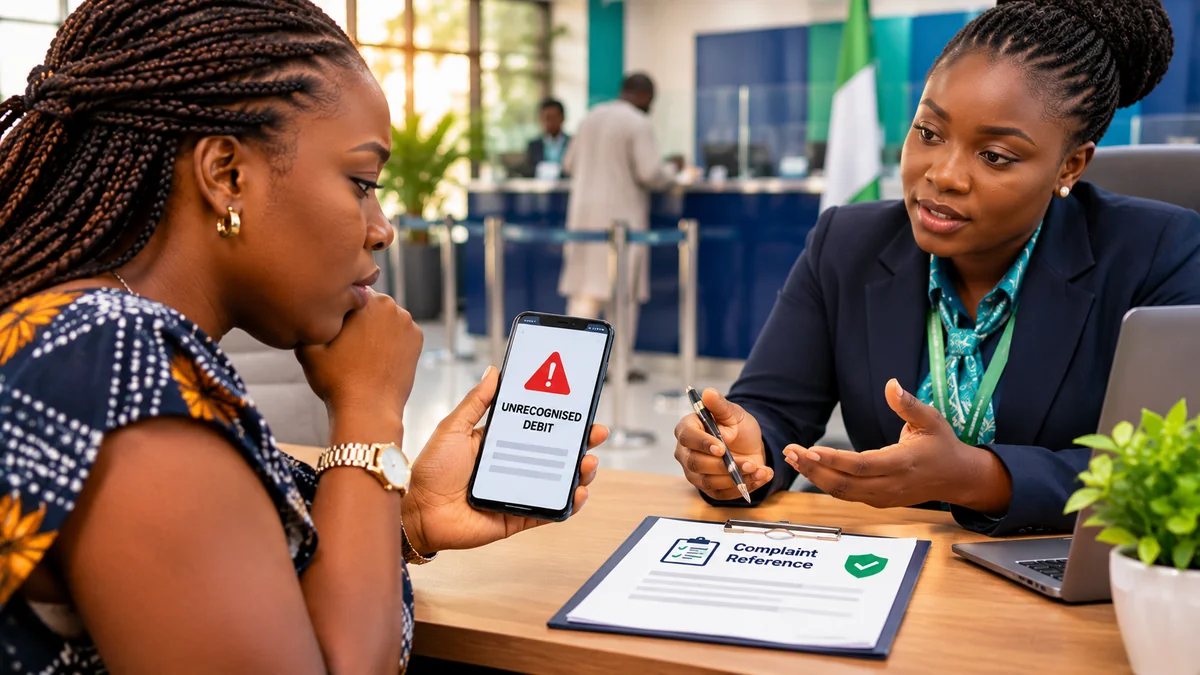
How to Report an Unauthorized Bank Transaction in Nigeria
Imagine checking your banking app and discovering a ₦75,000 debit you did not make. Perhaps a transfer went to an unfamiliar account, your ATM card was used somewhere you have never visited, or you received login alerts just before money disappeared. The first few minutes matter—but reporting the problem correctly matters too.
If you notice an unauthorised bank transaction in Nigeria, contact your bank immediately through a verified emergency channel, ask it to secure the affected account or card and investigate the debit, and obtain a complaint reference number. If the money was transferred, request urgent tracing and any available recall or interbank restriction process. Save the transaction details and follow up in writing. You can then track the complaint through the Central Bank of Nigeria (CBN) system and escalate an unresolved dispute to the CBN Consumer Protection Department under the applicable rules.
Do not wait two weeks before reporting the fraud. The familiar two-week period concerns unresolved bank complaints and regulatory escalation; it is not a waiting period for emergency action. This guide explains the steps, documents, timelines and realistic refund expectations for Nigerian consumers. Research verified: 11 November 2026.
What to do in the first 15 minutes
| Priority | Action | Why it helps |
|---|---|---|
| 1. Identify | Check the debit amount, date, time, reference and destination if shown | Distinguishes actual account movement from a suspicious message |
| 2. Secure | Use your bank's official card-freeze or emergency channel; request account restrictions | May prevent additional withdrawals |
| 3. Report | Tell the bank clearly: “I did not authorise this transaction” | Starts a formal fraud or disputed-debit investigation |
| 4. Trace | If it was a transfer, request an urgent trace and possible recall or recipient-bank intervention | Gives institutions a chance to investigate before more movement |
| 5. Document | Save alerts, screenshots, statements and the complaint number | Creates an evidence trail for the bank, CBN or police |
The CBN's 2019 Consumer Protection Regulations, section 6.2.4 , require regulated institutions to provide emergency reporting channels for time-sensitive issues, especially fraud. Its fraud-awareness page advises immediate contact with the financial institution and prompt securing of compromised accounts.
1. First confirm what the debit actually is
An unexpected message is not always evidence of a completed unauthorised transfer. Open your bank's genuine app directly or review a current account statement. Do not use links inside a suspicious SMS or email. Check whether the entry is a completed debit, a pending card authorisation, a bank charge, a standing instruction, a merchant subscription or a duplicate notification.
Look at who appears to have received the money and which payment channel was used: bank transfer, card, ATM, POS, USSD, internet banking or an automatic debit. If the narration is unfamiliar, ask the bank to identify the transaction instead of guessing from an abbreviation.
Different disputes follow different procedures. A card payment you never approved is not the same as a transfer you knowingly made to a scammer, a failed transfer you initiated, an incorrect recipient you selected or a disputed loan deduction. All deserve attention, but the evidence and possible remedies differ. FlyingEze has a separate guide for people who deliberately sent money to a suspected fraudulent bank account .
2. Contact the bank immediately through an official channel
Use the emergency support number on the back of your bank card, inside its official app or on its verified website. If available, use the app's card-blocking or fraud-reporting function. Do not search social media for a random “bank agent” who promises refunds; fake support accounts and sponsored phishing links can worsen the loss.
Tell the bank what happened, whether you still control the phone and SIM associated with the account, and whether additional transactions are possible. Request appropriate protective action: temporarily blocking the card, restricting app or USSD access, reviewing device sessions, limiting outgoing transfers or placing a targeted restriction on the account. Ask the bank to explain which functions will remain available, because a freeze can affect legitimate payments.
If you suspect your phone was stolen or your SIM was fraudulently replaced, contact the mobile network provider through official channels as well. Protect your associated email account and any payment apps that might share credentials or recovery details.
Never give a caller your PIN, password, CVV, full card details or one-time code. A legitimate complaint does not require you to transfer a “verification amount” to an unknown account.
3. Ask the bank for a formal complaint reference
Make the complaint explicit: “I dispute this transaction because I did not authorise it.” Ask the bank to record the amount, timestamp, transaction reference and disputed channel. Request a case or tracking number and the expected next update. A phone conversation alone can be difficult to prove later, so follow up using the bank's official email, in-app ticket or branch complaints desk.
Under sections 6.2.2 and 6.3.2 of the CBN's Consumer Protection Regulations , institutions must acknowledge complaints and provide a unique identifier within 24 hours of lodgement, including for recorded verbal complaints. The acknowledgement should include the complaints desk's contact details, expected resolution timeframe and escalation options.
The bank may need time to investigate, but it should not treat a missing branch visit as a reason to ignore an urgent report made through a supported emergency channel. If a representative refuses to log the case, request the institution's complaints unit and record the time and channel used.
4. If it was a transfer, request urgent tracing and recovery action
Tell the bank whether the money moved to another account at the same bank or to a different institution. Provide the transaction reference, destination bank and account details shown in the receipt, without posting that information publicly. Request an urgent fraud trace and ask whether the bank can initiate a recall or alert the beneficiary institution through the applicable interbank process.
Do not assume that pressing a “reverse” button can automatically pull money from the recipient's account. Completed instant transfers are not universally reversible by the sender. A hold, restriction or recovery may depend on timing, remaining funds, evidence, institutional procedures, legal requirements and the beneficiary bank's response. A bank should explain what it has done without promising an outcome it cannot guarantee.
Where the issue is a transfer you authorised but later discovered was a scam, tell the bank that fact accurately. Misrepresenting an authorised transfer as a system error may hinder the investigation. If the payment was genuinely unauthorised, state that clearly and request the relevant authorisation and authentication evidence be reviewed.
5. Secure the rest of your digital banking accounts
Once the emergency report is made, change your banking and email passwords using a device you trust. Sign out of unrecognised sessions and revoke access to suspicious third-party applications where the bank permits it. Enable multifactor authentication and strong device locking. If you disclosed an OTP to a fraudster, report that separately—the code may already have been used to approve an action.
In March 2026, the CBN announced changes to instant-payment controls , effective from 1 July 2026. They include customer options to disable instant transfers, lower personal transaction limits subject to verification, and stronger controls around registering mobile-banking apps on new devices. Ask your bank how its supported protections work and whether they are appropriate to your case.
Do not install an “account recovery app” sent by a caller or share your screen with an unverified person. The EFCC's banking-scam guidance warns about fake institution websites and impersonation requests seeking sensitive credentials.
6. Collect the right evidence before it disappears
A useful complaint contains precise facts, not only a statement that “my money is missing”. Save the evidence as soon as you can, but keep it private and send it only through verified institutional channels.
| Evidence | What to capture |
|---|---|
| Bank statement | Entry showing the disputed debit, balance and date |
| Transaction record | Reference, amount, time, payment channel and available destination details |
| Security alerts | Unrecognised login, device change, OTP or password-reset notices |
| Messages and calls | Relevant scam texts, sender addresses, call times and URLs |
| Complaint trail | Bank ticket number, emails, staff correspondence and follow-up dates |
| Other proof | Card-possession evidence or location information, if relevant and lawfully available |
Keep originals where possible. Do not edit screenshots to change amounts or times. If your bank requests an affidavit, police report or additional identity documents, ask why they are needed and use only an official submission process. Their request does not remove the need to log an emergency fraud report promptly.
7. Know the CBN complaint timelines—and their limits
Two separate issues often get confused: the need for immediate fraud containment and the time allowed for complaint resolution or regulatory escalation. There is no reason to wait for a regulator's general complaint period before blocking a stolen card or alerting the bank about a fraudulent transfer.
The CBN's public complaint-lodgement guide generally tells consumers to report to their financial institution first and escalate unresolved cases to its Consumer Protection Department after two weeks. It specifies 30 days for certain excess-charge and loan disputes. Its 2019 regulations also include category-specific review periods, so one headline timeline is not a guaranteed refund date for every case.
The same regulations recognise additional escalation circumstances, including an institution's failure to acknowledge a complaint within three days under section 6.4.1. If the bank provides a decision and you dispute it, follow its written review and regulatory escalation instructions without delaying indefinitely. For complex cases, seek qualified advice about applicable limits and procedures.
Important: a bank's duty to acknowledge a complaint within 24 hours does not mean it must refund a disputed debit within 24 hours. CBN regulations require investigation and appropriate redress for identified unauthorised debits, but individual liability and recovery turn on the facts.
8. Use the CBN Complaints Management System to track your case
The CBN operates an official Complaints Management System portal . Its published instructions say to first lodge the complaint with your bank, obtain the bank's reference number, allow 24 hours for the institution to upload the complaint, and then use the portal and the requested information to check it.
This 24-hour process is about tracking a complaint already submitted to the institution; it is not a promise that every bank dispute is settled in one day, nor does it remove ordinary escalation requirements. If your reference cannot be found after the relevant period, contact the bank's complaints desk and ask it to confirm that the case was recorded and submitted correctly.
Always navigate to the CBN's genuine cbn.gov.ng domain or a service linked from it. Ignore social media accounts offering to “upgrade” your CBN complaint for a fee.
9. Escalate an unresolved complaint to the CBN Consumer Protection Department
If the bank fails to resolve the dispute or satisfy the applicable acknowledgement and review rules, escalate with the supporting records. The CBN's Complaints Management page identifies the Consumer Protection Department (CPD) as the regulator's complaints channel.
Email: cpd@cbn.gov.ng
Postal or hand-delivered complaint: Director, Consumer Protection Department, Central Bank of Nigeria, Central Business District, Abuja. The CBN says petitions can be submitted at its head office or branches nationwide.
Include your full name and contact details, your bank's name, transaction history, amount in dispute, what outcome you request, the bank's complaint reference, evidence of your earlier complaint and any response received. Never include your banking PIN, app password, card CVV or OTP. Keep copies and use a concise, chronological account.
Sample complaint letter: unauthorised bank debit
Subject: Urgent complaint — unauthorised debit of ₦[amount] on [date]
Dear Complaints Team,
I discovered a debit of ₦[amount] on my [bank name] account on [date and time], with transaction reference [reference]. I did not authorise this transaction and request immediate protection of my account, a formal investigation and available recovery action.
Please confirm whether the transaction was a bank transfer, card payment or another channel; investigate how it was authenticated; and provide a complaint reference, expected response date and a written explanation of the outcome. I have attached a relevant transaction record and supporting alerts.
My name is [name]. My verified contact information is [phone/email]. Please contact me through your official channels. I will provide any further required account details securely, without disclosing a PIN or password.
Yours faithfully,
[Name]
Replace the brackets with genuine details. Send the letter to the bank first. If escalating to the CBN, add the original bank complaint date, reference, follow-up history and the reason the response was inadequate. The CBN's July 2025 consumer guidance recommends a clear description of what happened, when and where, the requested remedy and your contact information.
10. When should you report to EFCC or the police?
An unauthorised debit may involve a bank error, account compromise, identity theft or criminal fraud. Regulatory complaints and criminal investigations serve different purposes. A CBN complaint challenges a financial institution's handling of a problem; an EFCC or police report can address suspected criminal conduct. You can report suspected fraud to law enforcement promptly rather than waiting for the bank's internal complaint period to expire.
The Economic and Financial Crimes Commission advises victims to report phishing and fraudulent activity to its zonal commands or appropriate law-enforcement agencies. Its published contact is info@efcc.gov.ng. The Nigeria Police Force National Cybercrime Centre also provides an online cybercrime reporting portal for cases including fraud, hacking and identity theft.
A police or EFCC report does not by itself ensure a refund, and a bank should not promise that a criminal case will recover the money immediately. Keep the case reference, maintain contact with your bank and respond to lawful requests for evidence.
11. Can your bank refund an unauthorised transaction?
Possibly—but not automatically in every case. The 2019 CBN Consumer Protection Regulations say institutions should refund identified unauthorised debits and other established excess charges or underpayments in accordance with applicable rules. That does not mean every complaint is immediately established or that all losses from social engineering are treated identically.
The investigation may consider the account or device involved, how the payment was authenticated, whether a card was lost, whether credentials were compromised, when the bank was notified, what its controls recorded, and whether funds can still be recovered. Depending on the circumstances, a bank may accept the complaint, propose a refund, reject it with reasons or ask for additional evidence.
Request the decision in writing. Where the bank has confirmed unauthorised debits or other errors, ask about applicable redress and interest provisions rather than relying on an unsupported claim that every customer is legally entitled to a fixed compensation amount. If you disagree with the decision, use the bank's review process and available CBN escalation routes.
12. How this differs from failed transfers, wrong recipients and bank charges
| Situation | How to describe the complaint | Potential next step |
|---|---|---|
| Transfer from your account that you did not approve | Unauthorised transfer or suspected account compromise | Secure account, fraud trace, investigate authentication |
| Transfer you sent to a scammer | Fraud-induced but authorised transfer | Urgent bank recall attempt and fraud report |
| Money debited but the beneficiary did not receive it | Failed or delayed transfer | Request transaction reconciliation and appropriate reversal |
| Money sent to the wrong recipient you selected | Erroneous transfer | Ask the bank for available recovery steps; no guaranteed reversal |
| Card used at an unfamiliar merchant | Disputed card transaction | Block card, ask for card dispute or chargeback investigation if applicable |
| Unfamiliar recurring payment or fee | Unrecognised subscription or unauthorised charge | Identify merchant or charge, revoke authorisation if appropriate, dispute |
The categories matter because the bank may have different evidence requirements and regulatory timelines. The CBN's complaints classifications distinguish failed transfers, erroneous transfers, fraud and unauthorised charges. An accurate description helps route your report correctly.
13. What to do if the bank is not responding
If support repeatedly says “we are working on it”, ask for the complaint reference, assigned team, action taken, next review date and written outcome. Follow up on the official email or ticket channel, citing the same reference every time. A branch manager or customer-experience complaints desk may assist when a call-centre response is incomplete.
If the institution does not acknowledge the matter as required, note the 2019 regulation's three-day escalation provision. If it remains unresolved beyond the relevant review timeframe, escalate to CPD with all correspondence. For suspected active fraud, keep asking for urgent containment independently of the ordinary timetable.
Avoid threatening individual staff online or publicly posting account numbers, card information or transaction documents. Those disclosures can create new security problems and rarely improve formal case handling.
14. How to reduce the chance of another unauthorised transaction
Set banking alerts for transactions where available, use a unique banking password, keep phone and app software updated and enable an appropriate second authentication factor. Do not reuse your banking password on shopping sites. Avoid sharing OTPs or PINs, installing unfamiliar APKs or approving unexpected device registrations.
Check standing orders, saved cards and merchant subscriptions periodically. Lower transfer limits if your bank offers the option and the limits suit your usual spending. Separate everyday spending money from large savings where that is practical, and review account statements regularly rather than relying only on push notifications.
CBN's consumer education guidance says customers should protect their instruments and information and report suspected fraud promptly. Its 2026 instant-payment reforms provide additional control options that customers can discuss with their banks.
Frequently asked questions
Where do I report an unauthorised bank transfer in Nigeria?
Report it immediately to your bank through its verified emergency support or complaints channel. Ask for account protection, a fraud investigation and a reference number. If the institution fails to resolve the complaint under the relevant rules, contact the CBN Consumer Protection Department.
What is the CBN email for unresolved bank complaints?
The CBN publishes cpd@cbn.gov.ng for its Consumer Protection Department. First report the issue to your bank and retain its complaint reference and response history.
Do I have to wait two weeks to tell my bank about a fraudulent debit?
No. Report immediately. Two weeks is a general CBN escalation guideline for unresolved complaints, not a period during which a customer should leave a compromised account unprotected.
Must a bank refund me within 24 hours?
No universal 24-hour refund rule applies to every reported fraud. CBN's 2019 rules require a complaint acknowledgement and tracking number within 24 hours, while investigation and any redress depend on the complaint category and facts.
What is the CBN complaints tracking website?
The official portal is complaintsportal.cbn.gov.ng . It instructs customers to obtain a bank complaint reference and allow 24 hours for the institution to upload the matter before checking the record.
Can a completed bank transfer always be reversed?
No. Banks may try to trace, recall or restrict proceeds according to the circumstances, but a completed transfer is not automatically reversible by the sender. Prompt reporting improves the opportunity to investigate before funds move further.
Should I report a case to EFCC even if my bank is investigating?
You can report suspected criminal fraud to EFCC or the police promptly. A bank complaint concerns account protection and financial redress; law-enforcement reporting concerns possible criminal activity. Neither action guarantees recovery.
Will sharing my BVN or OTP help recover stolen funds?
No. Never send an OTP, password, PIN or full card credentials to someone promising a refund. Give necessary personal information only through authenticated channels required for legitimate verification.
Conclusion
An unauthorised bank debit is stressful, but a clear process can reduce confusion: secure the account, contact the bank immediately, obtain a complaint reference, request urgent tracing where applicable, and preserve evidence. Track the case and escalate unresolved institutional complaints under CBN rules; report suspected crime to an appropriate law-enforcement agency without delay.
Most importantly, do not confuse a 24-hour complaint acknowledgement with a refund deadline, or a two-week escalation guide with permission to wait before stopping fraud. The right response is immediate action supported by accurate records and realistic expectations about investigation and recovery.



