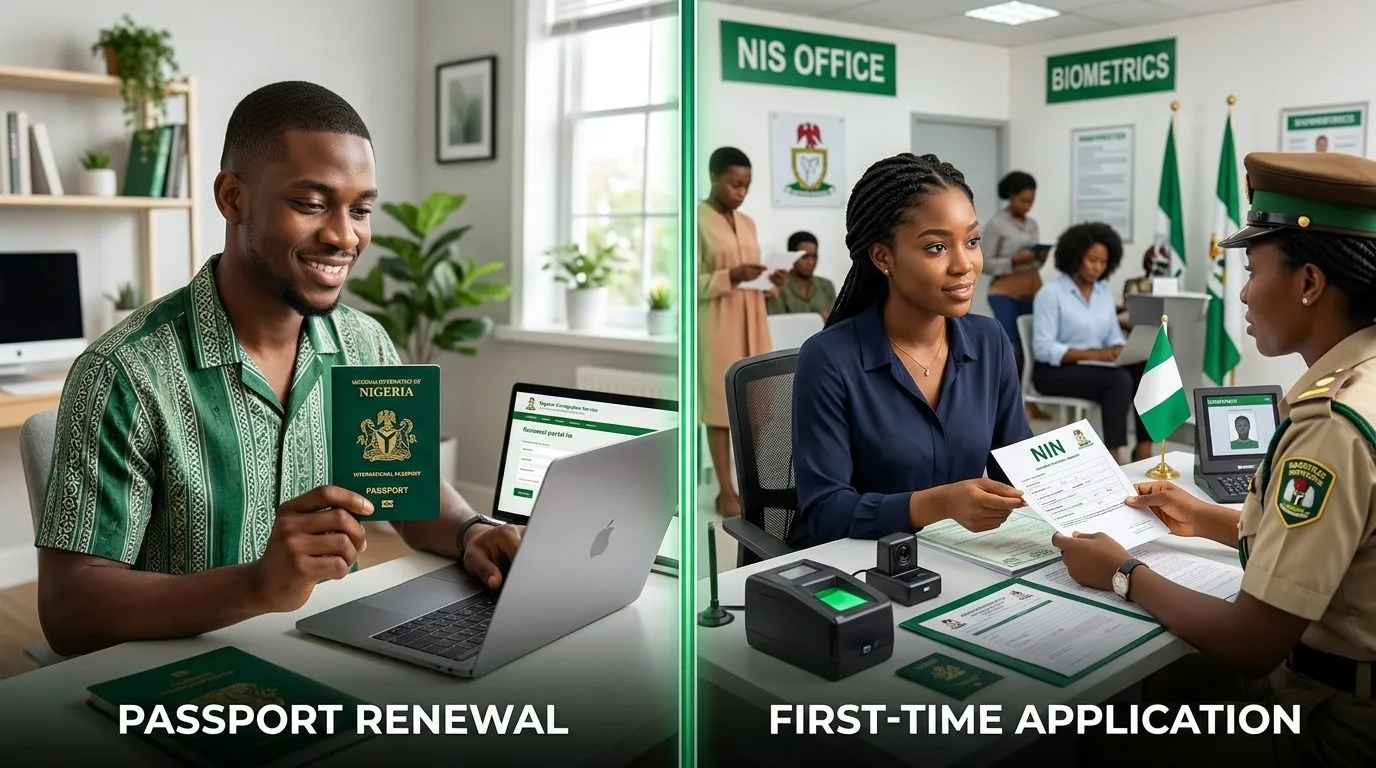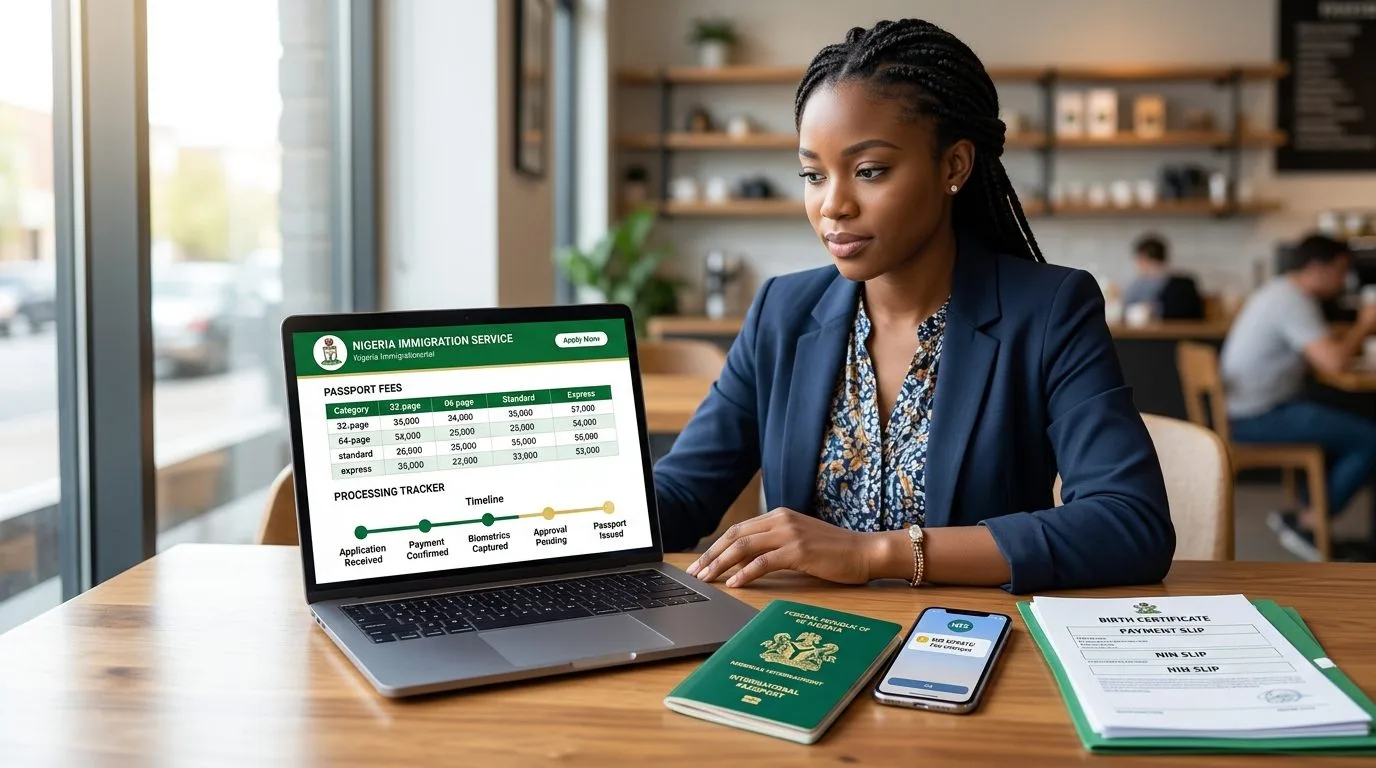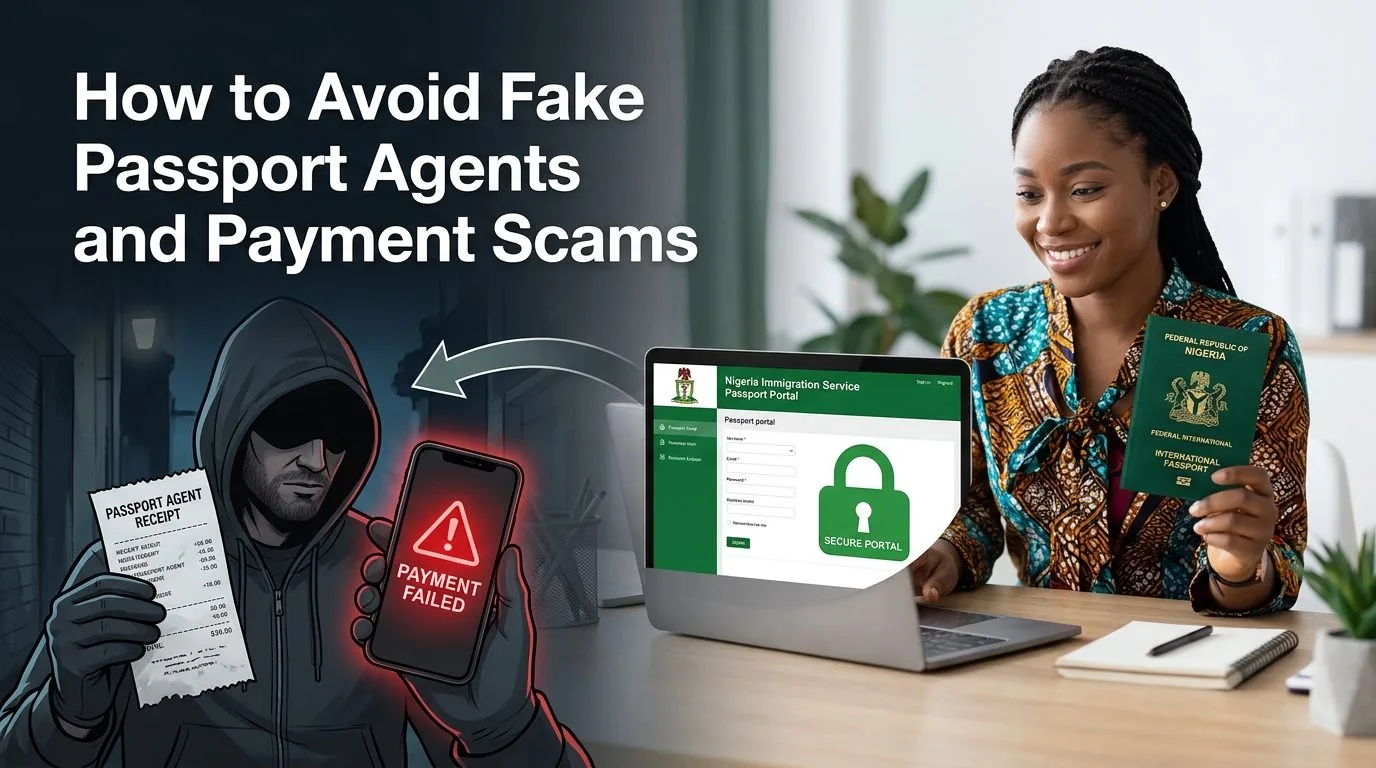
To avoid fake passport agents and payment scams in Nigeria, start your application on the official Nigeria Immigration Service (NIS) website, verify the exact passport fee, keep your login and identity details private, and never pay for a promised shortcut through someone's personal bank account. You can submit a normal passport application directly through passport.immigration.gov.ng , which is linked from the agency's official website . A private individual who promises a guaranteed appointment, an instant passport or a “special approval” is not a substitute for NIS verification.
People searching how to obtain international passport in Nigeria can encounter genuine official information mixed with outdated price lists, sponsored search links, copied government branding and unsolicited WhatsApp messages. This guide explains how to recognise common scam tactics, protect your NIN and payment records, verify NIS's standard 2026 booklet charges, and respond quickly if you have already sent money or personal details to someone suspicious. It is based on primary government sources checked on 17 November 2026.
Start with the verified facts, not an agent's promise
| Passport service | What official NIS information establishes |
|---|---|
| Domestic application | passport.immigration.gov.ng , accessed independently or from immigration.gov.ng |
| New application | “Apply for Fresh Passport”; NIN verification, supported documentation, official payment and appointment |
| Renewal | “Apply for Renewal/Re-issue”; existing passport details and category-specific evidence |
| 32-page/five-year standard booklet | ₦100,000 for domestic applications under the published schedule, excluding bank charges |
| 64-page/ten-year standard booklet | ₦200,000 for eligible domestic applicants, excluding bank charges |
| Fresh passport service target | 42 days after successful enrolment; not a guaranteed date from payment |
| Routine reissue service target | 21 days after successful enrolment; not a guarantee of immediate collection |
| Official appointment and tracking | NIS appointment system and application tracker |
NIS announced the domestic standard passport fees in August 2025 for implementation on 1 September 2025. Its April 2026 service-level agreement repeats the amounts and timelines. These are the published standard figures, not a promise that every applicant pays exactly the same final total. Check the official live application checkout for any applicable bank charges, special categories or later policy changes.
1. Fake passport websites: check the address, not just the logo
A fraudulent website can copy the colours, official coat of arms, language and layout of a real government portal. A search result or paid advertisement can also lead to a lookalike page. Some sites may demand a “registration fee” before showing a form; others ask applicants to upload NIN slips, birth certificates and passport photographs for supposed pre-approval.
Instead, manually open immigration.gov.ng and use its passport link, or type passport.immigration.gov.ng directly. Inspect the actual hostname in the browser's address bar: an unfamiliar domain that happens to contain “passport”, “nis” or “immigration” is not thereby part of the government service. Do not accept a page as genuine merely because it has a padlock symbol. HTTPS encrypts the connection but does not prove ownership by NIS.
NIS has publicly cautioned against fake e-visa websites , demonstrating a real impersonation risk for its digital services. That warning concerns e-visa websites specifically; it is not evidence that every suspicious passport URL is a case already confirmed by NIS. Passport applicants should nonetheless apply the same primary-source verification habit.
2. Beware of “guaranteed passport in 48 hours” messages
One common red flag is a private promise that an applicant can get a normal passport in a day, two days or a week by paying an insider. NIS's April 2026 agreement instead publishes a 42-day target after successful enrolment for a fresh passport and a 21-day target for routine renewal/reissue. These are service standards, not guarantees, and any separate expedited or intervention programme would require its own authentic notice and eligibility rules.
Do not assume a stranger controls the processing queue because they know the name of an immigration office or can show a photograph of a passport booklet. A real appointment is confirmed in the NIS system. Ordinary first-time applicants in Nigeria still attend the selected office for biometric capture; a message claiming that an unknown agent can waive identity checks is particularly suspicious.
If you are under pressure from an upcoming visa interview or international flight, book only after checking the official appointment portal and the actual service status. A stressful deadline does not make an unauthorised guarantee reliable.
3. Personal bank transfers and invented “processing fees”
The published government booklet fee is a useful reality check. For standard applications made in Nigeria, the NIS's fee revision sets ₦100,000 for 32 pages/five years and ₦200,000 for 64 pages/ten years, excluding bank charges. The application checkout for your real route determines the authorised amount payable at that point.
A scammer may describe a separate transfer as a “slot reservation”, “staff mobilisation”, “biometric exemption”, “priority queue”, “file activation” or “special stamp”. Those labels do not establish an official NIS charge. If a new fee exists, it should be traceable to a current government notice and the legitimate payment flow, not only to a personal WhatsApp message or bank account supplied by a third party.
There are legitimate administrative charges for particular services: the 2026 NIS agreement, for example, lists a ₦30,000 correction-of-data administrative charge. It does not mean that every applicant must pay a general ₦30,000 “passport verification” fee. Verify the category and the displayed official cost rather than confusing a real special-service charge with a universal requirement.
4. Fake appointment sellers and altered receipts
An applicant who has already paid may be told that every available biometric appointment has been “reserved by agents”. Someone may offer to sell a time slot or send a PDF that resembles a government confirmation. Neither a professional-looking PDF nor a claimed connection to staff verifies that the booking exists.
The domestic passport portal has options to check centre availability, book an appointment, resume an application and print receipts. The official appointment system supports booking-related services with the application's own identifiers. Confirm your centre and appointment through the genuine portal rather than trusting a screenshot sent by a stranger.
For a first-time standard application, NIS requires the applicant to present payment and appointment slips at the selected passport office and attend for photo and biometric data capture. If your booking does not appear in the system, contact NIS using its official contact page before transferring more money. FlyingEze's published passport application tracking and appointment guide explains the legitimate tracking route in greater detail.
5. Requests for NIN, OTP, passwords and complete document folders
Passport applications involve high-value personal information: full names, dates of birth, NIN records, photographs, addresses, birth certificates and sometimes a child's documents. A fraudster may say they need a one-time code “to verify your application” or require the password to your email so they can download a supposed appointment letter.
Do not share an account password or one-time authentication code with a third party. Keep control of the email and phone number on the application, use a strong unique password where the portal permits one and save sensitive records in private storage. Enter your NIN only in the authorised application process and provide supporting documents only when they are genuinely requested by NIS or another competent issuing authority.
If a helpful relative or professional is assisting with form preparation, you can still review the information yourself, complete sensitive account steps directly and retain the official payment receipt. Help with reading a form is not the same as allowing someone to impersonate you, take control of the account or promise to bypass biometric checks.
6. Fake guarantor documents and “NIN correction” shortcuts
Scam risks extend beyond payment. A person offering to create a birth certificate, state-of-origin letter, guarantor endorsement or corrected NIN slip without going through the competent authority can expose the applicant to document fraud and future identity problems. The NIS application process compares key details against official identity records, so altered documents may cause verification issues or legal consequences.
Check your personal details carefully before paying. NIS's fresh passport instructions specify NIN verification and use of personal details from the NIMC record. A mismatch between records should be resolved through authorised channels, not by editing a scan or creating a new identity under another spelling.
For genuine discrepancies, FlyingEze has a separate guide to passport and NIN record mismatches . If documents involve a minor, verify parental consent and citizenship evidence through the correct process. Paying someone to make an identity record look valid is not a substitute for legal evidence.
7. Does an “NIS-certified agent” badge prove a passport offer is real?
Not by itself. NIS has an official Nigeria Certified Immigration Agent (NCIA) programme described as a system for regulating visa facilitation and visa advisory services. The existence of this visa-related certification should not be interpreted as a universal authorisation to issue Nigerian passports, control passport appointments, promise guaranteed passport approvals or collect government passport fees into personal accounts.
If a consultant says they are licensed, independently check the claimed status through the official programme that actually applies to the service in question. Ask exactly what assistance they are offering, what fees are theirs rather than government's and whether the NIS passport application and payment remain under your control. Do not assume that every individual offering administrative help is fraudulent; the warning is about unverified authority, misleading guarantees and requests for sensitive access or unofficial payments.
8. What if you have already paid a suspected fake passport agent?
Act promptly, using the information you have, without assuming the money can definitely be recovered. The Central Bank of Nigeria's fraud guidance advises consumers whose bank information may be compromised to contact their bank immediately. Its consumer education guidance likewise calls for prompt reporting to the bank and appropriate authorities.
- Stop sending money or credentials. Do not make a second “release”, “reversal” or “refund processing” payment requested by the same contact.
- Call your bank through a verified number or app. Report the transfer as suspected fraud and request any available protective action, transaction trace or recovery assessment. A transfer reversal is not guaranteed.
- Secure compromised accounts. Change affected passwords using legitimate services, revoke suspicious sessions where possible and contact your bank about cards, accounts or one-time codes that may have been exposed.
- Preserve evidence. Save transaction IDs, bank receipts, dates, account details, chats, voice notes, website addresses, screenshots and promises made; do not publicly post your full NIN or other sensitive data.
- Report the alleged cybercrime. The Nigeria Police Force National Cybercrime Centre has an official e-reporting portal. The Economic and Financial Crimes Commission (EFCC) also accepts reports of suspected financial fraud through its official channels.
- Alert NIS if its name or portal was impersonated. Use the current NIS contact page for complaints and check whether a genuine application exists under your details.
Distinguish a criminal scam payment made to an impostor from a payment made through the real NIS online application. The agency's refund rules apply to payments on its own official portal; they do not automatically make NIS responsible for repaying transfers sent to a stranger.
9. What NIS actually says about online payment refunds
Before paying or restarting an application, read the NIS Online Payment Refund Policy . It generally treats portal payments as final, with limited exceptions reviewed by the agency. One important distinction is between two payments on one application and two separate applications for the same person.
| Payment situation | Published NIS position |
|---|---|
| Same application charged more than once | A refund may be considered, subject to evidence and agency approval |
| Passport application with no appointment booked | May be considered under stated conditions, with contactless exclusions |
| Appointment already booked | Listed among generally non-refundable situations |
| Application contains errors found after payment | Listed as non-refundable |
| Second application to switch booklet size | Listed as non-refundable |
| Two different applications for the same person | Listed as non-refundable, unlike an accidental double charge for one application |
| Refund request timing | Must be submitted within 21 days of payment |
Approval remains at NIS's discretion. Its policy notes that approved refunds typically take around six weeks after receipt of the complaint; this is not a promise that every request will be approved or settled on a guaranteed date. NIS's online policy also contains contact information that applicants should validate via the agency's main contact page before sharing documents, particularly when an address or instruction seems inconsistent. Always use the live official policy for the actual request process.
10. Distinguish an NIS service complaint from a banking fraud complaint
The correct response depends on where the money went. If you paid the real NIS portal but a receipt failed to appear, check the payment status using the genuine application service and contact NIS or its authorised payment support with the transaction reference. Avoid submitting a duplicate application merely because the first checkout screen did not refresh.
If you transferred funds directly to an unknown individual or fraudulent business account, contact your bank promptly and report suspected fraud to the appropriate authorities. A private scam should not be treated as though it qualifies automatically under NIS's government-portal refund policy. If a bank mishandles a financial complaint, the CBN's complaint guidance explains the bank-first escalation process.
For persistent official passport-service problems, keep the appointment acknowledgement, status history and payment record before contacting NIS. FlyingEze's published guide to applying for a Nigerian international passport through official channels explains the standard workflow and helps identify which stage may have been missed.
11. How to verify a passport payment request in five minutes
Before entering payment details or handing over an identity record, make the following checks:
| Verification question | What a safe answer looks like |
|---|---|
| Am I on the correct website? | The NIS passport portal was opened independently from an authentic immigration.gov.ng page |
| Is the application mine? | It displays the correct applicant category, NIN-linked details, booklet and processing centre |
| Does the price match the current published schedule? | Any standard booklet fee and extra bank charge are shown by the authorised checkout |
| Who receives the payment? | The payment is initiated through the official portal, not an agent's personal transfer instruction |
| Can I confirm the booking? | An appointment or application can be checked through the genuine NIS system |
| Is a shortcut being promised? | No private guarantee of immediate printing, biometric waiver or guaranteed approval |
| Who controls the account? | The applicant controls email, passwords, OTPs and application records |
| What evidence will I keep? | Official receipt, application number, reference number and appointment confirmation |
This checklist does not replace the final government form or verify an individual NIS transaction automatically. It is a practical way to catch inconsistencies before money or personal data is sent.
12. Realistic examples of suspicious passport offers
Example A: The “special slot” contact. A traveller receives a message that all immigration appointments have been booked but can pay ₦25,000 to reserve a hidden appointment. The safer response is to check the availability and booking directly through the official system . A claim about hidden slots is not proof that NIS authorised the payment.
Example B: The urgent payment upgrade. Someone shows an old screenshot of a passport fee and then asks for another payment to “upgrade” it. Check the official 2025 fee revision and current checkout; a change in the published price does not authorise an additional personal-account transfer. If a payment failed, verify the original transaction first.
Example C: The fake identity fix. An individual offers to generate a corrected NIN slip and birth certificate within minutes, without dealing with NIMC or the appropriate record issuer. Refuse the fabricated-record route and use authorised correction processes. False documents can create lasting legal and identity problems beyond the passport application.
Example D: The refund recovery trick. After a reported scam, a new number offers to recover the money if the victim pays a small “court release fee” or supplies an OTP. Treat it as another unverified demand. Use the bank, regulator and law-enforcement channels that can be identified independently.
These are hypothetical scenarios illustrating common warning patterns, not verified allegations against named people or claims that a particular NIS office is running a fraud scheme.
13. Parents, students and Nigerians applying from abroad: extra precautions
Parents applying for a child's passport may need birth evidence, parental consent and citizenship documents; those records are sensitive. Do not send them to a stranger merely because they claim to know how to “fast-track children's biometrics”. The NIS passport requirements page provides category-specific guidance that should be checked directly.
Students applying before admission, scholarship or travel deadlines should begin early and avoid guarantees that a specific date can be met. Travellers abroad should use the authorised overseas route and verify whether they qualify for any contactless renewal service. NIS's certified visa-agent programme does not by itself confirm a consultant's authority over a diaspora passport application.
If you are renewing, follow the right reissue instructions and avoid declaring yourself a fresh applicant to escape a lost-booklet or name-correction problem. See FlyingEze's published passport renewal document checklist for a more detailed distinction.
Frequently asked questions
How do I know if a Nigerian passport agent is fake?
Look for unverifiable authority, a lookalike government website, personal-account payment requests, demands for passwords or OTPs and promises to skip NIS biometrics or guarantee quick issuance. Verify the actual service through immigration.gov.ng rather than trusting a logo or a claimed badge.
What is the genuine Nigerian passport application website?
For applications made within Nigeria, NIS operates passport.immigration.gov.ng . Start from the official agency website if uncertain. The domestic portal provides fresh, renewal, correction, appointment, receipt and status services.
How much does a Nigerian international passport cost in 2026?
The published domestic standard booklet fees are ₦100,000 for 32 pages/five years and ₦200,000 for 64 pages/ten years, excluding bank charges. Other authorised services may have additional fees. Confirm the amount in the current official application checkout.
Is paying a passport agent always illegal?
Not every form-filling or administrative assistance service is necessarily fraudulent. However, third-party help is not a guarantee of a passport and should never involve false identity declarations, unauthorised government fees or handing over account credentials. Government charges must be verified through NIS.
Can an agent guarantee a passport within two days?
Do not trust that promise without an authentic NIS notice for a lawful service. NIS's April 2026 standard targets are 42 days after successful enrolment for fresh applications and 21 days for routine reissue, with no guarantee of individual collection dates.
Can I apply without attending biometrics if an agent handles everything?
Normal first-time domestic passport applications require attendance at an NIS processing centre for biometric capture. Some eligible applicants abroad have a separate contactless service, but that is not a universal exemption.
What if a supposed NIS agent asks for my NIN and OTP?
Do not share passwords or one-time codes with the person. Verify any identity request through the genuine NIS application, protect your email and bank accounts, and report suspicious attempts if necessary.
Can I get a refund after paying twice?
NIS may consider a refund for two charges against one application, subject to its policy and verification. Two different applications for the same person are generally listed as non-refundable. The published refund-request period is 21 days after payment.
What if I already transferred money to a fake passport agent?
Contact your bank immediately, ask for available fraud-protection or recovery steps, retain transaction and message evidence and report suspected cybercrime through the NPF National Cybercrime Centre or other lawful reporting channels. Recovery is not guaranteed.
Is an NIS-certified visa agent allowed to issue passports?
The NCIA programme is described by NIS as regulating visa facilitation. Its existence does not confer independent power to issue passports, waive biometrics or collect official passport fees into private accounts.
Where can I check whether a passport appointment is genuine?
Use the appointment functions connected to the official passport portal or the NIS appointment system . Do not rely only on a PDF or WhatsApp screenshot.
Final checklist: protect your money and your identity
- Open the official NIS passport portal independently; verify the hostname before entering sensitive details.
- Check the applicable booklet price and any bank charges through NIS's current notices and checkout.
- Select the correct fresh, renewal, replacement or correction workflow rather than improvising.
- Verify appointments, payments and application status through the real NIS systems.
- Keep your NIN, identity scans, passwords, OTPs, application numbers and bank records private.
- Reject unverified guaranteed approvals, biometric waivers, hidden slots and personal-account “activation” fees.
- If you suspect a scam, contact your bank promptly, preserve evidence and use legitimate police or financial-fraud reporting channels.
Bottom line: The simplest way to reduce exposure to fake passport agents is to keep your application under your own control and use the verified Nigeria Immigration Service systems for payment, appointments and tracking. Fraudsters often exploit urgency, confusion about government fees and the desire to avoid delays. Checking the official portal, refusing document falsification and acting quickly after a suspicious transfer can protect both your money and your personal identity.
Editorial verification: 17 November 2026. Based on the NIS official passport service, fee announcement, April 2026 service-level agreement, refund policy and digital-services warning; plus guidance from the Central Bank of Nigeria and law-enforcement reporting channels. This is independent consumer guidance, not a fraud finding against any named person, a guarantee of fund recovery or a promise of passport issuance. Government rules and contact details can change; confirm the current original sources before acting.