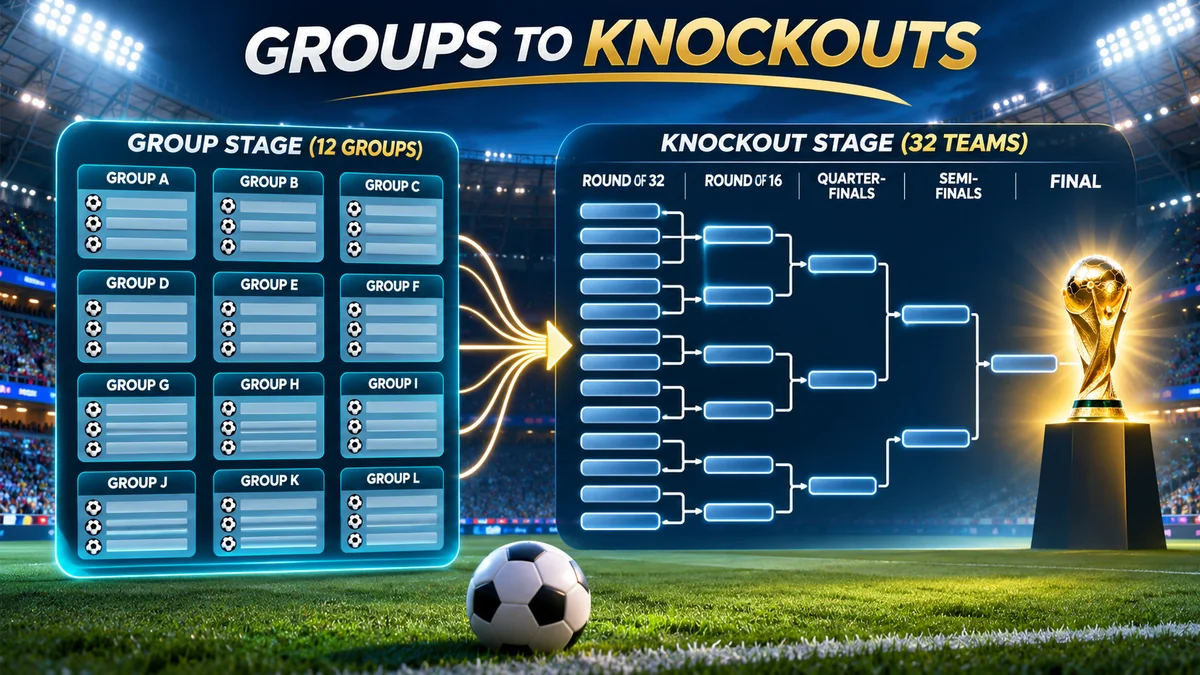
How are FIFA World Cup fixtures arranged, and why can a knockout opponent remain unknown even when the match date is fixed? The answer lies in two connected systems: a round-robin group stage, where teams play several matches and earn points, followed by a knockout bracket, where each fixture decides who advances. The expanded 2026 men's World Cup offers a clear example. It featured 48 teams in 12 groups, with 32 advancing to single-elimination rounds and 104 matches overall.
Important date clarification: the 2026 men's FIFA World Cup ran from 11 June to 19 July 2026 and has finished. As of 25 November 2026, there are no fixtures remaining in that tournament. Readers searching for “world cup fixtures of today” should first confirm which FIFA tournament, age group, gender category or qualifying competition they mean, rather than mistaking a historical schedule for live matches. FIFA's official 2026 fixtures and results page preserves the complete tournament record.
What does a World Cup fixture schedule actually show?
A fixture is a planned match. A useful World Cup fixture listing identifies the competing teams, match number, competition stage, date, scheduled kick-off, venue and local time zone. Once the match is played, the same listing can become a results record. Before every team has qualified or every group has finished, some fixture slots show placeholders such as “Group A winners” or “Group B runners-up”. Those labels describe positions in a bracket, not teams that FIFA has yet to choose.
Three different questions are often confused. A calendar answers when and where a match will happen; a group table explains who is currently in position to qualify; and a knockout bracket shows how advancing teams are paired. Reading all three together makes a complex tournament much easier to follow.
How FIFA builds the group-stage schedule
Teams are placed into groups before the fixtures are completed
A men's World Cup final tournament starts with a draw that places qualified national teams into groups under the relevant draw rules. FIFA then connects teams to its prearranged match calendar: stadium allocations, dates, match numbers and kick-off windows. The draw and the calendar work together, but they are not the same thing. The match schedule must also account for travel, rest periods, broadcasting and stadium availability.
In 2026, the competition expanded from the former 32-team format to 48 teams divided into 12 groups of four, labelled A through L. FIFA confirmed this format and the additional round of 32 in its explanation of the 48-team competition .
Each group uses a round-robin system
In a four-team group, every side plays each of the other three sides once. Each national team therefore has three group fixtures, while the group as a whole produces six matches. The arithmetic is straightforward: four teams make six distinct pairings, and 12 groups produce 72 group-stage matches.
Imagine a fictional group containing Team A, Team B, Team C and Team D. Its matches could be organised as follows:
| Matchday | Fixture 1 | Fixture 2 |
|---|---|---|
| 1 | Team A v Team B | Team C v Team D |
| 2 | Team A v Team C | Team B v Team D |
| 3 | Team A v Team D | Team B v Team C |
This is an illustration of the round-robin principle, not a historical World Cup fixture list. Notice that every team appears exactly three times and no pairing is repeated. Matches can be spread across cities and dates, but the underlying structure stays the same.
Why the final group games start together
The final two fixtures within a group are commonly scheduled for the same kick-off time. FIFA's 2026 match-schedule announcement explicitly described simultaneous matches within the same group as a safeguard for competitive integrity. The reasoning is simple: if one team knows another group's decisive result in advance, it might be able to calculate exactly what scoreline it needs. Simultaneous starts reduce that advantage.
That does not mean every World Cup fixture starts at the same hour. Matches during the opening rounds can be spread across several daily time slots, particularly when the tournament spans multiple cities and countries. The 2026 edition took place in 16 host cities across Canada, Mexico and the United States, making time-zone handling especially important.
How group tables decide who advances
Group-stage results determine the standings. Teams earn three points for a win, one for a draw and none for a defeat. The table also records goals scored, goals conceded and goal difference. A side that wins twice and draws once collects seven points; a side that draws all three matches collects three. A team can sometimes qualify without winning its group, so the finishing position matters as much as the points total.
In the 2026 men's World Cup, the top two teams from each of the 12 groups qualified automatically. That supplied 24 places. The remaining eight places went to the eight best third-placed sides, creating a 32-team knockout field. Four third-placed sides did not progress, along with the 12 fourth-placed teams.
Ties on points are not resolved by guesswork. FIFA's competition-specific ranking rules decide how teams are separated, which may involve head-to-head results and other criteria. Those rules matter particularly when two teams have the same number of points after three matches. For more detail, see FlyingEze's existing guide to 2026 World Cup group-stage tiebreakers .
How the best third-placed teams affect the schedule
With 12 groups but only eight third-place qualification slots, fans cannot assume that every third-place team advances. FIFA must compare the eligible third-place finishers using the tournament regulations. Crucially, that also affects which opponent a group winner will face.
A preliminary bracket might say “Group E winner v third-placed team from a specified set of groups”. That is intentional. The date and stadium can be fixed before FIFA knows which qualifying third-place combination will occur. After the group stage, the authorised pairing rules identify the actual country in that slot. The bracket is structured in advance, but some team names only become certain once all relevant results are known.
How the World Cup knockout schedule works
In a knockout stage, a match produces one advancing team. The losing side exits the championship race, except that the two defeated semi-finalists contest the third-place play-off. Unlike a group table, the bracket is a sequence of linked matches: winner of one fixture moves to a specified later fixture.
For the expanded 2026 competition, the progression was:
- Round of 32: 32 qualified teams contest 16 matches; 16 advance.
- Round of 16: 16 teams contest eight matches; eight advance.
- Quarter-finals: eight teams contest four matches; four advance.
- Semi-finals: four teams contest two matches; two advance to the final.
- Third-place play-off: the two losing semi-finalists play one classification match.
- Final: the two semi-final winners meet to decide the champion.
These rounds account for 32 knockout-stage matches: 16 + 8 + 4 + 2 + 1 + 1. Combined with the 72 group games, that gives the tournament's official total of 104 matches. The addition of the round of 32 also meant a champion could play eight matches rather than the seven associated with the earlier 32-team men's format.
Follow the actual match pairings and final results through FIFA's 2026 knockout bracket and results . A bracket is more reliable than an early prediction because its paths are determined by the competition rules, not by which teams commentators expect to win.
The complete 2026 World Cup stage-by-stage calendar
The following dates are historical. They show how FIFA distributed the 2026 men's tournament from its opening group fixture through the final, rather than presenting upcoming matches in November 2026.
| Stage | 2026 dates | Number of matches |
|---|---|---|
| Group stage | 11–27 June | 72 |
| Round of 32 | 28 June–3 July | 16 |
| Round of 16 | 4–7 July | 8 |
| Quarter-finals | 9–11 July | 4 |
| Semi-finals | 14–15 July | 2 |
| Third-place play-off | 18 July | 1 |
| Final | 19 July | 1 |
| Total | 11 June–19 July | 104 |
These phase dates correspond to FIFA's official fixtures and results archive . The schedule also built in gaps between some later knockout rounds for travel, recovery and preparations. Each match had its own host venue, meaning that teams did not simply remain in one stadium throughout the championship.
What happens if a knockout game finishes level?
A group-stage draw is an acceptable final result because teams are competing for points. A knockout draw cannot simply leave both countries in the competition. Where the World Cup knockout rules require a winner, a match tied after 90 minutes proceeds to two periods of extra time of 15 minutes each. If the score is still level, a penalty shoot-out decides which team advances.
That is different from a two-legged home-and-away tie. Men's World Cup knockout games are single-match encounters; there is no second leg or aggregate score to calculate. The International Football Association Board's Law 10 on determining the outcome of a match explains the permitted procedures for resolving tied games and the mechanics of penalty shoot-outs.
For a viewer, the practical implication is that a knockout fixture can last significantly longer than its advertised 90 minutes. Broadcasters' subsequent programming and a team's recovery schedule must allow for the possibility of extra time and penalties. A match listed as “finished 1–1, penalties 4–3” does not mean the shoot-out goals changed the match score to 5–4; the shoot-out is a separate deciding procedure.
Why World Cup fixture lists can change in appearance
Many match slots are established long before the tournament starts, but the names attached to them can change as teams qualify or progress. A knockout fixture may initially be described by group positions, later show the confirmed countries, and finally become a result with a winning team. The match number, planned venue and bracket position help readers recognise that it is the same fixture throughout those stages.
Schedules can also be revised by organisers when necessary, so screenshots and older social-media posts should not be treated as definitive. Check the official fixture record for the relevant tournament rather than relying on an undated image. A well-maintained list makes clear whether a match is upcoming, live, completed, postponed or otherwise changed.
When several countries host an event, the same kick-off can fall on different calendar dates around the world. A match beginning late in North America may appear on the next day's calendar in Nigeria. This is a time-zone conversion, not an additional fixture. The safest comparison uses the match's original venue-local time alongside a correctly converted local time.
How to find the World Cup fixtures of today without being misled
The search phrase “world cup fixtures of today” sounds simple, but “World Cup” is not a unique competition name. FIFA organises men's, women's and youth world championships, while World Cup qualifiers and club competitions follow their own calendars. Start with the competition name before scanning a generic results page.
- Identify the tournament. Decide whether you need the men's senior World Cup, Women's World Cup, a youth tournament, qualification fixtures or the Club World Cup. These are different competitions.
- Check the relevant official competition page. FIFA's 2026 match archive is the reliable reference for the completed 2026 men's finals. Use the dedicated current tournament page when looking for different, ongoing FIFA events.
- Confirm the date and time zone. For Nigerian readers, West Africa Time is UTC+1. Compare the listing's stated local time with Nigeria time and watch for fixtures that cross midnight after conversion.
- Read the status, not just the pairing. An old “Team A v Team B” listing can survive in search results long after the game was completed. Look for current status, scores, dates and updated organiser information.
- Separate qualification from final-tournament fixtures. A World Cup qualifier is part of the process of reaching the finals, not a group-stage game in the finals. FlyingEze's guide to Nigeria's AFCON and World Cup qualification routes explains why the distinction matters.
As at the 25 November 2026 research check, a search result advertising a “2026 men's World Cup fixture today” would be out of date: that championship ended on 19 July. An active youth tournament or another FIFA competition may have its own fixtures on a given day, so do not generalise the men's finals status to every event in FIFA's calendar.
A worked example: following one team from groups to the final
Suppose Team A is in a four-team group. It wins its first match, draws the second and loses the third, finishing with four points. Whether four points are enough to progress depends on its final group position and, where relevant, the tournament's ranking and third-place comparison rules. A points total alone is not a guaranteed qualification ticket.
If Team A finishes second, it enters the round-of-32 position assigned to that group's runner-up. Its opponent comes from the corresponding slot in the official bracket. Win that fixture and it advances to the round of 16; win again and it reaches the quarter-finals. It must then survive the quarter-final and semi-final to play in the final. A finalist that advanced from the group stage and won all four pre-final knockout ties will have played seven matches before the final, making eight in total if it reaches the end.
This example illustrates why a fixture schedule should be read as a connected progression rather than a disconnected list of dates. At the beginning of the event, Team A knows its group opponents and potential route; it does not know every future rival. Match results progressively turn conditional bracket slots into confirmed contests.
Frequently asked questions
How many group matches does a team play in the 48-team World Cup format?
Three. Each of the four teams in a group plays the other three once, giving six matches per group and 72 across all 12 groups.
How many teams move from the groups to the round of 32?
Thirty-two: the top two from each of the 12 groups plus the eight highest-ranked third-place sides under the competition's rules.
Why do knockout fixtures sometimes show “winner of Group A” instead of a country?
FIFA can determine the bracket's dates, stadiums and qualification slots before group positions are decided. The country's name replaces the placeholder after the relevant results are official.
Are there men's FIFA World Cup 2026 fixtures today?
No. The 2026 men's finals concluded on 19 July 2026. A search made on 25 November 2026 should treat those fixtures as historical results. Other FIFA tournaments and qualifiers have separate schedules.
Does a drawn World Cup knockout match need a replay?
No. The men's final-tournament knockout rounds use single matches. A tie is resolved through extra time and, if still necessary, a penalty shoot-out under the competition rules.
Why might a World Cup kick-off appear on two different dates?
Because time zones differ. A late-evening kick-off in a North American venue can fall after midnight in Nigeria or another country. Check the time-zone label and the original match date before assuming there is a discrepancy.
The bottom line
World Cup group fixtures are designed to give every team a defined set of round-robin matches; group standings then fill the places in a predetermined knockout bracket. The 2026 men's competition demonstrated the expanded version of this system: 48 teams, 12 groups, 72 group games and 32 knockout fixtures culminating in the final. To follow any World Cup schedule accurately, start by identifying the tournament, checking its official dates and then connecting the group table with the bracket. That approach is more useful than relying on an undated “today's fixtures” list.