How Away Goals, Extra Time and Penalty Shootouts Work in UEFA Ties
A Champions League knockout match can end with one team winning the night and the other celebrating qualification. That is because two-legged European ties are decided by their combined score, known as the aggregate score—and the old away-goals tiebreaker no longer decides who progresses.
Under UEFA's 2026/27 rules, if teams finish level on aggregate after 90 minutes of the second leg, they play two 15-minute periods of extra time. If the aggregate remains level, a penalty shootout decides the winner. Goals scored away from home do not count double or break the tie. The same basic knockout procedure applies in the UEFA Europa League and UEFA Conference League.
This guide explains the rules through practical examples, the difference between a two-legged tie and a single-match final, how shootouts work, and one easily missed exception: away goals can still feature in Champions League league-phase ranking criteria. Rules verified against UEFA's 2026/27 regulations and IFAB's Laws of the Game on 8 November 2026.
UEFA knockout rules: the quick answer
| Question | Current rule |
|---|---|
| Do away goals count double? | No. The away-goals knockout tiebreaker was removed from 2021/22. |
| How is a two-legged tie decided? | Add each team's goals from both matches; the higher aggregate wins. |
| What if aggregate scores are level after the second leg? | Play 30 minutes of extra time: two 15-minute periods. |
| What if teams score the same number of goals in extra time? | The tie goes to a penalty shootout. |
| Does the first leg ever go to extra time because it is drawn? | Not under the ordinary two-legged format. The teams play the return match. |
| What about the Champions League final? | One match; if tied after 90 minutes, extra time and then penalties if required. |
| Do penalty shootout goals add to the aggregate score? | No. The shootout identifies the winner; those kicks are not match goals. |
The controlling rules are Article 20 and Article 21 of the 2026/27 Champions League regulations . The regulations allow UEFA to set special principles if exceptional circumstances require a one-legged tie, so always confirm any unusual competition announcement.
1. What is the away-goals rule, and when did UEFA abolish it?
Under the former away-goals rule, the team that scored more goals at its opponent's stadium advanced if the two teams finished level on aggregate. The expression “away goals count double” was popular shorthand, but the rule did not literally add twice as many goals to the aggregate score. It was a separate tiebreaker.
For example, imagine Team A wins the first leg at home 2–1, then loses the second leg away 1–0. The aggregate is 2–2. Under the old system, Team B would have progressed because it scored one away goal, while Team A scored none.
That is not how the tie is decided today. UEFA announced on 24 June 2021 that the rule would be abolished in its men's, women's and youth club competitions starting with the 2021/22 qualifying rounds.
UEFA cited changes in the significance of home advantage and concerns that the rule discouraged attacking play or gave the visiting team in the second leg an unfair advantage during extra time. Since then, the number of away goals scored in a knockout tie does not provide an automatic route to the next round.
The subject still provokes debate. FlyingEze previously covered Thierry Henry's call to reconsider the away-goals rule . Such comments are opinions about the competition—not a reinstatement of the old rule.
2. How aggregate scoring works over two legs
In an ordinary UEFA Champions League knockout tie, each club plays its opponent once at home and once away. The goals scored by each team across the two matches are added together. Whoever has more total goals at the end of the second leg's normal time qualifies.
The first-leg winner is not automatically through, and a team trailing the tie can recover in the return match. A drawn first leg is simply one part of the overall contest.
| Example | First leg | Second leg | Aggregate | Outcome |
|---|---|---|---|---|
| Comfortable aggregate win | A 2–0 B | B 1–1 A | A 3–1 B | A qualifies |
| Old away-goals example | A 2–1 B | B 1–0 A | 2–2 | Extra time, not B by away goals |
| Comeback completed | A 3–0 B | B 4–0 A | B 4–3 A | B qualifies |
| Draw in both matches | A 1–1 B | B 2–2 A | 3–3 | Extra time despite unequal away goals |
| Second-leg deadlock | A 0–0 B | B 0–0 A | 0–0 | Extra time, then penalties if still tied |
These are invented scorelines to demonstrate the regulations, not results from actual UEFA fixtures. Keep the home team first in each match when calculating the aggregate. Focusing only on the second-leg scoreboard is a common source of confusion.
3. When does extra time happen in a UEFA two-legged tie?
Extra time happens only after the second leg's 90 minutes if the teams have the same aggregate number of goals, unless special competition arrangements apply. UEFA's 2026/27 Article 21 provides for two periods of 15 minutes.
There is a short break before extra time; UEFA's rules specify a five-minute break after normal time, with the players normally remaining on the field at the referee's discretion. The referee may add stoppage time to each period where appropriate.
There is no golden-goal rule: scoring first in extra time does not immediately finish the contest. Both 15-minute periods are played, and the side with more aggregate goals after extra time qualifies. A goal in extra time has the same value whether scored by the home or away team.
Suppose the aggregate is 2–2 at 90 minutes of the second leg. Team A scores in the first extra-time period to move 3–2 ahead overall. Team B then equalises in the second period: the aggregate becomes 3–3 and the match proceeds to penalties. The venue of either extra-time goal does not change that outcome.
4. What happens if the teams remain level after 120 minutes?
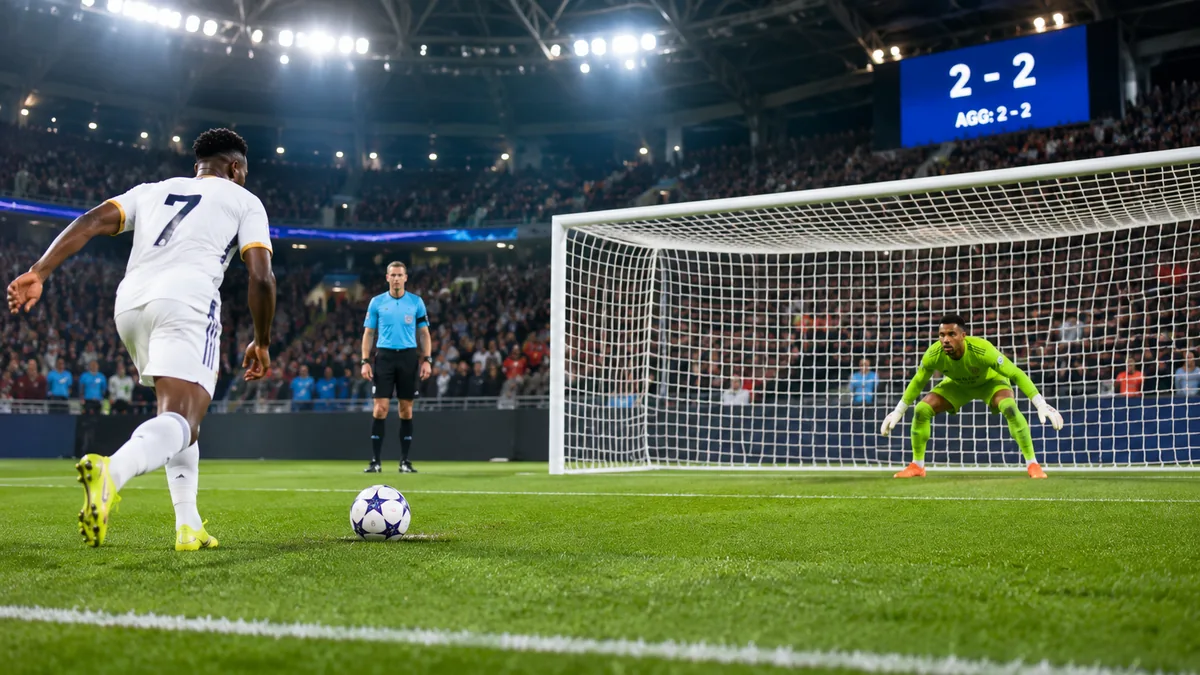
If the aggregate is still equal after the full extra-time period, the referee conducts a penalty shootout, following the International Football Association Board's Law 10 .
The referee first determines which goal will be used and conducts another coin toss to give the winning team a choice of kicking first or second. The teams then take kicks alternately, normally with five attempts available to each side.
Each kick is taken by a different eligible player. The contest can finish before all ten initial kicks are taken if one side becomes mathematically unable to catch up. If the teams remain level after five attempts each, the shootout enters what fans call sudden death: kicks continue in alternating pairs until one team leads after both have taken the same number of attempts.
Only players eligible under Law 10 can normally participate. Players sent off during the match cannot take part, and there are special provisions for an injured goalkeeper. If one team has more eligible players than the other, its numbers must be reduced to match before the kicks.
5. Are penalty shootout goals added to the match score?
No. A penalty shootout is a separate procedure used to determine the winner after the match has ended. It does not rewrite the goals scored in the two legs.
If the aggregate remains 2–2 and Team A wins the shootout 4–3, the result is properly described as Team A qualifying 4–3 on penalties after a 2–2 aggregate draw. It is not a 6–5 aggregate win.
The distinction also matters for match statistics. A goal scored from a penalty during normal time or extra time is a match goal. A successful kick in the post-match shootout is not added to a player's normal goal tally or the aggregate. UEFA's coefficient calculation principles also specify that shootout results do not count towards match points.
6. What is the difference between a penalty during the game and a shootout kick?
During normal time or extra time, a foul inside the penalty area can lead to an in-play penalty. After the ball is kicked, play may continue: for example, a rebound from the goalkeeper or post can become a second chance, subject to the ordinary Laws of the Game.
In a shootout, however, each attempt is a self-contained kick. The taker cannot deliberately play the ball a second time. The kick is over when the ball stops moving, leaves play or the referee stops it for an offence.
IFAB's 2026/27 Law 10 includes a clarification for an accidental double touch, such as a player's standing foot being struck by the ball immediately after the kick. If the ball goes into the goal from that accidentally double-touched kick, the attempt is retaken. If it does not go in, the kick is recorded as missed. A deliberate second touch is treated differently under the Laws.
This is one reason it is worth reading current IFAB guidance instead of relying on an old clip or an explanation from a different competition.
7. How do the rules apply to the Champions League's newer format?
The Champions League moved from a traditional group stage to a 36-team league phase. Under the current 2026/27 regulations , each club plays eight different opponents in a single league ranking: four matches at home and four away.
The top eight clubs advance directly to the round of 16; clubs ranked ninth to 24th enter knockout phase play-offs; clubs ranked 25th to 36th are eliminated. The knockout phase play-offs and subsequent knockout rounds, apart from the final, ordinarily use two-legged ties. Those ties are governed by aggregate goals, extra time and penalties as explained here.
For broader context, FlyingEze's guide to the newer Champions League league phase and club scheduling explains how the change affects match calendars and travel.
Do not confuse a league-phase draw with a knockout tie that ends level on aggregate. A 1–1 league-phase match simply gives each side one point; it does not lead to extra time or a shootout.
8. Do away goals still matter in the league-phase table?
Yes—in a narrow, different way. Although away goals no longer settle knockout ties, UEFA's 2026/27 Article 18 still includes the number of away goals scored during the league phase among its ranking tiebreakers.
When two or more clubs finish level on points, the rules first compare goal difference across the league phase, then total goals scored, then away goals scored, before moving to other criteria such as wins and away wins.
This is not a return of the abolished away-goals rule for two-legged ties. The two concepts apply in different contexts: one ranks teams in a league table; the other would have awarded victory in an aggregate knockout tie. Away goals in the league phase are a statistic used only when earlier ranking criteria fail to separate teams.
It is inaccurate to say “away goals have no role anywhere in the Champions League”. The precise statement is that away goals no longer serve as the knockout tiebreaker.
9. What happens in the Champions League final?
The final is one match at a preselected neutral venue, rather than a home-and-away tie. Article 22 of the 2026/27 regulations says that if the score is equal after 90 minutes, the teams play two 15-minute periods of extra time. If still level, penalties determine the champion.
There is no aggregate score to calculate in a single-match final, and the away-goals rule is irrelevant. The same broad principle applies to UEFA Europa League finals under the competition's published regulations.
10. Are the Europa League and Conference League rules different?
For the central knockout question, no. The current 2026/27 Europa League Article 21 and Conference League Article 21 prescribe the same process when a two-legged knockout tie is level: 30 minutes of extra time followed by penalties if necessary.
However, formats and scheduling details between UEFA competitions differ. Always verify the regulations for the specific tournament, season and round before applying a rule from another cup. For example, domestic competitions sometimes send certain drawn matches directly to penalties without extra time; that does not change UEFA Champions League rules.
11. How removing away goals affects team tactics
The change has practical consequences. Under the old system, a visiting goal could create a major advantage when the aggregate was tied, and a side hosting the return leg risked elimination despite drawing level on total goals. Now, the location of a knockout goal does not have that extra tiebreaking importance.
Teams may still value scoring away from home because every goal helps the aggregate and because the return match may be tactically different. But coaches no longer need to chase a special away-goals threshold. A team that concedes twice at home in the first leg can still force extra time by winning the away leg by two goals, regardless of the exact distribution of goals.
Extra time also gives the second-leg host up to 30 more minutes in its own stadium. UEFA's 2021 explanation identified the perceived imbalance of the old rule during those extra minutes as one reason for its removal. That does not mean the revised system eliminates home advantage; it removes one distinct scoring rule.
Common mistakes when interpreting UEFA knockout results
- Counting away goals twice: every goal adds one to the aggregate, whether home or away.
- Looking only at the second-leg score: always add the first-leg result before declaring a winner.
- Assuming extra time follows a drawn first leg: ordinary two-legged ties continue to the return match.
- Ending the match after the first extra-time goal: there is no golden-goal finish.
- Adding shootout goals to the aggregate: the penalty result is reported separately.
- Applying the knockout rule to the league table: the 2026/27 league-phase tiebreakers still include away goals.
Frequently asked questions
Do away goals count in the Champions League in 2026/27?
Away goals count as ordinary goals in the aggregate, but they do not break ties between teams level on aggregate. A separate away-goals statistic remains among league-phase ranking tiebreakers.
What happens if both UEFA teams finish 2–2 on aggregate?
They play two 15-minute periods of extra time at the end of the second leg. If the aggregate remains level after extra time, the winner is determined by a penalty shootout.
Are there penalty shootouts in Champions League finals?
Yes, if a final is drawn after 90 minutes and remains level after 30 minutes of extra time. The final is a single match, not a two-legged tie.
Can a team win because it scored more away goals in extra time?
No. The away-goals knockout tiebreaker has been abolished. If both sides score the same number of goals in extra time and remain level on aggregate, they go to penalties.
How many penalties does each team take?
Each team initially has up to five alternating kicks, with an early finish if the other cannot catch up. If still equal after five kicks each, alternating kicks continue until a team leads after an equal number of attempts.
Does a penalty shootout goal count toward a player's scoring record?
No. Shootout goals determine the winner but are not match goals and do not change the aggregate score. A penalty scored during normal or extra time is different.
Is the European Championship League the same as UEFA EURO?
No. People searching for “European Championship League” often mean the UEFA Champions League, a club competition. The UEFA European Championship (EURO) is a national-team tournament with its own format and regulations. This guide addresses UEFA club ties, principally the Champions League.
Conclusion
Understanding a UEFA knockout tie takes three steps: add the goals over both legs, ignore the old away-goals tiebreaker, and use extra time and penalties if the aggregate remains level. In a single-match final, compare the score after 90 minutes, then follow the same extra-time and shootout sequence if necessary.
The one subtlety worth remembering is that away goals can still affect how clubs with equal points are ordered in the Champions League league-phase table. That ranking rule is not the old knockout away-goals rule. With this distinction, even a dramatic second-leg comeback becomes easier to follow.