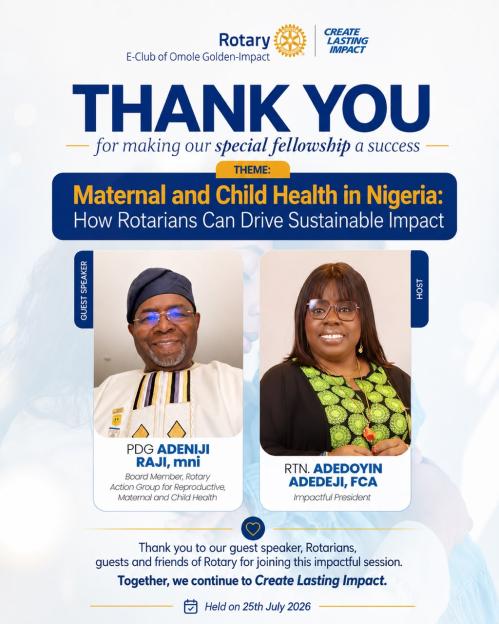
The Rotary E-Club of Omole Golden Impact, Rotary Internationa District 9111, held a special club fellowship on Maternal and Child Health, honoured by the presence of PDG Adeniji Raji, mni, as Guest Speaker.
The session was highly enlightening, practical, and thought-provoking, as it brought renewed attention to the urgent need for sustained action in reducing preventable maternal and child deaths in Nigeria.
In his presentation and the discussions that followed, the club reflected on the troubling burden of maternal and child mortality in Nigeria, noting that the country accounts for a significant proportion of global maternal deaths, with many women still dying annually from
preventable pregnancy and childbirth-related causes. Child mortality also remains a major concern, with under-five and infant mortality rates still unacceptably high.
The meeting identified several major issues contributing to poor maternal and child health outcomes, including low antenatal attendance, risky pregnancies, inadequate healthcare infrastructure, malnutrition, malaria, poor transportation, weak referral systems,
poor data management, myths around family planning, and lack of community awareness.
Particular emphasis was placed on the three critical delays that often lead to preventable deaths: delay in deciding to seek healthcare, delay in reaching a health facility, and delay in receiving adequate care upon arrival at the facility.
The meeting also recognised that many Primary Health Centres remain under-equipped and under-resourced, lacking basic medical equipment, adequate bed space, clean water, reliable electricity, blood bank support, baby scales, and functional delivery or operating facilities.
Participants noted that these gaps weaken the ability of frontline health facilities to respond effectively to maternal and child health emergencies.
The fellowship further highlighted the need to strengthen community education around antenatal care, birth preparedness, child spacing, danger signs in pregnancy, proper use of mosquito nets, family planning options, and the importance of seeking timely care at appropriate health facilities.
Another key point of discussion was the role of Traditional Birth Attendants within communities. While acknowledging existing limitations, the meeting noted that traditional birth attendants remain influential in many communities and should be engaged, trained,
and linked to Primary Health Centres to encourage early referral of complicated cases.
The session also brought attention to the importance of reliable data in improving maternal and child health outcomes. The need to promote better health data recording, maternal and perinatal death surveillance, and digital reporting systems such as the NOGA Network
was identified as an important step toward better policy planning and intervention.
Following the discussions, the Rotary E-Club of Omole Golden Impact affirmed that maternal and child health advocacy should not be limited to the month of July alone, even though July is Rotary’s Maternal and Child Health Month. The club recognised that the challenges are
ongoing and require sustained advocacy, partnerships, community outreaches, facility support, and public education throughout the Rotary year.
The meeting proposed several areas of action, including:
• Advocacy to traditional leaders, community influencers,
government agencies, and relevant stakeholders for improved funding
and upgrading of Primary Health Centres.
• Community dialogues and outreaches focused on antenatal
attendance, child spacing, birth preparedness, transportation
planning, and danger signs in pregnancy.
• Training programmes for health workers, traditional birth
attendants, health information officers, and local government
monitoring and evaluation officers.
• Needs-based support to Primary Health Centres through the
provision of essential medical equipment and facility support.
• Promotion of family planning counselling, with encouragement for
couples to attend counselling sessions together.
• Support for blood bank systems at local government level to help
address emergencies such as postpartum haemorrhage.
• Mosquito net distribution with proper education on usage and maintenance.
• Support for HPV testing and awareness among young girls.
• Improved data management and promotion of maternal death surveillance systems.
The club also noted that Rotarians have a unique role to play in driving change through advocacy, service projects, partnerships, education, fundraising, and community mobilisation. However, it was strongly emphasised that projects must be based on proper needs assessment to ensure relevance, sustainability, and measurable impact.
The Rotary E-Club of Omole Golden Impact expressed deep appreciation to PDG Adeniji Raji, mni, for honouring the club with his presence,wisdom, and fatherly guidance. His contribution further strengthened the club’s resolve to pursue maternal and child health interventions
with greater structure, sensitivity, and sustainability.
As a young but purpose-driven club, the Rotary E-Club of Omole Golden Impact remains committed to promoting healthier mothers, healthier children, stronger families, and more resilient communities.
Every mother deserves care. Every child deserves a healthy start.
Service is powerful. Impact is golden.
Rtn. Adedoyin Adedeji
President,
Rotary E-club of Omole Golden Impact”