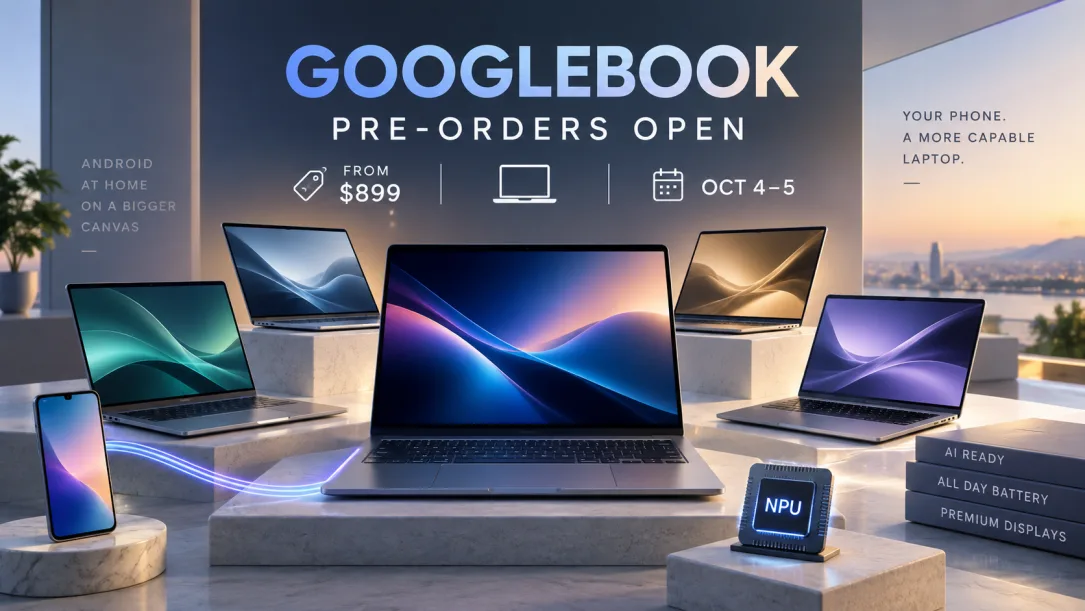
Google has opened pre-orders for Googlebook, a new premium laptop category built on the Android technology stack and designed around Google's Gemini intelligence.
The first wave of devices comes from Acer, ASUS, Dell, HP and Lenovo. Prices start at US$899, with retail availability beginning on 4 October in the United States and 5 October in Canada, the United Kingdom, Ireland, France, Germany and Australia.
For buyers, the important point is that Googlebook is a category rather than one single laptop model. Specifications, processors, displays and other hardware will vary by manufacturer, so the headline features should not be assumed to apply identically to every machine.
Googlebook at a glance
- Starting price: US$899.
- Pre-orders: open now.
- Manufacturers: Acer, ASUS, Dell, HP and Lenovo.
- US retail availability: 4 October 2026.
- Selected international markets: 5 October 2026 in Canada, UK, Ireland, France, Germany and Australia.
- Platform: Android technology stack with desktop foundations drawn from ChromeOS.
- AI: designed for Gemini Intelligence, with dedicated neural-processing hardware on supported configurations.
- Displays: touchscreen options up to 2.8K OLED.
- Processors: Intel or Qualcomm, depending on the device.
- NPU performance: dedicated NPUs exceeding 45 TOPS on applicable configurations.
- Battery: up to 14 hours claimed on applicable models and configurations.
What exactly is Googlebook?
Googlebook is Google's attempt to establish a premium laptop experience around the Android ecosystem while retaining desktop foundations developed through ChromeOS. That positioning matters because Android has traditionally been associated primarily with phones and tablets, while ChromeOS has served Google's laptop strategy.
The new category is intended to bring those environments closer together. Google is emphasising continuity between Android phones and laptops, alongside Gemini-powered features and hardware capable of running more AI workloads locally.
It should not be confused with a single Google-manufactured computer. Acer, ASUS, Dell, HP and Lenovo are producing the initial hardware, meaning buyers will need to compare individual models rather than treating “Googlebook” as one fixed specification.
How much does Googlebook cost?
Google says prices start at US$899. That puts the entry point firmly in premium-laptop territory rather than the inexpensive segment traditionally associated with many Chromebooks.
The starting price is not the price of every Googlebook. Higher-resolution OLED displays, additional memory or storage, different processors and other manufacturer-specific configurations can change the final price. Buyers should therefore check the exact model and configuration before comparing it with a Windows laptop, MacBook or Chromebook.
Processors and on-device AI
Initial Googlebook hardware can use Intel or Qualcomm processors. Supported configurations include dedicated neural processing units rated above 45 TOPS, giving manufacturers hardware designed to accelerate compatible AI workloads without sending every task to a remote server.
TOPS — trillions of operations per second — is commonly used as one measure of an NPU's computational throughput. It should not, however, be treated as a complete measure of real-world AI performance. Software optimisation, memory, processor architecture, thermal limits and the particular AI model all influence actual results.
Googlebook is designed around Gemini Intelligence, but buyers should distinguish the presence of Gemini features from a claim that every AI task runs entirely on-device. Availability and execution can depend on the particular feature, hardware and service requirements.
Displays: up to 2.8K OLED
Google says Googlebook devices can include touchscreens with resolutions up to 2.8K and OLED technology. OLED panels can provide strong contrast and deep blacks, while touchscreen support fits the closer relationship with Android applications.
Again, “up to” is important. Not every Googlebook will necessarily ship with the maximum-resolution OLED option. Individual manufacturer specifications remain the source of truth for a particular model.
Battery life
The platform announcement describes battery life of up to 14 hours on applicable hardware. Manufacturer battery estimates are useful for comparing intended capability, but real-world endurance varies with display brightness, applications, wireless connectivity, AI workloads and power settings.
FlyingEze therefore recommends treating the 14-hour figure as a manufacturer/platform claim rather than a guaranteed runtime for every Googlebook.
Android phone and laptop continuity
One of Google's clearest strategic advantages is the size of the Android ecosystem. Googlebook is designed to make moving between an Android phone and laptop more natural, reducing the separation between mobile and desktop workflows.
That can be particularly relevant for people who already use Android applications and Google services throughout the day. The practical value will depend on which continuity features are supported by a buyer's phone, laptop model, region and account.
When can you buy one?
Pre-orders are open now. Google says the first devices will reach shelves in the United States on 4 October 2026.
Availability follows on 5 October in Canada, the United Kingdom, Ireland, France, Germany and Australia.
Those dates should not be interpreted as worldwide availability. Google has identified specific launch markets, and buyers elsewhere should wait for confirmed local availability rather than assuming an October release.
Which companies are making Googlebooks?
The initial manufacturer list consists of Acer, ASUS, Dell, HP and Lenovo. This multi-vendor strategy means Googlebook will compete as an ecosystem rather than a single piece of hardware.
It also means specification sheets matter. Two Googlebooks may share the same platform identity while differing significantly in processor, display, memory, storage, ports, size, weight and price.
What buyers should check before ordering
Before placing a pre-order, compare the exact configuration rather than relying on category-wide maximum specifications.
- Confirm whether the model uses an Intel or Qualcomm processor.
- Check the exact display technology and resolution.
- Verify memory and storage capacity.
- Check whether the configuration includes the NPU capability needed for the AI features you expect to use.
- Review the manufacturer's battery methodology rather than assuming 14 hours in every workload.
- Confirm that the applications you rely on work well with the device and processor architecture.
- Check local warranty, pricing and availability.
Googlebook versus Chromebook: what changes?
The biggest conceptual change is the platform emphasis. Chromebooks established Google's desktop presence around ChromeOS and web-first computing. Googlebook brings the Android technology stack much closer to the centre of the laptop experience while retaining desktop foundations developed through ChromeOS.
That potentially gives Google a more unified phone-to-PC story, particularly as AI features increasingly span devices. But the practical difference for a buyer will depend on application compatibility, hardware and how individual manufacturers implement the platform.
Should you pre-order?
Googlebook's specifications make the category worth watching, particularly for Android users who want tighter phone-and-laptop integration. But a pre-order should be based on a specific model, not the Googlebook name alone.
Independent reviews will also provide information that launch specifications cannot: sustained performance, keyboard and trackpad quality, display behaviour, fan noise, real-world battery life and how useful the Gemini features are in everyday work.
Bottom line
Googlebook marks a significant expansion of Google's laptop strategy. Pre-orders are open from US$899, five major PC manufacturers are participating, and the first machines arrive in early October across seven announced markets.
The most important buying detail is also the simplest: Googlebook describes a family of laptops. Features such as 2.8K OLED displays, more than 45 TOPS of NPU performance and up to 14 hours of battery life represent capabilities available within the category, not a promise that every model has the same specification.