 womans-eye-looking-macro-photography-1106503872 Credit: Getty
IT’S normal to get the odd bump, lump or mark on your face.
Usually, blemishes are nothing serious and tend to fade in days or weeks – but yellow patches appearing around the eyes could indicate you’re at higher risk of or heart attack over the next decade.
The fatty lumps are known as , and tend to pop up on the upper or lower lids.
They tend to puff up when immune cells called macrophages get stuffed with cholesterol and other fats.
Xanthelasma is often linked to higher levels of cholesterol – unhealthy fats that clog up the arteries – in the blood.
Recent research by Stanford University also revealed the clumps are linked to a higher risk of atherosclerosis, when fatty plaques form in the arteries, narrowing the vessels and increasing the risk of dangerous blood clots.
Over time, atherosclerosis can trigger , stroke and other forms of cardiovascular disease.
It often builds up slowly and silently, without causing symptoms – until it causes a medical emergency.
So warning signs such as xanthelasma could be key to spotting the condition early, before it causes too much damage.
Stanford ophthalmology researcher Negin Yavari wrote in the journal Atherosclerosis : “A few studies have supported the association between xanthelasma and an increased risk of cardiovascular events.
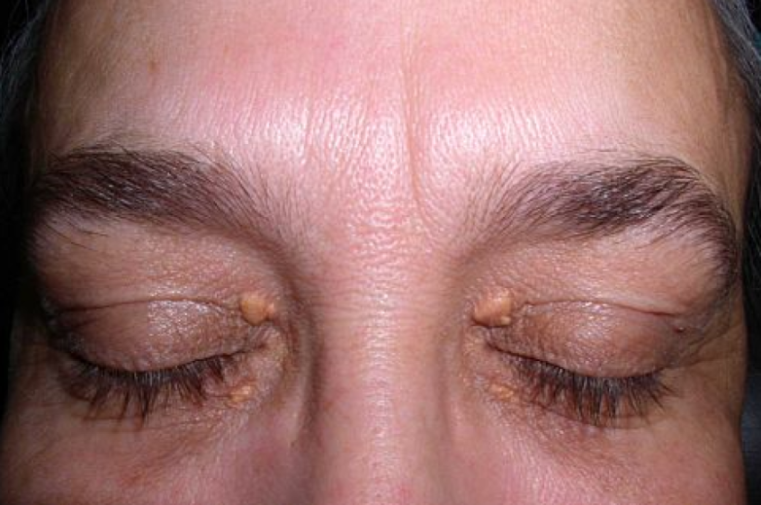 Xanthelasma is when fatty lumps appear around the eyes Credit: Wikimedia Commons
 What is atherosclerosis?
Atherosclerosis is where your arteries become narrowed, making it difficult for blood to flow through them.
It increases your risk of heart attack and stroke.
You may not have any symptoms of atherosclerosis, but symptoms can include:
- Chest pain
- Pain in your arms and legs, especially when exercising
- Feeling short of breath
- Feeling tired all the time
- Feeling weak
- Feeling confused
If you’re aged 40 to 74 you can get a free NHS health check which can spot the early signs of heart disease and stroke, as well as kidney disease, dementia and type 2 diabetes.
Source: NHS
“Others debate that it may not be an independent risk factor once traditional risk factors are accounted for.”
Other “traditional” risk factors for cardiovascular disease include being overweight or obese, or having high cholesterol or high blood pressure.
The study analysed data from 17,925 people diagnosed with xanthelasma.
It compared them to an equal number of people with farsightedness, who didn’t have xanthelasma.
Over the course of a year, 178 patients with fatty lumps around their eyes – about one per cent of this group – suffered a heart attack.
Meanwhile, 0.95 per cent of those with xanthelasma had a stroke, and another 0.6 per cent had a (TIA), also known as a ‘mini-stroke’.
Only 63 – or 0.35 per cent – of the farsighted group suffered a heart attack in the same period of time.
Another 0.3 per cent had a stroke and 0.19 per cent had a TIA.
The xanthelasma group were more likely to experience these health emergencies whether or not they had abnormally high levels of fat in their blood – suggesting xanthelasma may be an independent risk factor.
Those are all low percentages – but it still translates to a much higher risk for the xanthelasma group.
The gap between the two groups narrowed slightly over time.
But the xanthelasma group remained at higher risk of heart attack and stroke five and 10 years down the line.
Researchers wrote: “Xanthelasma is associated with higher short- and long-term incidence of major cardio-cerebrovascular events up to 10 years.”
This means the yellow lumps could be used as a “clinical marker” to spot and prevent cardiovascular disease, they said.
They added: “Our study suggests that xanthelasma can be considered as a risk factor for future major cardio-cerebrovascular events.”
This doesn’t mean that the eyelid patches themselves are causing heart attacks or strokes.
But researchers suggested that in future, people with xanthelasma could be screened for heart health problems earlier.
“Most of the patients with xanthelasma are seen by dermatologists for cosmetic reasons, while they may have undiagnosed or uncontrolled cardiovascular risk factors that contribute to this elevated risk,” they wrote.
“Findings of our study highlight the importance of evaluating the patients with xanthelasma at early stages to identify and control their underlying systemic conditions, helping to prevent potential cardio-cerebrovascular events.”
Further research may look into why people with xanthelasma are at such a higher risk of heart attack and stroke.