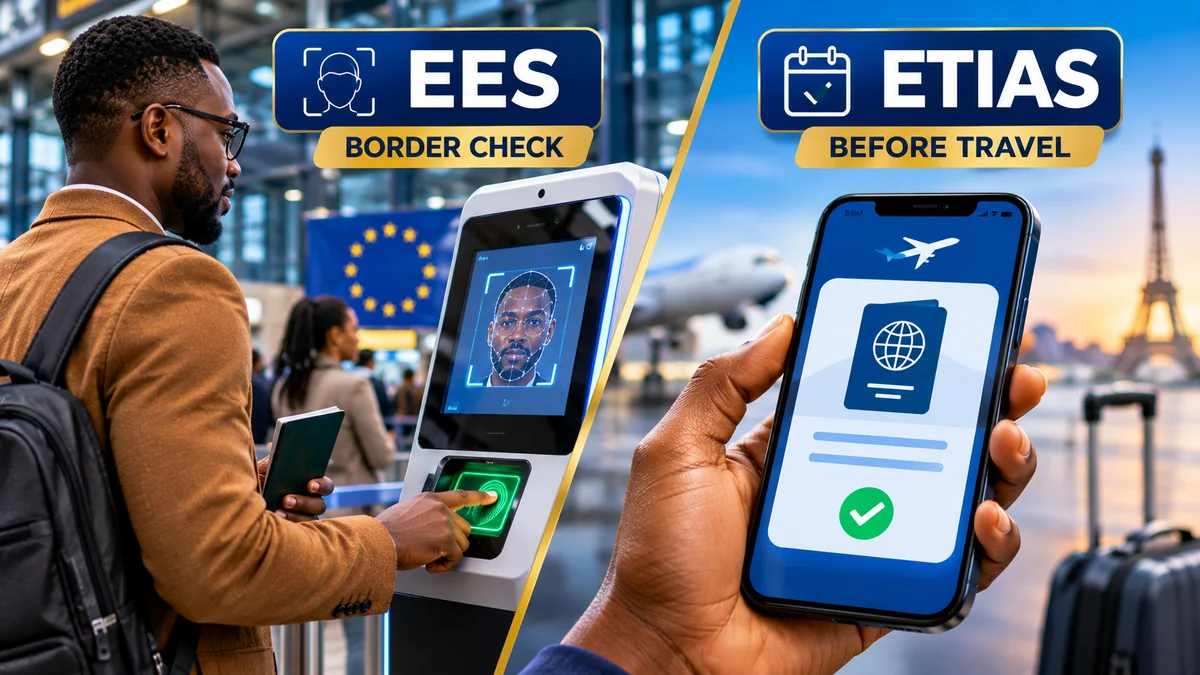
The EU Entry/Exit System (EES) and ETIAS are not the same travel requirement. EES is an operational border-registration system that records eligible non-EU visitors' arrivals, departures and identity information. ETIAS is a separate pre-travel authorisation for eligible visa-exempt nationals; as of 2 November 2026, the European Union says ETIAS is not yet accepting applications. For most Nigerians travelling on an ordinary Nigerian passport, the practical combination remains a valid Schengen short-stay visa and an EES border check—not ETIAS.
The distinction matters because websites and social-media posts sometimes advertise an “EES visa,” suggest that every Nigerian must pay an ETIAS fee, or confuse a mobile border tool with a mandatory application. The European Commission's April 2026 comparison makes clear that the two systems work at different stages and cover different groups.
This guide compares the purpose, countries, application procedure, biometrics, fees, passports and travelling scenarios, including Nigerian dual citizens and residents abroad. Verified on 2 November 2026 from official European Commission and Travel Europe material. Rules may change; confirm details again before travel.
The simplest difference: EES happens at the border; ETIAS happens before travel
EES registers a covered traveller's crossing of an external border. It can record passport details, a facial image, applicable fingerprints, entry and exit locations and dates, and refusal-of-entry decisions. It applies to short-stay visitors who need a Schengen visa as well as those who are visa-free, subject to exemptions.
ETIAS will require qualifying visa-exempt nationals to obtain electronic travel authorisation before departure, once the system launches and applicable transition rules have run their course. The authorisation is linked to the traveller's passport and can be checked by carriers. It does not replace a visa for someone whose nationality remains visa-required.
A traveller using ETIAS may also be registered by EES on arrival. A Nigerian tourist entering France on a Schengen visa will generally be registered in EES but will not need ETIAS. These are not competing alternatives.
EES versus ETIAS: side-by-side comparison
| Question | Entry/Exit System (EES) | ETIAS |
|---|---|---|
| What is it? | Digital border entry/exit and identity-registration system | Electronic pre-travel authorisation, not a visa |
| Status on 2 November 2026 | Fully operational since 10 April 2026 | Not operational; no applications accepted |
| Who is generally covered? | Eligible non-EU short-stay travellers, visa holders and visa-exempt visitors | Eligible visa-exempt non-EU nationals |
| Countries covered | 29 European countries in the Schengen area | 30: those 29 plus Cyprus |
| When does it happen? | At eligible external border crossings | Online before travel, once launched |
| Separate traveller application fee? | No independent EES application or EES fee | €20 for most fee-paying applicants; exemptions apply |
| Biometrics | Border facial image and applicable fingerprint capture/verification | Online application data; no fingerprint collection in the ETIAS application |
| Validity | Crossings and identity records under applicable retention rules | Up to three years, or passport expiry if earlier |
| Does it guarantee admission? | No; border officers decide admission | No; an authorisation does not guarantee admission |
| Ordinary Nigerian passport short visit? | Generally yes, at eligible external borders | Generally no; a Schengen visa remains necessary |
The distinctions above come from the European Commission's EES/ETIAS comparison and the respective EES and ETIAS official guidance. Individual exemptions and specific travel documents require separate assessment.
Why ordinary Nigerian passport holders generally need a Schengen visa instead of ETIAS
Nigeria is a visa-required country for ordinary short visits to the Schengen area. Consequently, a Nigerian resident travelling with an ordinary Nigerian passport for tourism, business meetings or a family visit should normally apply for the appropriate short-stay visa through the embassy or consulate of the principal destination or its authorised application service.
The European Commission's visa guidance explains that a Schengen visa permits a short temporary visit, usually subject to the 90-days-in-any-180-days framework and any shorter limits on the visa itself. Applicants ordinarily submit a passport, documentation supporting the trip, medical insurance and biometric information, with specific exceptions.
ETIAS does not make the Schengen visa optional. Purchasing a purported “ETIAS for Nigerians” cannot cure a missing visa. Nor does having an ETIAS-like email, a European hotel booking or an EES record authorise a person to work, study long-term or remain beyond the entry conditions.
If a Nigerian citizen holds a qualifying residence permit, long-stay visa, EU family residence card or a second nationality, the rules may differ. The appropriate documents—not simply the person's place of birth or where they currently live—are central to the assessment.
What actually happens during an EES border check?
The EES began a phased rollout on 12 October 2025 and became fully operational on 10 April 2026. At a participating external border, eligible non-EU short-stay visitors present their passport and visa where required, complete identity checks, and have their entry or exit registered digitally. Routine manual passport stamping has been replaced for travellers covered by EES.
According to the official EES process , the first registration involves creating a digital record with a photo and, as applicable, fingerprints. On later crossings, border staff normally verify the existing record; it may be necessary to collect information again. Some locations offer kiosks or optional pre-registration tools. Travellers still have to satisfy admission rules and follow border officers' instructions.
For short-stay visa holders, fingerprints collected with the visa application are already held in the Visa Information System (VIS), so they are not stored a second time in EES. A fingerprint scan may nevertheless be used to verify identity against that system. For visa-exempt covered travellers, EES can retain four fingerprints and a facial image. Children below 12 are generally exempt from EES fingerprint scanning, although other checks continue. These distinctions are outlined in the EES FAQs .
There is no separate paid EES registration website for a Nigerian to use before travelling. Certain countries may provide a supported Travel to Europe mobile feature to prepare some details before a crossing, but this does not replace the required border procedure or become a new visa.
How ETIAS will work once it opens
The official Travel Europe ETIAS page currently states that the system is not in operation and is not collecting applications. The EU had scheduled it for the last quarter of 2026, but that planning window should not be mistaken for a confirmed opening day. Travellers should rely on the portal's live status instead of announcements from paid intermediaries.
Once available, an eligible visa-exempt traveller will use the official ETIAS site or mobile application, provide personal and passport details, answer the prescribed questions and pay the applicable fee. The authorities will evaluate the request and communicate a decision by email. Most applications are expected to be handled quickly, but some may take up to 96 hours or longer if additional information or an interview is required; certain cases can require additional weeks.
Successful authorisation is linked to the passport used in the application and generally lasts three years or until that passport expires, whichever happens first. A replacement passport requires a new authorisation. Travellers must still satisfy ordinary border entry conditions, so ETIAS approval is not an unconditional right of entry.
This online step will be relevant to eligible visa-exempt travellers, including many holders of UK, US or Canadian passports, but it is not an additional step for an ordinary Nigerian visitor already required to obtain a Schengen short-stay visa.
ETIAS costs €20—but the fee does not apply to ordinary Nigerian visa applicants
Official 2026 guidance specifies a €20 application fee for ETIAS applicants who are required to pay. The older €7 figure circulated online is outdated. The official application guidance provides fee exemptions, including applicants younger than 18 and those older than 70, and eligible family members meeting the relevant conditions. A fee exemption does not necessarily mean an otherwise eligible person can skip submitting an application.
The €20 fee has nothing to do with EES border enrolment. Separately, the standard adult Schengen short-stay visa application fee is currently €90, with different rates, exemptions and possible service-centre charges under official visa policy . Budget for the applicable visa route, not ETIAS, if you are travelling with an ordinary Nigerian passport and do not qualify for a different exemption.
Be cautious of websites advertising paid EES registration, guaranteed ETIAS approval or a discount visa bundled with ETIAS. FlyingEze has previously covered fraud warnings involving proposed European travel-rule changes . Check the official EU portal and the relevant consulate directly before submitting passport information or payment details.
Why EES covers 29 countries but ETIAS will cover 30
EES applies at external borders of the 29 Schengen-area countries: Austria, Belgium, Bulgaria, Croatia, Czechia, Denmark, Estonia, Finland, France, Germany, Greece, Hungary, Iceland, Italy, Latvia, Liechtenstein, Lithuania, Luxembourg, Malta, the Netherlands, Norway, Poland, Portugal, Romania, Slovakia, Slovenia, Spain, Sweden and Switzerland.
ETIAS is designed for qualifying visa-exempt arrivals in those 29 countries plus Cyprus. Cyprus is not part of the EES area, but its entry rules are within the future ETIAS coverage. Ireland is not included in either system. The United Kingdom has its own border and electronic travel permission rules.
This matters for routes. A person flying Lagos–London–Paris is not entering EES at London, but an eligible EES check occurs when they enter the Schengen area in Paris. A visitor whose journey is solely to Cyprus is not registered by EES there, although Cyprus will fall within the ETIAS regime for applicable visa-exempt travellers once introduced. Such differences do not remove country-specific visa requirements.
There is also an important stay-period nuance: the official ETIAS FAQ explains that Cyprus's short-stay allowance is calculated separately from the Schengen 90/180-day allowance. Travellers should not simply add countries and assume that all 30 share one identical border or duration calculation.
Does ETIAS change the 90 days in 180 days rule?
No. The basic short-stay framework for the Schengen area remains up to 90 days within a rolling 180-day period, subject to visa validity, the number of entries authorised and other conditions. EES helps record covered crossings and identify overstays. ETIAS does not award extra stay days to an eligible visa-exempt visitor.
For instance, if a traveller spends 25 days in Spain and 35 in France within the same rolling window, those 60 days normally count together under the Schengen short-stay calculation. Crossing between France and Spain does not automatically reset the clock. A traveller with a visa allowing only 30 days must observe that more restrictive permission instead.
Checking a visa's duration of stay, permitted entry count and expiry dates is therefore just as important as understanding the new technology. A valid ETIAS authorisation or an EES digital record does not override those conditions.
What if a Nigerian also has British, Irish or another European nationality?
Dual citizenship can change the answer, but the passport actually used to travel matters. Consider these illustrative scenarios:
| Situation | Practical implication |
|---|---|
| Nigerian citizen travelling on Nigerian passport alone | Usually needs a Schengen visa and EES registration for a covered short stay; no ETIAS |
| Dual Nigerian–British national using a valid British passport | Generally visa-exempt for short Schengen visits and expected to require ETIAS under future applicable rules; also typically within EES on entry |
| Dual Nigerian–French or Nigerian–Irish national using the valid European passport | Not an ETIAS applicant under the relevant citizenship exemption; EES is not the ordinary short-stay process for an EU/Irish national |
| Nigerian citizen resident in the UK or US but travelling on Nigerian passport | Foreign residence alone does not automatically provide ETIAS eligibility or a Schengen visa exemption |
| Nigerian citizen with qualifying Schengen residence permit or long-stay visa | May be exempt from the ordinary EES short-stay registration regime; check the exact document and itinerary |
The European Union's dual-citizenship ETIAS guidance stresses nationality and travel document consistency. A traveller whose ETIAS is attached to a British passport cannot assume it applies to a different Nigerian passport. Those who are citizens of an EU/EEA country or Ireland must use the appropriate qualifying travel document.
Travellers with residence cards, family rights, unusual passport categories or refugee travel documents should seek advice from the destination country's official authorities. This table simplifies common cases; it is not an eligibility decision for a specific person.
What if ETIAS launches shortly before a trip?
The EU has published plans for transition and grace periods following ETIAS's launch. Its revised rollout information anticipates at least 12 months of combined arrangements, and the detailed EU guidance describes an initial transition period and a later grace period with narrower first-entry conditions.
However, travellers should not assume that ETIAS will never be checked during the introductory period or that every trip will qualify for a grace exception. Eligibility, the start date and enforcement details must be confirmed from official sources at the time of the journey. The safest approach for a person genuinely eligible for ETIAS is to obtain it once applications are open and the applicable requirement is in effect.
Ordinary Nigerian visa applicants should not delay or abandon their Schengen visa process because they see an ETIAS launch headline. The two routes continue to serve different traveller categories.
Biometric data and privacy: what is collected?
EES processes information directly related to border movements and identity. The EU's EES data notice describes travel-document information, facial images, applicable fingerprints and entry, exit or refusal records, with retention and authorised-access rules.
ETIAS applications will collect the personal and travel-related information required for pre-travel screening. An ETIAS application is not a remote fingerprint enrolment process; travellers who are subject to EES may still have biometric checks on arrival. Do not send biometric images, passport copies or payment details to unofficial “ETIAS verification” businesses.
Passengers should review the privacy information on official portals and use the applicable authority channels to request access or correction when their records are inaccurate. Personal data rules and appeal rights differ depending on which system or visa decision is involved.
How to choose the correct process before travelling from Nigeria
- Confirm your passport and nationality. If you have two citizenships, determine which valid passport you will use for the whole itinerary and check carrier requirements.
- Check the destination. Establish whether it is an EES-operating Schengen country, Cyprus, Ireland or the UK; do not treat all European countries as interchangeable.
- Determine visa eligibility. Ordinary Nigerian passport holders generally need the appropriate Schengen visa for short visits; exceptional categories should be checked individually.
- If visa-required, apply through the correct consulate. Prepare supporting documents and appointments well ahead of your trip; a future ETIAS application is not a substitute.
- If visa-exempt, check the ETIAS portal. As of this article's verification date, applications are closed; after launch, check whether authorisation is currently required and use the official channel.
- Prepare for EES checks. Eligible visitors should expect passport and biometric verification at participating external borders, even if visa or ETIAS permission is already in place.
- Respect the authorised stay. Track your visa limits and the relevant 90/180-day period; never assume a new country grants a fresh allowance.
- Watch for scams. Avoid unofficial “EES visa”, guaranteed ETIAS and paid border registration advertisements.
Common mistakes that could spoil a European trip
Applying for ETIAS on a Nigerian passport that requires a visa: an ordinary Nigerian passport does not become visa-exempt through the ETIAS system.
Assuming EES requires an online payment: eligible border registration is not a separately purchased visa or authorisation.
Using an outdated €7 ETIAS fee: the published official charge is now €20 for applicants required to pay.
Confusing Cyprus with the Schengen area: Cyprus is in future ETIAS coverage but does not operate EES and has its own entry and stay considerations.
Assuming approval guarantees entry: both visas and ETIAS authorisations can be followed by border refusal when entry conditions are not met.
Ignoring a second passport: the passport selected for travel can determine visa/ETIAS requirements, and an ETIAS authorisation is linked to a particular document.
Assuming a future rollout date is confirmed: the official ETIAS portal still says that no applications are being accepted as of 2 November 2026.
Frequently asked questions
Do Nigerians need both EES and ETIAS?
Ordinary Nigerian passport holders generally need a Schengen visa for short visits and are registered under EES at participating external borders. They do not apply for ETIAS as a substitute for that visa. Dual-national and exempt-document cases may differ.
Has ETIAS launched in November 2026?
As checked on 2 November 2026, the official EU ETIAS portal states that the system is not operational and is not accepting applications. The planned timeframe is the final quarter of 2026, with an exact launch date to be announced officially.
How much do EES and ETIAS cost?
There is no separate EES application fee. ETIAS is planned to cost €20 for fee-paying applicants once operational; eligibility and age or family-status exemptions apply. Schengen visa fees are separate.
Will a Nigerian with a British passport need ETIAS?
When ETIAS becomes applicable, an eligible British passport holder will generally need the authorisation for short visits to covered countries, unless an exemption applies. Their British passport and corresponding ETIAS should be used consistently.
Does ETIAS replace passport checks and fingerprints?
No. ETIAS is checked before travel, while border officials still verify entry conditions. EES captures or verifies relevant biometric information for covered non-EU short-stay border crossings.
Can a traveller visit Cyprus with EES registration?
An EES record is not permission to enter Cyprus. Cyprus is not an EES country; its entry requirements must be assessed separately. The future ETIAS system will include Cyprus for eligible visa-exempt travellers.
Where should travellers check the latest information?
Use the official EU ETIAS portal , EES guidance and the consular website for the country you intend to visit. Avoid sites requesting payment for unlaunched ETIAS applications or supposed EES visas.
Conclusion
EES records eligible border crossings; ETIAS will authorise eligible visa-exempt travel before departure. They have separate purposes, different country coverage and different requirements, and neither replaces a needed Schengen visa. For most Nigerians holding only an ordinary Nigerian passport, the correct preparation remains obtaining the relevant visa and being ready for EES checks. People with additional citizenships or qualifying residence documents should confirm their specific route. Use official EU sources, especially while the ETIAS launch timetable remains subject to confirmation.