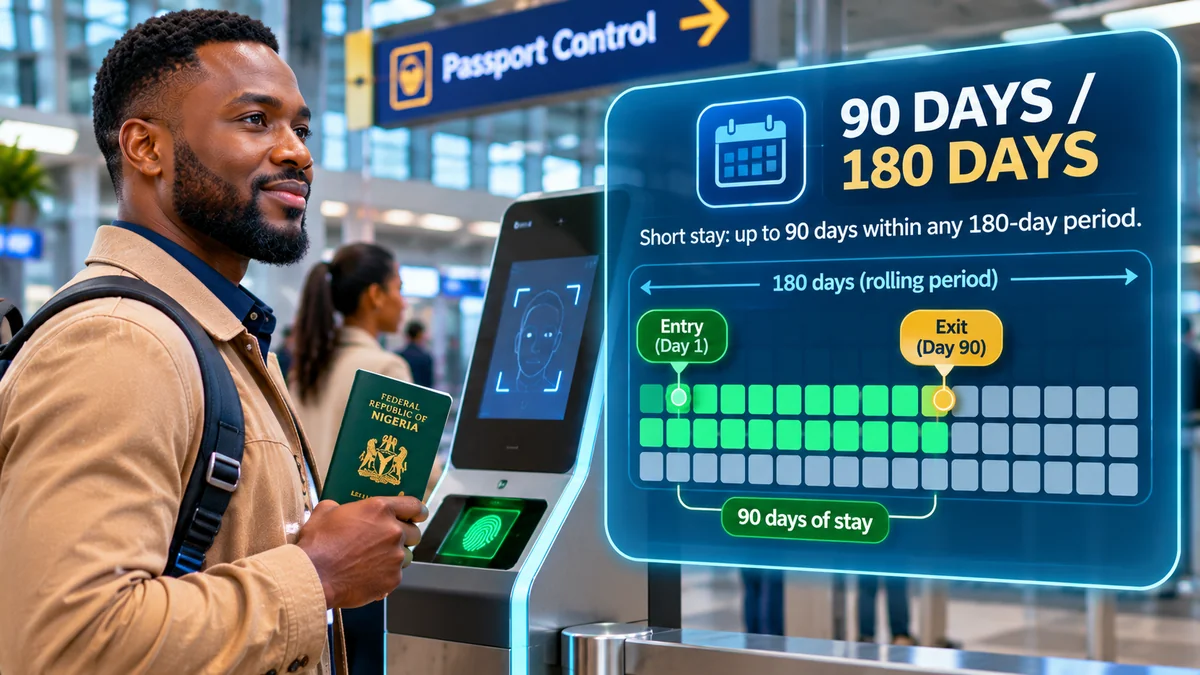
The EU Entry/Exit System (EES) helps border authorities identify when a visitor has used more than the permitted short-stay days, but it does not create a new allowance. The familiar Schengen limit remains up to 90 days in any rolling 180-day period. For an eligible Nigerian traveller, EES electronically records external border entries and exits, checks the available days and can flag a possible overstay. Both arrival and departure dates count as days spent in Schengen.
The rule is frequently misunderstood. Ninety days is not three calendar months, the allowance does not reset on 1 January, and crossing from France to Germany does not start another 90-day clock. A visa can also authorise fewer days than the general maximum. The European Commission's short-stay calculator guidance confirms that travellers must check the moving 180-day window for each day of their stay.
Here is a practical, Nigerian-focused guide to understanding the calculation, using the official tools, avoiding common mistakes and responding to errors in border records. Research verified on 2 November 2026. The examples are illustrative calculations, not individual immigration advice.
What changed when EES became fully operational?
The Entry/Exit System began its phased operation on 12 October 2025 and became fully operational across the external borders of the 29 Schengen countries on 10 April 2026. Instead of relying on routine passport stamps for travellers subject to the system, border authorities now record the place and date of arrival or departure, travel-document data, applicable biometric details and refusals of entry in digital records.
For ordinary Nigerian passport holders with a qualifying short-stay Schengen visa, EES registration generally applies at the external border. A short-stay visitor's visa remains essential where required; EES does not turn a visa-required traveller into a visa-free traveller, and a digital record does not guarantee admission.
As the European Commission explained on the full implementation date , the digital records make it easier to identify travellers whose authorised stay has expired. The underlying 90/180-day rule itself did not start in April 2026.
What does “90 days in any 180-day period” really mean?
On every day of a short visit, look backwards over a 180-day period that includes that day. Count all the calendar days spent within the covered Schengen territory during that window. For an ordinary short stay, the result may not exceed 90, and the passport holder must also satisfy their visa's more specific limits.
The window moves forward one day at a time. Old days cease to count when they fall outside it. If the traveller used only 40 days recently, the general rule may leave more room; if the traveller used 90 days, a further visit may not be possible until enough earlier stay days have fallen outside the rolling window. This is why “three months in, three months out” is only a rough memory aid, not an accurate substitute for the calendar.
Even a one-day visit counts. The date of entry counts as the first day and the date of exit as the last. Entering late at night and leaving just after midnight uses two calendar days, although fewer than 24 hours may have passed. A visit from 1 to 10 June counts as ten days, not nine.
Worked example: three trips, one shared allowance
Consider a fictional Nigerian traveller with a valid multiple-entry short-stay visa whose authorised conditions permit these stays. The traveller enters the Schengen area on three occasions in 2026:
| Trip | Stay dates (inclusive) | Days counted | Running total |
|---|---|---|---|
| France | 1–20 June 2026 | 20 | 20 |
| Spain | 1–30 August 2026 | 30 | 50 |
| Germany | 1 October–9 November 2026 | 40 | 90 |
On 9 November 2026, the relevant 180-day window runs back to 14 May 2026. All three trips fit in that window, meaning the person has used 90 days. An additional day in Germany on 10 November would exceed 90 for that day's rolling window, assuming no different lawful permission applies. The country changes did not reset anything.
All numbers above are calendar-based examples, not actual FlyingEze travel records. Always check the actual visa's expiry date, number of entries and authorised duration, which may prevent a trip even when the general 90/180 calculation appears to allow it.
What if you travel to more than one Schengen country on a single trip?
The allowance is shared across the EES-participating Schengen states. Suppose a traveller arrives in Paris on 5 December, takes a train to Amsterdam on 10 December, flies to Rome on 15 December and leaves the Schengen area from Rome on 20 December. The whole stay is 16 calendar days, inclusive of the entry and exit dates. It is not a separate visit of six days in France, five in the Netherlands and six in Italy for the purposes of resetting the short-stay allowance.
Internal travel between Schengen countries usually creates no new EES external-border entry or exit. The traveller's relevant EES record reflects the entry into and departure from the covered territory. Temporary internal border checks or local identity checks do not independently renew the short-stay allowance.
Ireland, Cyprus and the United Kingdom do not operate EES. For a standard Schengen short-stay calculation, time spent entirely outside the Schengen area does not use Schengen days, although these destinations have their own immigration and visa rules. A trip through London is not an entry to Schengen unless the traveller actually crosses the relevant border.
What the EES system records—and how it identifies overstays
For a covered short-stay traveller, EES retains identity and travel-document details, a facial image and applicable biometric information, along with the border crossing's date and location. At exit, the departure is added to the record. The system can compare visits against the authorised period and determine whether the person stayed beyond the limit.
The official EES data information page says that those who remain longer than permitted can be identified as overstayers and added to a list available to authorised immigration, border and visa officials. This increases the chance that an overstay will be detected at departure, a later border crossing or in a subsequent visa process.
However, the computer does not independently decide every legal consequence. National law and the circumstances determine whether there may be a fine, removal, detention or later re-entry restrictions. A credible medical emergency or another unforeseen circumstance can warrant an investigation and correction of records. Travellers should keep relevant evidence rather than assume a software alert automatically proves a deliberate violation.
How to use the two official short-stay tools
1. The European Commission's Schengen short-stay calculator
The Commission's Short-stay Calculator is useful when planning a trip or checking previous stays. Its planning mode helps assess a proposed future entry, while checking mode evaluates a past or ongoing stay. Enter every applicable arrival and departure date, including visits made before EES reached full operation. If necessary, the calculator interface allows entry of paired dates.
Limitation: the calculator checks the general 90/180 rule; it cannot automatically authorise more days than are printed on a short-stay visa. The Commission specifically warns visa holders with fewer than 90 authorised days to rely on the stricter visa conditions. The output is an aid, not a legal right to enter or remain.
2. The EES “Check how long you can stay” service
The separate EES online stay-check tool uses information associated with a traveller's document and the participating state. It can show an “OK” or “not OK” result and a remaining authorised-stay figure. Depending on the enquiry, it asks for passport document type and number, issuing-country code, destination country and intended entry or departure dates.
Critical 2026 limitation: according to the official EES notice, the remaining-stay result does not reflect Schengen stays that began before 10 April 2026, whether those stays ended before that date or continued afterwards. Those days can still matter legally in the rolling window. Travellers whose history crosses the rollout period should compare personal records, older passport stamps and the Commission's separate short-stay calculator, and seek clarification from competent officials if uncertain.
The service also carried a historical caution about certain single- or double-entry visas until 6 October 2026. That specific warning window has already passed at the time of this article; the older-stay limitation above remains important.
Why a valid multiple-entry visa does not give unlimited days
Look at the visa sticker or valid visa record. Three separate controls matter: the validity period (when the visa can be used), the duration of stay (the maximum days allowed) and the number of entries (one, two or multiple). A visa valid for a year does not mean the holder may live in Schengen for 365 days.
For example, a multiple-entry visa might remain valid for twelve months but still be subject to the 90/180-day limit. A single-entry visa may become unusable after one departure even if unused days remain. A visa granting only 15 days of stay does not suddenly allow 90 simply because the EES calculator displays a positive general allowance.
The European Commission's visa policy guidance explains that short-stay permission must be read together with its conditions. Nigerian travellers should check the visa carefully before booking onward journeys or changing travel plans.
When do previously used days become available again?
Because the 180-day period moves forward daily, old stay dates eventually fall outside it. You do not receive 90 fresh days whenever a new calendar month or year begins. Nor is it always necessary to remain outside for a rigid three calendar months after a brief visit. The exact available days depend on your history.
If someone has used a full 90 consecutive days and then remains completely outside Schengen for 90 consecutive full days, the standard rolling calculation will generally permit a new stay of up to 90 days—assuming valid travel documents, entry permission and no other restriction. That does not mean staying outside for only 30 days always restores 30 days.
For travellers making many short business trips, use the official planning calculator with each previous visit rather than guessing from total months. The safe approach is to check the whole proposed stay, including the planned departure date, and allow a margin for cancellations or travel disruption.
What about a long-stay visa, residence permit or special family status?
The ordinary short-stay formula is not the right tool for everyone. Holders of a qualifying Schengen long-stay visa or residence permit are generally outside the standard EES short-stay registration regime for travel on that status. The Commission's calculator guidance also distinguishes periods of stay authorised under residence permits and national long-stay visas from ordinary short visits.
Some family members of EU, EEA or Swiss citizens have distinct rights and EES calculation treatment under relevant free-movement rules. The European Commission's July 2026 exemption guidance explains several categories that should present their appropriate documentation instead of being enrolled like ordinary short-stay visitors.
These rules can be complicated when someone holds a permit from one country but visits another. Do not conclude that a foreign student, UK resident or holder of a temporary card is automatically exempt. Check the document and itinerary with the relevant national authorities.
What happens if the passport record is missing or wrong?
Errors can occur, and not every disagreement means a deliberate overstay. A departure may not appear as expected, the passport may have been replaced or the traveller may hold a document that changes their status. Keep boarding passes, flight confirmations, older passport pages, residence cards and other authentic evidence of where and when you travelled.
The official EES privacy and overstayer guidance describes rights to obtain information and request correction of inaccurate data through competent authorities. If a hospitalisation or comparable unforeseen event prevented timely departure, provide credible supporting evidence promptly. Authorities can consider amending EES records where the applicable requirements are met.
Do not publish copies of passports or biometric information to a public social-media group seeking help. Use official border, immigration or data-protection channels. When a potentially serious overstay or visa refusal is involved, seek professional advice specific to your case.
Practical checks before departing from Nigeria
- Read the visa: verify its validity dates, authorised days and entry limit, along with passport validity.
- List earlier Schengen stays: include dates from old and new passports, including journeys before 10 April 2026 if still relevant.
- Count both endpoints: arrival and departure calendar dates each count as one day.
- Use the rolling window: check the 180 days preceding each planned day in Schengen, not just the month of arrival.
- Check the official tools: compare the Commission's calendar calculator and EES stay-check tool, taking note of their different limitations.
- Verify country coverage: Schengen stays share the allowance; the UK, Ireland and Cyprus have different rules.
- Prepare for biometrics: EES controls may verify a facial image and relevant fingerprints during external border processing.
- Plan disruption margins: avoid relying on the final allowable day when weather, cancellations or illness could delay exit.
- Keep evidence: retain dated travel records and contact the authorities if the digital history appears incorrect.
FlyingEze has previously reported on traveller warnings and airport queues associated with new European border procedures . Delays and practical disruptions are among the reasons to plan a sensible margin instead of scheduling departure at the last possible moment.
Common 90/180-day mistakes to avoid
“Ninety days means three calendar months.” No. Count calendar days, including arrival and exit; months vary in length.
“The allowance resets when I enter another Schengen country.” No. The covered territory shares the same general short-stay allowance.
“My 12-month multiple-entry visa gives 12 months of residence.” No. Validity and permitted stay duration are different.
“If EES says OK, my visa allows the trip.” Not necessarily. Visa entry counts and shorter authorised stays can independently prevent travel.
“My pre-April 2026 visit cannot matter because EES does not show it.” False. A database display limitation does not erase legally relevant days.
“I can stay past the limit as long as my ticket is booked.” A ticket alone does not authorise an overstay; contact relevant authorities if exceptional circumstances arise.
Frequently asked questions
Does EES automatically calculate the days Nigerians have left?
The system electronically records covered border movements and supports authorised-stay checks. Its online tool can show a remaining allowance, but historical data gaps and visa-specific restrictions mean travellers should verify their own records too.
Are arrival and departure days included?
Yes. Both the entry date and exit date count. A same-day visit counts as one day; arriving before midnight and leaving after midnight counts as two.
Does leaving for London reset the 90-day clock?
No. Time in the United Kingdom is generally outside Schengen, but earlier Schengen days remain in the rolling 180-day window until they age out.
Can I stay 90 days if my visa sticker says 30 days?
No. The visa's authorised duration may be stricter than the general 90/180 ceiling. Do not treat the official calculator as permission to disregard the sticker.
Are trips before 10 April 2026 ignored?
No. The EES online tool explicitly warns that its remaining-stay figure may omit trips begun before that date. If those days are still in the relevant 180-day period, account for them separately.
What if EES wrongly classifies me as an overstayer?
Preserve records and contact the relevant border or immigration authority to request review. The official framework provides mechanisms to seek correction and consider credible evidence of mitigating circumstances.
Conclusion
The EES does not grant a fresh 90-day stay—it helps enforce the existing moving limit. For most Nigerian short-stay travellers, the safest practice is to count actual days across all Schengen visits, include arrival and departure days, respect visa-specific restrictions and verify historical journeys that the EES calculator may not display. Digital records make border checks more systematic, but personal planning and accurate documentation remain essential.