
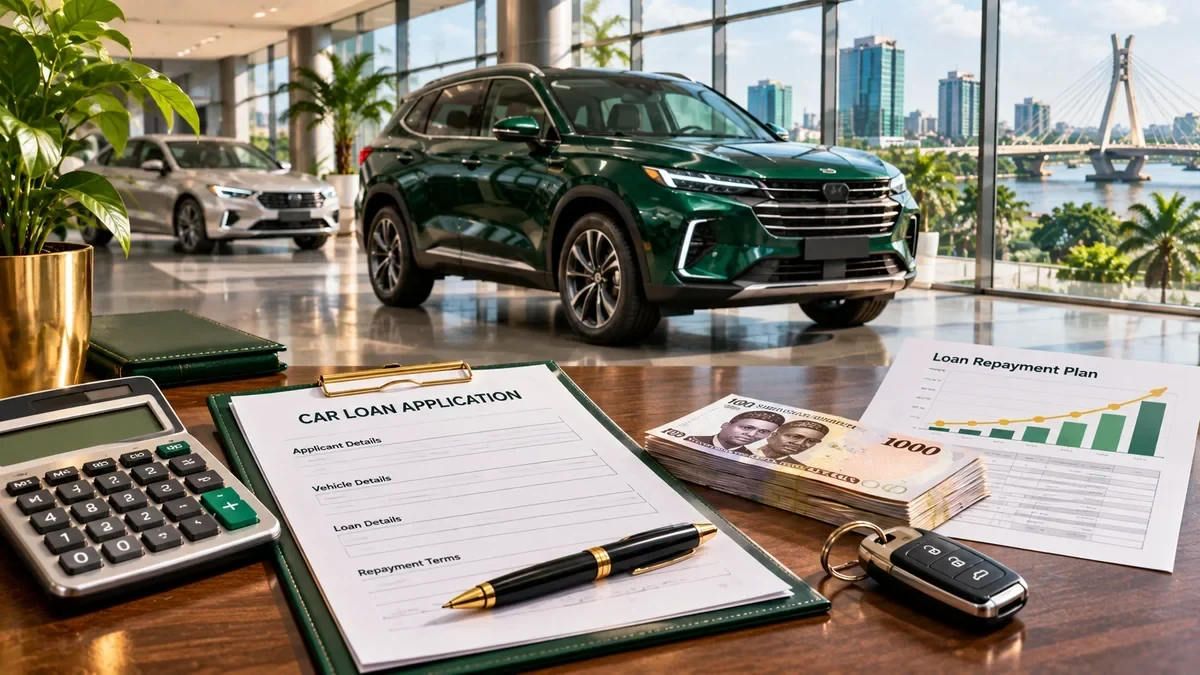
Auto financing in Nigeria allows eligible buyers to pay for a vehicle over time, but the real cost is more than the advertised interest rate. A car loan can involve an upfront equity contribution, monthly interest, compulsory insurance, registration, documentation and conditions restricting the sale of the car until repayment is complete. The right comparison is therefore not merely “Which bank has the lowest rate?” but “How much cash will leave my account from the first deposit to the final instalment?”
As of 16 November 2026, official Nigerian lender pages show materially different product terms. FCMB advertises standard auto loans starting at 33.50%, while UBA's August 2026 Mikano Motors partnership announced a 23% interest rate on its particular 36-month programme. Neither headline figure should be assumed to be the same as the all-in annual percentage rate (APR) payable by every applicant. Rates, product eligibility and fees can change; obtain a written quote before committing.
How car financing works in Nigeria
Most conventional auto loans are secured instalment arrangements. You choose an eligible vehicle, apply to a lender, make a required deposit or equity contribution and, after approval, the lender finances some of the purchase price. You repay the loan over an agreed term, often by monthly debit from your salary or business account. The vehicle usually provides security, and the lender may retain a lien or control over title documents until the financing has been settled.
For example, if a vehicle costs ₦15 million and the lender requires 20% equity, the buyer pays ₦3 million upfront and borrows ₦12 million. The ₦3 million is not the total cash required before collection: insurance, documentation or dealer charges may also fall due, depending on the agreement.
A loan is different from leasing or subscription-style access. In a lease, the financier may retain ownership and the contract might provide a purchase option, a residual payment or a required return of the vehicle. Read the specific agreement rather than assuming every “drive now, pay later” offer eventually transfers ownership automatically.
Auto financing options available in Nigeria
1. Bank vehicle finance
Commercial banks offer loans for new vehicles and, in selected programmes, approved used vehicles. The application commonly involves identity and income checks, a dealer's proforma invoice, credit assessment, an equity payment and insurance. Access Bank says its auto-loan product allows equity contributions as low as 10% and repayment up to 60 months; its published product page also mentions financing limits of up to ₦400 million for brand-new vehicles and ₦200 million for pre-owned vehicles. These are ceilings and product features, not approval promises.
2. Dealer-backed financing through a partner bank
A vehicle dealer may introduce buyers to an agreed financing partner. This can simplify vehicle verification, paperwork and disbursement, although it may restrict the cars you can choose. The UBA–Mikano Motors scheme , announced on 11 August 2026, states a 30% initial contribution, financing of 70%, a 36-month term and a headline 23% interest rate for eligible buyers. It includes self-employed applicants, subject to assessment.
3. Used-car finance and specialist intermediaries
Used-car loans can have narrower eligibility rules because vehicle age, mileage, title and resale value affect collateral risk. Stanbic IBTC lists financing for new or pre-owned cars with a minimum 10% contribution and terms up to five years; its page specifies used-vehicle age and mileage restrictions. The Nigerian Consumer Credit Corporation (CREDICORP) credit-partner directory also lists car-loan providers, including an Autochek offering sponsored by VFD Microfinance Bank with used-car tenors of six to 36 months.
Listing on an intermediary or government-backed directory does not by itself guarantee that every borrower qualifies for a subsidised rate. Verify the actual lender, regulator, pricing and loan agreement.
4. Personal loans, asset leases and non-interest arrangements
Some borrowers consider an unsecured personal loan, a business asset lease or a Sharia-compliant vehicle finance arrangement. These can differ in security requirements, ownership structure, charges and repayment method. An unsecured loan may avoid a vehicle-specific lien but can have its own higher effective borrowing costs or shorter repayment term. For the differences between secured and unsecured borrowing, see FlyingEze's comparison of secured and unsecured loans .
For a non-interest or Islamic finance product, request the full purchase price, agreed profit margin or rentals, late-payment treatment, ownership transfer provisions and total amount payable. “Non-interest” should not be read as “cost-free”.
Car loan rates in Nigeria: examples from lenders in 2026
The following terms came from official product pages and announcements reviewed on 16 November 2026. These are advertised product details, not individual approvals or verified all-in APRs. Product-specific rates can be revised, and the lender must confirm whether its advertised percentage is nominal annual reducing-balance, flat, variable or another quoted basis.
| Lender / programme | Publicly stated rate | Initial contribution | Illustrative advertised terms |
|---|---|---|---|
| FCMB Standard Auto Loan | Starting at 33.50% | From 20% | ₦500,000–₦30 million; 12–60 months; lender says insurance is included in the financing |
| UBA–Mikano Motors | 23% for this partnership | 30% | Up to 36 months; eligible new Mikano vehicles |
| Access Bank Auto Loan | Individual quotation required | As low as 10% | Up to 60 months; new and approved pre-owned vehicles |
| Stanbic IBTC Vehicle & Asset Finance | Individual quotation required | From 10% | New/pre-owned cars; up to five years; used-vehicle restrictions |
| FCMB–GAC dealer-specific promotion | 38.5%, subject to market indices | 20% for salaried; 30% for eligible self-employed applicants | Up to 60 months; selected GAC vehicles |
These figures come respectively from FCMB's standard product page , UBA's scheme announcement , Access Bank's auto-loan page , Stanbic IBTC's product page and FCMB's GAC programme FAQ . Check the offer date and request a current Key Facts Statement; never assume that two published percentages use exactly the same basis.
Understanding the interest rate: reducing balance, flat rate and APR
Reducing-balance interest
With an amortising reducing-balance loan, interest is calculated on the outstanding principal as you pay it down. If the annual nominal rate is 23% and monthly repayments are equal, the lender normally calculates the instalment using an appropriate monthly rate and the number of payments. The effective annual rate and true APR may differ from the headline nominal figure.
Flat-rate interest
A flat rate may apply the stated percentage to the original amount borrowed for each year, even though the balance reduces. A quote that says “23% flat” can therefore be considerably more expensive than “23% nominal annual rate on a reducing balance”. Always ask the calculation method.
Annual percentage rate (APR)
APR is designed to present the cost of credit in a comparable annualised format and take account of relevant fees as well as interest. The Central Bank of Nigeria's Consumer Protection Regulations require the lender to disclose the applicable APR, fees, key loan features, repayment schedule, insurance requirements, variation terms and early-liquidation provisions. They also provide for a Key Facts Statement that borrowers can use to compare offers.
Regulatory note: A separately published CBN Guide to Charges dated April 2026 was explicitly labelled an exposure draft. It should not be treated as a final enacted charging rule without confirmation of its adoption. The 2019 consumer-protection regulations and the lender's actual contract provide the sounder basis for the disclosure checklist here.
Car financing calculator: what does a ₦15 million vehicle really cost?
Consider a hypothetical car priced at ₦15 million. You provide a 20% deposit of ₦3 million and finance the remaining ₦12 million. To isolate the effect of interest, assume a fixed nominal annual rate on a reducing balance, equal monthly instalments and no fees or insurance financed into principal. These are mathematical illustrations, not quotations from FCMB or UBA.
| Assumed nominal annual rate and term | Approx. monthly repayment | Total loan repayments | Total interest |
|---|---|---|---|
| 23% reducing, 36 months | ₦464,517 | ₦16,722,600 | ₦4,722,600 |
| 30% reducing, 36 months | ₦509,419 | ₦18,339,081 | ₦6,339,081 |
| 33.5% reducing, 36 months | ₦532,694 | ₦19,176,975 | ₦7,176,975 |
| 30% reducing, 60 months | ₦388,241 | ₦23,294,445 | ₦11,294,445 |
At 23% reducing over three years, the borrower would pay about ₦19.72 million in deposit plus principal-and-interest payments, before other acquisition, insurance and running costs. At 33.5% over the same 36 months, that increases to roughly ₦22.18 million. Extending a 30% reducing-balance loan from 36 to 60 months reduces the monthly payment but increases the total interest from roughly ₦6.34 million to ₦11.29 million.
Flat-rate warning: If the same ₦12 million were instead charged at 23% flat for three years, the simple-interest calculation would be ₦12 million × 23% × 3 = ₦8.28 million in interest, or approximately ₦563,333 per month over 36 months. That contrasts with approximately ₦4.72 million in interest at an assumed 23% nominal reducing rate for the same term. The actual APR requires the lender's cash-flow and fee disclosures.
Hidden car-financing costs you need to check
Deposit and cash needed before collection
A 10%, 20% or 30% deposit is only the buyer's contribution towards the car price. Request a written breakdown of any inspection, valuation, registration, tracking, loan processing or dealer documentation required before collection. Some costs may be capitalised into the loan rather than paid in cash; either way, they matter.
Comprehensive insurance and renewal
Third-party motor insurance is compulsory in Nigeria. The National Insurance Commission has highlighted enforcement under the Nigerian Insurance Industry Reform Act 2025. However, a vehicle financier often requires comprehensive coverage to protect its security interest. This is more extensive than the legal third-party minimum.
Ask who selects the insurer, which risks are covered, whether a deductible/excess applies, if insurance is included in the repayment, and how subsequent-year premiums will be paid. “Insurance included” can mean financed, not free. Verify the insurer through NAICOM's published licensed-provider information.
Processing, documentation, valuation and tracking
Some loan offers require an arrangement or management fee, inspection of a used vehicle, credit checks, tracking hardware or proof-of-ownership registration. The amounts, who receives the payment and whether it is mandatory differ by programme. The CBN's disclosure rules require relevant lending fees and security arrangements to be stated in the credit documents. Never pay an unexpected “release” or “activation” charge to an individual claiming to represent a bank.
Vehicle registration, taxes and road documentation
Buying the car can also involve number plates, registration, proof of ownership and other licensing-related expenses. These are not always lender fees, but they still affect the cash you need. The FRSC National Vehicle Identification System provides vehicle-number-plate verification, while the FRSC Proof of Ownership portal provides an ownership-verification route. Verify genuine documents before completing payment on a used car.
Late payment, repossession and early settlement
Read the conditions for late charges, missed payments, repossession, debt collection, additional interest and early repayment. A loan secured on a car can put that car at risk if the agreement is breached. Early settlement does not always waive every fee or interest item. Ask for a written schedule showing what happens if you repay after 12 months, lose your income, or sell the vehicle while the lender's interest remains registered.
Fuel, repairs and depreciation
Loan affordability also depends on operating costs. Budget for fuel or charging, servicing, tyres, tyres replacement, parking, tolls, repairs and insurance renewals. A high-mileage used car may cost less upfront but require more maintenance, while a financed car can lose value faster than you repay its loan. Check the risk of owing more than the car could reasonably sell for.
Illustrative total-cash-cost checklist
Here is how extra costs affect the previous ₦15 million example. These supplementary amounts are hypothetical budget allowances, not published lender charges or market averages.
| Item | Illustrative cash amount |
|---|---|
| Vehicle deposit (20%) | ₦3,000,000 |
| 36 repayments at 23% nominal reducing (approx.) | ₦16,722,600 |
| Hypothetical 1% one-time processing fee on ₦12m | ₦120,000 |
| Hypothetical first-year insurance allowance | ₦450,000 |
| Hypothetical documentation/registration allowance | ₦150,000 |
| Illustrative total before later insurance and running costs | ₦20,442,600 |
If any listed fee or premium has already been included in the financed principal or repayments, do not count it twice. Likewise, later insurance premiums, maintenance, fuel and changes in variable rates are not included in the total above. Before signing, ask for the equivalent full-life calculation based on your actual offer.
Who qualifies for a car loan in Nigeria?
Each bank applies its own credit standards, but the published lender programmes commonly refer to verifiable income, an acceptable credit profile and a qualifying vehicle from an authorised or approved seller. Requirements may include:
- Valid identification, BVN and other know-your-customer information required by the lender.
- Recent salary slips, bank statements or evidence of regular business income.
- Evidence of employment or business operation and ability to meet the proposed instalments.
- A proforma invoice from the dealer, vehicle specification and, for used cars, inspection or valuation documents.
- Proof that you can pay the required equity contribution and associated costs.
- Consent for credit-bureau checks and the applicable vehicle security and insurance arrangements.
For example, Stanbic IBTC's published vehicle-finance page refers to a salary-linked bank account, proof of income and a dealer invoice, while FCMB states that salaried and regularly earning self-employed applicants can apply. These are eligibility indications, not guarantees of approval.
How to compare and apply for car financing safely
- Choose a realistic vehicle budget. Start with the all-in purchase price and include the reserve you need for repairs, registration and insurance.
- Get at least two or three genuine lender quotations. Compare bank finance, relevant dealer-partner schemes and suitable used-car products on the same principal and term.
- Ask for the Key Facts Statement and APR. Confirm whether the quoted interest is fixed or variable, flat or reducing, and which compulsory fees and insurance costs are included.
- Compare the total naira paid, not just the monthly instalment. A 60-month loan may be easier each month but substantially more expensive overall.
- Inspect the vehicle and confirm title. Obtain a reliable used-car inspection, identify liens, check accident or flood damage where possible and confirm the dealer's authority to sell.
- Stress-test your income. Ask whether the instalment remains manageable if earnings fall or fuel, repairs and insurance costs increase. Avoid committing your entire monthly surplus to the loan.
- Read the final contract and repayment schedule. Confirm late charges, repossession rights, changes in rates, insurance renewal, early liquidation and vehicle title transfer.
- Make traceable payments through verified channels. Use bank or dealer accounts confirmed independently. Retain all receipts and written communications.
What if a lender adds charges you did not agree to?
Raise a formal complaint with the institution and ask for its breakdown of the relevant APR, fees and contractual clause. Keep the signed offer letter, Key Facts Statement, instalment schedule and account statement. The CBN's complaint guidance says consumers should complain to the institution first and may escalate unresolved issues to its Consumer Protection Department, subject to the prescribed resolution timetable. For complaints about excess charges and loans, CBN's guidance refers to a period of up to 30 days for the bank's resolution process.
A complaint does not automatically suspend a loan payment or replace a legal dispute process. Continue to follow applicable terms unless you receive an agreed written variation or professional legal advice.
Frequently asked questions about car financing in Nigeria
Which Nigerian bank has the lowest car loan interest rate?
There is no reliably universal lowest rate for every borrower. Publicly disclosed 2026 examples include the 23% headline rate for UBA's specific Mikano scheme and FCMB standard auto-loan rates starting at 33.50%. Those are not necessarily directly comparable APRs, and each lender sets eligibility and product conditions.
Can I finance a fairly used car?
Yes, some banks and finance intermediaries support approved pre-owned vehicles. Used-car eligibility can depend on age, mileage, condition, seller and verification of ownership. Access Bank and Stanbic IBTC both describe used-vehicle offerings.
How much deposit is required for a car loan in Nigeria?
There is no one-size-fits-all deposit. Access Bank and Stanbic IBTC advertise qualifying contributions as low as 10%; FCMB's standard programme begins at 20%; UBA's Mikano partnership requires 30%. The approved contribution depends on the particular lender, vehicle and applicant.
Is a 23% flat car loan the same as 23% reducing-balance interest?
No. Charging a flat rate on the original principal can result in much higher total interest than applying a nominal rate to the declining outstanding principal. Request the APR and full repayment schedule to compare offers correctly.
Does the bank own the car until it is paid off?
The answer depends on the legal structure. A conventional secured car loan may allow the buyer to use the vehicle while the lender holds a security interest or controls title documents. A lease can use different ownership arrangements. Check what the agreement says about title, resale and final transfer.
Can a self-employed person apply?
Yes, several published programmes accept self-employed applicants with verifiable income. FCMB and UBA expressly mention self-employed borrowers in selected offerings. Approval still depends on credit assessment and the terms of the product.
Bottom line: borrow against a budget, not a headline rate
Car financing can help Nigerian buyers spread a large purchase, but a lower deposit should not obscure the money that remains payable. Review the APR, total repayments, equity contribution, insurance, dealer costs, vehicle security and default conditions as one package.
The safest approach is to obtain current written quotes from properly regulated lenders, verify the car and its documents, and stress-test monthly repayments against realistic household or business cash flow. A car that is affordable at the showroom can become expensive if its financing and running costs are ignored.
Research checked 16 November 2026. Product features and published rates are snapshots, not personalised offers or guarantees. Financial and legal terms should be verified with the lender before signing.



