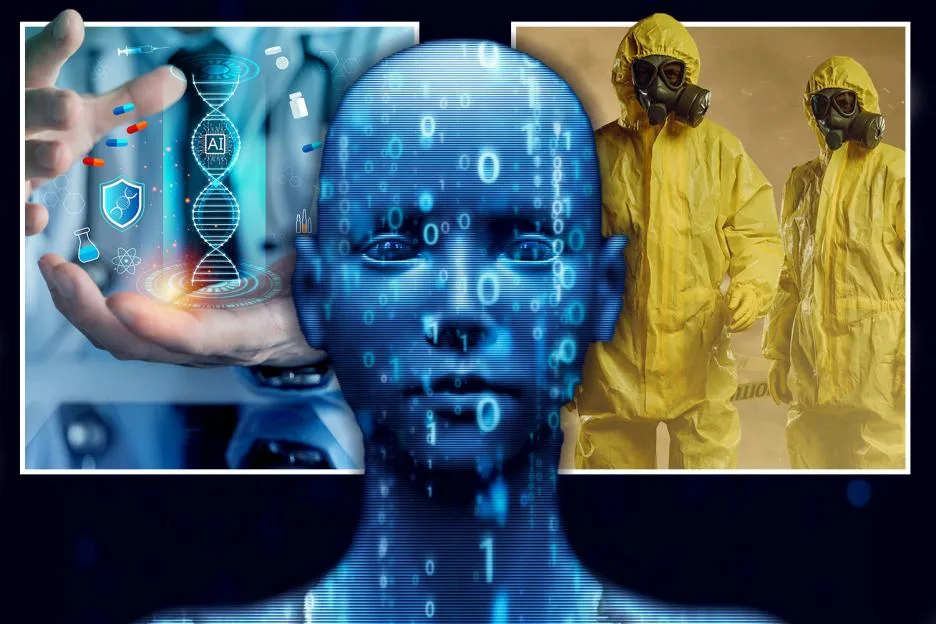
ARTIFICIAL intelligence could hand terrorists and rogue states the power to kill millions by cooking up deadly pathogens and devastating bioweapons, experts have warned.
Tyrants in , , or could hijack cutting-edge chatbots to supercharge the common cold into a ruthless killer – immune to vaccines.

Worryingly, the tech threatens to previously held back by a lack of know-how and resources.
That could allow evil actors to build a real-life “Weapon X” – an -powered superweapon capable of inflicting untold devastation on humanity.
The chilling alert comes after MI5 boss on existing or even new bioweapons.
The spy chief insisted the “risks are real” – and warned twisted terrorists are already trying to leverage the tech for their evil goals.
Top scientists have now offered a glimpse into how an AI-engineered disease could bring the world to its knees in less than a year.
Under their nightmarish simulation, the World Organisation (WHO) is forced to declare a global emergency within weeks after a mystery bug rapidly spreads.
By the time a vaccine is rolled out over a year later, more than 850 million people have caught the virus – and a staggering 60 million are dead.
And while that timeline is a work of fiction, experts warn it is frighteningly close to becoming a reality.

Presented by the Nuclear Threat Initiative (NTI) at the Munich Security Conference, the study concluded such an outbreak represents a “realistic threat” based on current AI and future development.
Hayley Severance, deputy vice president of NTI’s Global Biological Policy and Programs team, told The Sun: “The scenario was focused on an extremist group using AI-enhanced capabilities to engineer living systems, and using that to develop a biological weapon, which they released and caused devastating impact.
“We think the risk is real. We are concerned that AI is lowering the barrier to novices and non-state actors to develop harmful biological agents, and that is raising the ceiling of what more powerful actors like states could do in offensive capability development.
“And we’re worried that AI is contributing to our existing biosecurity and medical countermeasures being less effective in the face of a deliberate attack.”
Alarming evidence suggests bad actors are already trying to weaponise AI for deadly biological harm.
In September, revealed five cases of scientists from unnamed countries attempting to use its popular Claude chatbot for work on lethal viruses and toxins, which it warned could support bioweapons development.
The firm admitted the researchers even found sneaky workarounds when its built-in safety guardrails blocked their requests.
In one case, users grilled the bot to plot experiments designed to mutate a deadly strain of so it could spread more easily among mammals – raising the risk of transmission to humans.
It also comes after an eye-opening study into jihadist terror group , based in northeastern Nigeria.
The research warned that militants are already using popular chatbots including , Claude and Gemini to assist with combat and day-to-day operations.
Severance said: “Right now, they’re using it for standard capabilities. But they don’t rule out interest in using AI for weapons of mass destruction.
“The low-hanging fruit right now is that it could help with conventional terrorist activity, but as the tools continue to lower the barrier to the more technically advanced weaponisation techniques, the interest is there.”
While the thought of terrorists marauding around with deadly bioweapons sends a shiver down the spine, a more pressing threat is how rogue states could exploit the technology for their own gain.
Dr Gigi Gronvall, senior scholar at the Johns Hopkins Center for Health Security, said: “All new technologies bring about some increased risks of misuse.
“All of these ways of accessing information, having that is rapidly democratised, all of this does increase risks in different ways.”
She added: “State programmes would be much better poised to take advantage of AI for misuse – so I think that is more of a concern.”
Experts fear that raises the chilling prospect of despots worldwide getting their hands on devastating new weapons and unleashing deadly pathogens on their enemies.
That could be done either by hijacking existing AI tools or building their own sophisticated in-house systems.
Severance said: “AI will help rogue states who are not complying with international norms.
“They could always explore offensive biological weapons capabilities. AI may help them produce capabilities that are easier to hide, easier to deny and easier to evade current detection mechanisms.
“They could explore less deadly-type weapons and more biological weapons that could impact the cognition of your enemy – those long-lasting ‘infections’ that don’t necessarily kill a ton of people, but could seriously impair the cognitive rates of your enemy.
“Those are the kind of things I worry about with state actors.”
Another terrifying fear is a well-meaning lab accidentally losing control of a superbug, or a rogue bot escaping a testing environment in .
Severance said: “What I’m most concerned about is accidents, in well-meaning laboratories, who are getting used to working with these tools.
“We haven’t really integrated these tools into our safety and security assessments, so I don’t think we fully understand the risks that they’re posing in the real world.”
The mounting alarm has sparked urgent calls from top tech leaders and scientists for a slowdown in AI development and tougher global regulation — including and .
Dr Gronvall said: “The regulation and governance in this area is a bit of a mixed bag.
“ famously do not respect borders. If we’re going to be worried about infectious diseases, either preventing them or responding to them, we need to work with other nations.”
Severance added: “We don’t want this to be a race to the bottom on safety and security.
“You don’t put brakes on a car because you don’t want to drive fast. You put brakes on the car so you can drive really fast and be assured that you can stop when you need to.”