
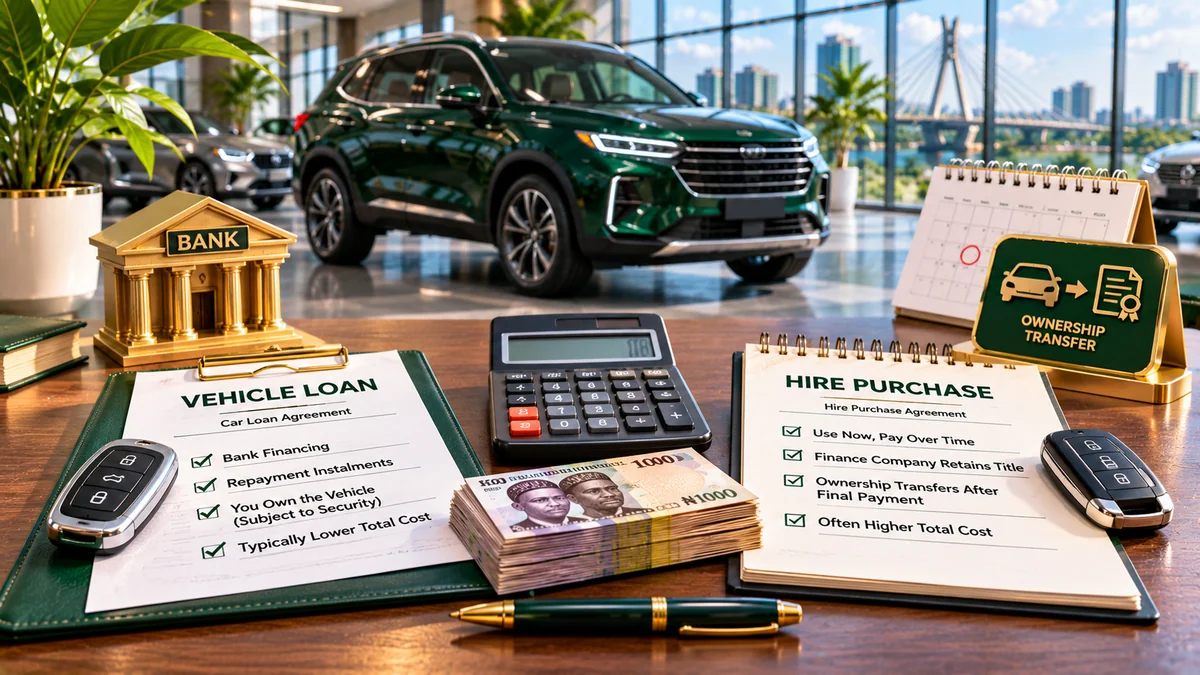
A vehicle loan and a hire-purchase agreement can both put a car on the road before you pay its full price, but they are not legally identical. Under a conventional secured car loan, the buyer generally acquires the vehicle subject to the lender's security interest and remains liable for the loan. In a genuine hire-purchase arrangement, the owner retains title while the hirer uses the vehicle and may acquire ownership after satisfying the agreed purchase conditions. The precise contract—not the “drive now, pay later” slogan—determines your position.
For Nigerian buyers, the choice affects ownership, the consequences of missed payments, the right to terminate, insurance responsibilities and the total cost of financing. Nigeria's Hire-Purchase Act (Cap H4, Laws of the Federation 2004) includes specific rights for motor-vehicle hire-purchase agreements, while secured bank loans may involve the Secured Transactions in Movable Assets Act 2017 and the Central Bank of Nigeria's Consumer Protection Regulations .
This guide explains those differences, shows a worked naira comparison and identifies contract questions to ask before signing. The legal and product information was checked on 16 November 2026. Financing conditions and rates may change, and individual agreements can differ substantially.
Vehicle loan vs hire purchase in Nigeria: the quick comparison
| Issue | Secured vehicle loan | Hire purchase |
|---|---|---|
| What you obtain initially | Financing to buy the car; buyer typically holds ownership subject to security | Possession and use; owner retains legal title until purchase conditions are satisfied |
| Who is owed payments? | Bank or other lender | Owner, dealer or finance provider under the HP agreement |
| Document to examine | Loan offer, security agreement, repayment schedule | Signed HP memorandum showing cash price, HP price, deposit and instalments |
| Cost comparison | Compare total repayments, fees and APR where applicable | Compare deposit, every instalment, fees, option payment and total HP price |
| During default | Secured creditor's enforcement rights depend on applicable law and security agreement | Hire-Purchase Act protections, including the motor-vehicle three-fifths threshold, may apply |
| Ending the deal early | Request the full early-settlement amount; return of the car does not automatically cancel debt | Statutory right of written termination before the final payment falls due, with possible liabilities |
| End of payments | Seek release of the lender's security and any documents held | Complete the contractual purchase option and obtain transfer of legal ownership |
These describe the typical legal structures, not every product bearing a similar marketing name. Some banks finance cars using hire-purchase or lease structures, and a dealer might offer credit sales rather than genuine hire purchase. Ask the provider to identify the actual transaction type.
How a vehicle loan works
A standard car loan advances money or finances the agreed vehicle purchase price. The borrower generally pays a deposit, signs a credit contract and repays principal plus interest over a specified term. Because the vehicle supports repayment, the lender may take and register a security interest, hold documentation or impose restrictions on selling or transferring the car until discharge.
The National Collateral Registry explains that secured finance allows borrowers to keep using movable assets even while they are pledged. Under a conventional secured loan, possession does not mean the debt has been repaid, and ownership or registration records alone do not prove the vehicle is free of a lien.
Current lender pages illustrate how these products operate. Access Bank's Auto Loan advertises equity contributions as low as 10% and repayments up to 60 months, for eligible customers and vehicles. Stanbic IBTC's Vehicle and Asset Finance describes new and approved used-car finance, a 10% asset-value equity contribution and terms of up to five years. These are advertised features, not automatic approval or a guaranteed rate. Get the current individual price and written contract.
What does ownership mean while the car is financed?
It is safer to distinguish legal title, registration, possession and security. A buyer may hold title or registration documents while a bank still has a legally enforceable interest in the car. Conversely, some lender agreements place title in a nominee or use a lease-type structure. Read the offer and security documentation: the words “car loan” alone do not settle that question.
How hire purchase works
In a genuine hire-purchase arrangement, the customer—the hirer—receives the car and pays a deposit and instalments while the financing owner retains ownership. Subject to the agreement, the hirer obtains the option to purchase the car, often upon making the final payment and meeting any other stated requirements.
Section 1 of the Nigerian Hire-Purchase Act covers hire-purchase and credit-sale agreements involving motor vehicles regardless of the vehicle's purchase price. Section 2 sets important contract requirements, including prior disclosure of the cash price and a signed agreement with the hire-purchase price, instalment amounts and dates, deposit, true interest rate and sufficient identification of the car. It also requires the prescribed notice and generally a copy of the memorandum within 14 days, subject to the Act's specified judicial dispensation provisions.
A dealer who says “pay weekly and the car is yours later” may be describing hire purchase—but the terms must be examined. A fixed-term vehicle rental without a purchase option, a conditional sale or an ordinary secured credit agreement can involve different legal consequences. The label used by a sales agent does not override the substance of the written contract.
The most important legal difference: termination and repossession
Hire-purchase termination before the last instalment
Section 8 of the Hire-Purchase Act allows the hirer to terminate the agreement by written notice before the final instalment falls due. That does not mean a hirer can return a damaged car and walk away owing nothing. The section provides for accrued liability, a possible additional payment bringing the relevant total to one-half of the hire-purchase price (or a lower contractual amount), damage resulting from failure to take reasonable care, and return of the vehicle. The exact settlement depends on what has already been paid and fallen due.
This statutory termination mechanism differs from a conventional loan: selling or handing a financed car back to the bank does not by itself release the borrower from any shortfall on the loan.
The three-fifths rule for motor-vehicle hire purchase
Section 9(1) and (4) of the Hire-Purchase Act create a key protection. Once three-fifths (60%) of the hire-purchase price of a motor vehicle has been paid or tendered, the owner generally cannot enforce recovery of the car except through a court action, subject to the Act's exceptions. This threshold concerns the agreed hire-purchase price, not necessarily 60% of the dealer's cash price or 60% of the car loan's original principal.
There is an important caveat in section 9(5): if three or more instalments are due and unpaid, the owner may remove the motor vehicle to premises under the owner's control to protect it from damage or depreciation while an action is determined; the owner may be liable for loss or damage caused by that removal. Do not describe the three-fifths rule as absolute immunity from any vehicle movement or from court proceedings.
Default on a secured car loan
A bank's recovery rights under an applicable secured-loan structure are not simply governed by that hire-purchase three-fifths threshold. Under section 40 of the Secured Transactions in Movable Assets Act 2017, a creditor enforcing security under that Act must give notice of default and intention to repossess. The statute permits possession after 10 days from sending that notice and provides for judicial repossession or, where the security agreement authorises it, certain nonjudicial repossession procedures. Other relevant laws and contractual protections may also apply.
Practical takeaway: Neither a bank nor a hire-purchase company should be assumed to have unlimited power to seize a car whenever an instalment is late. Equally, neither arrangement makes it safe to ignore a default notice. Read the applicable contract, seek a statement of account and obtain legal advice promptly if repossession is threatened.
Worked comparison: a ₦15 million car under each arrangement
To make the alternatives easier to understand, imagine two hypothetical offers for the same ₦15 million vehicle. Both require a 20% initial cash contribution (₦3 million), and both run for 36 months. These are calculations for education, not 2026 quotes from any named Nigerian bank or dealer. Assume no insurance, registration or maintenance costs are included in either model.
Option A: secured vehicle loan
The bank advances ₦12 million at an assumed fixed 24% nominal annual interest rate on a reducing balance. With equal monthly payments for 36 months, the approximate repayment is ₦470,794, the total loan repayments are ₦16,948,592 and loan interest is ₦4,948,592. Adding the ₦3 million deposit gives a total cash outlay of approximately ₦19,948,592, before other charges.
Option B: hire purchase
The owner sets an illustrative contractual schedule of ₦3 million upfront, then 36 monthly instalments of ₦520,000, plus a final ₦100,000 purchase-option/transfer amount. That means ₦18,720,000 in instalments and a total cash outlay of ₦21,820,000. No APR or nominal rate is implied by this hypothetical HP schedule; a proper annualised financing-cost comparison would require the timing and structure of all payments.
| Cost item | Illustrative bank loan | Illustrative hire purchase |
|---|---|---|
| Vehicle cash price | ₦15,000,000 | ₦15,000,000 |
| Upfront contribution | ₦3,000,000 | ₦3,000,000 |
| Monthly payment (36 months) | ≈₦470,794 | ₦520,000 |
| Total instalment / loan payments | ≈₦16,948,592 | ₦18,720,000 |
| Additional purchase-option fee | None assumed | ₦100,000 |
| Total cash paid | ≈₦19,948,592 | ₦21,820,000 |
| Extra amount above cash price | ≈₦4,948,592 | ₦6,820,000 |
In this particular invented example, hire purchase costs approximately ₦1.87 million more. That is not evidence that all hire-purchase plans cost more than vehicle loans: different lenders can reverse the result. A lease may also include a substantial residual or balloon payment; assess it separately. Real offers should include a full written breakdown of fees, insurance and any optional final transfer charge.
Why the smallest monthly payment is not always best
A lower payment can hide a longer term, a large final balance or a flat-rate calculation. Before comparing, use the same vehicle cash price, same deposit, similar payment dates and the complete amount payable to own the car. The effective cost of a loan may be different from its advertised rate. FlyingEze's guide to secured versus unsecured loans provides additional context on how collateral changes the borrowing risk.
Which arrangement fits different Nigerian buyers?
Salaried workers seeking predictable payments
A properly priced bank vehicle loan may work for someone with stable, verifiable earnings who wants a fixed repayment schedule and clearly documented security and ownership arrangements. Check eligibility, employment continuity, insurance renewals and your ability to pay if your earnings change. Do not assume a five-year term is cheaper just because the monthly debit is lower.
Self-employed buyers with variable cash flow
Neither arrangement is automatically safer for variable earners. Some providers consider bank statements, tax returns and business earnings; others may demand guarantors, a larger deposit or shorter repayment terms. Hire purchase can be accessible through a dealer or commercial-vehicle operator, but frequent instalments may create extra pressure when client receipts are irregular. Assess repayment flexibility from the actual written contract.
Ride-hailing and commercial vehicle operators
For anyone planning to use the car for ride-hailing, logistics, delivery or other commercial work, disclose that use before signing. A personal-use finance policy or private-motor insurance may not cover commercial operation. Model net income after fuel, service, repairs, insurance, platform fees, licence requirements and unexpected time off the road; gross daily takings cannot safely be treated as cash available for instalments.
People expecting to sell or upgrade the car soon
Ask how title will be transferred and how much early settlement will cost. A buyer with a secured bank loan may need a formal release of lien before selling. A hirer generally cannot sell a vehicle as owner before the purchase right has been completed. If resale flexibility is important, the early-exit terms may matter more than a small difference in monthly payment.
Hidden costs and contract terms buyers should compare
Whether you choose a vehicle loan or hire purchase, request a written itemisation of:
- Deposit and true cash price: Compare what the same vehicle would cost without financing, including any dealer markup.
- Interest and full financing price: Determine whether a rate is flat, reducing-balance, fixed or variable; ask the bank for its APR and Key Facts Statement.
- Insurance and registration: Confirm who buys and renews coverage, what use is permitted, the insured value, excess, registration and transfer charges.
- Security and ownership: Identify title holder, any registered lien or tracker, and how to obtain release or transfer documents after payment.
- Late charges and missed-payment procedure: Ask for the actual default timeline, notice terms, cost of collection or repossession, and what happens after the car is recovered.
- Early repayment or termination: For loans, get an early-liquidation quote; for hire purchase, review the statute, the termination clause and all sums payable on exit.
- Final or balloon payment: Check whether the advertised monthly payments leave a large balance or separate purchase fee outstanding.
For institutions regulated by the CBN, its 2019 Consumer Protection Regulations require pre-contract disclosure of features, risks and charges; a Key Facts Statement for consumer loans; and contract disclosure of the APR, repayment schedule, early-liquidation terms and total cost of credit. A private hire-purchase merchant is not necessarily regulated under the same bank-loan requirements, so examine both the applicable Hire-Purchase Act obligations and any other consumer law.
Checklist: documents to request before signing
- Written quotation: Vehicle make, model, year, VIN/chassis number, cash selling price and all taxes or dealer charges.
- Ownership statement: Legal title holder during the agreement; registration documents; whether a lender's security is registered.
- Payment schedule: Deposit, due dates, amounts, full financed or hire-purchase price, and any balloon or option fee.
- Credit disclosures: APR and Key Facts Statement for regulated bank lending; hire-purchase memorandum and statutory notices where the Act applies.
- Vehicle inspection: Independent condition report and checks for prior encumbrances, accident damage, mileage issues or disputed title.
- Insurance confirmation: Named insurer, type of permitted use, cover, premium renewal and claim payout arrangements.
- Default and exit rules: Written notice procedures, repossession provisions, termination costs and after-sale treatment of any remaining balance.
- Receipts and document delivery: Keep signed documents, payment proof and a dated copy of all terms; do not send your deposit to an unverified personal account.
What happens if you miss payments?
Act early. Contact the provider in writing, request the precise arrears and settlement figure, and discuss an authorised restructuring before the situation escalates. Keep evidence of all payments and promises. Do not hide or dispose of a financed vehicle; doing so may create additional legal problems.
In a hire-purchase dispute, check whether the three-fifths statutory threshold has been met, whether three or more instalments are due and unpaid, and whether the proposed action is consistent with sections 8 and 9 of the Hire-Purchase Act. The correct response depends on the actual payment history and contract.
For a regulated bank loan, begin with the bank's complaints channel and retain a complaint reference. The CBN complaint-lodgement guidance describes escalation to the CBN for unresolved complaints after the relevant bank-resolution period; for complaints about loans or excess charges it identifies up to 30 days. A dispute does not automatically suspend the payment obligations.
Frequently asked questions
Is a hire-purchase car legally mine before I finish paying?
In a genuine hire-purchase structure, the financing owner generally retains legal ownership while you use the vehicle, and title transfers when you validly exercise or complete the purchase option. Check the precise terms and any proof-of-ownership documentation.
Can a lender repossess a financed car after one missed payment?
There is no universal rule covering every product. The rights and required steps depend on the contract and governing law. Motor-vehicle hire purchase has specific protections in section 9 of the Hire-Purchase Act; secured loans may be governed by different notice and enforcement provisions.
What does the three-fifths hire-purchase rule mean?
Once 60% of the agreed motor-vehicle hire-purchase price has been paid or tendered, the owner generally must bring a court action to recover the car, subject to section 9's exceptions, including protective removal where three or more instalments are overdue.
Can I return a hire-purchase car instead of making more payments?
Section 8 provides a right to terminate by written notice before the final instalment becomes due. You must return the vehicle and may still owe arrears, a statutory balancing payment and damages for failure to take reasonable care. Do not assume handing back the keys settles every liability.
Which is cheaper in Nigeria: a bank loan or hire purchase?
Neither is always cheaper. Calculate each option's deposit plus all instalments, fees, insurance and any final purchase payment on comparable terms. Ask a bank for its APR; compare genuine written offers rather than headline monthly payments.
Do I need to register the car in my name?
Registration and legal title are related but separate issues. Ask the provider who is recorded as the owner, whether there is a security interest and what transfer or lien-release procedure applies when financing ends.
The bottom line
A vehicle loan may suit a buyer seeking conventional financed ownership subject to lender security; hire purchase may suit a buyer comfortable using a car while the owner retains title until the purchase conditions are met. Neither structure is inherently cheaper or risk-free.
For Nigerian buyers, the most important questions are: Who owns the car now? What is the total price to become its unencumbered owner? What happens if I miss payments? How do I exit? Compare those answers in writing, not just the size of the deposit or the sales agent's promised monthly payment.
Editorial note: Legal provisions and official lender pages were reviewed on 16 November 2026. This article provides general financial and legal information, not individual advice. Consult a qualified Nigerian lawyer before acting on an actual repossession or contested ownership dispute.



