
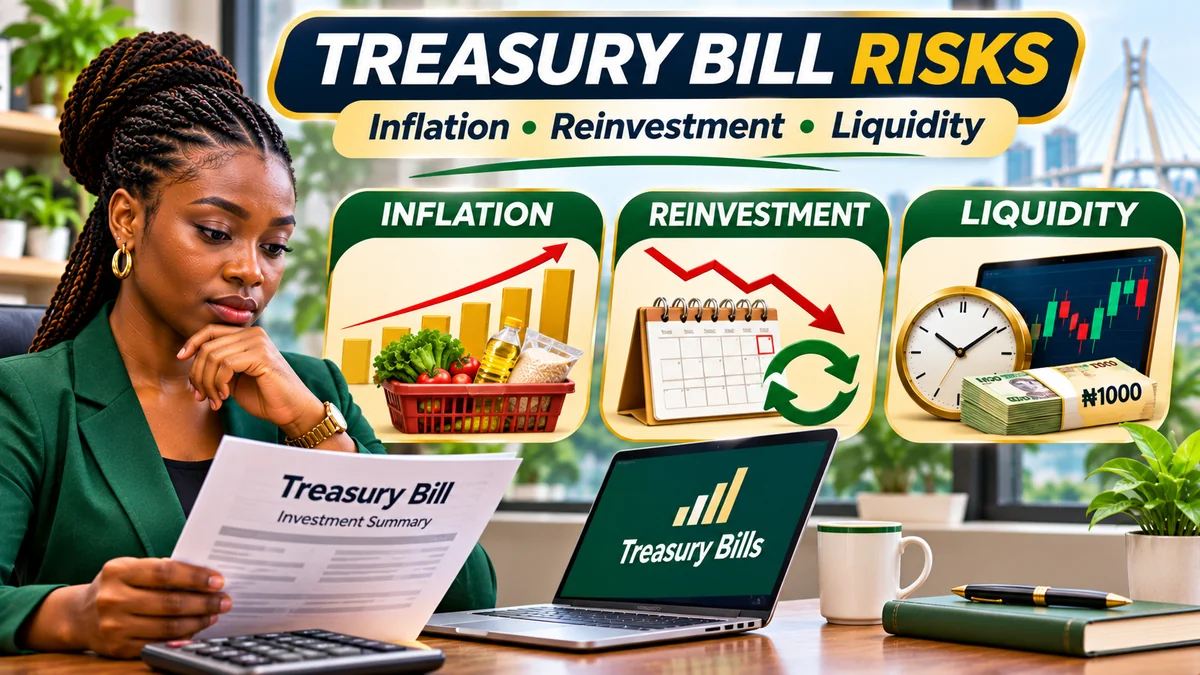
Nigerian Treasury bills are generally considered lower-credit-risk investments, but they are not risk-free: inflation can erode the buying power of your return, reinvestment rates may fall when a bill matures, and selling early can mean accepting a loss or a poor price. The short maturities and Federal Government backing make them useful for some savings goals, but those features do not eliminate every financial risk.
For readers searching for someone to explain treasury bills, it helps to separate three questions: Will the government repay the face value when due? What will that naira amount be worth when I need it? And can I obtain cash early without sacrificing the expected return? The first is about credit and maturity, the second about inflation, and the third about liquidity and market prices.
This guide uses CBN information, Nigerian market reporting and clearly identified hypothetical examples to show how each risk operates. It also explains interest-rate movements, dealer fees, taxes, investment ladders and the checks to make before buying. Research checked: 16 November 2026. This is general financial education, not individual investment advice.
What is a Nigerian Treasury bill—and why does it still carry risk?
A Nigerian Treasury Bill (NTB) is a short-term Federal Government debt security issued through the Central Bank of Nigeria (CBN), commonly with a new-issue maturity of 91, 182 or 364 days. It is typically purchased at a discount to its face value and is scheduled to repay that face value when it matures. The difference between the purchase price and maturity repayment is the gross gain before applicable costs and taxes. The CBN's government-securities FAQ describes these terms and notes that previously issued bills can be sold in a secondary market.
For example, an investor might pay ₦950,000 to acquire a bill with a face value of ₦1,000,000. If the bill is held until maturity and the government pays as scheduled, the nominal gross gain is ₦50,000. This is an invented example, not a live auction quote; the actual holding period, price, taxes and fees determine the investor's return.
Government backing reduces the type of credit risk associated with many private borrowers. However, the amount of naira you receive, what it can buy, and whether you can sell the security at a favourable price before maturity remain different questions. This article focuses on the risks that are most easily overlooked when a product is described simply as “safe”.
The main Treasury bill risks at a glance
| Risk | How it affects you | Practical response |
|---|---|---|
| Inflation | Your proceeds may buy less than expected even after earning a nominal gain | Compare the after-tax holding-period return with price increases over the same period |
| Reinvestment | A matured 91- or 182-day bill may have to be replaced at a lower rate | Match maturities to your goals; consider staggered maturities where suitable |
| Liquidity | You may need cash before maturity but receive an unattractive dealer quote | Keep accessible emergency money and check secondary-market terms |
| Interest-rate / price | Higher prevailing yields can reduce an existing bill's resale price | Understand what an early sale would pay, not just the redemption amount |
| Tax and charges | Withholding tax, spreads and fees reduce the amount you keep | Request a written, net-of-costs illustration |
| Intermediary and operational | Record errors, payment problems or an unverified seller can complicate access | Use independently verified institutions and retain trade confirmations |
| Sovereign and currency | Government or policy disruptions, and naira depreciation for foreign-currency goals, can affect outcomes | Understand the issuer and match investment currency to future spending needs |
The risks are connected. A lower-than-expected reinvestment rate may become especially painful when inflation remains elevated, while a cash emergency can force a sale just as market yields rise.
Risk 1: Inflation can turn a positive naira gain into a real loss
Inflation risk means the prices of goods and services rise enough to reduce what your investment proceeds can purchase. A Treasury bill can repay its full face value while your shopping basket, rent, building materials or school costs become more expensive.
It is important to distinguish a nominal return from a real return. The nominal return measures how much naira your investment grows. The real return adjusts that gain for inflation during the same period. For a simplified comparison, the real-return formula is:
Real return = (1 + holding-period nominal return) ÷ (1 + inflation over the same period) − 1.
Worked example: ₦1 million grows but loses purchasing power
Assume, purely for illustration, that an investment begins with ₦1,000,000, earns a 15% nominal return over one year and ends with ₦1,150,000. Assume consumer prices rise by 20% over that same year. These figures are hypothetical and are not current Nigerian Treasury bill rates or inflation data.
| Measure | Illustrative result |
|---|---|
| Starting money | ₦1,000,000 |
| Nominal one-year return | 15% |
| Ending nominal value | ₦1,150,000 |
| Price of a ₦1m basket after 20% inflation | ₦1,200,000 |
| Real return | About −4.17% |
In that example, you have ₦150,000 more than you started with, but you are ₦50,000 short of buying the same representative basket. That is a purchasing-power loss, not a failure by the government to pay its debt. The exact inflation affecting your own planned expense may differ substantially from a national CPI estimate.
If applicable tax and fees reduce the nominal 15% gain to an illustrative 13.5% before other charges, the real return with 20% inflation falls to about −5.42%. This second calculation assumes a simple 10% deduction from the interest component solely to demonstrate the arithmetic; it is not personalised tax advice or a claim about the timing of every deduction.
For context on why Nigerians may face persistently high living costs even as a reported inflation rate moderates, read FlyingEze's guide to falling inflation versus rising everyday prices . A slower increase in prices still means costs can be rising.
How should a beginner compare Treasury bill yields with inflation?
Use a comparable time frame and a comparable return measure. A CBN auction table may quote an annualised discount or marginal rate, while your bill may mature in only 91 days. Do not compare a one-year inflation figure directly with a three-month cash gain and declare one superior without adjusting the periods.
First obtain the security's actual purchase price, face value and number of days remaining. Work out the holding-period return using the amount invested, then account for dealer fees and applicable tax. Compare the resulting return with inflation over that holding period, or use consistent annualised assumptions for both measures.
The CBN's government-securities table showed marginal rates of 15.40%, 15.79% and 15.80% for its 91-, 182- and 364-day NTB auction on 28 October 2026. Those are dated auction discount rates, not promises of a retail investor's annualised net yield, and cannot alone determine whether the purchaser will beat future inflation.
For an exact financial goal—such as paying ₦1.5 million in school fees in six months—the most useful comparison may be the amount you actually expect to receive on the due date versus the likely amount needed then. A “high” nominal rate can still be inadequate when your actual future expense increases faster.
Risk 2: Reinvestment rates can fall before your goal is reached
Reinvestment risk means money returned when a Treasury bill matures may only be investable at a less attractive rate. It matters most when you repeatedly buy short-duration bills to fund a longer-term goal.
Imagine starting with a 91-day security because its quoted annualised rate looks attractive. Three months later, the bill matures. To keep earning, you must choose another product at the rate available at that future time, not the rate published at your original purchase.
If interest rates fall as the CBN adjusts monetary policy, or if demand for bills increases and the government accepts lower stop rates, your new investment may earn less. CBN's 2026 monetary-policy decisions show that policy settings can change: the Monetary Policy Rate was reset to 23% at the September 2026 meeting, from 26.5% at the July meeting. Treasury bill yields do not mechanically match the policy rate, but changes in policy and market expectations can influence future investment opportunities.
Worked example: rolling over a six-month investment
Consider a simplified one-year plan beginning with ₦1,000,000. Suppose the money earns a 9% return during the first six-month period, then you reinvest the proceeds for another six months. Again, these are hypothetical six-month holding-period returns, not quoted annual discount rates on actual NTBs.
| Scenario | First six months | Second six months | Ending balance before costs |
|---|---|---|---|
| Rates remain attractive | +9% | +9% | ₦1,188,100 |
| Reinvestment rate falls | +9% | +5% | ₦1,144,500 |
In the lower-reinvestment scenario, the ending balance is ₦43,600 less than if the second six-month period had also earned 9%. Nothing failed to repay; the return on the next investment was simply lower.
Shorter tenors create more frequent opportunities to reassess your money, but they also create more frequent exposure to whatever yields the market offers next. Longer available maturities reduce the number of reinvestment decisions before their maturity but may create more early-sale price sensitivity if you unexpectedly need the cash.
Can a Treasury bill ladder help?
A maturity ladder spreads eligible investments over different maturity dates instead of putting all the money into one bill ending on the same day. For example, an investor with enough capital and appropriate dealer access could divide part of an investment allocation across 91-, 182- and 364-day maturities.
As each bill matures, the investor can use the proceeds for a known expense, keep cash accessible or consider another investment based on the rates then available. A ladder can reduce reliance on one reinvestment date and help align cash with planned expenses.
It cannot guarantee higher returns. If yields fall broadly, the proceeds from every maturing rung may face the same lower-rate environment. A ladder also does not eliminate inflation or protect an investor forced to sell the longest-dated bill early. Retail minimums and transaction charges may make a multi-rung approach impractical for smaller budgets.
A sensible ladder starts with the timing of expenses, not an arbitrary promise to split money equally into three maturities. A bill that matures after your school-fee deadline does not solve that deadline merely because it sits in a diversified ladder.
Risk 3: Treasury bills may be tradable without being instantly liquid at a good price
Liquidity risk concerns the ability to convert an investment into cash promptly and at an acceptable price. The CBN's FAQ confirms that Treasury bills trade in a secondary market through institutions such as banks, discount houses and brokers. That provides an exit route; it does not mean a Treasury bill works like an ordinary bank account with unrestricted withdrawals at face value.
To sell early, you need a buyer or dealer willing to quote a price for the bill's remaining life. That price reflects market rates, demand for the specific maturity, trading conditions and the provider's spread or charges. If you urgently need money, you may have to accept a less favourable quote than you expected.
Nigerian policymakers and market participants were discussing improvements to domestic debt-market liquidity in 2026. BusinessDay's 22 October 2026 report describes why a functioning secondary market and transparent pricing matter to investors who need to sell government securities before their due dates. Having a secondary market is valuable; the selling price remains important.
Early-sale example: a bill that would have made a profit at maturity
Suppose you buy a bill with ₦1,000,000 face value for ₦950,000. If held to maturity and repaid as scheduled, the expected gross nominal gain is ₦50,000, before applicable tax and fees.
Now suppose an unexpected medical or business expense forces you to sell early. Your dealer offers an illustrative ₦940,000 net sale price before any extra fees, reflecting the market quote and conditions at that time.
| Path | Cash received | Difference from original purchase cost |
|---|---|---|
| Hold to maturity, assuming repayment | ₦1,000,000 | +₦50,000 gross |
| Sell early at illustrative quote | ₦940,000 | −₦10,000 before extra costs |
The early-sale price is hypothetical; it is not a claim that a particular market bill traded for that amount. The lesson is that holding to maturity and selling before maturity are financially different transactions. A bill's planned maturity proceeds do not guarantee that a dealer will purchase it early at a price that preserves your principal or expected gain.
Why rising market yields can reduce the price of an existing bill
A basic fixed-income principle is that prices and required yields move in opposite directions, all else equal. If investors can buy newly issued bills offering higher yields, an existing bill with a fixed future payment generally needs a lower resale price to compete.
A simplified zero-coupon pricing illustration is:
Price ≈ Face value ÷ [1 + (required annual yield × remaining days ÷ 365)].
This formula is a teaching model using a simple money-market yield convention; an actual NTB trade may use a different dealer quotation convention and settlement basis. Its purpose is to explain the direction of price movements, not quote an executable price.
As the required yield rises, the denominator grows and the estimated price falls. When the required yield declines, the reverse generally happens. The remaining number of days also matters: longer remaining maturities usually have greater sensitivity to a rate change than bills very close to maturity.
That is the link between interest-rate risk and liquidity risk. If you can hold a properly issued bill to its scheduled repayment, market-price fluctuations may never require you to realise a sale loss. If you must exit, the market price becomes decisive.
Bid–ask spreads, fees and delays can make early exits more expensive
Even when a secondary buyer is available, the bid price a dealer offers to buy from you may be below the ask price at which it would sell the same bill. The gap helps cover dealing costs and market risk. Spreads can vary with market conditions, issue size and the institution involved.
Ask for the net cash settlement amount, including any brokerage, custody, transaction and tax costs. A quoted annualised yield by itself does not tell you what will arrive in your bank account.
For a concrete example of provider-specific charges, Stanbic IBTC's published Treasury bill terms list a transaction charge, custody fees and VAT on specified fees, subject to its product rules. They also describe a ₦100,000 secondary-market minimum and a much higher primary-auction amount. Those terms should not be assumed to apply to all banks or investing apps.
A secondary-market sale also involves settlement procedures. It should not be described as guaranteed instant cash availability merely because a product page uses the word liquid.
What about sovereign credit risk, naira depreciation and fraud?
The Federal Government backs NTBs, so their credit risk is generally lower than that of many private borrowers. But describing any investment as completely risk-free is misleading: sovereign repayment depends on government obligations being met, and investors still depend on functional legal, payment and settlement systems.
Currency risk matters particularly when the goal is priced in dollars or another foreign currency. A naira Treasury bill may grow in naira terms while a university fee, imported machine or overseas obligation becomes more expensive if the naira weakens. A nominal naira gain is not the same as a guaranteed dollar-denominated gain.
Intermediary risk arises when a bank, broker, platform or representative fails to execute, record or settle a transaction correctly. Keep evidence of ownership, purchase price, maturity and payment instructions. Use the SEC registered-operator directory
Beware of anyone claiming to guarantee Treasury bill allotment, an unrealistically high fixed return, or special CBN access through an unofficial link. FlyingEze has previously reported on CBN warnings about fake emails and links used to compromise bank accounts . Do not share OTPs or send payment to an unknown agent solely because a message mentions the CBN.
Taxes can turn a borderline real return into a weaker one
Net returns matter more than attractive headline rates. On 1 July 2025, Nigeria's SEC published a circular addressing the expiry of an earlier tax exemption for certain short-term securities. In October 2025, the tax authority directed financial institutions to withhold 10% on interest income from specified short-term securities including Treasury bills, as Reuters reported .
The deduction concerns the applicable income, not an automatic 10% charge on the entire principal or face value. Whether withholding is creditable or final, and exactly when it is applied, depends on the relevant law, recipient and transaction. Tax rules can change, so confirm the current treatment and ask the dealer for a written calculation.
Consider a simple hypothetical: a ₦100,000 investment yields ₦12,000 in gross income. A 10% deduction on that income is ₦1,200, leaving ₦10,800 of that income before other costs, if that withholding applies. The effective net return is lower than the gross return, which makes it harder to preserve purchasing power when inflation is high.
BusinessDay reported in January 2026 that declining fixed-income yields were increasing the significance of the tax deduction for investors. For a meaningful comparison, use the tax and fee treatment of your instrument rather than assuming all government securities or fixed deposits are taxed alike.
How to choose a Treasury bill tenor when risks matter
No tenor is inherently best for everybody. A 91-day bill may help with a near-term goal and reduce the chance of being forced to sell early. But if you intend to invest for a year, it exposes you to more reinvestment decisions. A 364-day bill may allow you to hold an agreed repayment until a later date, but the price can be more sensitive if you need to sell after only a few weeks.
| Goal or situation | Risk consideration | Question to ask |
|---|---|---|
| Money needed in about three months | Early-sale risk if maturity is too late | Will the security mature before the payment deadline? |
| Business reserve that may be needed any day | Liquidity and timing risk | Should part remain accessible rather than be invested? |
| One-year goal funded through repeated 91-day bills | Several reinvestment decisions | What if later bills offer much lower yields? |
| Future overseas expense | Exchange-rate exposure | Will a naira return protect the foreign-currency amount needed? |
| Investor using a small retail account | Fees and available market access | What is the minimum, spread and net cash quote? |
Use the maturity date to match the expected cash need. Do not accept a longer bill solely because a website displays a higher number; compare the actual yield on cash invested, maturity, taxes, costs and likelihood of needing an early exit.
A practical risk-management checklist before you buy
- Separate emergency money: Keep enough immediately accessible funds for reasonable unexpected expenses.
- Confirm the cash goal: Write down what the money will pay for, in which currency, and on what date.
- Read the correct quote: Distinguish annualised auction discount rate from holding-period return and yield on actual purchase cost.
- Estimate real purchasing power: Compare a plausible after-tax return with inflation over the same period; treat forecasts as uncertain.
- Consider rollover outcomes: Work out what happens if the next bill's yield is substantially lower.
- Ask about early sales: Obtain the dealer's quote process, spreads, fees and realistic settlement time.
- Verify the provider: Use independently confirmed contact details and avoid promises of guaranteed rates or allotments.
- Retain confirmation: Save the security description, face value, price, acquisition date and maturity instructions.
- Review before maturity: Decide whether proceeds should fund the original goal, stay liquid or be reinvested at the rates then available.
A useful stress test is to consider three scenarios for each bill: held to maturity as planned, sold early after yields rise, and rolled over at a lower rate. Compare whether your financial goal still works under each one.
Frequently asked questions
Are Nigerian Treasury bills risk-free?
No. NTBs have comparatively low sovereign credit risk, but inflation, reinvestment conditions, early-sale prices, taxes, fees, currency changes and intermediary issues can affect the investment's outcome.
Can I lose money on a Treasury bill?
Yes, particularly if you sell before maturity at a price below what you paid or incur substantial costs. Even if you hold to maturity and receive the full face value, you can lose purchasing power when inflation exceeds the after-tax return.
Does inflation affect Treasury bills if the government repays them?
Yes. A successful nominal repayment does not preserve the same buying power. For a comparable period, real return depends on your actual net investment gain and the increase in prices.
What is Treasury bill reinvestment risk?
It is the chance that the proceeds of a maturing bill can only be placed into a new investment at a lower yield. It matters most when repeatedly rolling short-maturity bills to meet a longer-term goal.
Can I withdraw Treasury bill money before maturity?
Usually you would need to sell an eligible bill through the secondary market rather than withdraw it like a bank deposit. A buyer, market price, dealer spread and settlement process apply. You may receive less than expected.
Why do Treasury bill prices fall when interest rates rise?
If new investments offer higher yields, an older fixed-payment bill generally must trade for a lower price to remain competitive. This price effect matters most when selling before maturity.
Which is safer: 91-day or 364-day Treasury bills?
They have the same broad Federal Government issuer exposure, but different timing risks. A 91-day bill matures sooner and requires reinvestment sooner; a 364-day bill may better match a later cash goal but can carry more price risk if sold early.
Are Treasury bill returns always higher than inflation?
No. Returns and inflation change over time. A positive nominal investment gain can coexist with a negative real return, especially after tax and transaction charges.
Are Nigerian Treasury bill earnings taxed in 2026?
Nigerian authorities introduced withholding-tax treatment for specified short-term securities in 2025, including Treasury bill income. Confirm the current rules, withholding method and your personal or business tax position with the institution or adviser.
Does the CBN guarantee I can sell my bill immediately?
CBN recognises a secondary market in previously issued securities, but that is not the same as a guarantee of instant settlement or a specific resale price. Actual liquidity depends on buyers, intermediaries and market conditions.
Should I put my whole emergency fund in Treasury bills?
That can be unsuitable if you may need same-day access. A bill has a maturity date and an early-sale process that may involve delays or losses. Keep an appropriate accessible cash reserve based on your circumstances.
Conclusion: low credit risk is not the same as no financial risk
Treasury bills can serve Nigerian savers and investors who understand the time horizon and have a realistic need for a short-term naira government security. But the real question is not just whether the Federal Government is expected to repay the face value. It is also how much those naira will buy, what rate will be available when the money matures, and what happens if you need to sell early.
Before investing, calculate the expected after-tax, after-fee cash return, match the maturity to your actual obligation, keep accessible emergency funds and ask how an early sale would be priced. A Treasury bill is most useful when you understand all three major risks—inflation, reinvestment and liquidity—before committing your money.



