
I was nine-months-pregnant when my husband’s heart stopped – on a frantic 999 call I battled to save his life
A HEAVILY pregnant mum-to-be gave her husband lifesaving CPR after he went into cardiac arrest in the middle of the night. Emma King had by chance got up to go...
 Written byEze Chidiebere Paul
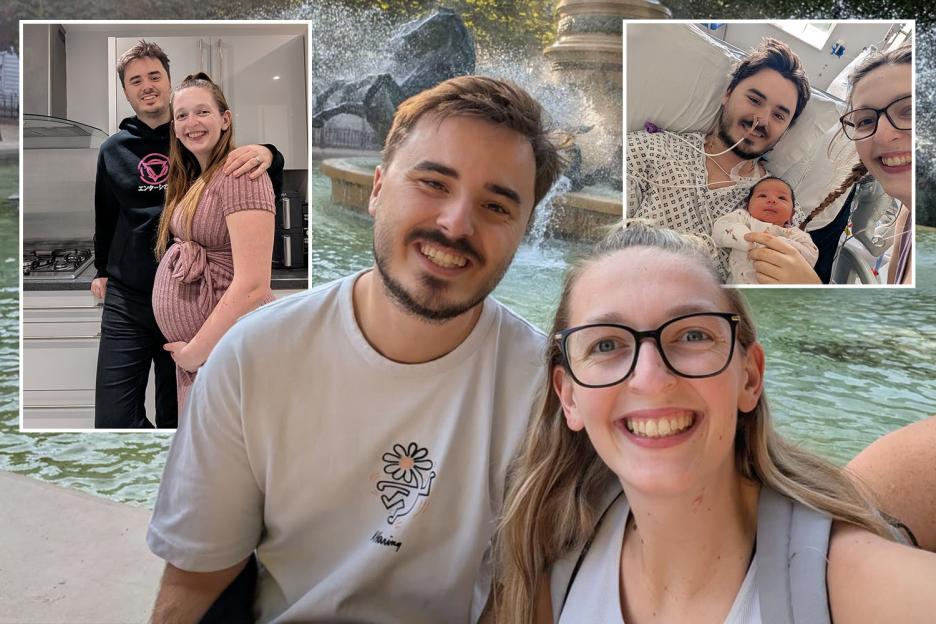
A HEAVILY pregnant mum-to-be gave her husband lifesaving CPR after he went into cardiac arrest in the middle of the night.
Emma King had by chance got up to go to the toilet in the early hours when she noticed partner Sam was barely conscious and making “weird noises” as he gasped for breath, with his eyes rolling back.
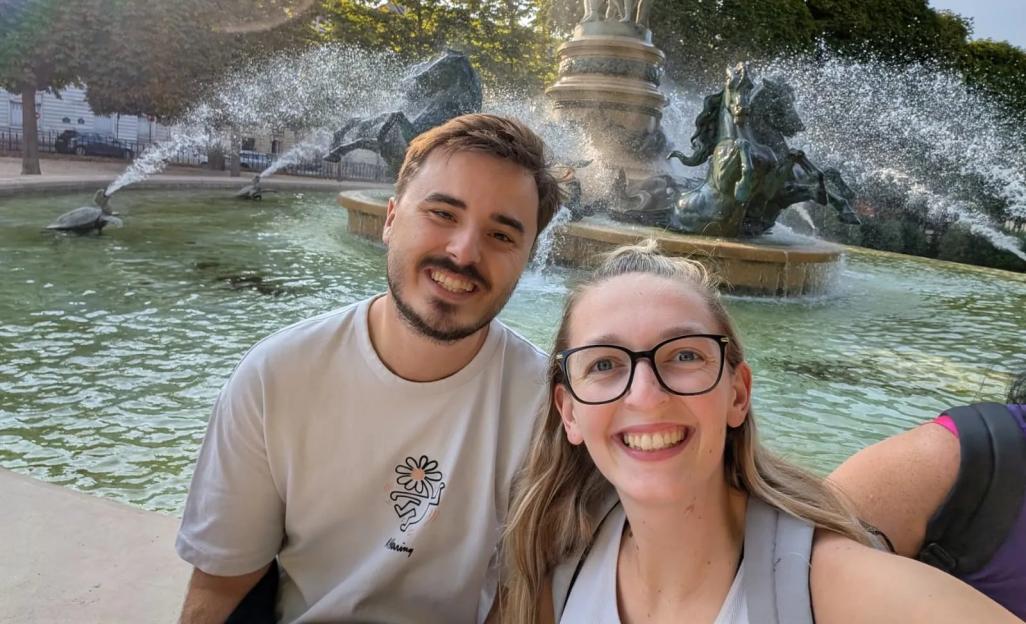 Sam and Emma King were expecting their first child in a matter of days when disaster struck Credit: Sam King
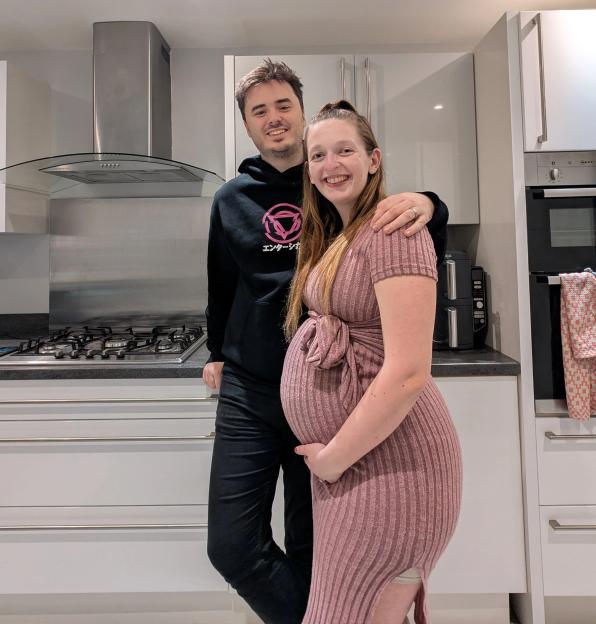 Sam suddenly fell into a cardiac arrest in the middle of the night – leaving Emma to perform CPR while heavily pregnant Credit: Sam King
She dialled 999 and the call handler instructed her to begin doing chest compressions – which continued once paramedics arrived for an unheard of two hours, with little chance given of survival.
Emma, 27, who had previously been first-aid trained, was talked through the process over the phone, having clambered over Sam, also 27, on the bed, despite her large baby bump.
She told The Sun: “Ideally, if you’re giving CPR, they’re meant to be on a hard floor, but Sam was on our memory foam bed.
“So I had to keep adjusting my knees… I was physically bouncing the bed pretty much.”
Emma continued: “The call handler never told me to give breath, she just said to perform chest compressions.
“I knew where to put my hands and that you can give as much force as you can – the harder you do it, the better.
“It was a case of the timing, she made me repeat the timing out loud.
“Every time I’d do a compression, I’d go ‘push, push, push, push’ so she knew whether I was doing it at the right time.”
 The couple, who met on Tinder, married last year Credit: Sam King
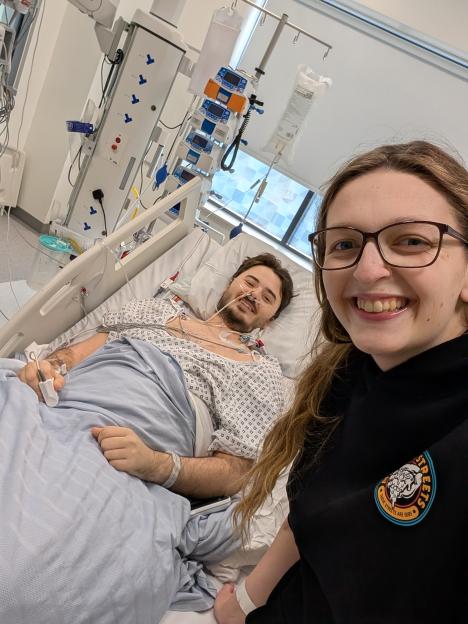 Sam in hospital after awaking from a coma Credit: Sam King
The emergency unfolded at around 4am on April 3 this year at the couple’s townhouse in Hedge End, Hampshire – days before they were due to welcome first child Sophie.
Emma added: “I had no idea he was in cardiac arrest at first.
“It was waking up to go to the toilet in the middle of the night, and then Sam gasping for breath and me thinking ‘what the hell?’
“I’ve turned my phone to look at him and his eyes have gone back in his head.”
Emma said the call handler “saved his life by telling me to do CPR”.
Ambulance and fire teams arrived within minutes and, struggling to restart his heart, medics worked on Sam for two hours, including giving him 11 zaps with a defibrillator, and using a hands-free mechanical chest compression called LUCAS.
His heart was showing little signs of life and the couple later learned continuing CPR for so long is rare.
The paramedics would’ve stopped but having intubated Sam, they detected he was still producing CO2, meaning his body was taking in oxygen.
What is CPR and how to learn it
CPR stands for cardiopulmonary resuscitation, an emergency life-saving procedure performed when someone’s breathing or heartbeat has stopped.
It keeps blood moving, provides oxygen and buys time.
Learning CPR is one of the most impactful skills you can acquire, and you can start learning right now for free or choose an in-person certified course depending on your goals.
Here are the primary ways to learn CPR, ranging from quick online tutorials to official certifications:
Free Online Training (Quick & Convenient)
If you want to learn the basics immediately without a formal certification, excellent digital tools are available:
- British Heart Foundation (BHF): You can use their free, interactive RevivR Online CPR Training Tool . It takes just 15 minutes using your smartphone or tablet and a cushion to practice on. It teaches you how to recognise cardiac arrest, make an emergency call, perfect your compression technique, and use a defibrillator.
- Video Guides: For a quick visual overview of the technique, you can watch step-by-step demonstrations via the St John Ambulance CPR Guide or standard medical walkthroughs like this First Aid Tips CPR Video
In-Person Courses (For Certification & Workplace Needs)
If you need an official certificate for work, or if you prefer hands-on practice with a medical mannequin, you should book an in-person class:
- St John Ambulance: They are the UK’s leading first aid training provider and offer everything from basic community sessions to formal workplace certifications (such as Emergency First Aid at Work).
- The British Red Cross: They provide robust, locally available first aid courses covering adult, child, and infant CPR.
- Community Groups: Organisations like the East Anglian Air Ambulance and local rescue services frequently run free or low-cost 1-hour community workshops.
An ultrasound later showed it was “fluttering”, meaning, despite no pulse or blood pressure “there was still some electrical activity”, explained Sam.
“If they could restart it, then I had a chance, although a bloody small one, of surviving,” he said. “So they did CPR for two hours, which is just crazy.”
On realising there was little more they could do outside of hospital, the paramedics had to manoeuvre the 6 ‘2 patient down multiple flights of stairs, with the bedroom in a loft conversion, and navigate tight corners, while still doing CPR in a relay-style routine.
During the journey to hospital, the LUCAS device even ran out of battery, meaning medics had to return to manual compressions in the back of the ambulance.
They arrived at Southampton General Hospital around 6am – but Sam said his understanding is there was still little hope of survival.
He said: “They were basically like, ‘we’ll give it a go, but he’s just going to die’. There’s no way that people survive that.”
Sam’s heart did finally restart once he was in hospital but there was a high likelihood of brain damage, and he was put on dialysis with his heart, lungs, liver, kidneys and gut all failing.
“It was a roll of the dice even on the ambulance ride,” he said.
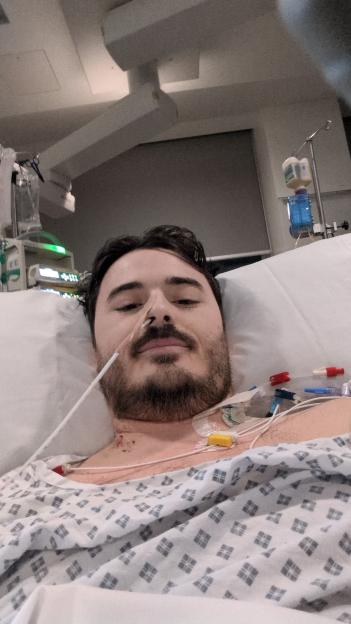 Sam after coming off a ventilator but with a feeding tube Credit: Sam King
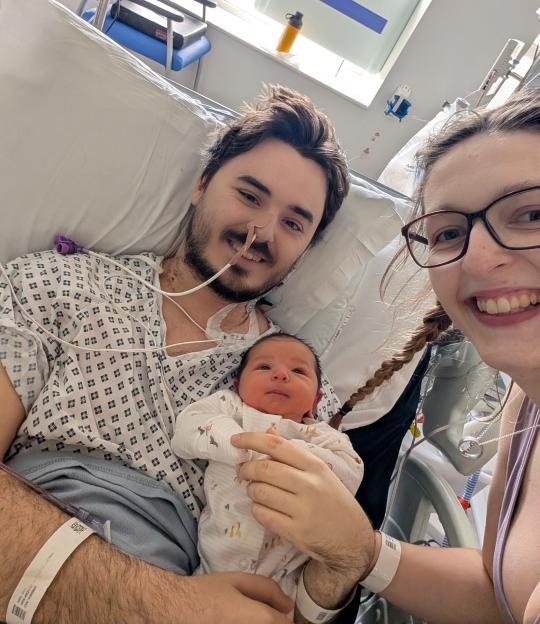 While Sam battled for his life, Emma gave birth to Sophie Credit: Sam King
Luckily, on-duty doctor Edward Langford, part of , who was among the medics who scrambled to the scene, thought ahead, getting an extracorporeal membrane oxygenation device (ECMO) – shipped to Southampton from St Thomas Hospital in London.
There are very few of the mechanical heart and lungs, but it arrived as Sam was in surgery that afternoon.
He said: “I’ve got these big scars on my thighs because they go into your main arteries and plug in this big lung to replace your heart and lungs.”
That evening, Sam was blue-lighted to London where he remained in a coma until May 12.
Four days after his cardiac arrest, Emma – who had her care transferred to London – gave birth to daughter Sophie on April 6, after a 36-hour labour.
Four hours after Sam woke up, she was brought down with the little tot to see him, and he burst into tears.
Laughing, he said: “There’s this video of me, I’m being unventilated, I’m all yellow because my liver doesn’t work, I’ve got this stuff in my thighs, it’s not pretty – and Sophie was held up to me.
“They placed Sophie on me and apparently I cried. Emma said ‘Sam, Sophie’s here.’”
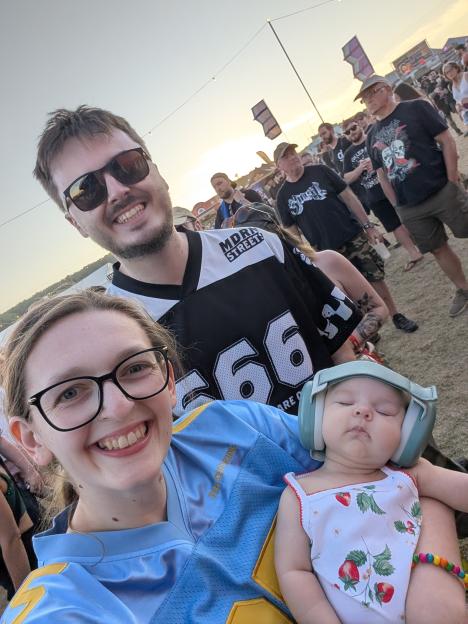 The little family are now counting their lucky stars Credit: Sam King
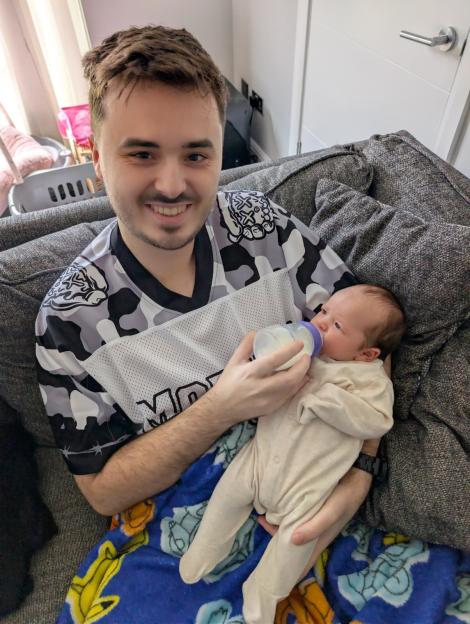 Sam feeding Sophie for the first time after returning home Credit: Sam King
Emma said: “It was one of the most overwhelming experiences that any person could ever go through.”
At that point, the doctors were unsure of Sam’s brain capacity, and whether he would recover.
Emma admitted she had been worried as time went on, and was even thinking about having family move in to help look after Sam long-term.
“To begin with, you think so far into the future and you’re like, oh God, how are you going to cope?” she said.
“But because he was so unwell, I kind of forgot or I ignored any thoughts about his brain activity. There were so many other things wrong with him and it was about would he survive?”
But, miraculously, Sam appears to have made a full recovery, with tests still ongoing as to the cause of the sudden cardiac arrest.
Sam left hospital on May 6 after 33 days and has had a cardioverter-defibrillator fitted similar to footballer who suffered a cardiac arrest on the pitch during Euro 2020, and the device can restart his heart if it ever stops again.
He remained on dialysis while his kidney function recovered and is now even back to work and playing sports – as well as helping with baby Sophie.
“I’m not allowed to hold her stood up,” he said. “Because if I have another cardiac arrest, my fibrillation will kick in and I’ll collapse.
“So I can just have her in my arms while I’m sitting down.”
The couple – both software developers who met on in 2018 before marrying last year – are taking things slowly, with Sam admitting “we’re incredibly lucky”.
Sam has since met with the 11-strong team of members of the South Central Ambulance Service, as well as the Hampshire and Isle of Wight Fire and Rescue Service and an emergency doctor who saved his life.
He said: “I’ll never forget the second chance they’ve given me.”
Continue reading

Obasanjo mourns ex-PDP Chairman Bamanga Tukur, describes him as patriot, bridge-builder
Former Nigeria President, Olusegun Obasanjo, has mourned the death of former National Chairman of the Peoples Democratic Party, PDP, Alhaji Bamanga Tukur, descr...
![Vacation: Tinubu arrives in France [VIDEO]](https://image.flyingeze.com/posts/file/33ea72/thumb-384x288-tinubu-bola.webp)
Vacation: Tinubu arrives in France [VIDEO]
President Bola Tinubu has arrived in Paris, France, for the second phase of his three-week vacation in Europe. The President was welcomed by the Nigerian Ambass...

Should political party donations be capped? VOTE NOW
NIGEL Farage recently secured donations totalling to £72million from two crypto billionaires to help give Reform a “fair fight” in the polls. However, has he ma...
Report suspicious movements promptly – Gov Adeleke to Osun residents
Osun State Governor, Ademola Adeleke, has urged residents to remain vigilant and promptly report suspicious movements or individuals to security agencies. The g...