
Ancient Carved Symbols Discovered Worldwide May Uncover Secrets of a 40,000-Year-Old Lost Civilization
MYSTERIOUS carved symbols found across the world could point to a lost human civilisation dating back 40,000 years. Matthew LaCroix claims he has uncovered “pa...
 Written byEze Chidiebere Paul
MYSTERIOUS carved symbols found across the world could point to a lost human civilisation dating back 40,000 years.
Matthew LaCroix claims he has uncovered “paradigm-shifting evidence of a lost civilisation” that could radically rewrite human history.
 Matthew LaCroix believes his research could reveal a civilisation dating back 40,000 yearsCredit: Matt LaCroix
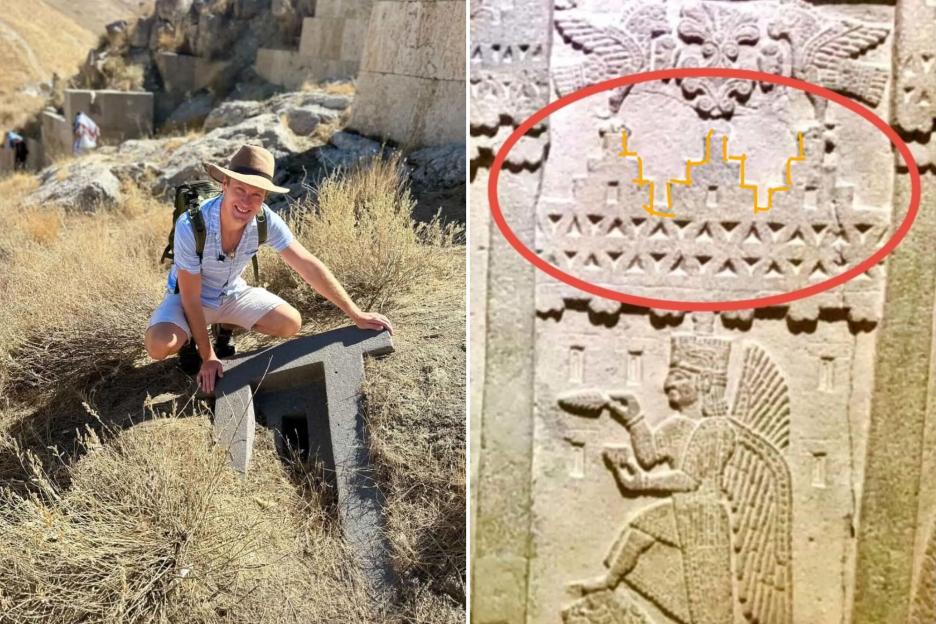
 The presence of recurring symbols, such as inverted pyramids, only fuels LaCroix’s claimsCredit: Matt LaCroix
 The archaeologist says there are multiple sites across the globeCredit: Matt LaCroix
Speaking to the Daily Mail , he said the discovery links ancient symbols found on multiple continents and dates them to between 38,000 and 40,000 years ago.
LaCroix argues that this civilisation concealed a sophisticated code within geometry, symbolism, and monument design across the globe to preserve its knowledge ahead of catastrophic events.
He believes the civilisation tracked cosmic cycles, anticipated global disasters, and embedded teachings about human origins, the structure of the universe, and divine existence into monuments and sacred sites.
His investigation began after he noticed recurring features carved into ancient stonework worldwide, including giant T-shapes, three-level indents, and step pyramids.
“These specific symbols are built in different size proportions, and the symbols are found in ancient stones around the world, are not supposed to exist; no cultures are supposed to have any cross-platform,” LaCroix said.
The symbols appear in locations ranging from Turkey to .
According to LaCroix, their origin lies in eastern Turkey – specifically at a site known as Ionis in the Lake Van region.
Recurring motifs such as giant T-shapes, step pyramids, inverted pyramids, lions, and sacred geometry appear at Ionis in their greatest concentration.
LaCroix claims it is the earliest known source of the symbols, architecture, and teachings, dating the site to around 40,000 years ago.
Nearby Kefkalesi, he says, provides one of the clearest examples supporting his theory.
A four-foot-by-four-foot basalt carving known as the Kefkalesi relief contains complex iconography that mirrors symbols found at Ionis and other sites worldwide.
“This relief became one of the most important artefacts for my research,” LaCroix said.
“It connects Egypt back to this region and lets us back-engineer the global pattern.”
He believes the relief helped clarify the symbolic system and accelerated his analysis of similar structures at Egypt’s Sphinx Temple.
Mainstream archaeologists, however, strongly disagree.
They date the Lake Van sites to the Urartian period, ruling out the possibility of a pre-Ice Age global civilisation – a conclusion LaCroix contests.
There is currently no peer-reviewed research supporting his proposed dating.
LaCroix said his eureka moment came in November 2025 while examining a photograph of the Sphinx Temple.
He claims the image revealed what he believes is an inverted pyramid embedded in the structure.
“There, in front of me. It was like I had never seen it before,” he said.
“There was the inverted step pyramid, but the right side had been broken off.”
This prompted him to analyse the entire Giza Plateau, where he claims to have identified repeated inverted step pyramids and giant T-shapes in the Sphinx Temple, Valley Temple, and the mortuary temples of Khafre and Menkaure.
Using astronomical precession and the proposed alignment of the Sphinx with the constellation Leo, LaCroix dates the construction to either 12,000 years ago or 38,000 years ago, one full precessional cycle earlier.
He dismisses the younger date, citing theories of catastrophic flooding that would have destroyed surface structures.
LaCroix also claims the same architectural layout appears in South America at Tiwanaku and Puma Punku.
Central to his interpretation is what he calls a cosmogram – an ancient geometric model representing the structure of the universe.
He argues that symbols such as three-level step pyramids, inverted pyramids, and T-shapes encode layered realities: the non-physical underworld, the physical realm, and the celestial realms.
He believes the evidence suggests humans were once understood as divine and deeply interconnected with existence itself.
“We have ancient proof that shows we’re divine beings, connected to everything,” he said.
“We’re supposed to be living in harmony with the Earth and the universe.”
 LaCroix noticed recurring features carved into ancient stoneworkCredit: Matt LaCroix
 The Sphinx and Valley Temples in Egypt reveal similar patternsCredit: Matt LaCroix
Continue reading

Infinix Launches GT 50 Pro: The Ultimate Hardcore Gaming Flagship with Industry-First Cooling and Control
Driven by a breakthrough thermal engine, the Infinix GT 50 Pro harmonizes physical precision, flagship hardware, and software intelligence to transform a mobile...

Infinix GT 50 Pro Set to Make Nigerian Debut at PMNC Nigeria Finals on September 12
For competitive gamers, the wait is almost over. Infinix has confirmed September 12 as the Nigerian debut of its new GT 50 Pro gaming smartphone, with the launc...

iOS 27 Release Date: What to Expect in Features and Compatible Devices!
APPLE has unveiled its flagship iPhone 18 Pro and foldable iPhone Duo. But one of the biggest upgrades coming to your pocket is the software running under the h...
3,000-Year-Old Mystery of Egypt's 'Screaming Mummy' Solved: Death Frozen in Terror Unraveled!
SCIENTISTS may have finally unravelled the mystery behind the death of an Egyptian mummy after 3,000 years. The female corpse known as the “screaming woman” was...