
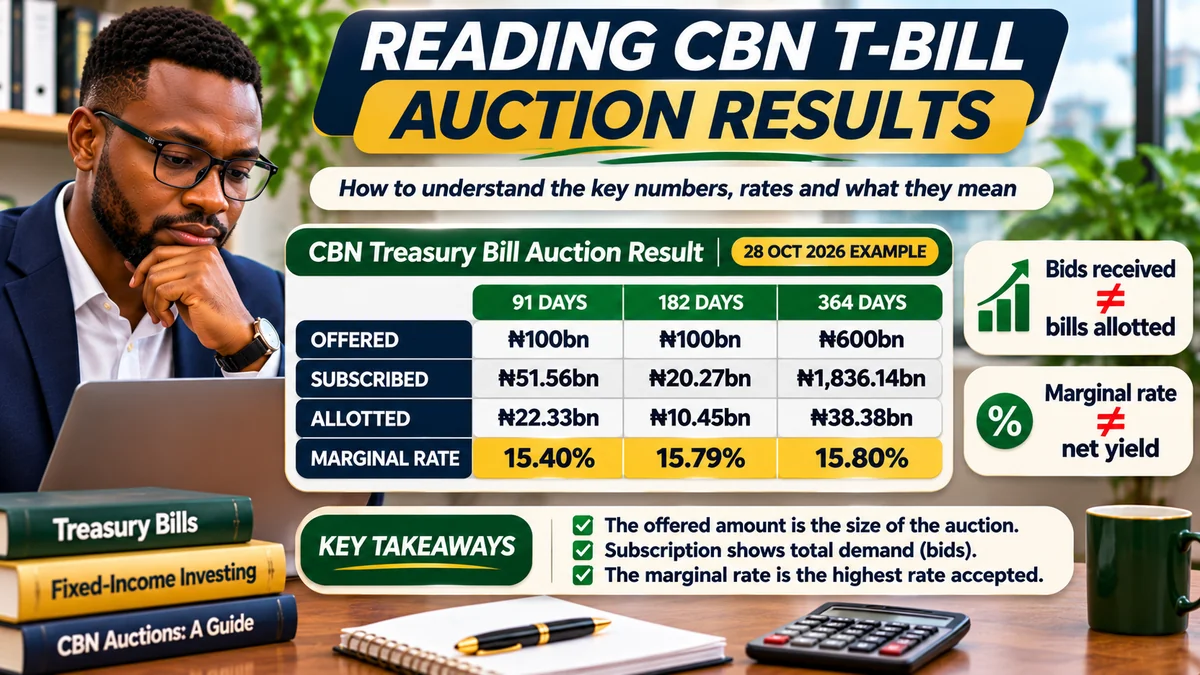
To read a Central Bank of Nigeria (CBN) Treasury bill auction result, start with the auction date and tenor, then compare the amount offered, total subscriptions, actual allotment and marginal or stop rate. Those four numbers tell you how much the government planned to sell, how much investors wanted, how much it actually accepted and the highest accepted discount rate. They do not, by themselves, tell you the exact net return your bank will pay you.
Many Nigerians searching for someone to explain treasury bills encounter news headlines such as “T-bill auction oversubscribed by 200%” or “one-year stop rate falls to 15.80%”. Without understanding the auction table, it is easy to confuse strong demand with successful applications, a stop rate with a personal investment yield, or an advertised offer with money actually borrowed.
This guide uses the CBN's published Nigerian Treasury Bills (NTB) results for 28 October 2026 as a worked example. It explains every essential column, calculates bid-to-cover and acceptance ratios, demonstrates discount pricing, highlights misleading interpretations and shows how to check the result independently. Research checked: 16 November 2026. This is educational information, not a live investment quotation.
Quick answer: the four numbers to read first
Think of an NTB auction result as a record of an offer and the government's decision about competing bids.
| Column | Simple meaning | Question it answers |
|---|---|---|
| Amount Offered | The announced face amount the government intended to issue | How much was put up for sale? |
| Total Subscription | Combined volume of investors' bids | How much did investors request? |
| Total Successful / Allotted | Face amount of bids accepted and securities issued | How much was actually allocated? |
| Marginal / Stop Rate | The highest bid discount rate accepted at the auction | Where did the auction clear? |
Two mistakes to avoid: “₦1 trillion subscribed” does not mean ₦1 trillion was allotted, and a “15.80% stop rate” does not mean someone earns 15.80% cash profit in 364 days after costs. You need the allotment figure for the first claim and the actual discounted purchase price for the second.
Where to find official CBN Treasury bill auction results
Use the official CBN site rather than a rate image forwarded in a WhatsApp group:
- Open CBN Government Securities Summary .
- Find the Primary Market table for NTB (Nigerian Treasury Bills), not the separate FGN Bonds, OMO or CBN Bills sections.
- Check the Date of Auction and the 91DAY, 182DAY or 364DAY security label.
- For more history, open the CBN's NTB drill-down , which shows auction records by date and has an Excel export control.
- Read the table's unit label before converting amounts. The current published pages show monetary figures in millions of naira (₦ million).
- Record the auction date when citing the result. A figure from October is a historical result, even if the page is opened in November or December.
CBN's Key Rates page separately summarises selected Treasury bill rates with their dates. It is a useful cross-check, but the primary-market auction table provides more detail about offers, bids and allotments. The latest row visible on a public page is not necessarily proof that no later auction has occurred; verify the date and any newer official notice.
Real example: CBN Treasury bill auction of 28 October 2026
These figures come from the CBN NTB auction history , rounded for readability. They are actual published results for that specific date, not today's available rates.
| CBN measure | 91-day | 182-day | 364-day |
|---|---|---|---|
| Maturity date | 28 Jan 2027 | 29 Apr 2027 | 28 Oct 2027 |
| Amount offered | ₦100bn | ₦100bn | ₦600bn |
| Total subscription | ₦51.56bn | ₦20.27bn | ₦1,836.14bn |
| Total successful / allotted | ₦22.33bn | ₦10.45bn | ₦38.38bn |
| Range of bid rates | 14.90–19.00% | 15.30–16.65% | 15.00–18.24% |
| Successful bid rates | 14.90–15.40% | 15.30–15.79% | 15.00–15.80% |
| Marginal / stop rate | 15.40% | 15.79% | 15.80% |
The government offered ₦800 billion across the three tenors. Investors submitted approximately ₦1.908 trillion in bids, yet only about ₦71.16 billion was allotted. The CBN's underlying exact allotments add to ₦71.156209 billion; published analysis from the Financial Markets Dealers Association (FMDA) and Nairametrics, 29 October 2026 confirms the same broad outcome.
The important conclusion is not simply “investors wanted government bills”. It is that demand was heavily concentrated in the one-year instrument, while the issuer accepted only a small proportion of the bids. High subscriptions did not compel it to sell the entire advertised amount.
Column 1: Auction date, tenor and maturity date
Auction date identifies when bids were considered and the result was determined. Tenor is the intended length of the bill—normally 91, 182 or 364 days for a new NTB. Maturity date is when the security is scheduled to repay its face value.
The CBN invitation to tender reproduced for the October auction specified bid submissions on 28 October 2026 and allotment/payment on 29 October 2026. So the auction date and the issue or settlement date are not always the same. The 364-day issue was scheduled to mature on 28 October 2027.
Do not automatically calculate the number of days from the public auction date without checking the allotment or issue date. Nor should you assume that a Treasury bill bought two months later in the secondary market still has its original full tenor remaining.
Column 2: Amount offered—what was announced for sale
Amount Offered is the face amount the Federal Government, through the CBN/DMO auction process, planned to sell for a particular tenor. At the October 28 example, it offered ₦100 billion in 91-day bills, ₦100 billion in 182-day bills and ₦600 billion in 364-day bills.
A beginner must read the unit correctly: 100,000.0000 under “₦ million” means ₦100,000 million, or ₦100 billion. It does not mean ₦100,000 naira. Likewise, the 364-day value of 600,000.0000 means ₦600 billion.
The offered total can change between auctions depending on government funding needs and market conditions. An official offer is not a promise to accept all bids, and the eventual securities allotment is not necessarily the same as the cash price investors pay for discounted bills.
Column 3: Total subscription—how much investors requested
Total Subscription is the combined nominal amount of bids received for a tenor. In the example, investors sought about ₦51.56 billion of 91-day bills, ₦20.27 billion of 182-day bills and ₦1.836 trillion of 364-day bills.
That means short-bill demand fell below the advertised amount, whereas demand for the one-year bill was more than three times its offer. Investors might favour one maturity because of yield expectations, funding plans, market liquidity or expectations about future interest rates. The numbers alone cannot prove any one of those explanations.
Subscription does not mean money has been allotted or accepted. Competitive bidders may seek rates that the government decides not to accept, and a bid can remain unsuccessful even when overall subscription is lower than the offered amount.
Column 4: Total successful or allotted—what the CBN accepted
Total Successful or Allotment records the accepted nominal volume. The 28 October result shows ₦22.33 billion accepted for 91-day bills, ₦10.45 billion for 182-day bills and ₦38.38 billion for 364-day bills, against an overall ₦800 billion offer.
This is why the auction attracted headlines about approximately ₦1.84 trillion in bids left unfilled. The government accepted only around 3.73% of the ₦1.908 trillion subscribed and allotted less than 9% of its original advertised offer. That is an observation from this auction, not a general rule about how much is accepted in every sale.
A low allotment relative to demand can reflect the issuer's decision not to borrow at higher rates. It does not establish that every rejected investor was ineligible or that the government lacked enough Treasury bills to sell. Check the bid-rate ranges and the stated marginal rate to understand how price affected the allocation.
What is the bid-to-cover ratio?
The bid-to-cover ratio compares the total nominal amount of bids received with the announced offer:
Bid-to-cover = Total subscriptions ÷ Amount offered.
Using the CBN's 28 October 2026 figures:
| Tenor | Calculation | Result | Meaning |
|---|---|---|---|
| 91-day | ₦51.56bn ÷ ₦100bn | 0.52× | Subscriptions below offer |
| 182-day | ₦20.27bn ÷ ₦100bn | 0.20× | Subscriptions well below offer |
| 364-day | ₦1,836.14bn ÷ ₦600bn | 3.06× | Demand above three times the offer |
| All tenors | ₦1,907.97bn ÷ ₦800bn | 2.38× | Overall oversubscription |
Above 1× means investors requested more than the government offered; below 1× means they requested less. But the ratio is a demand measure, not an acceptance measure or a promised return.
For the separate acceptance measure, divide total successful bids by total subscriptions. In October's example, ₦71.16 billion ÷ ₦1,907.97 billion is approximately 3.73%. This is how an auction can be heavily oversubscribed but result in little actual allotment.
Column 5: Range of bid rates and successful bid rates
A bid rate is the rate an investor or intermediary proposed in a competitive bid. The range of all bids shows the lowest and highest rates submitted. The successful-bid-rate range shows the rates associated with the accepted bids.
For 364-day bills on 28 October, the CBN published 15.00% to 18.24% as the overall range, but only 15.00% to 15.80% among successful bids. This tells us that higher requested rates were not accepted at that auction.
Because a higher discount rate generally means a lower cash purchase price and therefore a higher cost of borrowing for the issuer, the government may reject high-rate bids. The full allocation mechanics, including any partial awards at the boundary and the price applied to individual successful bids, depend on the specific tender and settlement rules. Do not assume your own bid was successful merely because its rate appears near the stop rate: confirm your allotment notice.
Column 6: Marginal rate or stop rate—what does 15.80% mean?
The marginal rate, frequently called the stop rate, marks the highest discount rate accepted for that tenor in the auction. On 28 October 2026, the reported marginal rates were 15.40% for 91 days, 15.79% for 182 days and 15.80% for 364 days.
The marginal rate matters because it summarises the auction's pricing outcome. But it should not be read as a savings-account annual percentage rate, an automatic net return, or a guarantee that a bank will quote that exact figure to an individual buying later.
A primary-dealer trade may be governed by the auction's allotment terms, while a retail buyer may purchase an already-issued bill in the secondary market at a different market price. Therefore, always compare the actual purchase price and expected proceeds on your own written confirmation with the published auction rate.
Another useful comparison is the change in stop rate. FMDA's analysis shows the 364-day rate declined from 15.90% on 14 October to 15.80% on 28 October 2026—a fall of 10 basis points, because one basis point is 0.01 percentage point. A lower stop rate usually means cheaper new borrowing for the issuer, not a loss already realised by every holder of an existing bill.
Stop rate versus true yield: calculate the difference
New Nigerian Treasury bills are discount instruments. You generally pay less than the face value and receive the face value at maturity, subject to applicable tax and settlement procedures. That means a percentage calculated against face value differs from the yield on the smaller amount actually paid.
For a simple standardised illustration using a 365-day year:
Discount = Face value × Discount rate × Days ÷ 365.
Purchase price = Face value − Discount.
Holding-period return = Discount ÷ Purchase price.
Simple annualised yield = Holding-period return × 365 ÷ Days.
Use the 28 October 2026 364-day marginal rate of 15.80% to illustrate a hypothetical ₦1,000,000 face-value purchase. This small face value is for educational arithmetic, not a claim that an individual can directly submit a ₦1 million primary-auction bid.
| Example calculation | Value |
|---|---|
| Face value to be repaid at maturity | ₦1,000,000.00 |
| Annual discount rate used for illustration | 15.80% |
| Days to maturity | 364 |
| Calculated discount | ₦157,567.12 |
| Calculated cash purchase price | ₦842,432.88 |
| Gross gain if held to maturity | ₦157,567.12 |
| Gross holding-period return on purchase cost | About 18.70% |
| Simple annualised true yield | About 18.76% |
The calculations are approximate, ignore dealing fees and tax, and apply the marginal discount rate as an illustrative transaction rate. They are not the settlement statement of a particular investor. A bid accepted on its own terms or a secondary-market trade can have a different cash price.
Notice how a 15.80% quoted discount rate corresponds to a roughly 18.76% simple annualised gross yield under this example. The income divided by the actual purchase cost is greater than the income divided by the full face value.
Why does the CBN table sometimes show “True Yield 0.0000”?
The CBN's public Government Securities Summary and NTB history showed 0.0000 in the True Yield field for the 28 October 2026 rows when checked for this article. Yet those same rows show positive marginal discount rates. The display should therefore not be quoted as proof that the bills yielded zero.
The public record does not establish why that particular figure appears. It may reflect a field that was not populated in the displayed data; the safest interpretation is simply that the shown value is not a usable calculated yield for those entries. Use verified price and cash-flow figures to calculate yield, or ask the authorised dealer for its actual yield-to-maturity quote.
Likewise, a “Total Amount Repaid” value of zero against a bill that has not yet matured should not automatically be interpreted as a default. Read the field in the context of the auction's issue and maturity dates.
Does heavy subscription guarantee a high interest rate?
No. In the example, the one-year bill drew about ₦1.836 trillion against ₦600 billion offered, yet the government accepted only ₦38.38 billion at a marginal discount rate of 15.80%. That demonstrates a basic principle: strong demand can coexist with a low successful-allotment amount and a lower stop rate.
More buyers competing for a limited issue can allow the government to choose bids demanding lower yields. Conversely, weak demand does not force it to accept higher-rate bids. Changes also depend on banking-system liquidity, expectations about future CBN policy, government cash needs and secondary-market pricing.
Read one auction alongside earlier issues of the same tenor. Comparing a 91-day rate with a 364-day rate without considering the extra holding period can lead to a mistaken conclusion about which investment is preferable. The FMDA's 28 October review also distinguishes primary-market stop rates from secondary-market yields, which may move differently.
What is the difference between the primary auction and secondary-market price?
The primary auction is where new Treasury bills are sold through the authorised bidding system. A secondary-market transaction involves a bill that has already been issued and is being bought or sold with fewer days remaining until maturity.
A bank or dealer may quote a different rate from the original marginal rate because market yields, trading spreads, fees and remaining maturity have changed. At a secondary-market purchase, calculate the expected return using your actual settlement price and remaining days, not simply the headline stop rate from the bill's original auction.
There is also an access difference. The October 2026 tender notice specified a primary bid minimum of ₦50,001,000, while Stanbic IBTC's published Treasury bills offering describes secondary-market access starting from ₦100,000 under its own product terms. The latter is a provider-specific minimum, not the rule for every bank.
An older CBN general FAQ mentions a ₦10,000 minimum, but that should not override the specific 2026 auction tender when discussing direct primary bids. Confirm the current rules before planning a purchase.
What can the auction result tell you about your own investment?
It is useful for understanding the market, but the CBN results table does not disclose your individual trade details. Before investing or after a bid, request written confirmation of:
- The precise security and whether you are in the primary or secondary market.
- The auction or settlement date, maturity date and the applicable days to maturity.
- The face value allotted to you, which may differ from the amount requested.
- Your actual cash purchase price, not just the face amount.
- The discount rate and gross yield, clearly labelled.
- Bank or dealer commission, custody charges, applicable VAT on fees and taxes.
- The expected net proceeds or tax treatment and the repayment account.
Tax matters when comparing the quoted return with what you keep. The SEC's July 2025 circular addressed the end of an earlier exemption for certain short-term government securities. Reuters reported in October 2025 that the tax authority directed withholding of 10% on income from specified short-term securities, including Treasury bills. That is a deduction on the applicable income, not 10% of every investor's entire face-value principal. Confirm current rules and your own tax position with the institution.
A beginner should not treat a historical CBN rate as a personalised, guaranteed after-tax return. For context on how inflation can erode the purchasing power of nominal investment gains, see FlyingEze's analysis of Nigerian inflation and living costs .
Five mistakes to avoid when reading Treasury bill auction headlines
- Confusing subscribed with allotted: Bids are requests; only successful bids result in allocation.
- Reading the table's units as naira rather than millions: “600,000” under ₦ million represents ₦600 billion.
- Calling the stop rate the investor's net yield: Discount rate, purchase-cost yield, tax and fees are different measures.
- Ignoring the auction date or product type: An OMO auction is not the same as an NTB sale, and a dated rate is not a live retail quote.
- Assuming oversubscription guarantees success: The 28 October auction was more than twice subscribed overall, but only a small fraction was allotted.
Do not send money to a social-media account claiming that it can reserve an auction rate or guarantee CBN allotment. Start with an independently verified dealer and its official payment route. FlyingEze's coverage of CBN warnings about fake emails and banking links explains related phishing risks.
Frequently asked questions
What does “amount offered” mean in a CBN Treasury bill auction?
It is the amount of new Treasury bills announced for sale for a particular maturity. It is not the amount investors bid for, nor necessarily the final amount allotted.
What does “total subscription” mean?
It is the combined nominal value of all bids submitted for the auction or tenor. Subscription above the amount offered is called oversubscription, but it does not mean those bids were all successful.
What is the difference between subscription and allotment?
Subscription records the amount sought; allotment records the amount accepted. On 28 October 2026, about ₦1.908 trillion was subscribed across all tenors, but only ₦71.16 billion was allotted.
What does the stop rate mean?
It is the highest accepted discount rate for a particular Treasury bill tenor at that auction. It helps describe the auction's pricing, but it is not automatically the annual net investment return to a retail customer.
What is the bid-to-cover ratio?
Total subscriptions divided by the amount offered. A figure above 1× means investors bid for more securities than were offered. The 28 October 2026 auction had an overall ratio of approximately 2.38×.
Why did CBN reject bids even when the bills were oversubscribed?
The government can decline bids that require borrowing at rates it is unwilling to accept. Therefore demand alone does not compel full allotment, even when there are many bidders.
Is a 15.80% Treasury bill stop rate the same as earning 15.80% in a year?
No. It is a quoted discount rate. For a hypothetical 364-day face-value purchase at that discount, the simple annualised gross yield on cash invested can be around 18.76%, before fees and tax. Your actual investment may have different pricing.
Why does CBN's True Yield column sometimes show 0.0000?
For the October 2026 entries checked, the public table displays 0.0000 despite positive discount rates. Do not report it as a genuine zero return; use the actual purchase price to derive the yield or obtain a verified dealer quote.
Can I buy at the stop rate published on the CBN website?
Not automatically. You must use an authorised channel under the applicable auction or secondary-market rules. Your actual price, allocation and charges may differ from the headline marginal rate.
Does a higher bid-to-cover ratio mean Treasury bill rates must rise?
No. Stronger investor demand can allow the issuer to accept lower required rates. The actual rate also depends on government decisions, financial-system liquidity and investors' bid prices.
Where can I find past auction results?
Use the official CBN NTB drill-down and identify each auction date. The page offers a historical record and an Excel export control. Compare the same tenors and units across dates.
A practical checklist for reading any future CBN auction result
- Confirm the record says NTB and the correct auction date.
- Read the unit: millions of naira, billions or trillions.
- Identify the tenor and exact maturity date.
- Record amount offered, total subscribed and total successful.
- Calculate bid-to-cover and, separately, the acceptance percentage.
- Compare the full bid-rate range with the successful-bid range.
- Record the marginal discount rate with the date and tenor.
- Calculate or obtain a true yield from the actual purchase price, time and repayment amount.
- Check all fees, withholding tax and whether the quote is from the primary or secondary market.
- Do not confuse an unattributed screenshot or WhatsApp rate with an official CBN result.
Conclusion: read demand, acceptance and rate together
The easiest way to interpret a CBN Treasury bill auction is to keep offer, subscription, allotment and marginal rate separate. The 28 October 2026 auction illustrates why: the government offered ₦800 billion, investors requested about ₦1.908 trillion, but only ₦71.16 billion was accepted. One-year subscriptions were exceptionally strong even though the government left most bids unfilled.
For a beginner, the auction results are a transparent source of market information—not a guarantee of a personal investment return. Use the CBN's dated data, verify the dealer, and calculate the yield on what you actually pay after understanding taxes and charges. Once you can distinguish what was offered, what was requested, what was sold and at what rate, Treasury bill auction headlines become far easier to evaluate.



