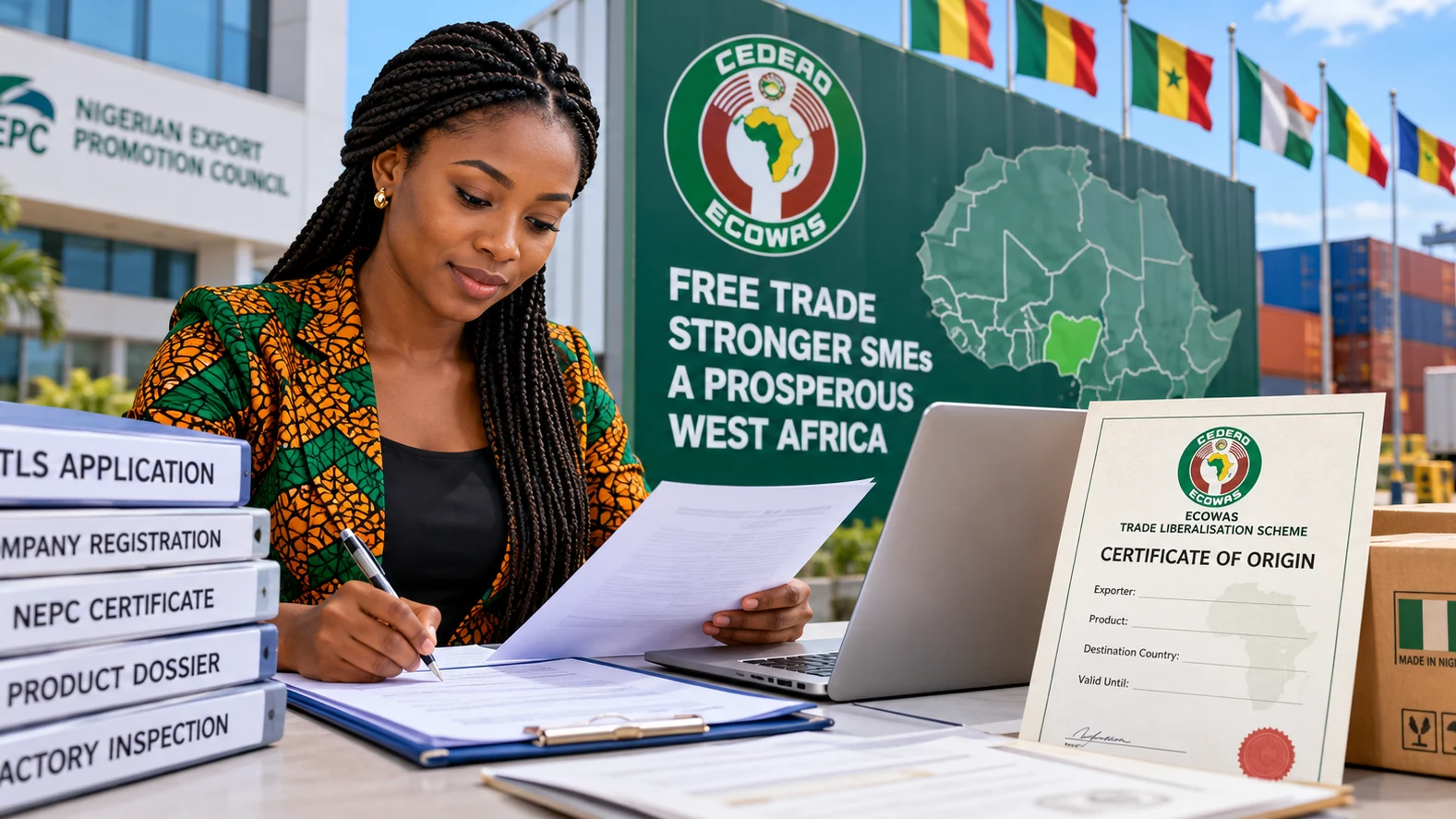
Verified on 22 October 2026. Nigerian small and medium-sized enterprises planning to sell eligible Nigerian-made goods in West Africa can explore the ECOWAS Trade Liberalisation Scheme (ETLS). The scheme may offer relief from customs import duties for qualifying originating goods, but it is not a waiver of every tax, product rule or export formality. This checklist explains eligibility, documents and the five application stages shown on Nigeria's official Trade Information Portal.
Why does this matter to SMEs? FlyingEze previously reported on the South-East campaign to help small businesses benefit from ECOWAS trade reforms . The practical next question is how an eligible manufacturer prepares and obtains the required approvals.
Who is eligible for ETLS?
- Business: A legally registered enterprise operating and producing qualifying goods in Nigeria, with the intention to trade in an eligible ECOWAS market.
- Product: Eligible categories include agricultural and livestock products, fishery products, handicrafts and industrial goods. Industrial goods require product-level consideration and approval.
- Origin: Products must satisfy the applicable ECOWAS origin rule. ECOWAS recognises goods wholly produced in the region and specified substantial-processing tests, including a change in tariff classification or qualifying regional content/value addition. Nigeria's portal highlights 60% regional raw-material content or at least 30% value addition; these are not blanket tests that should be applied without checking the exact product's rule.
- Production site: ECOWAS cautions that goods from export-processing/free zones or comparable special schemes may not qualify; obtain an official assessment before applying.
Destination-country alert: ECOWAS now has 12 member states following Burkina Faso, Mali and Niger's withdrawal on 29 January 2025. ECOWAS directed continued ETLS treatment for goods from those three countries until further notice under post-withdrawal arrangements. Exporters should confirm the current bilateral/destination treatment before dispatch, rather than relying on older guidance referring to 15 member states.
ETLS documents: practical application checklist
- ☐ ETLS application form completed for the enterprise and proposed product(s).
- ☐ CAC certificate of incorporation/registration and relevant company statutes or incorporation documents.
- ☐ NEPC exporter's registration certificate (obtain through the official NEPC exporter-registration process).
- ☐ Product description and tariff classification: correct HS/ECOWAS nomenclature, brand/label and supporting product details.
- ☐ Production-flow chart, manufacturing-process description and details of the factory or facilities.
- ☐ Origin and costing records: sources, quantities and costs of raw materials, consumables and packaging; ex-factory price and value-added computation for each product.
- ☐ Sector-specific evidence, where applicable: for example NAFDAC certification or an association-membership certificate, if required by the Nigerian portal for the application.
- ☐ Factory-inspection checklist and records for the inspection stage.
- ☐ Supporting attachments, as applicable: details of capital investments/amortisation, any relevant preferential-treatment instrument and other documents requested by the competent authority.
- ☐ Identification for certificate collection where required at the final stage.
Use the official ECOWAS sample application form (PDF) to understand how product, production and costing information is presented. Confirm the current accepted filing version with the Nigerian authority before submission.
How to apply: the five official stages
- Submit the application. Complete the ETLS form, attach the company, exporter and product documents, and submit through the competent Nigerian authority identified by the Nigeria Trade Information Portal's ETLS procedure . Retain acknowledgement and copies.
- Obtain notification of inspection. Wait for the responsible agency's notice, and check whether additional records or a proposed inspection date are required.
- Undergo facility inspection. Make the production site and records available. Inspectors may assess whether the stated processes, inputs and outputs match the application.
- Obtain notification of ETLS approval. The National Approvals Committee examines applications; recommendations proceed through the competent ministry to the ECOWAS Commission for validation/notification. Do not treat inspection as final product approval.
- Obtain the ETLS Certificate of Origin. Once the relevant approvals and regional notification have occurred, request the properly endorsed certificate for the approved product and intended destination from the competent authority. The certificate is distinct from the company's earlier ETLS approval.
The Trade Information Portal describes the ETLS procedure as free of charge, but that does not mean all export registration, certifications, shipment or administrative costs are free. Check the current fees and processing period for the relevant product and authority before making business commitments.
Before shipping: avoid these common mistakes
- Assuming registration alone guarantees duty-free entry. Product origin, approval, the correct certificate and the importing country's controls all matter.
- Using unsupported origin percentages or the wrong tariff code. Retain invoices, input-origin records and a defensible calculation for the specific product.
- Mixing certificates. A general certificate of origin, an ETLS Certificate of Origin and an AfCFTA Certificate of Origin serve different procedures.
- Reusing one certificate for different products or destinations. ECOWAS says the ETLS certificate covers one product and one destination country, with a six-month validity period. Check shipment quantity and consignment conditions.
- Overlooking destination taxes and import rules. Applicable VAT/excise duties and local standards or restricted-product rules may still apply despite ETLS approval.
ETLS is not the AfCFTA application process
ETLS is the ECOWAS regional preference scheme described above. AfCFTA is a separate continental trade framework with its own preferential origin requirements and certificate procedure. Nigeria's Trade Information Portal lists an AfCFTA Certificate of Origin separately; do not substitute an AfCFTA form for an ETLS form or apply these five ETLS stages to an AfCFTA shipment.
Official documents and further help
- Nigeria Trade Information Portal: five-stage ETLS procedure and document checklist
- ECOWAS: origin recognition and enterprise approval procedure
- ECOWAS: official ETLS forms, certificate template and legal documents
- ECOWAS ETLS FAQs: eligibility, rules of origin and certificate use
- ECOWAS: sample ETLS Certificate of Origin (PDF)
- Nigeria Export Promotion Council: general export documents and procedures
- ECOWAS statement on 2025 membership withdrawal and interim ETLS treatment
Editorial note: This article is general procedural information, not a substitute for product-specific advice or written confirmation from the Nigerian ETLS competent authority and the importing country's customs service. Verified 22 October 2026.