HER body “slowly failing” over a brutal two years, Danielle Bryce was plagued by night sweats, dizzy spells and breathlessness.
The mum was struck down following the birth of her youngest, but says doctors repeatedly brushed it off as hormones.
 Mum Danielle Bryce was told by doctors for years that her dizziness was caused by her hormones Credit: Jam Press/@daniellebrycey
 She believed her body was failing after suffering from night sweats and breathlessness for two years Credit: Jam Press/@daniellebrycey
It was only in February of this year that the 44-year-old was diagnosed with severe after being rushed to hospital when she began haemorrhaging from her uterus.
Danielle, from , is furious she wasn’t diagnosed sooner, claiming she’s now left with complications like vestibular neuritis, an inner ear problem that affects balance.
She tells : “I think a lot of this could have been avoided had they admitted me quicker – because I’m not just left with anaemia, I now have vestibular neuritis, which is crippling when I’m and I have sensory issues, and the room is spinning.
“It’s paralysed me, essentially. I’ve been in bed on and off for weeks.”
 The 44-year-old was eventually diagnosed with severe anaemia after being rushed to hospital Credit: Jam Press/@daniellebrycey
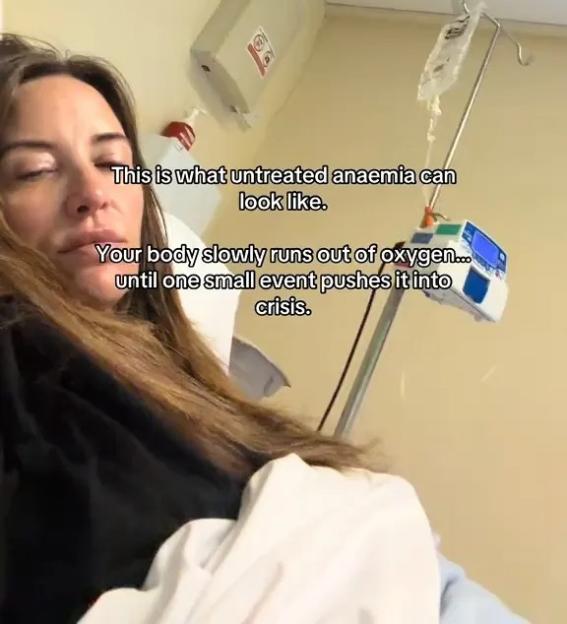 The mum says the delay in her diagnosis also caused her to develop vestibular neuritis Credit: Jam Press/@daniellebrycey
“I ended up back in hospital with pain a couple of weeks ago because my body’s just really struggling at the moment and I just felt very dismissed.
“‘Do you want some antidepressants?’ No, I don’t.
“They treat you like you’re losing your mind but actually this is very real and this could have been avoided.”
Danielle’s nightmare began after she gave birth to her youngest child, now two, via C-section, which involved heavy blood loss.
“I was given iron tablets for 28 days after having my daughter, but was never told what my iron levels were,” she says.
She says she went to the “multiple times” with worrying symptoms – including extreme , breathlessness, dizziness, and anxiety.
But she claims she was repeatedly told it was or a hormonal imbalance.
“I think it’s so easy as women, especially when you get male GPs that don’t understand how this feels, just to be dismissed,” Danielle, an author, student and content creator, says.
She says she has no recollection of being offered a simple blood test by her GP which would have checked her iron levels.
Things took a terrifying turn in February 2026 when Danielle said she suddenly felt “very unwell” while meeting her eldest daughter for lunch, before collapsing at home due to a uterine haemorrhage.
She says: “My partner ran in panicking, there was just blood everywhere, clots the size of my head. I was rushed to hospital and the bleeding wouldn’t stop.
“I was bleeding through the pads they gave me, it was constant, like a tap.”
 Danielle collapsed at home in February due to a uterine haemorrhage Credit: Jam Press/@daniellebrycey
 What are the symptoms of anaemia?
People with anaemia don't have enough red blood cells or haemoglobin in their body.
Anaemia can develop for several different reasons:
- Your body isn’t making enough healthy red blood cells – this can be caused by an iron deficiency
- Your body breaks down your red blood cells too quickly
- You’ve lost a lot of blood
- Having a condition that affects your immune system – examples include infections and cancer
If you have anaemia that’s developed slowly over time, you may not have any symptoms at all. But according to Bupa Health , you might eventually start to notice some of these signs:
- Looking pale
- Feeling tired and weak
- Not feeling able to do as much exercise as you normally would
- Feeling dizzy
- Feeling faint
- Feeling short of breath when you exercise
- Having a thumping or unusual beating of your heart (palpitations)
Doctors initially tried to manage the bleeding and booked her in for surgery the following week – but her condition worsened dramatically.
Danielle says: “I had been calling the ward every day to try and go back in, I was saying ‘something is wrong’, but they just told me they had no space.
“I required two ambulances due to the severity of my symptoms, including extreme dizziness and fatigue.
“I was eventually rushed in to have the surgery on my uterus on Saturday night instead.
“Looking back, I strongly feel this situation could have been handled sooner and more appropriately.
“Rather than trying to stabilise my blood loss in the hospital, why not operate? Why continue to leave me bleeding?”
After surgery, Danielle was diagnosed with severe anaemia – a condition where the body lacks enough healthy red blood cells to carry oxygen.
She said: “My haemoglobin levels were borderline for needing a blood transfusion.
“Due to the risks, doctors opted to treat me with an iron infusion instead.
“While this has helped, recovery has been slow and difficult, especially while caring for my children.”
Danielle is now also battling vestibular neuritis – an inner ear condition that causes severe dizziness, nausea and balance issues.
She says: “I’ve since had to seek private treatment with an ENT specialist, where I was diagnosed with vestibular neuritis.
“I was told this was likely triggered by the physical trauma my body went through, including the blood loss and resulting anaemia.”
She believes the most frustrating part of her ordeal was not being taken seriously.
Danielle says: “I was repeatedly told my symptoms were likely hormonal, and I don’t feel my concerns were taken seriously early enough.
“This isn’t the first time I’ve experienced this; I was also diagnosed later in life with autism and ADHD , after years of being treated for and .
 After Danielle collapsed she had to have emergency surgery on her uterus Credit: Jam Press/@daniellebrycey
 The mum says her vestibular neuritis was caused by the physical trauma her body went through Credit: Jam Press/@daniellebrycey
“I do feel that concerns can often be overlooked or minimised.
“It’s too easy for serious symptoms to be attributed to hormones or stress, and that can delay proper diagnosis and treatment.”
Now recovering, Danielle says she is slowly improving – but still faces a long road ahead.
She takes , magnesium, iron and omega-3, but says the impact on her life has been huge.
She adds: “I was given a range of different medications for the vestibular neuritis; anti-nausea, anti-dizziness, anti-anxiety tablets, it was too much.
“They’re too quick to push tablets onto women, it’s preventing proper care.
“I don’t want to be filled with tablets that aren’t working and have severe side effects.
“I can’t even drive at the minute due to the vestibular neuritis; this is something that isn’t going to change overnight, it’s something that I’ll have to continue to navigate.
 The mum has been in bed on and off for weeks suffering from vestibular neuritis Credit: Jam Press/@daniellebrycey
 What is vestibular neuritis?
Vestibular neuritis is thought to be caused by a viral infection that affects the inner ear and causes vertigo.
The condition causes inflammation of the vestibular nerve – the nerve that takes messages from the balance organ within the inner ear to the brain. Symptoms include:
- Dizziness or feeling that everything around you is spinning (vertigo)
- Feeling unsteady and off balance – you might find it difficult to stay upright or stand in a straight line
- Feeling or being sick
Symptoms usually last from anything between a few days to several weeks. In a small number of cases, however, symptoms can persist for months or even years.
In these cases, the viral infection will have gone but the inflammation and damage caused by the infection may cause persistent, milder unsteadiness.
“This has had a huge impact on my day-to-day life.
“The dizziness and vertigo have been debilitating at times, and I’m now navigating recovery from both anaemia and a vestibular condition caused by the effects simultaneously, while also raising my children.
“This experience has completely changed how I view my health and how important it is to be listened to.
“[I want] to raise awareness so that other women feel empowered to push for answers and not ignore persistent symptoms.”