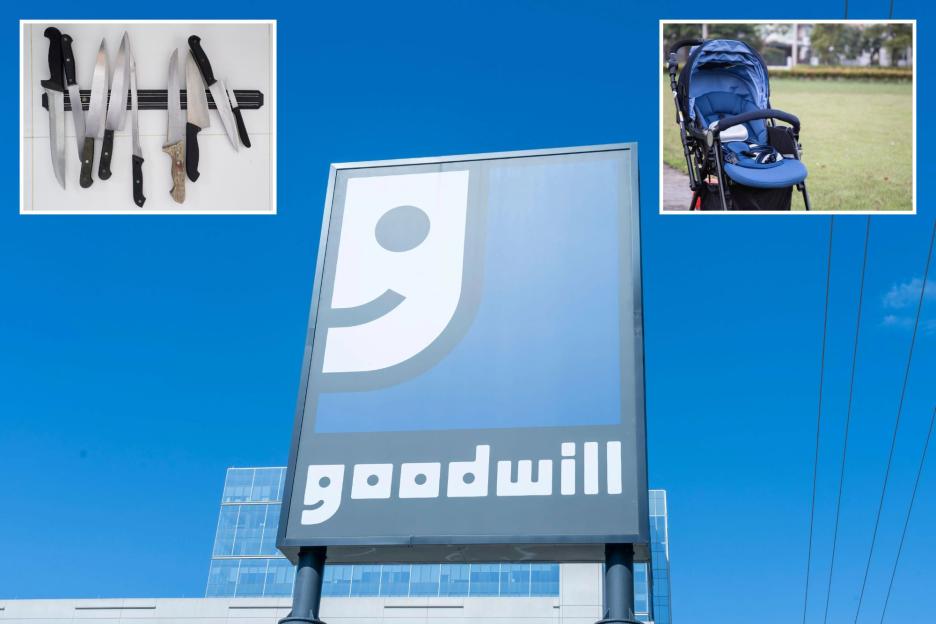
AMERICANS looking to declutter may want to think twice about donating certain items to Goodwill and other thrift stores.
Six may be accepted at some locations, but will ultimately be thrown out by them before ever hitting shelves.
 Goodwill and other thrift stores may accept some items, but that doesn’t mean they’ll ever make it to shelves Credit: Alamy
 Knives are often kept off the salesfloor due to the risk they pose as potential weapons Credit: Getty
Americans can instead save themselves a trip to Goodwill and other thrift stores by junking some items themselves, such as knives.
Even if stores accept these items, they don’t end up on shelves since even a steak knife can be turned into a weapon, thrifting expert PJ Gach told The Spruce .
Shoppers should call ahead to see if a location will junk the knives or put them on shelves, and consider giving them to friends or family instead if they won’t be sold.
Car seats and strollers are also often thrown out after being accepted as a donation due to the potential safety issues surrounding their resale.
“Due to constant recalls and safety issues, the thrift store I volunteered for would not allow them onto the sales floor,” said Gach.
“This is a health and safety issue.”
Owners of these items looking to get rid of them should instead visit their local recycling center, which is likely to accept these items.
Used cosmetics and skincare products, no matter how lightly or gently they were used, also can’t be resold due to hygiene issues.
 Strollers and car seats pose safety risks due to the recalls surrounding them, forcing thrift stores to throw them out Credit: Getty
 New sealed cosmetics can be resold at thrift stores, but anything open is typically disposed of, even if there are no obvious signs of use Credit: Getty
In addition to the fact that thrift stores have no way of confirming their conditions, old cosmetics are also susceptible to decay and can even fully spoil over time.
“As anyone who’s opened an old makeup palette and found mold growing in the eyeshadows knows, old makeup needs to be tossed out,” explained Gach.
Owners of these items can instead give them to a friend, or reuse the makeup containers for other purposes, including coin holders, candle jars, or sand-art.
While sealed new cosmetics can be accepted and resold, anything already open will be thrown out, even if it hasn’t been visibly used.
The same applies to bike helmets over the safety concerns that come with reselling a previously used piece of protective equipment.
“We just don’t want anyone to get hurt by a non-working, defective, or out-of-date product,” Cynthia Traxler, founder of a thrift store website, told The Spruce.
A surefire way to get rid of old helmets is to donate them to community bicycle repair programs, the members of which will be more informed on individual helmets and evaluating their conditions.
Local sports programs could also accept helmet donations as a means of cutting costs for activities where top-of-the-line protection isn’t fully required.
 Bike helmets aren’t resold by thrift stores due to their status as a piece of protective equipment that is best when brand new Credit: Getty
 Thrift stores are already drowning in reusable grocery bags from bulk donation drop offs, and can only resell a small portion of what they receive Credit: Getty
Reusable grocery bags are yet another item that shouldn’t be donated since thrift stores already receive plenty and can’t resell most of them.
“Only about 10% of the nicest ones are marketable,” said Traxler.
These items are instead best kept and reused by their original owners, or donated to local grocery stores.
Used vacuum cleaners also pose a marketability issue since most of those donated are often dirty or broken in some way.
“Even if they turn on, they tend to have poor suction, are clogged, have a broken belt, or are missing attachments,” explained Traxler.
Americans should instead try their hand at repairing the vacuum with the help of a YouTube video, or take it to a small appliance recycling program instead of a thrift store.