EU leaders couldn’t be more blatant about it if they tried.
They have worked out that is highly likely to be Prime Minister in 2029, with yesterday’s defection of former Tory Chancellor a further sign of which way the political weathervane is blowing.
 Nigel Farage is highly likely to be Prime Minister in 2029Credit: Alamy
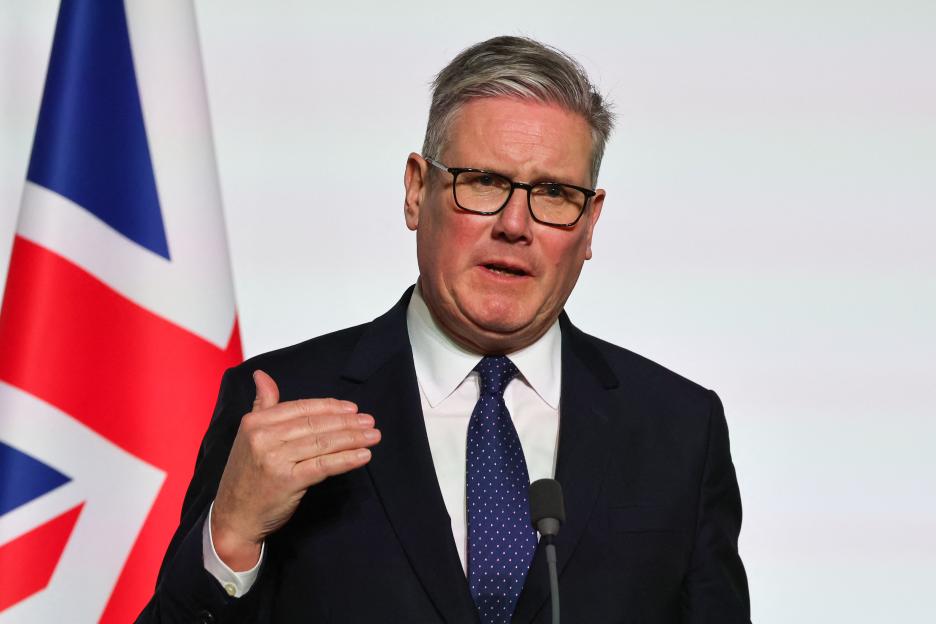 Keir Starmer is being extremely naive if he thinks the EU has changed its spots since the Brexit negotiationsCredit: AFP
They are desperate to clip Farage’s wings while they can by trying to trap Britain in cage forever after.
How else to explain a clause in a draft agreement on veterinary standards whereby Britain would be on the hook for billions of pounds of compensation payments should we ever decide to withdraw from it?
has already said that it would reverse efforts by government to take us closer to the EU.
The agreement on veterinary standards would be a terrible deal for Britain.
While it would — in theory at least — free UK exporters from some of the bureaucracy they currently face while selling goods to EU customers, this would come at a high price.
Forced to adopt
The agreement demands that Britain agrees to ‘dynamic alignment’ with EU standards indefinitely.
This means that not only would Britain be obliged to incorporate existing EU regulations into our law, we would also be forced to adopt any regulations that the EU might choose to pass in future.
It is not difficult to work out how the EU would take advantage of the situation.
It would endlessly devise new regulations which were targeted at UK farmers and food processors.
French farmers, who once cruelly set light to lorries carrying live lambs from UK farms — even when we were members of the EU — would continuously lobby for regulations which discriminated against the way Britain rears farm animals.
This is exactly what and chocolate producers did soon after Britain joined the EU.
Those countries dreamed up rules saying that to call a product ‘chocolate’ it wasn’t allowed to contain vegetable fats — which, funnily enough, is how a lot of UK chocolate was produced.
Don’t be surprised if in future the EU redefines a ‘lamb’ as a woolly animal which has been raised on EU pastures.
There would be nothing we could do about it.
Unlike when we were in the EU, we would not even get a say in any new regulations.
There is likely to be another grave consequence.
Reform has already said that it would reverse efforts by Keir Starmer’s government to take us closer to the EU
Ross Clark
One of the advantages of leaving the EU was that Britain could develop a new technology known as gene-editing, where crops can be engineered to grow faster, or require less fertiliser or pesticide.
It is an updated, more precise form of genetic modification.
The EU, in its usual Luddite fashion, wants to throttle the industry with regulations.
Rules passed by government turned Britain into a much more accommodating environment for gene- editing, meaning that the industry could flourish here.
But this is now likely to be snuffed out in Starmer’s reset.
Don’t even assume that it will become easier to trade with the EU under the new agreement.
Don’t even assume that it will become easier to trade with the EU under the new agreement
Ross Clark
If we learned anything about the EU during the long, agonising years of Brexit negotiations, it is that its leaders don’t really believe in free trade, even if they profess to.
They will go to any lengths to dream up ways of stopping other countries selling them their goods and services.
We are already supposed to have a free trade deal with the EU, negotiated by Boris Johnson’s government.
But as soon as it came into force we learned how much it meant.
Goods sent by post from UK businesses to EU customers were hit with mysterious charges which made their business uneconomic.
Food exporters were forced to fill in vast quantities of paperwork.
Lorry drivers arriving by ferry in the were even forced to dump their sandwiches before they were deemed not to conform to EU food standards — even though they had been produced under exactly the same legislation as had existed under Britain’s EU membership.
Even with a ‘reset’, the EU will try the same sort of tricks again.
The European Union is a master at what are called ‘non-tariff barriers’ — which means any wheeze employed to protect EU producers which does not involve a formal import duty.
Fooled himself
Keir Starmer is being extremely naive if he thinks the EU has changed its spots since the negotiations.
Having promised when he was elected not to reopen the issue of EU membership, nor that of the single market or customs union, he is allowing himself to be snagged in the EU’s web.
Why is he doing so? Since Brexit, Britain has traded a little less with the EU but a lot more with other countries.
Keir Starmer is being extremely naive if he thinks the EU has changed its spots since the Brexit negotiations
Ross Clark
We have new trade deals with Australia, New Zealand and India, one of the world’s fastest-growing economies.
Give it time and we can grow these new trade relationships to our advantage.
Instead, Starmer has fooled himself into thinking that it is only trade with the EU that really matters, and he is prepared to pursue it at any price.
The ‘Farage clause’ inserted in the reset agreement is a gross dereliction of the Prime Minister’s duty towards the British people, which could end up costing unnecessary billions.
Even so, I doubt it will stop a Reform UK government declaring Starmer’s deal null and void the moment it took office.
Indeed, yesterday Farage described Starmer’s deal as a ‘democratic outrage’, argued that “no Parliament may bind its successor” and that Reform UK would not be honouring any ‘Farage clause’.
The EU, in other words, can sing for its supper.