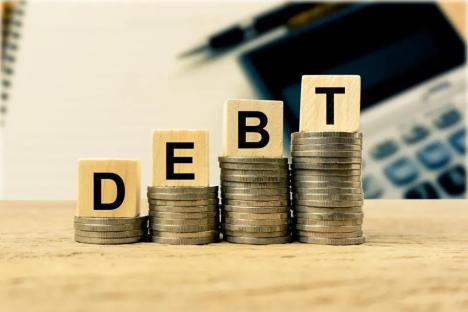
Economists and financial experts have reacted as Nigeria’s debt profile surged to N166.79 trillion amid the country’s plan to secure a fresh $1.5 billion loan from the World Bank.
DAILY POST reports that data released by Nigeria’s Debt Management Office, DMO, showed that the country’s debt profile had grown to N166.79 trillion as of June 2026.
The new debt figures released by the DMO indicated that Nigeria’s debt rose by 90.9 percent under Tinubu’s administration, increasing by N87.4 trillion to N166.79 trillion in June from N79.39 trillion in May 2023.
According to a further breakdown by the DMO, Nigeria’s external debt rose by 28.4 percent to $54.52 billion as of June 2026, while domestic debt increased by 55 percent to N91.59 trillion.
In a more specific calculation, the country’s current N166.79 trillion debt means that each Nigerian owes N716,822, representing an 87 percent increase from N383,442 three years ago.
Atiku, ActionAid react to Nigeria’s rising debt profile
The development has attracted condemnation from opposition party leaders, including Atiku Abubakar of the African Democratic Congress, ADC.
According to Atiku, the Tinubu government needs to tell Nigerians the impact of the country’s current debt burden before embarking on a fresh $1.5 billion loan from the World Bank.
Similarly, ActionAid Nigeria has also kicked against the country’s rising debt-servicing burden, which stood at N2.14 trillion in the second quarter of 2026, down from N3.14 trillion, according to the DMO.
Professor of Accounting at Lead City University, Godwin Oyedokun, and economist and Chief Executive Officer of SD & D Capital Management, Gbolade Idakolo, spoke to DAILY POST exclusively on the far-reaching implications of Nigeria’s rising debt profile.
Nigeria’s rising debt requires scrutiny, productive investment – Oyedokun
According to Oyedokun, Nigeria’s rising debt profile requires greater scrutiny. He stressed that the debate should not be limited to opposition to every new borrowing.
Oyedokun said the proposed additional $1.5 billion borrowing should be carefully assessed based on its purpose, cost, repayment terms and the economic value expected from the funds.
According to him, the key consideration should be whether the proposed borrowing would finance productive investments capable of generating jobs, increasing revenue and supporting sustainable economic growth.
“The proposed additional $1.5 billion should be assessed against its purpose, cost, repayment terms and, most importantly, whether it will finance productive investments that generate jobs, revenue and economic growth rather than recurrent expenditure,” he told DAILY POST.
He noted that borrowing could support economic development when properly targeted and transparently managed.
“The concern is not simply opposition to every new borrowing. The critical issue is the quality and accountability of how borrowed funds are deployed,” Oyedokun said.
He pointed to World Bank financing for Nigeria, noting that some of the loans and credits had been targeted at sectors and programmes aimed at strengthening investment and economic opportunities.
“The World Bank’s financing for Nigeria has included loans and credits targeted at areas such as investment and job creation, agriculture and MSME finance,” he said.
Oyedokun, however, stressed that the availability of financing was not enough, arguing that the government must demonstrate how such funds would translate into tangible economic outcomes.
“What matters is what the borrowed funds are used for, how effectively they are deployed and whether they generate sufficient economic value to justify the repayment burden,” he said.
He warned that Nigeria’s growing public debt could put additional pressure on the country’s future fiscal space if borrowing continued without corresponding economic returns.
“With public debt already placing pressure on future fiscal space, excessive borrowing can constrain the government’s ability to fund education, healthcare, infrastructure and employment opportunities for young Nigerians,” he said.
According to him, increasing debt obligations could reduce the resources available to the government for other critical sectors if borrowed funds fail to generate adequate returns.
Oyedokun called for a clear debt-to-development strategy that would link every major borrowing to specific and measurable economic objectives.
“Nigeria needs a clear debt-to-development strategy. Every significant borrowing should have measurable economic returns, transparent utilisation, strict project monitoring and a credible repayment plan,” he said.
He further urged stronger oversight of borrowed funds to ensure that projects financed with debt were completed and delivered the economic benefits for which the loans were obtained.
“Every significant borrowing should be subjected to transparent utilisation and strict project monitoring,” Oyedokun said.
He said the government should also provide Nigerians with sufficient information on the terms and expected outcomes of major borrowing programmes.
“There must be a credible repayment plan for every major borrowing, because the repayment burden ultimately falls on the Nigerian economy and future generations,” he said.
Oyedokun maintained that the central issue in Nigeria’s debt debate was not merely the size of the country’s borrowing but the purpose and impact of such borrowing.
“The concern is not merely how much Nigeria borrows, but what we borrow for, what value it creates, and who ultimately bears the repayment burden,” he said.
Debt: Expert blames DMO as Nigeria risks insolvency
On his part, Idakolo raised concerns over Nigeria’s rising debt profile, warning that increased borrowing under President Bola Tinubu has resulted in a high cost of debt servicing.
Idakolo said the Federal Government’s borrowing over the past three years had continued to increase the country’s debt burden, with the impact of the government’s economic reforms yet to be significantly felt by ordinary Nigerians.
According to him, the estimated debt burden of more than N700,000 per Nigerian is alarming, particularly given the country’s growing population.
“The past three years of President Bola Tinubu have witnessed increased borrowing, which has led to a very high cost of debt servicing.
“Despite the very harsh economic reforms to strengthen the economy, the impact is largely not felt by ordinary Nigerians,” Idakolo said.
He stressed that borrowing for infrastructure and other developmental projects should translate into tangible benefits for citizens.
“The principle of borrowing for infrastructural development must be matched with commensurate benefits to the citizenry, which is lacking at the moment,” he said.
The economist also questioned the effectiveness of the Debt Management Office, DMO, in managing the country’s borrowing structure.
He argued that the DMO needed to do more to ensure that the Federal Government does not exceed sustainable debt thresholds, warning that excessive borrowing could expose the country to insolvency risks in the event of a major economic shock or natural disaster.
“The DMO, which manages Nigeria’s debt structure, has also not strategically been up to the task in ensuring that the Federal Government does not overshoot the debt ratio, which can eventually lead to insolvency in case of a major shock in the economy or natural disaster,” he said.
Idakolo called for measures to reduce Nigeria’s appetite for borrowing, warning that continued accumulation of debt could place a heavy burden on younger generations.
“It is very imperative that Nigeria tame its loan appetite in order not to mortgage the future of young Nigerians, as this could prevent meaningful development if we continue to battle with debt servicing at the expense of investment in the future of the young ones coming up,” he added.