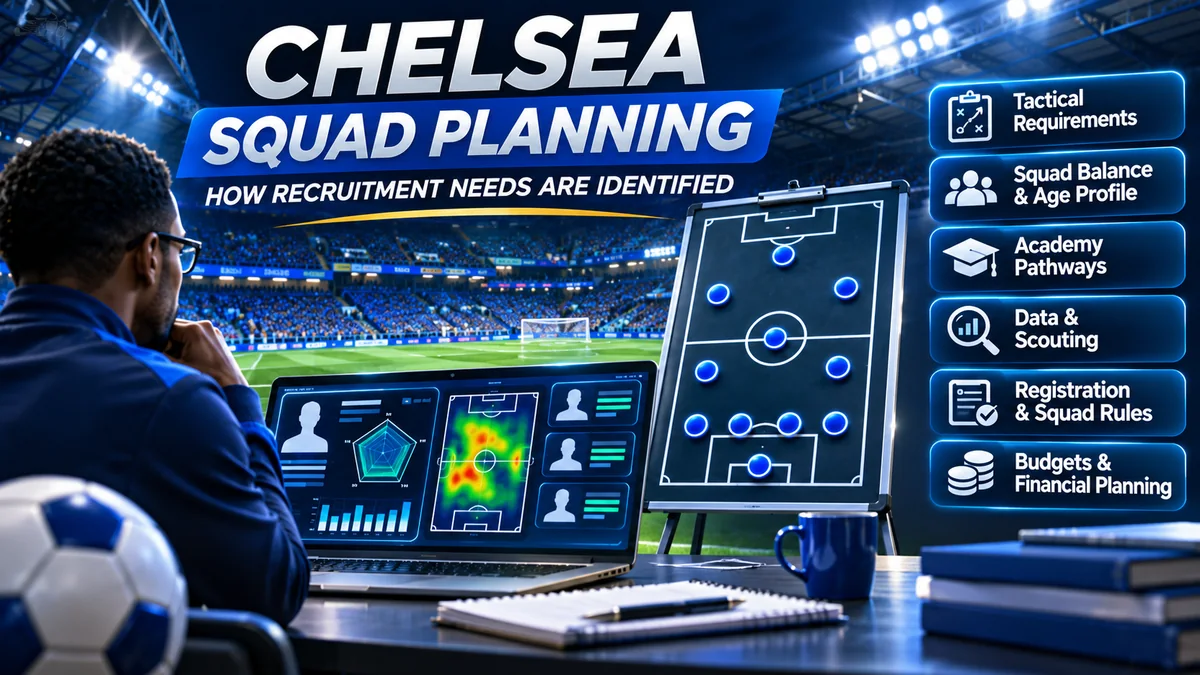
How does Chelsea decide whether a new signing is necessary? The credible starting point is not a viral transfer rumour or a famous player's availability. It is a structured review of what the squad can do, what the manager's football demands, which players may develop or depart, and whether a proposed recruit fits registration and financial limits. Recruitment needs are identified by comparing the roles required to compete with the players already available to perform those roles.
For supporters searching for “football news transfer Chelsea”, that distinction is essential. A club may be linked with numerous midfielders or defenders without having an urgent need for every one of them. This guide explains the recruitment logic, applying public information from Chelsea FC , the Premier League and UEFA . It does not claim access to Chelsea's private scouting files or undisclosed transfer targets.
Research verified: 25 November 2026. Chelsea appointed Xabi Alonso as men's team manager from 1 July 2026, according to the club's official announcement . That matters because a recruitment analysis must start with the footballing approach and the players required to execute it, while recognising that the coaching and sporting structure can change.
Start with the squad problem, not a transfer-market name
When supporters say a club “needs a striker”, they may be describing different problems: low-quality chances, poor finishing, limited movement behind the defence, weak pressing, a lack of aerial threat, injuries or insufficient alternatives. Each problem has a different solution. A new centre-forward might help one issue while doing little for the others.
A professional recruitment brief should specify the task to be performed. Instead of “sign a midfielder”, it might ask whether the team needs someone who can receive under pressure, protect space when full-backs push forward or carry the ball through the first defensive line. Scouts can then compare players who perform the relevant actions in their existing leagues, while analysts account for differences in playing style and opposition.
For Chelsea, this means evaluating the role in relation to Alonso's stated game model, not assuming a formation on paper tells the whole story. An attacking full-back, a wide defender in a back three and a conventional full-back all operate in different circumstances. Buying a player because they share a nominal position with an outgoing one does not guarantee a tactical replacement.
1. Audit every position, role and succession plan
Squad planning begins with an inventory, not a shopping list. The sporting team can map each position across a current starter, plausible rotation options, academy prospects, loaned players and potential departures. It also needs to note which players can credibly cover multiple roles. A full-back who has occasionally appeared on the opposite side is not necessarily an equally strong alternative there across a season.
For each role, a useful audit considers minutes played, performance under different opponents, expected availability, contract horizon, development stage and the risk of needing two alternatives at once. Public performance data can inform this conversation, but internal training, medical and tactical evidence is usually not available to readers.
For example, a squad with four centre-backs could still lack the specific left-sided passing profile the manager needs. Conversely, a position with only two senior names may not justify a transfer if an academy player is ready for meaningful minutes and the match schedule is manageable. Headcount alone is not the same as depth.
The club's official summer 2026 transfer tracker records arrivals, departures, contract developments and loans. Such records provide a firmer basis for counting available players than an old squad-number graphic, which can remain online even after transfers have altered the roster.
2. Identify tactical profiles rather than collecting famous names
The manager's game model changes the meaning of squad depth. A side that builds short under pressure may value centre-backs and a goalkeeper who can pass through a press. A high defensive line increases the importance of recovery speed and positioning. A demanding pressing system adds repeated sprint capacity and coordinated defensive behaviour to the assessment.
None of these traits should be reduced to a single statistic. A defender completing many passes may simply play in a side with safe possession. A winger with many dribbles may have a completely different role from one asked to attack the far post. Video review and context are needed to establish whether numbers indicate genuine suitability.
Look at role-specific questions:
- Defenders: Can they defend large spaces, win duels, progress possession and coordinate with different partners?
- Midfielders: Can they receive with pressure behind them, keep defensive balance, circulate possession and create progression?
- Wide players: Do they offer width, one-on-one threat, off-ball runs, reliable pressing and final-third decision-making?
- Forwards: Are they suited to the team's chance creation, link play, box movement and defensive work?
- Goalkeepers: How do shot-stopping, command of the area and distribution match the manager's system?
A signing who looks outstanding in one team's style may require adaptation at another. Good recruitment distinguishes an attractive footballer from a necessary and well-matched footballer.
3. Check availability, workload and squad balance
Recruitment needs are not determined only by a player's best performances. A club competing in domestic and European competitions needs enough reliable options across congested weeks. A footballer who can play two positions may provide flexibility, but repeatedly moving them around can create weaknesses elsewhere.
Evaluation therefore examines patterns over time: how regularly a player can be selected, the distribution of match minutes, recurring physical demands, recoveries after intense fixtures and the effects of international travel. Medical decisions should be based on authorised professional assessments, not fans diagnosing injuries from social-media clips.
Balance also includes age and experience. A squad heavily concentrated in one development stage can contain immense potential but still need leadership and experience in particular situations. The opposite problem arises when too many players have similar contract expiry dates or are likely to decline together. A useful succession plan asks which roles need cover now, which could need replacements in one to two seasons and which can be filled through development.
Illustrative scenario, not a claim about Chelsea's current squad: if a hypothetical team has one established holding midfielder, two attacking midfielders and a promising academy No.6, a recruitment team should first decide whether the young player can cover the holding role. Simply signing another attack-minded midfielder would not solve the defensive-balance problem.
4. Compare recruitment with Chelsea's academy and loan pathways
Buying is only one response to a squad need. A club can promote a graduate, recall a suitable loaned player where permitted, give an existing footballer a new role or pursue a targeted signing. These options should be assessed against the same football requirements instead of treating academy development as a separate afterthought.
Chelsea has publicly described this pathway. The club appointed Glenn van der Kraan as Academy Director in 2026 and announced a Pathways Director role dedicated to helping young players prepare for senior football. Its Academy leadership announcement also identified responsibilities spanning recruitment, insights, performance and player development.
From the 2026/27 season, Chelsea renamed its leading development sides Cobham Next Gen , stressing the transition toward senior football rather than viewing the Under-21s as an isolated competition. Reece James, Levi Colwill and Josh Acheampong were among the academy graduates identified by the club as senior-squad examples when it made the announcement.
Loans provide another route. Chelsea's 2026 summer tracker documents numerous players moving temporarily to senior teams in England and abroad. The existence of a loan does not automatically mean the player will become a first-team option: coaches still need to judge actual minutes, tactical fit, progression and contractual circumstances. But a well-developed player returning from loan may change a transfer priority.
How Chelsea has described its talent-identification process
In its Future Blues programme , Chelsea described academy scouting through grassroots observation, footage, trial sessions and regular assessment by coaches and scouts. The club outlined the use of scoring criteria and technology in evaluating young players. That is evidence of a structured approach to academy talent identification; it should not be misrepresented as a disclosure of the senior team's confidential recruitment algorithm.
5. Combine scouting judgement with data, not replace one with the other
Data can help identify players who merit a closer look. Event data can describe progressive carries, passes into dangerous zones, chance creation, pressing activity and duels. Tracking data, where available, may add positioning, movement and off-ball behaviour. Video allows analysts to inspect the situations behind those measurements.
Different contexts demand different adjustments. A player in a dominant team may spend little time defending. Another may face persistent pressure and have lower completion rates despite making more difficult passes. League quality, team tactics, playing time and age all affect interpretation. Shortlists should not rely on raw totals without analysing opportunity and role.
Chelsea's publicly described academy programme explicitly combines coaches, scouts and assessment technology. Its broader sporting leadership has also referenced scouting and data. Those announcements support the general principle of multidisciplinary evaluation without establishing exactly how any recent senior signing was scored or approved.
A sensible workflow is to define a role, use scouting and data to identify candidates, review full matches, compare skills against the team's tactical demands, investigate character and professional support within appropriate privacy boundaries, and test affordability. The strongest candidate is not necessarily the one with the highest highlight-reel output or the most fashionable name.
6. Account for Premier League squad registration rules
Even an ideal recruit must fit the competition's eligibility rules. The Premier League permits a squad list of up to 25 senior players, with no more than 17 who are not home-grown. Eligible Under-21 players are outside that 25-player list. The league's official 2026/27 squad-list explanation sets out the regulations.
“Home-grown” is a registration classification, not a nationality test. Under the Premier League's definition, qualifying training time with clubs affiliated to the English or Welsh associations before the relevant age threshold is key. A foreign national may qualify, while an English player who developed elsewhere may not. Readers should check the season-specific rules for the precise Under-21 eligibility cutoff rather than making assumptions based on a player's age alone.
Registration capacity can therefore create a problem not obvious from the transfer fee. A club that has filled its relevant list places might need to move another senior player out or alter its registration plan before an incoming footballer can be included. The official 2026/27 Premier League squad lists give supporters a better reference than an unverified social-media graphic.
7. European registration changes the calculation again
Domestic eligibility and European eligibility are related but not identical. UEFA's 2026/27 Champions League registration guidance describes List A and List B. Clubs can register up to 25 players on List A, with places reserved for locally trained footballers; if a club has fewer than eight locally trained players, its maximum List A size is reduced accordingly. List B has additional age and club-training requirements.
UEFA distinguishes club-trained and association-trained categories. A young signing is not automatically List B eligible simply because they are under 21: the relevant training history matters. Likewise, signing a player during a domestic window does not necessarily make that player eligible for all European fixtures immediately.
That creates a practical recruitment question: is the player being signed to help the Premier League squad, the European squad, the development pathway or a combination? A transfer that looks straightforward in domestic squad lists may require a different plan for UEFA registration.
8. Assess total cost under the rules that apply in 2026/27
The fee reported in a headline is not the whole cost of a signing. A recruitment decision may include wages, signing and agent fees, contract length, transfer-fee amortisation, performance incentives and potential future resale value. A low transfer fee can become expensive if ongoing wages are high; a costly acquisition may still be defensible if the sporting contribution and financial circumstances justify it.
Financial reporting must also use the correct rules for the correct season. According to the Premier League's July 2026 explanation , its Squad Cost Ratio and Sustainability and Systemic Resilience framework replaced the former Profitability and Sustainability Rules from the start of 2026/27. The Premier League SCR green threshold is 85% of relevant football revenue and net player-sale profit/loss, with additional compliance provisions. UEFA operates its own 70% squad-cost ratio for clubs covered by those rules.
It would therefore be outdated to present Chelsea's 2026/27 planning solely as a question of remaining room under the old Premier League three-year PSR test. Historical PSR cases can still concern earlier periods, but current recruitment analysis should consider the new framework and the club's European obligations where applicable.
Supporters should also avoid inventing Chelsea's internal spending headroom from media estimates. A club's exact compliance assessment depends on recognised revenue and cost definitions and information not always publicly available. The fact that a team can afford a fee in cash does not by itself settle registration or regulatory questions.
9. Turn the needs assessment into a ranked shortlist
A realistic recruitment plan usually contains priorities rather than an equal-interest list of stars. A club might classify one role as essential this window, another as useful if a departure occurs, and a third as a longer-term succession opportunity. These priorities can move when a player is injured, a young prospect improves, a contract changes or an unexpected offer arrives.
The following is an illustrative editorial framework—not Chelsea's internal scoring model. It shows how a hypothetical club could compare options consistently:
| Assessment | Key question | Possible evidence |
|---|---|---|
| Tactical fit | Can the player perform the specific role? | Full-match video, role-adjusted metrics, coaching review |
| Urgency | What happens if the club does not recruit now? | Depth chart, fixture load, contract and availability review |
| Development upside | How much could the player improve? | Age, progression, coaching needs, learning profile |
| Registration | Can the player be selected in intended competitions? | League and UEFA list eligibility |
| Total cost | Can the transaction fit financial limits sustainably? | Fee, wages, agent costs, amortisation, revenue scenarios |
| Alternative solution | Would promotion, a loan return or role change work? | Academy and loan scouting reports |
A shortlist should contain more than one candidate. Negotiations can fail, an injury can alter a valuation, or a club may refuse to sell. Good planning involves alternatives and a clear ceiling at which a sporting need no longer justifies the financial commitment.
10. Why a reported Chelsea transfer link is not proof of a recruitment need
Transfer reporting operates at different levels of certainty. A player can be scouted without being targeted for a bid. An agent may offer a player to multiple teams. An exploratory contact is not the same as an agreed transfer. A reported agreement can also remain subject to medical, paperwork or registration steps.
The reverse is true: a club can have a genuine tactical shortage without any public reporting about a preferred signing. Sporting departments have reasons to keep assessments confidential, while media reports often focus on a small subset of market possibilities.
FlyingEze has reported on a reported Chelsea–Arsenal transfer race involving Alex Scott . That is an example of the type of transfer-coverage headline readers should evaluate, not confirmation that Chelsea submitted a bid or identified the player as a strategic priority. Such assertions need independent, dated verification.
For related tactical context, FlyingEze also covered discussion of Alonso's approach to Arsenal's set-piece threat . Match-specific analysis can reveal how a manager uses available personnel; it should not be converted automatically into claims that Chelsea is seeking a particular replacement.
How supporters can test a plausible Chelsea recruitment story
When the next “Chelsea need to sign” headline appears, ask these questions before treating it as a club decision:
- What problem is the player supposed to solve? Name the tactical role, not only the position.
- Who already covers it? Check the current official squad, loan list and academy options.
- Is the weakness persistent? One poor match or injury scare can distort a wider pattern.
- Does the proposed player fit the manager's style? Consider off-ball duties and the context behind statistics.
- Is the player realistically eligible? Review domestic and European registration constraints.
- Is the cost sustainable? Consider wages and squad-cost rules, not merely the headline transfer fee.
- How strong is the source? Distinguish club confirmation, credible reporting, speculation and recycled rumours.
The most useful Chelsea transfer analysis answers those questions even when it cannot name a target. It adds more value than simply predicting a signing because a club is famous or a player's agent has spoken to journalists.
Frequently asked questions
Who identifies Chelsea's recruitment needs?
The process involves the manager and coaching staff, sporting leadership, scouting, analysts and academy or player-development personnel. Chelsea has publicly described a multidisciplinary sporting department, but responsibilities can evolve. Public sources do not reveal every internal decision or the confidential ranking of possible signings.
Why might Chelsea sign a player in a position that looks well covered?
Players in the same position can offer different tactical roles. The club may also be planning for contracts, future departures or a longer-term development opportunity. These are possible explanations, not proof of a reason behind an individual deal.
Can Chelsea use academy players instead of buying?
Yes. Promotion, development loans and assessing a returning player are potential alternatives. The key question is whether the individual is ready for the role and level of football required.
Does home-grown mean English?
No. The Premier League definition concerns qualifying time registered with affiliated English or Welsh clubs before the specified age threshold, regardless of nationality.
Do the old Premier League PSR rules still apply to 2026/27 planning?
The Premier League says Squad Cost Ratio and related sustainability regulations replaced PSR from 2026/27. Its powers concerning relevant earlier PSR periods remain, but a current 2026/27 squad-cost assessment should not be described as if the previous rules still govern the season.
Does a reported Chelsea transfer target mean a deal is close?
No. Scouting, interest, talks, bids, agreements and completed registration are distinct stages. Strong evidence and club or regulatory confirmation should determine how confidently each claim is described.
Conclusion: effective recruitment starts with clear needs
Chelsea squad planning is best understood as a balancing exercise involving the manager's tactics, first-team depth, youth development, loan pathways, performance evidence, registration eligibility and financial limits. A headline linking the club with another footballer is only a small piece of that process.
The strongest question for supporters following football news transfer Chelsea is not simply “Who will Chelsea sign next?” It is “Which role genuinely needs strengthening, what alternatives already exist, and what evidence shows a particular player is the right solution?” Asking those questions makes transfer coverage more informative, even when the market remains full of rumours.