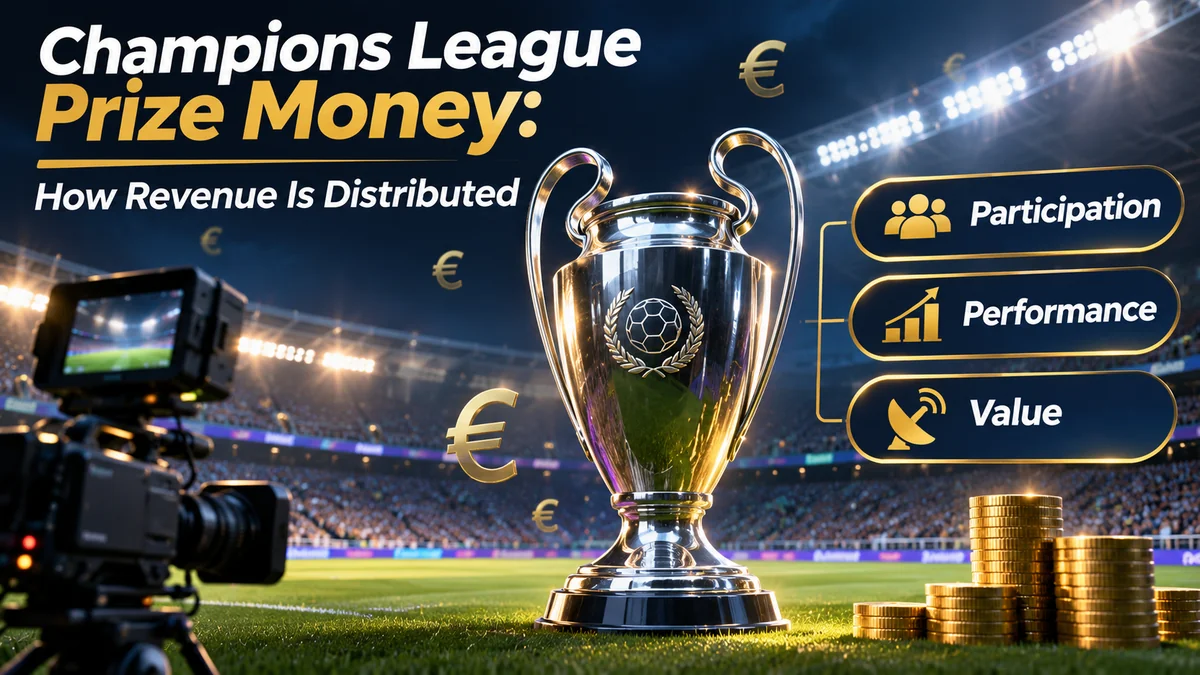
UEFA Champions League prize money is not a single cheque awarded to the club that lifts the trophy. Under UEFA's 2026/27 revenue-distribution system, every one of the 36 league-phase clubs has an expected starting allocation of about €18.62 million. Clubs can then earn €2.1 million per league-phase win, €700,000 per draw, league-table ranking bonuses, money for advancing through the knockouts and a separate allocation known as the value pillar.
UEFA expects to distribute €2.467 billion to clubs involved in the Champions League and the corresponding UEFA Super Cup for the season. Of that sum, €2.437 billion forms the league-phase-onwards distribution base, divided into three pillars: 27.5% equal shares, 37.5% sporting performance and 35% value-related distributions. The remaining €30 million in this Champions League/Super Cup allocation covers clubs eliminated in Champions League qualifying play-offs.
The figures come from UEFA Circular Letter No48, dated 13 July 2026 , and the 2026/27 competition financial regulations . These are planned distribution amounts, not guaranteed final receipts: UEFA says its ultimate allocations depend on revenues actually received and final confirmation.
This article explains where the money originates, how clubs qualify for each payment, why a strong league-table finish matters and why two clubs reaching the same round may still receive very different amounts. Although some readers search for “European championship league”, the competition discussed here is the men's UEFA Champions League, not the national-team European Championship. Research verified on 8 November 2026.
Where does Champions League prize money come from?
The biggest source of UEFA's club-competition revenue is the commercial rights it sells centrally, particularly television and streaming rights. UEFA also earns money through commercial partnerships, sponsorship and competition-related ticketing and hospitality arrangements. Those income streams are managed across the Champions League, Europa League, Conference League and Super Cup under the relevant commercial agreements.
UEFA's men's competitions financial-distribution overview describes how money is reinvested in both participating and non-participating clubs. A crucial distinction is that the combined €4.4 billion gross revenue threshold is not solely Champions League prize money. It is the planning basis for UEFA's three men's senior club competitions and the associated Super Cup.
The July 2026 financial circular sets out the following estimated flow, in euros:
| 2026/27 distribution step | Amount | Purpose |
|---|---|---|
| Gross club-competition revenue threshold | €4.4bn | Collective planning base for the UEFA men's club competitions and Super Cup |
| Organisation and administration | €387m | Estimated competition costs |
| Qualifying-round allocation | €132m | Payments across relevant qualifying competitions |
| Solidarity for non-participating clubs | €308m | Support for eligible clubs outside the main competitions |
| Women's Champions League and Youth League | €25m | €22m and €3m respectively |
| Resulting net amount | €3.548bn | Available for the final participating-club/UEFA split |
| Allocated to participating clubs | €3.317bn | 93.5% of the net amount, across the three men's competitions |
UEFA reserves the other 6.5% of net revenue for its investment in European football. The participating-club share is divided between the Champions League and Super Cup (€2.467bn), Europa League (€565m) and Conference League (€285m).
These are budgeted allocations, not audited final revenues for 2026/27. Comparing them with an individual club's earnings requires moving from the competition-wide pool to the club's specific payments.
The three pillars that determine a Champions League club's income
UEFA allocates the €2.437bn league-phase-onwards pool through three mechanisms:
| Pillar | Share of €2.437bn | Budgeted allocation | What determines an individual club's share? |
|---|---|---|---|
| Equal starting payment | 27.5% | €670m | Qualification for the 36-club league phase |
| Performance | 37.5% | €914m | Results, league ranking and progress through knockout rounds |
| Value pillar | 35% | €853m | Commercial-market and historical UEFA club-ranking calculations |
| Total | 100% | €2.437bn | Combination of the three parts |
The three-pillar structure is why headlines saying a winner earns just one prize-money figure can be misleading. The trophy winner also receives payments earned much earlier, and its value-pillar allocation may differ from that of another finalist.
1. Participation payment: €18.62 million for reaching the league phase
Every club among the 36 participants in the league phase receives a planned equal starting allocation of €18.62m, subject to UEFA's final distribution adjustments. UEFA divides that into an expected €17.87m down-payment and a €750,000 residual amount later in the payment schedule.
That starting fee does not depend on whether a club wins its first match or finishes in the bottom positions of the final league table. It is intended as the baseline participation reward for earning a place in Europe's premier club competition.
For a club from a relatively small commercial market, this amount can represent significant income. For a club with large operating costs, it is still not equivalent to free profit: wages, bonuses, travel, stadium costs and other obligations must also be met.
Important: qualifying for the league phase and reaching the summer Champions League qualifying play-offs are not the same. The different treatment of play-off losers is explained below.
2. Performance bonuses: wins, draws and final league ranking
How much does a Champions League win or draw pay?
Under the 2026/27 circular, UEFA allocates the following amounts for each league-phase result:
| League-phase result | UEFA performance allocation |
|---|---|
| Win | €2.1m |
| Draw | €700,000 |
| Defeat | €0 direct result bonus |
These match-result bonuses are separate from the starting payment, ranking rewards and the value pillar. A club winning four matches and drawing two during its eight-match league campaign would, for example, earn €9.8m in direct result bonuses: four wins at €2.1m (€8.4m) plus two draws at €700,000 (€1.4m).
UEFA has also designed a redistribution mechanism for the portion saved when matches end in draws. The amounts not paid as full win bonuses are added proportionally to the league-ranking distribution, so the initial ranking-share values described below can increase.
How the 36-team league table adds another payment
UEFA gives every finishing position a number of league-ranking shares. The team ranked 36th receives one share and the team ranked first receives 36 shares, producing a total of 666 shares across the table.
Each share starts at a planned €275,000, before the uplift generated by drawn matches. For illustration, the baseline allocations are:
| League-phase finish | Initial ranking shares | Initial ranking payment |
|---|---|---|
| 1st | 36 | €9.9m |
| 8th | 29 | €7.975m |
| 12th | 25 | €6.875m |
| 24th | 13 | €3.575m |
| 36th | 1 | €275,000 |
These are baseline calculations, not guaranteed final payouts, because the draw-related redistribution can increase their value.
There is a further ranking reward: clubs finishing 1st–8th earn an additional €2m, while clubs in 9th–16th receive an additional €1m. Finishing higher can therefore be valuable beyond simply earning a favourable sporting route.
3. Knockout prize money: what advancing through each round pays
The sporting-performance pillar rewards qualification for successive knockout stages. UEFA's 2026/27 circular lists the following additional qualification payments:
| Stage reached or qualification achieved | Additional allocation |
|---|---|
| Knockout round play-offs (clubs ranked 9–24) | €1m |
| Round of 16 | €11m |
| Quarter-finals | €12.5m |
| Semi-finals | €15m |
| Final | €18.5m |
| Winner of the final | €6.5m extra |
The amounts are cumulative stage-related additions, not alternative prize levels. For example, a club reaching the semi-finals after entering the round of 16 can collect the round-of-16 payment, the quarter-final payment and the semi-final payment, as applicable, in addition to earlier league-phase money.
A finalist receives the €18.5m final-qualification payment; the winner receives a further €6.5m. Accordingly, UEFA's additional winner's bonus is €6.5m, not the club's complete Champions League earnings and not a standalone €2.467bn pot.
Teams finishing in the league phase's top eight bypass February's knockout play-offs and do not need that extra round to reach the last 16. Clubs ranked ninth to 24th earn the separate €1m play-off qualification payment and can then earn €11m if they reach the round of 16. Teams finishing 25th–36th receive no further Champions League knockout qualification reward.
For context on how the revised qualification and knockout structure came about, FlyingEze's earlier report on the approval of the new Champions League format provides useful background. The monetary amounts here, however, come from UEFA's 2026/27 financial circular.
4. The value pillar: why clubs with similar results receive different totals
The most difficult part of Champions League distributions to understand is UEFA's €853m value pillar. Unlike the equal starting fee or fixed win bonus, this amount is not distributed equally and is not calculated from the current season's points alone.
The value pillar combines elements that previously formed the market pool and club coefficient pillars. Its purpose is to allocate money in a way that accounts for broadcasting-market values and clubs' historical participation and European performance. UEFA divides it into a European part and a non-European part.
For the 2024–27 rights cycle, UEFA's 2026 circular gives a 73% European / 27% non-European split, based on its relevant commercial contracts.
European part
UEFA first ranks the participating clubs' domestic markets by the financial contribution of domestic broadcasters. Clubs are then ranked within the permitted market-related positions and a separate five-year UEFA coefficient ranking is considered. The overall ranking combines those measures, and payments are distributed through a 666-share ranking system.
Non-European part
The non-European allocation uses a ranking based on the participating clubs' ten-year UEFA coefficients, excluding the historical title bonus specified in the rules. Again, the 36 clubs are ranked for shares rather than receiving identical amounts.
This means a club can earn a large value-pillar amount because of its historical standing and associated commercial-market contribution, even if another club has a similarly successful campaign. It does not mean that UEFA simply pays each club according to its social-media followers or individual ticket sales.
The value pillar also helps explain why comparing UEFA income totals between clubs by wins and knockout results alone is incomplete. To calculate a club's actual distribution, analysts need the final value-pillar shares as well as its sporting results.
Worked example: a hypothetical club that reaches the round of 16
Imagine a fictional club that finishes 12th in the league phase, records four wins, two draws and two losses, survives the knockout round play-offs and then goes out in the round of 16. Using UEFA's initial published figures:
| Revenue component | Illustrative calculation | Amount |
|---|---|---|
| League-phase starting allocation | Fixed expected starting fee | €18.62m |
| Win bonuses | 4 × €2.1m | €8.4m |
| Draw bonuses | 2 × €700,000 | €1.4m |
| League ranking (12th) | 25 shares × €275,000 | €6.875m |
| Additional top-16 ranking bonus | 9th–16th place | €1m |
| Knockout play-off qualification | Stage bonus | €1m |
| Round-of-16 qualification | Stage bonus | €11m |
| Subtotal before value pillar and adjustments | €48.295m |
The club's total would then also include its own value-pillar allocation and any league-ranking uplift from redistributed draw-related funds, subject to UEFA's final distribution. The example is not a prediction or a reported payout for a real club. It also omits any other income the club may earn commercially outside UEFA's central distributions.
This simple calculation shows why two clubs knocked out at the same stage can receive different amounts: they may have different win totals, ranking positions and historical-commercial value shares.
What happens to clubs eliminated during qualifying?
Not every club that enters Champions League qualification reaches the lucrative 36-team league phase. UEFA operates a separate qualifying-phase and solidarity payment system across its men's club competitions.
For the summer Champions League qualifying play-offs in 2026/27, UEFA allocates a separate €30m pool to clubs eliminated at that point, with an expected fixed payment of €4.29m per eliminated club. The play-off winners receive the league-phase distribution instead, not an additional €4.29m play-off payment.
That summer qualifying play-off is different from the knockout round play-offs played after the 36-team league phase. Confusing the two is a frequent source of inaccurate prize-money tables.
For earlier qualifying rounds, the July 2026 circular describes fixed per-round payments, elimination-related payments and certain extra support for domestic champions who do not make any UEFA league phase. Specific entitlements depend on a club's route and the competition it reaches after elimination. A club should not simply add all possible qualifying fees to its eventual Champions League league-phase payment.
What is Champions League solidarity money, and who receives it?
UEFA also directs part of its competition income to clubs that are not participating in the centralised league phases. Under the 2026/27 framework, 7% of the €4.4bn gross threshold—€308m—is budgeted for eligible non-participating clubs, alongside the separate 3% qualifying-round allocation of €132m.
These sums are not extra league-phase win bonuses. They are intended to spread part of the value created by European club competitions through the wider football system.
UEFA's solidarity policy explains that national associations and leagues have roles in distribution, subject to rules and development purposes. The funds are linked to youth development and eligible community or grassroots uses, rather than being an automatic flat payment to every club in Europe.
This is an important part of the debate about competitive balance. The Champions League generates substantial income for participants, but UEFA reserves a defined portion for clubs outside the elite competition. Whether that fully offsets financial disparities is a separate economic question, not something the existence of the solidarity fund alone can prove.
Do television audiences and national markets influence payments?
Yes, through the value pillar—but not through a simple formula based on one match's viewing figures. UEFA sells centralised audiovisual rights across countries. Those rights contracts help determine the ranking and allocation of the European market-related element of the value pillar. Historic club coefficients affect the distribution too.
By contrast, the direct €2.1m win reward is the same published amount for any league-phase club that wins. Similarly, the €18.62m starting allocation does not become larger merely because a club attracts a larger crowd to its first home fixture.
Club-level merchandising, individual sponsorships and certain ticket-related receipts should not be conflated with central UEFA distributions. A club might report substantial total matchday or sponsorship revenue without that money being part of the UEFA competition allocation shown in this article.
When does UEFA pay Champions League prize money?
UEFA does not pay all of a club's eventual entitlement immediately after the final. Its payment arrangements distinguish early participation advances, value-pillar instalments, league-phase results, ranking distributions, knockout-stage payments and later reconciliations.
UEFA's published provisional 2025/26 schedule , for example, separated the starting-fee down-payment and a first value-pillar instalment from later result and knockout payments. That historical schedule illustrates the principle; it is not a claim that every 2026/27 transfer will use the identical payment dates.
The 2026/27 Article 65 states that UEFA's payments are gross amounts, covering taxes and other charges, and are made in euros via the relevant national association's bank account, with the club responsible for coordination onward to its own account.
Final revenue receipts, adjustments, conditions and payment timing are therefore important when interpreting the amounts. A reported allocation is not necessarily the same thing as cleared cash available to spend that day.
Why Champions League earnings matter to clubs' finances
European competition can affect a club's annual accounts in several ways. Qualification creates an expected central revenue stream. Success in matches and knockout rounds raises that stream, while commercial exposure may support other business activities that are not directly included in UEFA prize-money calculations.
But additional fixtures can also increase operating costs: travel, match preparation, bonuses agreed with players or staff, security, hospitality and stadium operations. Some clubs may also face cash-flow timing differences between when expenses are incurred and when UEFA payments arrive.
A club's revenue is not the same as its profit. A €50m UEFA distribution does not imply €50m in net income, and a particularly successful season should not automatically be treated as a recurring long-term revenue guarantee. Clubs planning future budgets need to consider what happens if they fail to qualify in the following season.
Higher UEFA rewards for successful or historically strong clubs can also fuel debate about the financial gap between Europe's wealthiest teams and smaller competitors. Equal participation shares and solidarity payments reduce some differences, while performance and value-based allocations can magnify others. These are consequences of the design, not proof of how any particular club spends its award.
Common misunderstandings about Champions League prize money
- “The winner gets €2.467bn.” Incorrect. That is the planned Champions League and Super Cup distribution pool, not one team's reward.
- “Winning the final pays only €6.5m overall.” Incorrect. €6.5m is the additional winner's bonus, on top of other accumulated allocations.
- “Every club reaching the last 16 earns the same total.” Incorrect. Starting fees may match, but results, rankings and value-pillar amounts differ.
- “The €853m value pillar is split evenly.” Incorrect. UEFA uses market and coefficient ranking calculations.
- “UEFA has already paid every 2026/27 amount.” Incorrect. The circular describes planned distributions subject to later payments and final confirmation.
- “The Champions League knockout play-offs pay the same as the summer qualifying play-offs.” Incorrect. Those are distinct stages with different allocation rules.
Frequently asked questions
How much does a club get just for reaching the Champions League league phase?
UEFA's 2026/27 distribution circular provides an expected equal starting allocation of €18.62m for each of the 36 league-phase clubs, split between an initial down-payment and a later balance. Final distributions remain subject to UEFA's confirmation.
How much is each Champions League win worth?
A league-phase win earns a planned €2.1m direct performance reward. A draw earns €700,000. Clubs can also earn separate ranking, knockout and value-pillar allocations.
How much does the Champions League winner receive?
The winner is eligible for the €6.5m additional winner's bonus plus participation, league-phase results, ranking, knockout progression and its value-pillar allocation. The full total is different from simply adding the trophy-winning bonus.
What is the Champions League value pillar?
It is a planned €853m portion of the league-phase-onwards distribution, awarded using European and non-European market-related and UEFA club-ranking mechanisms. It is not shared equally.
Do clubs receive prize money for drawing a Champions League game?
Yes. Under the 2026/27 scheme, each league-phase draw brings a direct €700,000 reward, while additional unallocated performance funds are redistributed through league-ranking shares.
Do eliminated Champions League qualifiers receive anything?
Eligible clubs can receive specified qualifying, elimination or related competition payments depending on their path. The clubs eliminated in the summer Champions League play-offs have a distinct expected €4.29m allocation.
Is all Champions League prize money paid directly to clubs?
UEFA's 2026/27 rules state that payments are made in euros to the relevant national associations' bank accounts, with clubs coordinating onward transfers. The amounts are gross and can be affected by the applicable terms and adjustments.
Is Champions League prize money separate from Europa League and Conference League money?
Yes. UEFA operates different distribution pools for the three competitions, although their commercial revenue and overall solidarity mechanisms are addressed together in the 2024–27 framework.
Conclusion
The Champions League is more than a sporting tournament: it is a large commercial competition whose money is redistributed through a structured financial system. For 2026/27, UEFA plans an €18.62m starting allocation for every league-phase club, with further rewards for wins, draws, league ranking and knockout progression, alongside the substantial €853m value pillar.
The amount a club ultimately receives depends on several factors. A strong European season can add tens of millions of euros to its central distribution, but an accurate total requires the club's final result bonuses, ranking adjustment, value-pillar allocation and UEFA's confirmed payments. The competition also funds qualifying clubs and wider football solidarity.
For the authoritative figures and any later revisions, consult UEFA's 2026/27 financial circular and its financial-distribution overview .
Editorial verification: 8 November 2026. Monetary figures are UEFA's planned 2026/27 distributions and may be adjusted after revenues and final allocations are confirmed. FlyingEze is an independent publication and is not affiliated with UEFA.