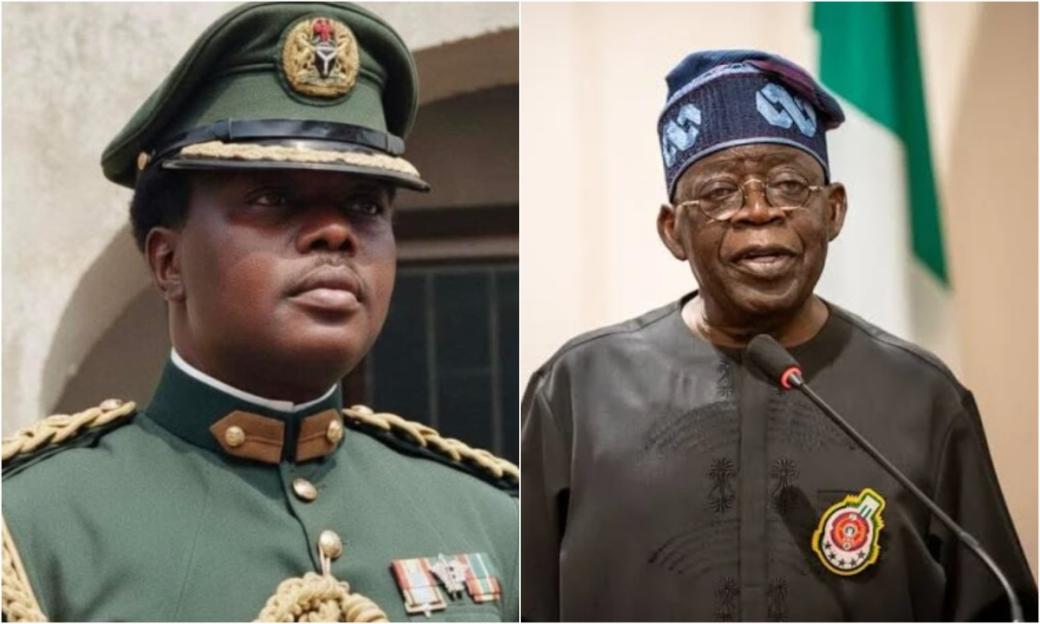
A chieftain of the All Progressives Congress, APC, Dr George Agbakahi has drawn comparison between the leadership styles and policy legacies of the late former military Head of State, General Murtala Muhammed, and the current President, Chief Bola Ahmed Tinubu.
Speaking on the Nigeria Television Authority (NTA) programme, Nigeria Today, monitored by DAILY POST, Agbakahi described both leaders as “courageous and visionary,” highlighting their shared commitment to bold, transformative reforms in critical sectors of the Nigerian economy.
The family and friends of Gen Muhammed recently marked the 50 years anniversary of his passing.
He was assassinated on February 13, 1976 (age 37 years) in a botched coup led by Bukar Suka Dimka, a Lieutenant Colonel in the army.
Agbakahi noted that while the two leaders operated under vastly different political systems, their policy objectives show distinct similarities.
In the area of education, he said General Murtala Muhammed established seven federal Universities shortly after the civil war, while President Bola Ahmed Tinubu launched 62 new higher institutions (Universities, Polytechnics, Colleges of Ed).
In the area of agriculture, he said Gen Murtala Muhammed introduced “Operation Feed the Nation,” while President Tinubu unveiled his agriculture transformation programme, green money project including mechanized farming, dry season farming with modern equipment and proliferation of fertilizer among the farming population.
Again, Agbakahi, South East leader of the Tinubu Support Organisation (TSO), stated that the late military Head of State initiated the relocation of the capital to Abuja, while President Tinubu focused on sustained development and expansion of the FCT.
He credited General Muhammed with the foundational vision for the Federal Capital Territory (FCT).
He argued that without Muhammed’s decisive action to move the capital from Lagos to Abuja, the city would not exist as it does Today.
He emphasized that President Tinubu is currently “working assiduously” to build upon that foundation, particularly in infrastructure development within the FCT.
Reflecting on the 201-day tenure of General Muhammed, Agbakahi recalled his zero-tolerance approach to corruption and sweeping civil service reforms.
He suggested that President Tinubu’s administration is following in a similar spirit by tackling systemic corruption, albeit through the mechanisms of a democratic framework.
He then went further to say: “The point that I’m making and I still make is that a military regime is totally different from a democracy.
“Murtala Muhammed was ruling with the Supreme Military Council, but in a democracy, there are a lot of trajectories. You go through the Senate, you go through the House of Reps, you go through the people for certain bills to be passed.”
He concluded that despite these structural differences, President Tinubu’s efforts in agriculture and infrastructure, extending from the North to the South, mirror the developmental spirit championed by the late General during his brief but impactful time in office.